 Plant As Deco
Small Room Decor Ideas
Cozy Living Room Ideas: 7 Small-Space Budget Upgrades
By Plant As Deco · Updated 16 November 2026
A small living room feels cozy when every seat has a reason to face the room, and cold when everything lines up against the walls. The seven upgrades below fix the two things that make small rooms feel wrong — floating furniture and flat overhead light — then add the soft layers that make the result feel finished instead of staged.
Order matters more than budget. Rearranging is free, so it happens first; anything you buy comes last, once the room has told you what it is actually missing. Every step is renter-safe: no drill, no paint, nothing that has to be undone before you move out. If the room also has to sleep you, start with the renter apartment decor guide, which fits a bed and a sofa into the same square footage.
Weekend-ready: $30–$150, one weekend. Rearrange first, buy last, landlord-safe.
This guide contains an affiliate link. As an Amazon Associate we earn from qualifying purchases, at no extra cost to you.
Key takeaways
- Float the main seat inward toward the light; a walkway you can cross without turning sideways is the limit.
- Two warm lamps beat one ceiling bulb — same warm tone on both sides.
- Hang the curtain rod high and wide: a tall window reads as a bigger room.
- Size the rug so the front legs of the main seat sit on it, never a small island in the middle.
- One large leaning frame on one wall beats a six-frame gallery kit.
- Clear the floor edge and clip the cords — guests notice this first.
1. Pull seating toward the light, not against the walls
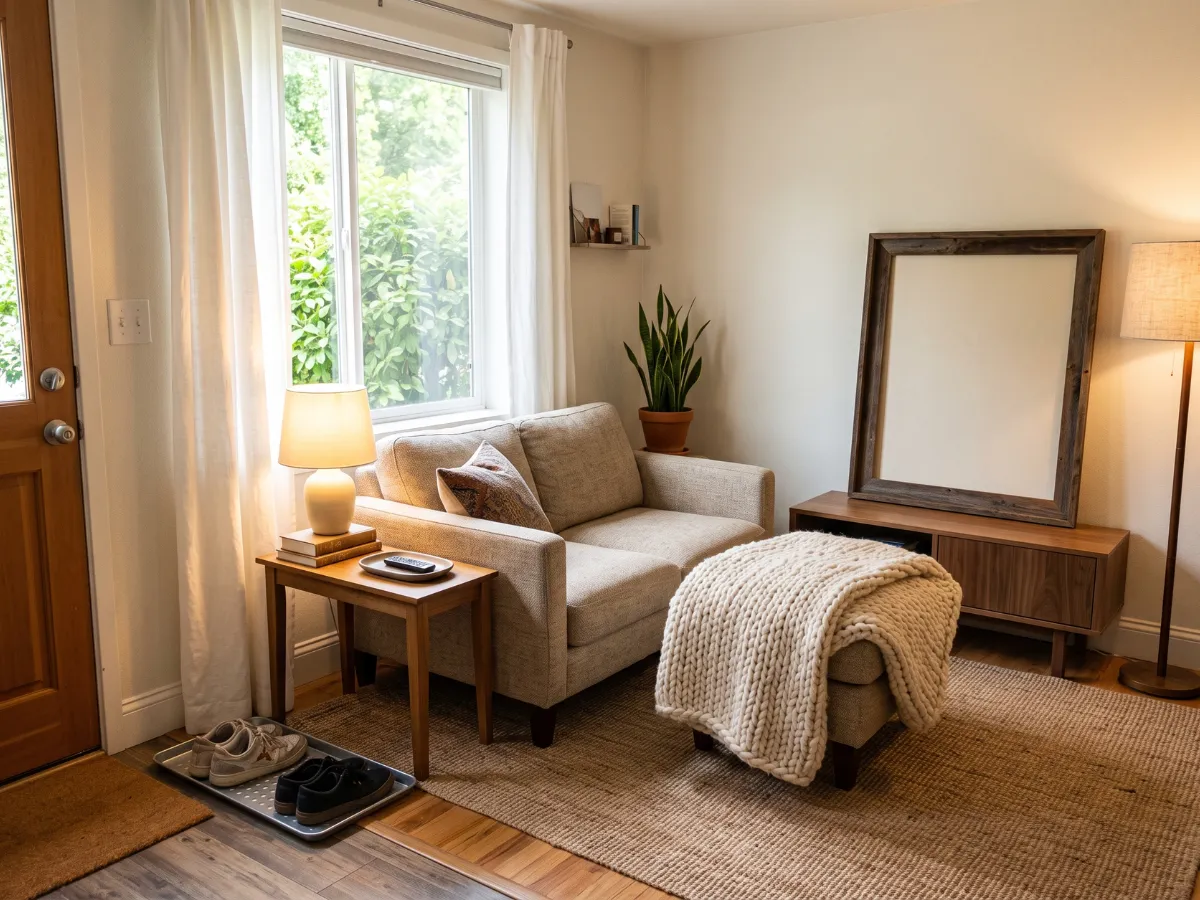
Pushing every seat against the wall leaves a dead middle and a dark corner. Float the main chair or loveseat a half-step inward and angle it toward the window. The room reads bigger because the middle finally has a purpose, and the wall behind the seat stops competing with everything in front of it.
In a room ten or eleven feet wide you can usually pull the seat eighteen to twenty-four inches off the wall and still keep a forty-inch path. Test it before you commit: mark the new position with painter's tape, live with it for an evening, then move the furniture. If you have to shuffle sideways to get past, pull the seat back three inches and try again.
Cost: $0. Time: 1 hour. Leave walkways clear — sideways shuffling is the signal you went too far.
2. Two warm light points beat one ceiling bulb
A single cold ceiling light flattens a small living room: it lights the ceiling, throws hard shadows under the furniture and makes every corner look like the same corner. Kill it after dinner and use two warm points instead — a floor or table lamp beside the main seat, and a second small lamp across the room at a different height.
Two points at two heights is what stops the room reading flat. Put the brighter lamp where you read or eat, the dimmer one behind the seat so it lights the wall rather than your eyes. Keep both bulbs on the same warm tone; a mixed pair is the most common reason a layered room still looks off, and you can see it the moment both are on.
Cost: $20–$60. Time: 20 minutes. For bulb basics, the ENERGY STAR lighting guide explains warm color temperature in plain terms.
3. Add one soft layer, not a full set
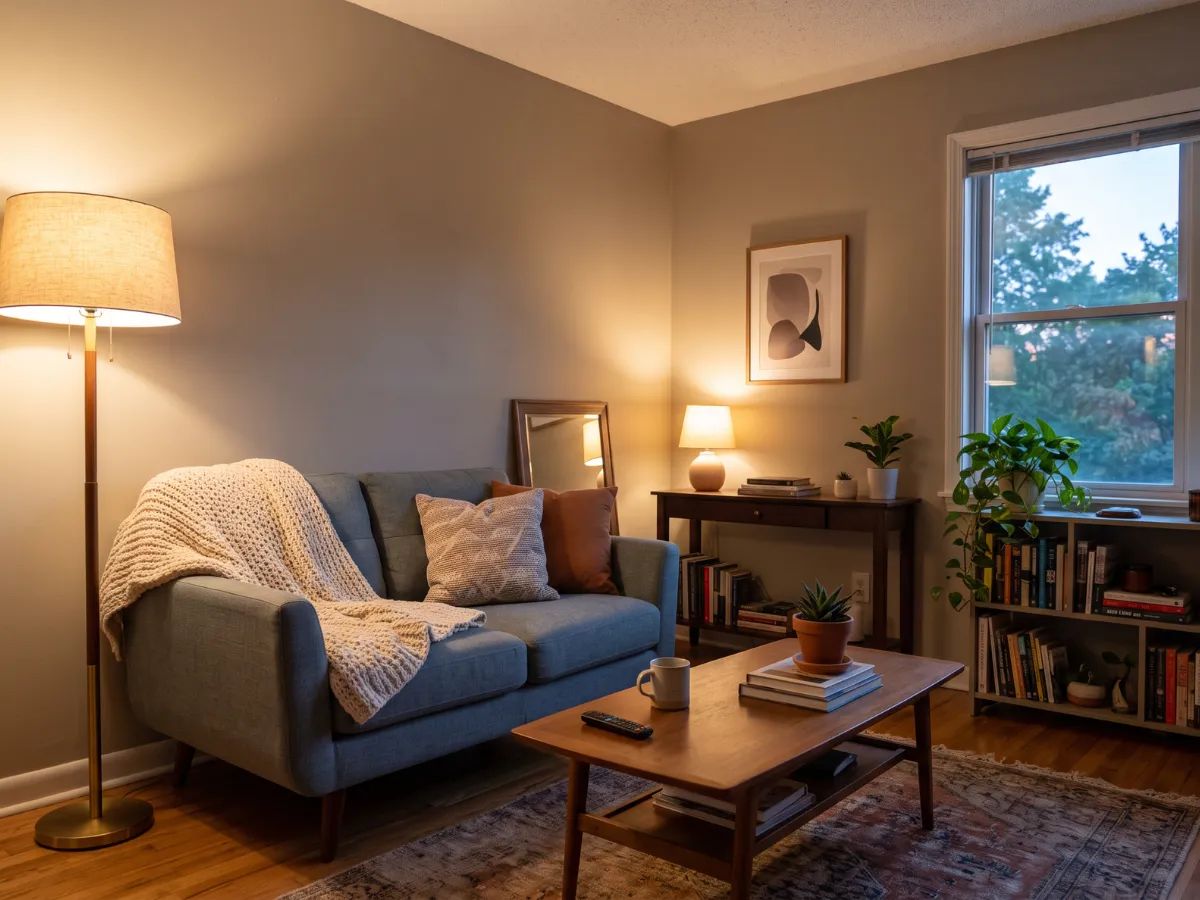
Cozy is texture, not quantity. One knit throw or two cushion covers in a muted tone warms the whole seat area. Skip the matching set — one contrasting texture reads more lived-in than four identical pillows, and in a small room four pillows eat the seat you actually wanted to sit on.
Pick the texture the room is missing. A leather or vinyl sofa wants something nubby and soft; a fabric sofa wants a smooth cotton or a woven throw so the two do not blur into one grey mass. Wash anything new before it goes on the seat, so it drapes instead of standing up like cardboard.
Cost: $15–$40. Time: 15 minutes. Two covers and one throw is the whole budget — resist the third.
4. Dress one wall, leave the rest alone
Small rooms drown in gallery walls. Pick the wall you face most, lean one large thrifted frame on a shelf or console, and stop. One confident piece beats six small ones competing for attention, and it gives the eye somewhere to rest instead of a grid to decode.
Scale is what makes this work. The frame should run roughly two-thirds the width of whatever it sits on, and the top of the console should meet it about a third of the way up. If your only wall is behind the sofa and there is no console, a leaning frame on a slim ledge works the same way — for renter-safe options beyond leaning, see wall decor without a drill.
Cost: $10–$30 thrifted. Time: 30 minutes. If it needs a nail, it does not belong in a rental living room.
5. Hang curtains high and wide, never just over the glass
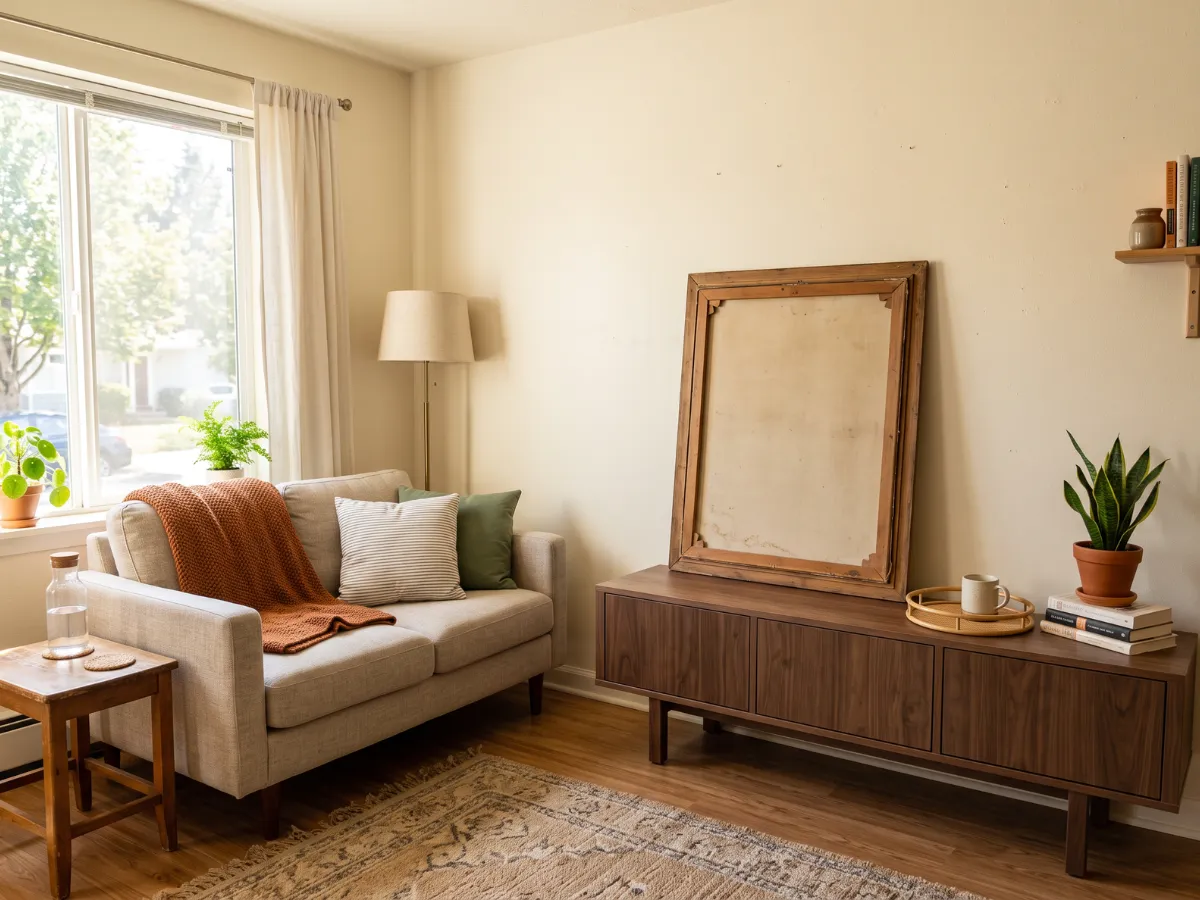
The single cheapest way to make a low ceiling look taller is to move the curtain rod up. Mount it as high as the wall allows — at minimum two to four inches above the window trim, and closer to the ceiling if the gap is short. Then extend the rod six to ten inches past each side of the frame so the panels hang over wall, not over glass.
Hanging wide does two things at once: it makes the window read wider than it is, and it lets the panels stack clear of the glass so daylight still comes in during the day. Hem or fold so the bottom just kisses the floor. Panels that stop mid-wall cut the room in half at exactly the height you were trying to hide.
Cost: $20–$70. Time: 45 minutes. Rentals: a tension rod inside the window recess, or adhesive brackets rated for the panel weight — not for a heavy blackout drape.
6. Size the rug so the front legs sit on it
A rug that floats in the middle of a small living room acts like a postage stamp: it shrinks the room and makes the furniture look like it is avoiding each other. The fix is a sizing rule, not a bigger budget. Set the rug so the two front legs of the main seat sit on it and the back legs stay off the floor covering.
In most small living rooms that means a five-by-eight, or a four-by-six in a genuinely tight room. If the loveseat is against the wall and a full rug will not fit, run a runner along the front edge of the seat instead — the same visual line, a fraction of the price. On wall-to-wall carpet, skip the rug entirely or use a thin flatweave; a thick pile on top of carpet fights the door and the chair legs.
Cost: $0 if you already own one, $40–$120 new. Time: 15 minutes. Measure the walkway first — the rug should not touch the door swing.
7. Clear the floor edge and corral the cords
Clutter lives at ankle height: cables, shoes, the basket of maybe. Run cords along one side with a single clip strip, move shoes to one tray by the door, and give remotes and chargers one small tray. Nothing new needs to be bought here — most small living rooms already own every item involved.
The floor edge is the line the eye follows when it enters the room. When that line is clean, the whole space reads wider than its measurements; when it is broken by three pairs of shoes, the room feels full even when it is not. Ten minutes at ankle height buys more perceived space than any piece of furniture you could buy.
Cost: $0–$15. Time: 45 minutes. This is the upgrade guests notice first.
What we would skip in a small living room
- Gallery wall kits. Six small frames in a small room compete instead of decorating. One large piece, or two at very different sizes.
- Sectionals under twelve feet wide. They close the walking path and turn the room into a corridor around a sofa.
- Matching three-piece furniture sets. Same height, same wood, same everything — it makes a small room look like a showroom with less floor.
- Cold white LED strips behind the TV. They flatten the room and pull the eye to the screen instead of the seat.
Weekend checklist: copy this before you start
- Main seat floated inward, angled toward the window, path clear
- Two warm light points set, same warm tone both sides
- One soft layer added — throw or two cushion covers, washed
- One wall dressed with a leaning frame, rest left alone
- Curtain rod raised and widened, panels kissing the floor
- Rug set so the front legs of the main seat sit on it
- Floor edge cleared, cords clipped, shoes on one tray
Common questions
Can I make a small living room cozy without buying anything?
Yes, and it is usually the better first move. Steps one, three and seven cost nothing: float the seat toward the light, pull one existing throw or cushion cover out of a cupboard, and clear the floor edge. Rearranging first also stops you buying a lamp or a rug to fix a problem that was actually furniture placement.
What warm light should I buy for a small living room?
Warm white, and the same warm white on both lamps. Check the box before you buy rather than after: two bulbs from different packs are the usual reason one lamp looks yellow and the other looks pink. If the room still feels cold with two warm points on, the problem is placement — one lamp is probably lighting a corner nobody sits in.
Do I need a rug in a small living room?
Only if it does a job. A correctly sized rug groups the seating and warms a hard floor; an undersized one shrinks the room. If the floor is wall-to-wall carpet, skip it — a second layer there fights doors and chair legs and adds nothing you can see.
Can I hang curtains in a rental without drilling?
Usually yes. A tension rod inside the window recess needs no fixing at all, and adhesive brackets work for light and mid-weight panels if you follow the weight rating on the pack. Heavy blackout drapes are the exception — those want a proper fixing or the existing rod, and pulling on them daily will find the weak point fast.
How do I stop the room sliding back into clutter?
Give the floor edge a nightly two-minute reset and pair it with something you already do — locking the door, switching off the main light. Small rooms fail at ankle height long before they fail at the walls, and a daily reset catches it while it is still three items instead of a basket.
The one lamp pair we would buy for step two
Step two is the only upgrade on this list that needs a purchase, and a pair of small warm lamps is the cheapest way to do it. A matched set keeps the two sides on the same color temperature, which is the detail that makes the room read warm instead of mixed.
See what we use: the Yarra-Decor set of two bedside lamps. If you would rather keep the budget lower, one lamp beside the main seat beats two cheap ones — the second light can wait until the room tells you where it wants it.
Price and stock were checked when this guide was last updated; they move. As an Amazon Associate we earn from qualifying purchases.
Save these on Pinterest
Pin the two upgrades you will do this weekend, then browse the Small Room Decor collection for the bedroom companion guide and the reading nook ideas that reuse the same two-lamp rule.