 Plant As Deco
Small Room Decor Ideas
Small Bedroom Ideas: 7 Cozy Budget Upgrades for Renters
By Plant As Deco · Updated 13 November 2026
Small bedrooms do not need a bigger budget. They need better decisions about what to move, what to remove, and what to leave alone. These seven small bedroom ideas are built for renters and first-home owners: cozy, renter-safe, and honest about cost and time. Pick two or three, finish them in a weekend, and the room finally reads cozy instead of cramped.
Weekend-ready: $40–$120, one weekend. No drill, no paint, landlord-safe.
This guide contains an affiliate link. As an Amazon Associate we earn from qualifying purchases, at no extra cost to you.
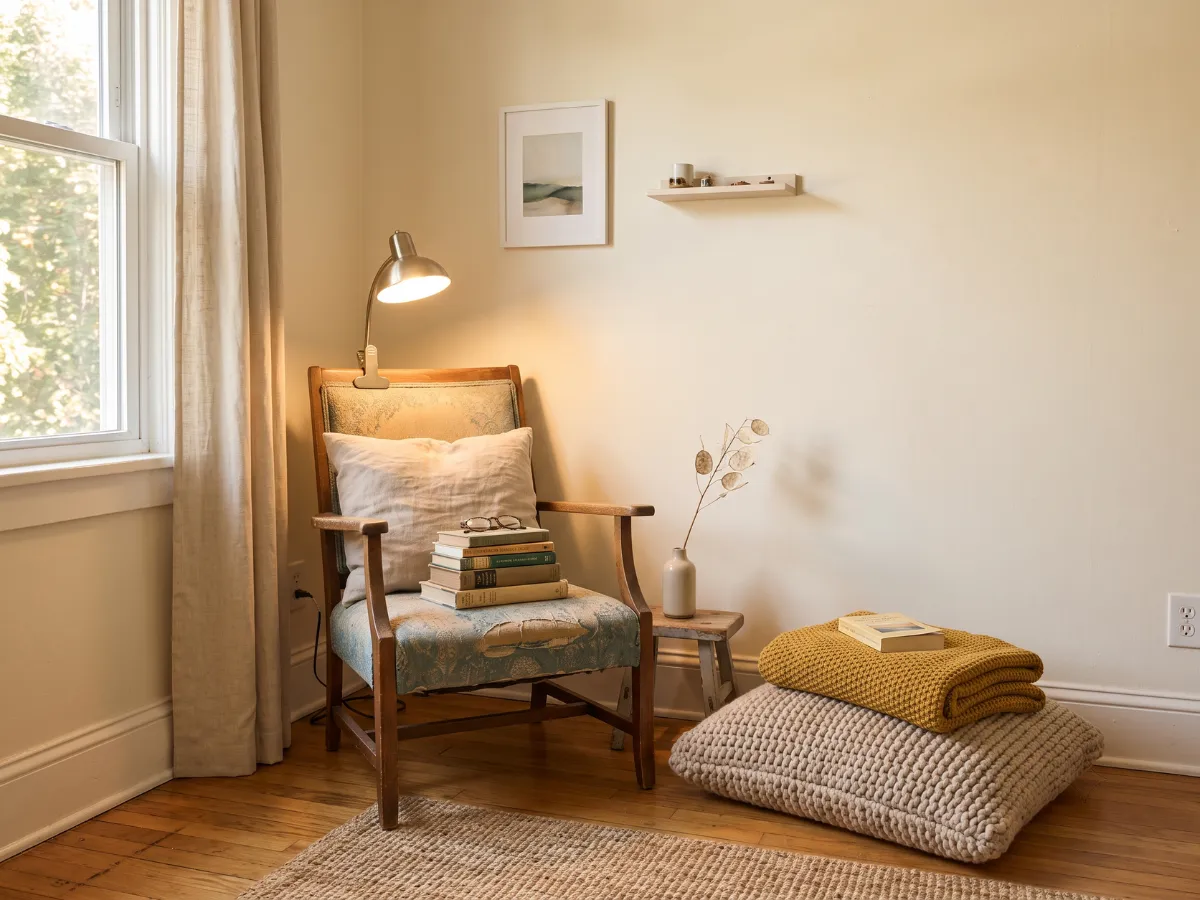
1. Measure the room, then move the bed toward the light
Most small bedrooms feel dark because the bed blocks the only window. Shift the headboard to the brightest wall, even if it feels unusual at first. Then remove the single bulkiest item next to it — usually an oversized nightstand or a chair that collects clothes — and the room gains more floor than any new furniture would.
Before buying anything bigger, tape the layout math on the floor. A queen bed is about 60 inches wide, and an 8 by 10 room is 96 by 120: set the bed against the long wall and the open side leaves 36 inches — exactly one walking path. In a 9 by 12, the same queen leaves 48 inches; a king at 76 inches wide still leaves 32, tight but workable. Tape the door swing before you commit the headboard: take the wall where the swing ends, not the one it crosses.
How wide should that path be? The US Access Board guide to the ADA standards puts the minimum continuous clear width of an accessible route at 36 inches, reducing to 32 inches at points such as doorways. That is a public-building figure, not a rule for your bedroom — but 36 inches is a useful floor for the one path you walk to and from the bed every day.
Cost: $0. Time: 45 minutes. You will know it worked when you can walk around two sides of the bed without stepping over anything.
2. Layer warm lighting instead of one ceiling bulb
One cold ceiling light makes every small bedroom feel like a hallway. Swap it off and use two warm points: a clip reading lamp on the headboard and a small table lamp across the room. Choose 2700K bulbs — warm, calm, and cheap.
Point the clip lamp at the pillow side, not the ceiling, and the room gains a second warm corner you can live in from the bed. A floor lamp by the reading nook in step five does the same job.
Cost: $15–$35. Time: 20 minutes. Keep the ceiling light off after 7pm for a week and see the difference. For bulb basics, the ENERGY STAR lighting guide explains warm color temperature in plain terms.
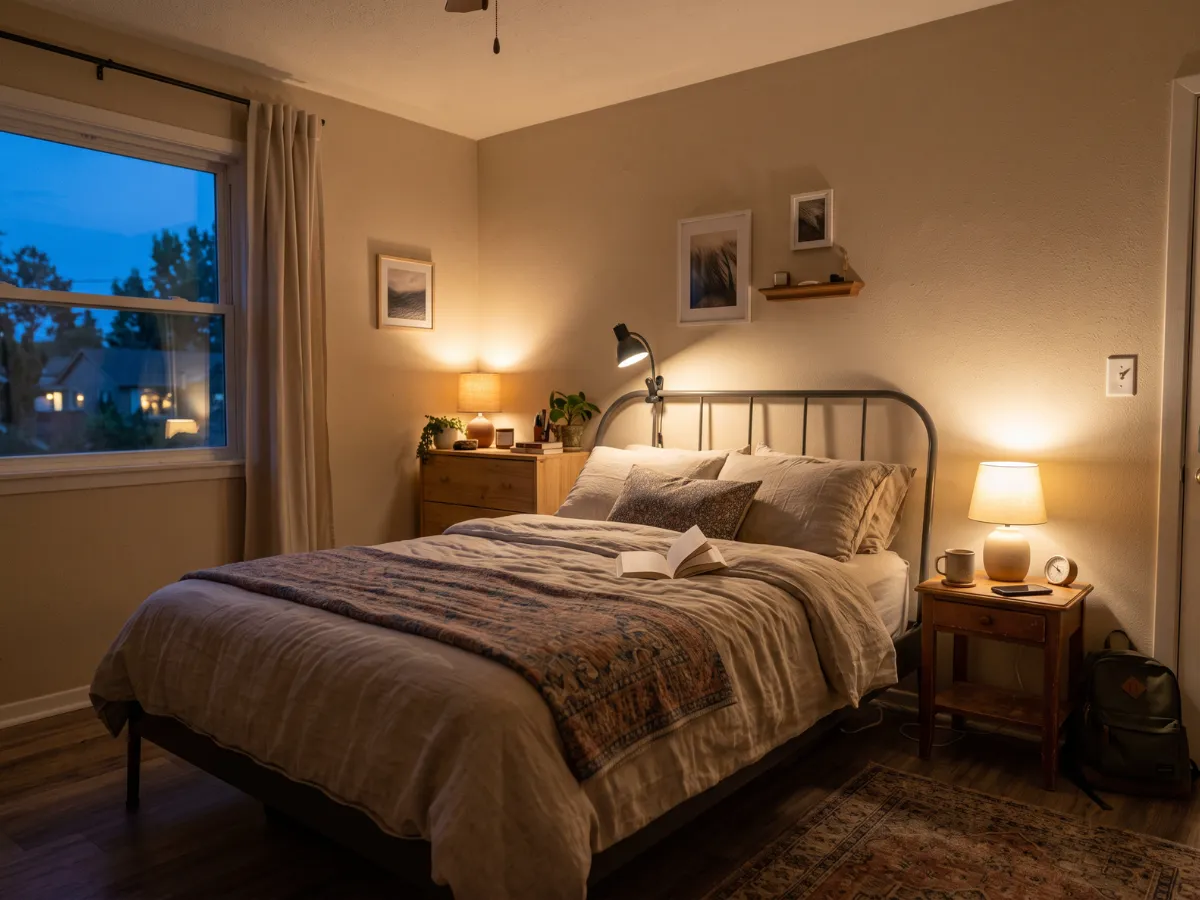
3. Lean art, do not hang it
Renter-friendly wall decor means no drill and no patching. Lean one large thrifted frame on the dresser and one medium frame on a shelf. Two large pieces read calmer than six small ones, and they cost less to frame.
Place each frame where you actually look from the bed, not where the wall looks empty. A narrow floor bookcase works as the stand when no shelf is tall enough — the wall holds nothing, and you take both with you at move-out.
Cost: $10–$30 thrifted. Time: 30 minutes. If a frame needs a nail, it does not belong in a rental bedroom.
4. Swap one textile layer, not the whole bed
You do not need new bedding to get a cozy bedroom. Add one warm layer — a throw across the foot of the bed or two pillow covers in a muted tone. Texture does more than pattern in a small space: knit, linen, or washed cotton beats a loud print.
Layer in one order: the throw over the foot, the pillow covers at the head. The second throw is where cozy turns into clutter.
Cost: $20–$40. Time: 15 minutes. Wash it first so it drapes like you actually live there.
The cheap version of that one layer
The step above caps the layer at one throw or two pillow covers, and covers are the half that costs least. Four cotton covers in one solid color cover the bed and the two on the chair, which is the whole point of a set — one muted tone across the room reads calmer than four different textures fighting each other.
See the four-pack of 18 by 18 cotton pillow covers. They are covers only — no inserts — so an 18-inch cover over the 18-inch insert you already own is the size that works; check yours against the tag before ordering, because a cover cut for a 16-inch insert looks pulled tight and a cover cut for 20 looks slack. Wash them first the way the cost line above says, or the dye comes off on the pillow.
Price and stock were checked when this guide was last updated; they move. As an Amazon Associate we earn from qualifying purchases.
5. Turn the dead corner into a reading nook
Every small bedroom has one corner that holds nothing but a laundry pile. Clear it, add a floor cushion or a secondhand chair, and move the clip lamp within reach. A nook gives the room a second purpose, which is what makes it feel larger.
If the corner survives the layout math in step one, build it the proper way: the reading nook guide walks the six steps for a corner that actually holds a chair, a lamp and a book.
Cost: $0–$25. Time: 1 hour including the declutter. If it does not fit a chair, a cushion and a small stack of books still count.
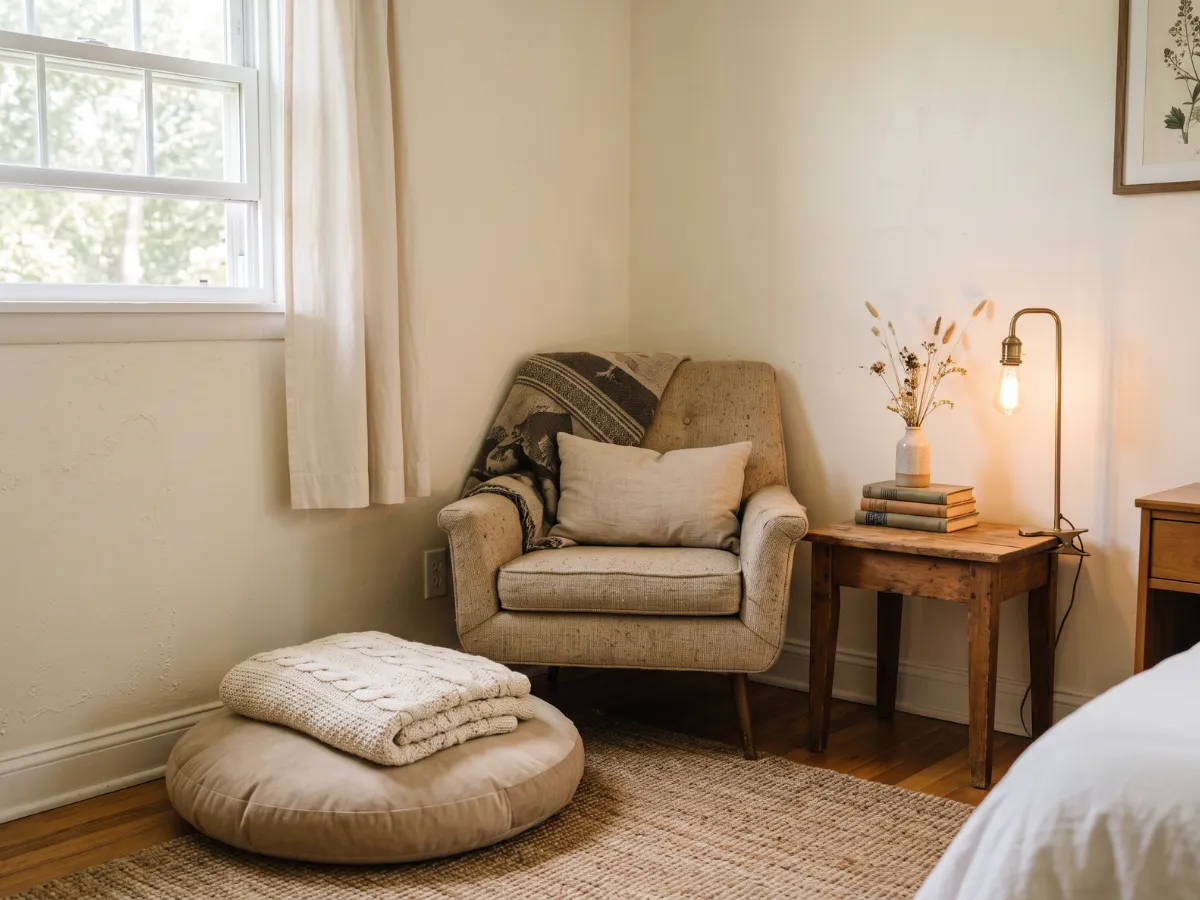
6. Reset the three visible surfaces
Cozy fails at the surfaces: nightstand, dresser top, and the floor by the bed. Take everything off all three, wipe them, and put back only what you use daily. Corral the rest in one small tray or basket. Organization is decor here — a clear surface reads as calm.
Work top to bottom: the nightstand first, because you sit at it every morning, then the dresser, then the floor. Ten minutes each night in the same order keeps the reset.
Cost: $0. Time: 30 minutes, then a 10-minute nightly tidy to hold it. This is the upgrade people notice first.
7. Do a one-afternoon seasonal refresh
Swap two things by season and stop there: pillow covers and one small plant or branch. Fall wants warm rust and a dried stem; spring wants pale green and something alive. Store the off-season set in one bag under the bed so the refresh stays a swap, not a shopping trip. Do it the weekend you are already moving furniture for step one, so the swap costs an afternoon instead of a project.
Cost: $0–$15. Time: 1 hour. If it takes longer than an afternoon, the scope is too big.
The vertical space above the bed
Small bedrooms fail upward: the wall above the headboard is usually empty air. A headboard shelf or a floating shelf reads built-in and hides the lamp cord. The honest limit is the number printed on the shelf itself: that rating assumes a solid, dry wall, so treat it as a ceiling, not a promise. Keep the weight books, not knickknacks — if the wall is thin, the narrow floor bookcase beside the bed does the same job and asks nothing of the wall.
If the landlord allows one small nail, the Delaware Art Museum hangs two-dimensional works of art at a 58-inch center, so the middle of each piece sits at a general eye level. That is a museum figure, not a rule your room must obey — but a shelf holding a lamp and one leaning frame lands around that line anyway.
Cost: $15–$45 for one shelf or one narrow bookcase. Time: 1 hour. Start with the shelf's printed limit, not the box's heavy-duty label.
Common questions
What small bedroom ideas make a small room cozy?
The seven here, in order: the measured layout, two warm light points, two large leaning frames, one soft textile layer, a claimed corner, three clear surfaces, and the seasonal swap. Start with two or three — the room reads cozy before all seven are done.
How do you lay out an 8 x 10 small bedroom?
Tape the bed footprint before you commit: a queen against the long wall leaves 36 inches of open side — one full walking path. Check the door swing, keep the path to the bed clear, and put the headboard on the brightest wall that still lets the door open.
How do I get warm lighting in a small bedroom?
Two warm points instead of one cold ceiling bulb: a clip lamp on the headboard and a small table lamp across the room, both on 2700K bulbs. Keep the ceiling light off after dark for a week and the room stops reading like a hallway.
Do these small bedroom ideas work in an apartment?
Yes — every step above is no-drill by default. Leaning frames, one shelf or one narrow bookcase, adhesive options rated on the package, and a layout you tape out before you move anything.
How much does a small bedroom makeover on a budget cost?
Plan $40–$120 for the full set: two lamps and bulbs, two thrifted frames, one throw, one shelf or bookcase, and the seasonal swap. Pick two or three of the seven and the total drops to under $50.
Bedroom decorating on a budget: what to buy, and in what order
Bedroom decorating goes wrong in the same way in almost every rental: the rug, the art and the bedding are bought in month one, the bed moves in month two, and half of it ends up against the wrong wall. The room is not the problem. The order is.
Buy nothing for two weeks. Move what you already own first — the bed against the brightest wall, the nightstand to the other side, the dresser out of the door swing. Almost every small bedroom improves in an afternoon with zero spending, and that is the version you have to beat before you shop.
Then buy in three steps. Step one, light and textiles: two warm lamps with bulbs, and one throw or two pillow covers, $40–$80 together. Step two, one wall: a single large frame or a shelf, $20–$50, only once the bed wall is final. Step three, the seasonal swap, last, and one piece at a time.
The rule that keeps the budget honest: never buy two things for the same job. Two rugs, two mirrors, or a second stack of blankets all do what the first one already does, and each new item makes the room smaller rather than warmer. Where the money should not go first: a bed frame upgrade before the mattress, a gallery kit, or a full bedding set bought to match a paint colour you cannot change.
Cost: $0 to plan, $60–$130 across the first month if you follow the order. Time: two weeks of waiting, then one Saturday.
Weekend checklist: copy this before you start
- Room taped: door swing, bed footprint, 36-inch path marked
- Bed on the brightest wall, one bulky piece removed
- Two warm light points set, ceiling light off after 7pm
- Two large leaning frames placed, small frames stored
- One shelf or one narrow bookcase, nothing over the bed
- One textile layer added — throw or two pillow covers
- Reading nook claimed, three surfaces cleared nightly
- Seasonal swap bag packed and stored under the bed
Before and after: what actually changes
Before: bed blocking the window, one cold ceiling bulb, six small frames, surfaces covered. After: bed on the bright wall with a clear 36-inch path, two warm light points, two large leaning frames, one shelf or bookcase, three clear surfaces, one corner that fits you. Same room, same furniture, same rental. The difference is decisions, not dollars. The bedroom makeover plan walks the same room through the three changes that matter.
What we would skip: a new bed frame for a mattress you already own, built-in shelves you cannot mount, a gallery wall that needs a dozen holes, or anything that needs a contractor. Small spaces deserve good design, not a big invoice.
Save these on Pinterest
Saving this checklist beats memorizing it. Pin the two upgrades you will do this weekend, then come back when the room is done — the Small Room Decor collection holds the rest of the room-by-room ideas.