 Plant As Deco
Gardening & Planting Tips
Grow Lights for Indoor Plants: What a Dim Apartment Needs
By Plant As Deco · Updated 13 November 2026
A grow light does not fix a plant in the wrong spot. Most plants that fail indoors are failing on water, not light, and a lamp cannot fix a root problem. So this page runs the other way round: check the room first, then buy the smallest light that answers the check. If the plant was fine until you moved it, the move is the problem.
Weekend-ready: $15–$45, one afternoon. No drill, no wiring change — renter-safe.
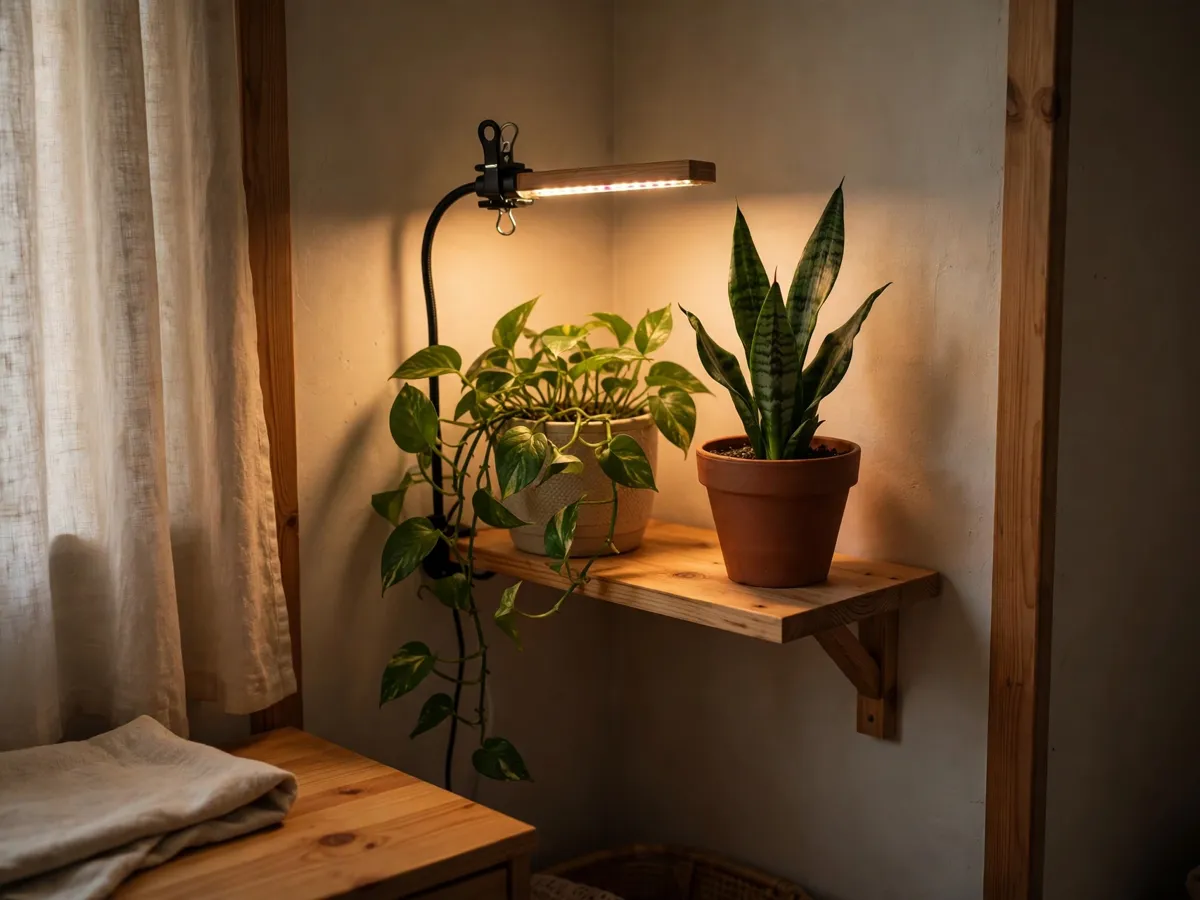
At a glance
- Who it is for
- Anyone with a dim apartment and a plant that has stopped growing.
- What you need
- One light, a plug-in timer, a tape measure and two weeks.
- What it costs and takes
- $15–$45 for the light, one afternoon to set up, two weeks to judge.
Three checks before you buy anything
Run all three in daylight, before you open a shop tab. Two of them depend on what the room actually looks like at noon rather than what you remember from the weekend.
1. The shadow test. Hold your hand flat two feet above the spot at midday. A crisp shadow means bright light, a soft fuzzy shadow means medium, and no shadow at all means dim. Fix: bright needs no light, medium gets one light on the dim side, and dim means move the plant or buy a light.
2. The window-distance test. Light drops fast with distance, so a plant six feet from a window lives in a different room from a plant six inches from it. Fix: move the plant closer before you shop.
3. The watering test. If the soil is still damp a week after watering, the problem is water, not light. Fix: stop watering, check drainage, then re-check growth.
Two of the three checks cost nothing, and only one of them ends in a purchase. That order matters, because the cheapest answer comes first and the most expensive answer has to earn its place.
Cost: $0. Time: 10 minutes.
What a grow light can and cannot fix
A light can extend the day in a north-facing room, keep a plant going through a dark winter, and give a seedling enough light to stay compact instead of thin and pale. Those are real problems, and a lamp is the right tool for them.
A light cannot rescue an overwatered root ball, replace a window for a plant that needs direct sun all day, or make a plant grow faster than its species grows. Those three failures look like light problems from across the room, which is why the checks above come first.
A light buys light, not time. A slow plant under a lamp is usually a cold, dry or underfed plant, and the lamp only makes that harder to see.
Cost: $0. Time: 5 minutes.
Pick by spot, not by spec sheet
The only spec that matters for a beginner is what the light physically attaches to. A fixture that cannot sit where the plant sits is the wrong fixture, however good the box looks. Measure the shelf or the corner before you order, because a clip bar needs an edge to grab and a stand needs floor space beside the pot. Find your spot in the table, buy that shape, and stop reading.
| Spot | Light type | Distance to the leaves | What it is good for |
|---|---|---|---|
| Bookshelf or desk | Clip-on LED bar | 8–12 inches | Two or three plants on one shelf |
| Floor plant in a corner | Floor lamp with a bulb socket | 12–18 inches | One tall plant, one fixture |
| Whole shelf of seedlings | Full-spectrum panel on a stand | 6–10 inches | A tray, moved up as they grow |
Skip colour-tuned “grow bulbs” for houseplants, and skip the purple or red-blue panels for a living room. A warm-white LED reads as a lamp in the room instead of a lab, which matters when the light sits beside your sofa. Skip wattage shopping too: the number on the box is power draw, not plant output, and a bigger number does not make a better shelf.
Cost: $15–$45. Time: 15 minutes to choose and order.
Set the distance and the timer
The gap matters more than the model. Set a clip bar 8 to 12 inches above the leaves, and a floor lamp 12 to 18 inches above them. If the top leaves look pale or dry at the edges, the light is too close. Raise the light as the plant grows rather than trimming the plant to fit the gap.
A plug-in timer set to 14 hours on and 10 hours off, at the same hours every day, is enough for a houseplant that is already growing. The timer is the part people skip, and an irregular schedule reads as a cloudy week to the plant. Be honest about the limit: a dark room plus 14 hours is still a dark room, so this fixes a north-facing window, not a closet.
The order that works: plug the light into the timer and the timer into the wall, hang the light, measure the gap with a tape measure, set the timer, and note the date you started. Five small steps, one afternoon, and the setup is repeatable next winter.
Cost: $5–$10 for the timer. Time: 20 minutes.
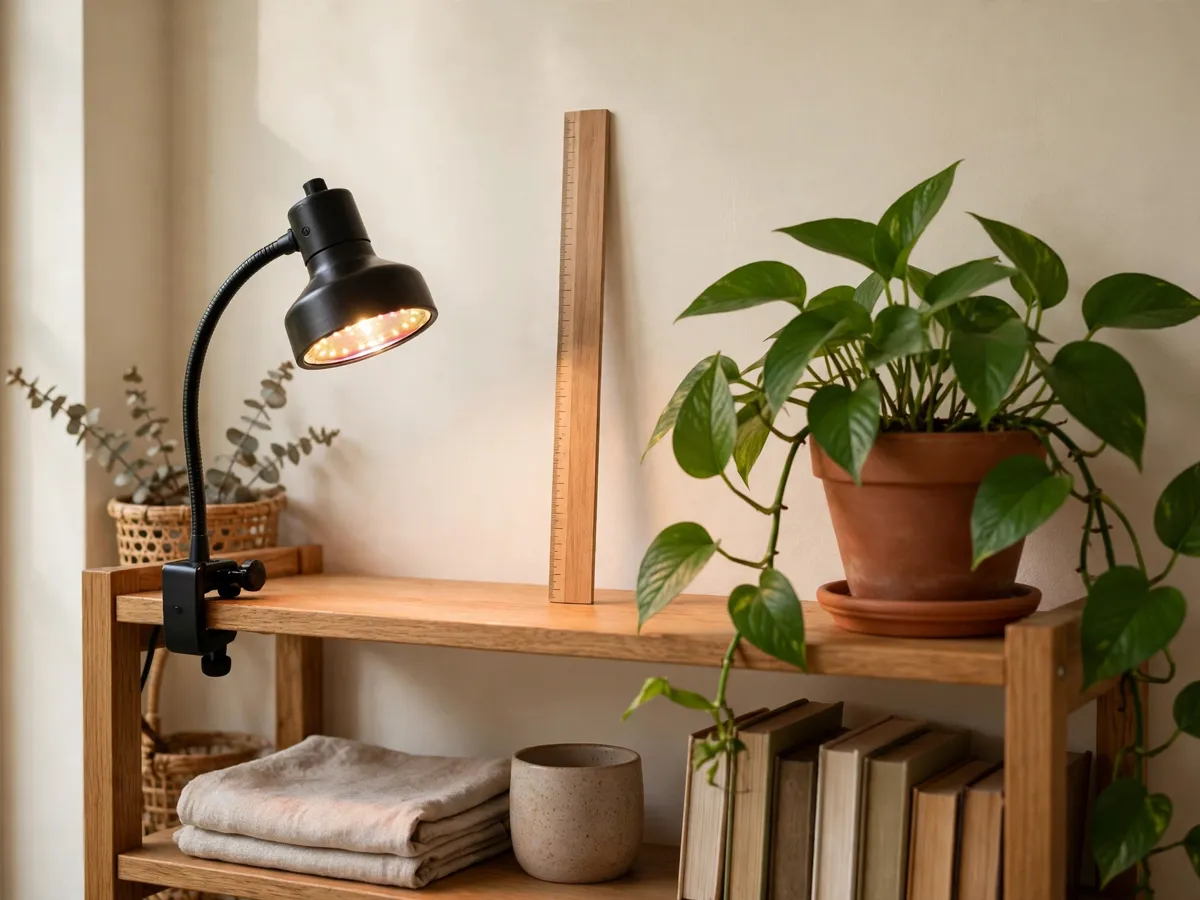
The two-week check: growing or stretching
At day 14, look for three signs of a plant that is happy: new leaves slightly larger than the last set, growth pointing toward the light, and colour holding instead of fading. Those three mean the gap and the hours are close enough for now.
Stretching looks different. Long gaps between leaves on a stem, stems leaning hard toward the window, and new leaves smaller than the old ones all say the plant is reaching. Reaching is a report about distance, not a personality trait.
Fixes, cheapest first: move the light closer by two inches, add an hour to the timer, or move the plant to a brighter spot and keep the light as a winter top-up. Give each change two weeks before you judge it, or you will be chasing your own adjustments. A photo on day one is the honest way to compare leaves later, because memory rounds a plant up.
This is the honest part of the page. If nothing changes in two weeks, the light is not the missing piece, and the water, the pot size or the temperature is. A plant that has been in the same pot for years is usually ready for the next size, and our repotting guide walks that through in one afternoon.
Cost: $0. Time: 5 minutes, twice.
What we would skip
Skip the full-spectrum panel sold for a single houseplant, the purple grow light in a living room, and the smart-app light that needs a hub before it will switch on. Skip buying two lights before you know the first one works. Skip any light that needs a wired-in fixture, because a rental does not need an electrician for a pothos. And skip the light entirely if the three checks pointed at water.
Cost: $0. Time: 2 minutes.
Which plants still need a window
A light helps a plant that tolerates low light; it does not turn a succulent into a shade plant. Succulents, cacti and most herbs still want direct sun, so a lamp is a winter top-up for them, not a replacement. If your collection is mostly those, spend the money on a brighter spot instead, and our low-light indoor plants guide lists the ones that actually tolerate a dim room.
Cost: $0. Time: 3 minutes.
Weekend checklist
- Shadow test done at midday
- Plant moved closer to the window
- Soil checked a week after watering
- Light type matched to the spot
- Timer bought and plugged in
- Gap measured with a tape measure
- Timer set to 14 hours
- Day-14 date written on a note
Questions beginners ask
How many hours a day?
14 on and 10 off, the same hours every day. Put both on a plug-in timer so the plant gets the schedule you intended rather than the one you remembered.
How far above the plant?
8–12 inches for a clip bar and 12–18 inches for a floor lamp. Measure the gap to the top leaves, then raise the light as they grow.
Can I use a regular lamp?
Only as a short-term top-up. A household lamp will not hold a dim room through winter, and a shade pointed at the wall does even less. If it is the only light you have, it buys you a few weeks to decide.
My plant is not growing. Is the light broken?
Run the three checks first. Usually it is water, a pot that is too small, or a plant sitting in the wrong room, and the light was never the problem.
Save these on Pinterest
Pin the two-week check, because it is the part you will come back to when the new leaves arrive. The Gardening & Planting Tips collection holds the rest of the room-by-room plant ideas.