 Plant As Deco
Small Room Decor
How to Decorate a Small Room: A Calm Step-by-Step Plan
By Plant As Deco · Updated 20 November 2026
Most small-room advice is a list of tricks: brighten the walls white, push the furniture to the edges, hang a mirror. Each one is true, and none of them is a plan. This page is the plan — the order that makes the tricks work together. What the room has to do comes before what the room looks like, light comes before color, and editing comes before buying. It fits one weekend and $60–$250, and every step is renter-safe: removable, patchable, or freestanding, so the lease never sees a change.
Weekend-ready: $60–$250 total, one weekend. Renter-safe: every step is removable, patchable, or freestanding.
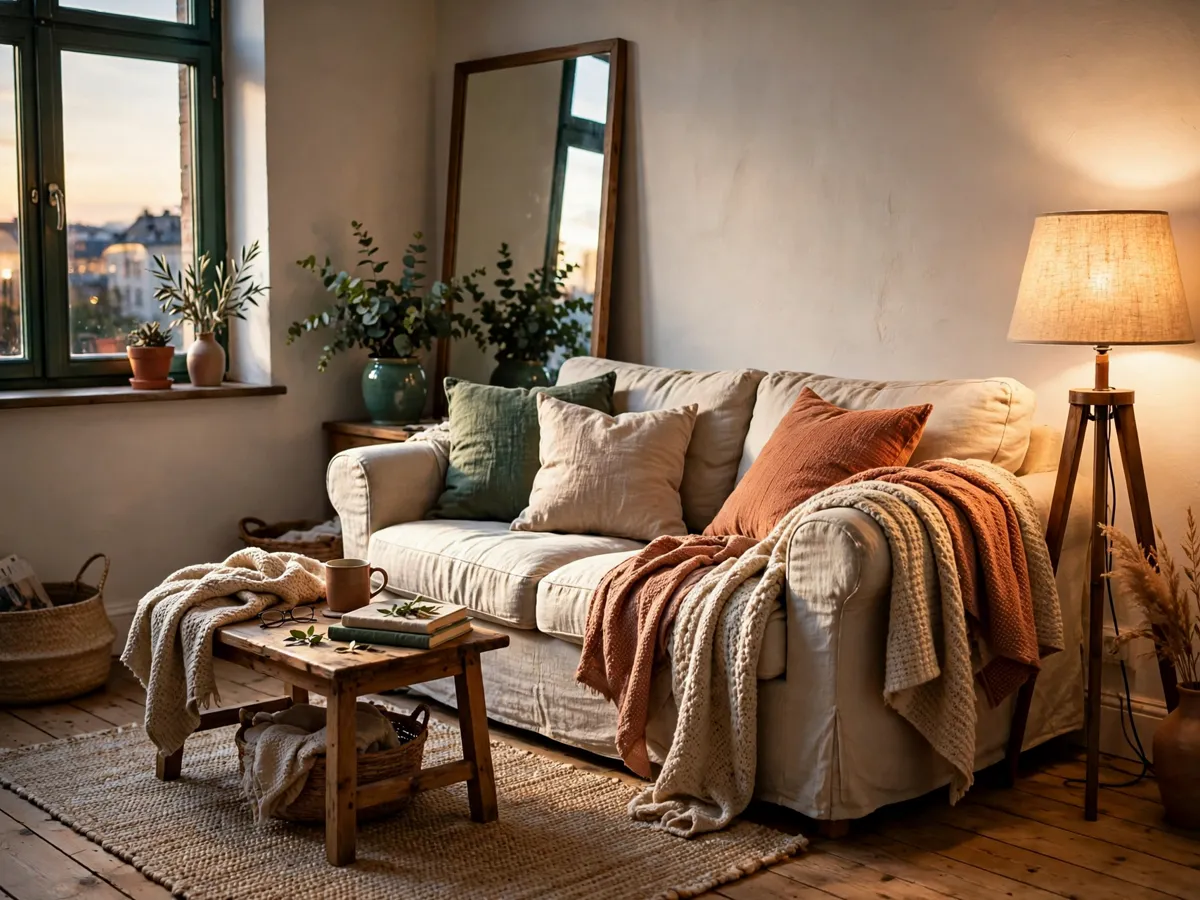
1. What decorating a small room really means
A big room absorbs mistakes. The wrong sofa in the wrong corner still leaves enough wall, floor and air around the error that the room reads fine. A small room has no spare anything: every piece sits in the eye's path, and the floor you lose to one wrong buy is the floor you walk on every day. That difference changes the job. Decorating a small room is mostly editing — deciding what earns the space — and the deciding happens before the buying, not after.
Three tests decide everything on this page. First, the room does its job: sleep, sit, work, store, in whatever order this room needs. Second, the eye gets one place to rest: a single focal corner, one story the room tells in a glance. Third, the floor stays visible: a room that shows its floor reads larger in every photo and every entry. The color rule, the furniture scale, the light layers, the texture and the storage below all exist to pass those three tests with fewer pieces, not more.
The upside is freedom, not limitation. Fewer pieces means fewer decisions, and a small budget stretches further: $60–$250 decorates a small room completely when it buys the right three things instead of the wrong twelve. The same edit frees space in the head as well as on the floor — one story to hold, three tests to run, and the room stops being a problem you re-solve every time you walk past it.
Cost: $0. Time: 20 minutes, and the only tool is a pen.
2. Start with what the room does
Write the job list before you look at a single piece of furniture. Every room has one — sleep, sit, host, work, dress, store — and most small rooms carry two or three jobs at once. A bedroom that is also an office is a different decorating problem than a bedroom that only sleeps, and the difference decides where the bed goes long before the color does. The apartment where the kitchen table is also the desk has the same problem in the living room: two jobs, one floor, and the plan has to give each job its own zone.
Then measure the walking. Paths need 30 to 36 inches, doors need their swing, and radiators and outlets need their breathing room. Thirty minutes with a tape measure and a notebook prevents the eight-hundred-dollar return, which is the most expensive mistake a small room can make. Tape the footprints on the floor with masking tape and live one day with the outlines — the empty space between them is what tells you the layout breathes. Put the big pieces against the job list first: the piece that does the most-used job earns the most room, and everything else arranges around it.
For the room whose jobs are sitting and hosting, the cozy living room guide walks the same exercise on a real floor plan, and the small bedroom guide does it for the room that sleeps and works at once.
Cost: $0, plus a $10 tape measure. Time: 30 minutes per room.
3. The one color rule
One color story per room: a base for the walls and the largest pieces, a mid for the window and bed linens, and one accent for the small objects. The proportions land around 60 percent base, 30 percent mid, 10 percent accent, and the ratio matters less than the count — three colors, one room. The accent earns its pop from the quiet around it, which is why the terracotta cushion reads warm in a linen room and noise in a rainbow one.
The reason is the physics of attention: the eye stops at every border where one color hands off to the next. A room with one story lets the eye travel, and a room the eye travels through reads larger than a room the eye trips across. This is also why the matching-set instinct fails — three palettes in one room, one in the throw and one on the wall, is three borders for the eye to catch.
Start at the walls. A warm off-white or a light mid tone reflects the daylight the room already has, and if you want depth, one accent wall in a deeper paint is the small-room dose. Buy a sample pot, brush it on two walls, and live one evening with it — morning light and lamplight are different colors. The rental rule: keep the paint within one shade of the original wall, photograph the wall before the first stroke, and the patch at move-out hides in plain sight.
The base color sets how large the space feels. Dark surfaces swallow daylight and pull the walls inward; light ones send it back, and the space reads a few feet wider than the tape says. You do not need white for that — linen, oat, warm putty and a pale sage all bounce light. Keep the largest surface the lightest thing in the room.
Cost: $3–$8 per sample pot, $15–$25 for one accent wall's worth of color. Time: one evening with the swatches on the wall.
4. Furniture scale and placement
Scale is the decision that reads in the first three seconds of walking in. An apartment sofa lands at 60 to 72 inches; the armless version reads smaller than the same width with arms, and exposed legs show the floor under the piece, which the eye counts as space. A low bed frame buys headroom the tall one steals. Shelves at 8 to 10 inches deep hold books and boxes; the 12-inch monster holds nothing and the walking path with it. Write the maximum width, depth and height on the notebook before the cart, and shop the notebook, not the showroom. The same numbers protect the space around the pieces: a dining chair needs 24 inches behind it to leave, a bed needs clearance on two sides to make the sheets without moving it, and the gap you keep is the space you feel.
Round corners earn their keep in a tight space. A pedestal table gives the walking path back where four square legs would lock it down, and a slim-arm sofa keeps seating for the same footprint — a bulky arm costs four to six inches along the wall.
Placement is the same decision from the other side. Pull the sofa two to four inches off the wall when the path allows — the gap reads as intention, and the room wraps around the seating instead of lining up against it. Anchor the seating on a rug whose front legs ride the fabric, so the floor reads as one field instead of islands. Keep the 30-inch walking path through every version. One statement piece per room, the rest quiet: the eye remembers the room by the one thing it is proud of.
Cost: $0 to measure, and the tape saves the wrong buy. Time: one hour with the numbers written down.
5. Light first, color second
Fix the light before you choose the color. A bright room forgives a shade you half-like; the same color in a dim room reads small all day, and no cushion fixes that. This is the step most plans skip, and it is the one that changes what the room looks like at 9 p.m., which is most of the hours you live in it.
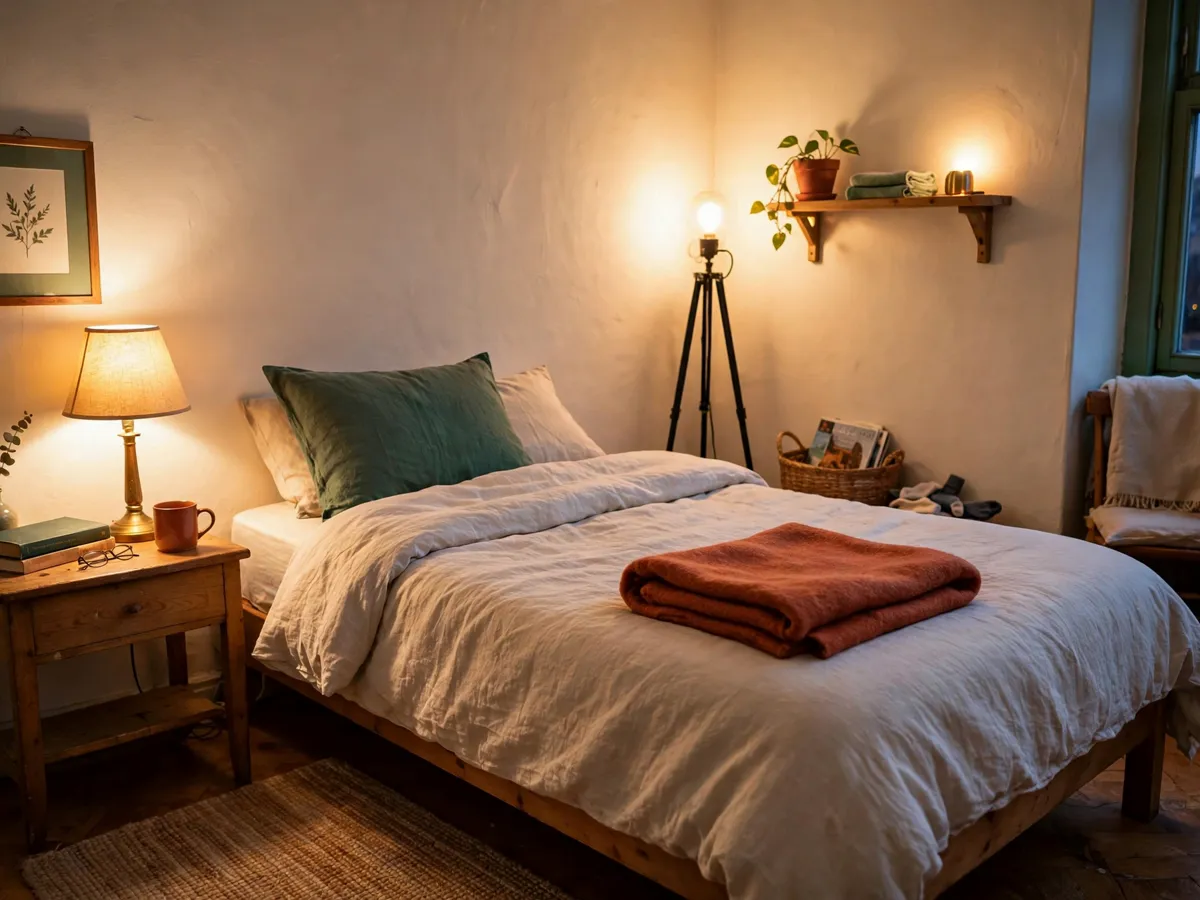
Build three layers. Ambient light fills the room — and the builder's single ceiling fixture pours one flat pool of light that shadows every corner, so the fix is two or three lamps instead of one big overhead. Task light does the reading, the work and the cooking — one lamp beside the chair, one under the shelf. Accent light is the free one: a small lamp on a stack of books lifts a corner the ceiling never reaches. Warm bulbs around 2700 kelvin, a dimmer on the ambient layer, and the lamp beside the mirror doubles the source for the price of the bulb.
The bulb spec sheet — kelvin, lumens, CRI — is in the warm lighting guide, with the three layers sized for a rental.
Cost: $40–$120 for bulbs and two lamps. Time: one evening, and the test happens at night, not at the store.
6. Vertical space is your extra wall
The floor area is fixed; the wall height is free square footage the big rooms use and the small ones forget. When the lines on the wall run up, the eye climbs with them and the ceiling reads taller. Two shelves at 8 to 10 inches deep hold the books and the boxes without stealing the walking path the wide unit takes, and a tall narrow case beats a wide low one for the same storage. Every shelf buys the space the floor never had.
The window gets the same move: hang the curtain rod 4 to 6 inches above the frame and run the curtain to the floor, and the wall the window sits on reads a full head taller. The back of the door holds hooks for the bag and the coat that otherwise march across the floor. One gallery wall — frames tight, one cluster, one wall — organizes the small objects into a single story instead of scattered stamps.
The order of filling matters: keep the bottom third near the floor mostly open so the floor stays visible, put the daily things at eye level, and the light, rare things at the top. Every bracket leaves a quarter-inch hole that spackle closes at move-out, which keeps the whole wall plan renter-safe.
Above the top shelf, the last six inches are the space most rooms leave dead. Run one board or a row of lidded boxes to within a hand of the ceiling and the storage reads finished instead of half-done. Keep that band pale and the space under it feels taller. Floor space is the one thing a small room cannot make more of.
Cost: $30–$80 for shelves, rods and hooks. Time: two hours and a level.
7. Mirrors, glass, and reflected light
The mirror is the oldest small-room trick and the most wasted one, because placement is the whole trick and the mirror is just the glass it runs on. The wall across from the window, at the height the eye stands, one big mirror instead of three small ones: that is the decision, and the leaning version needs nothing but the wall. The mirror placement guide walks through the height, the angle and the anti-tip strap in full.
The same logic runs through the rest of the room's surfaces. A glass side table reads lighter than a wood one the same size, because the eye walks through it and counts the floor behind as open. A lacquered dresser or a glazed lamp catches the lamp light and hands it back, which is why the mirror beside a lamp doubles the source. Clear and shiny surfaces borrow the room's light; matte ones absorb it, and a small room wants its light borrowed back.
The mirror buys more than light; it buys space. A big pane opposite the window opens the room to a depth the walls do not have, so the reflection should hold something worth seeing — the window, the plant, the lamp — not a doorway or a pile of papers. Stand in the doorway and check what it gives back before you commit to the size.
Cost: $40–$150 for one tall mirror, $8 for the anti-tip kit. Time: one hour to lean, aim, and check from the doorway.
8. Texture makes cozy without clutter
Texture is how a small room gets warm without getting busy. The color story stays at three, the object count stays low, and the surfaces do the work: the rough of a wool throw, the smooth of a linen duvet, the sheen of a ceramic pot. One fabric family everywhere reads flat — the all-knit room is one texture wearing four outfits — and three families in one glance is what the eye reads as cozy.
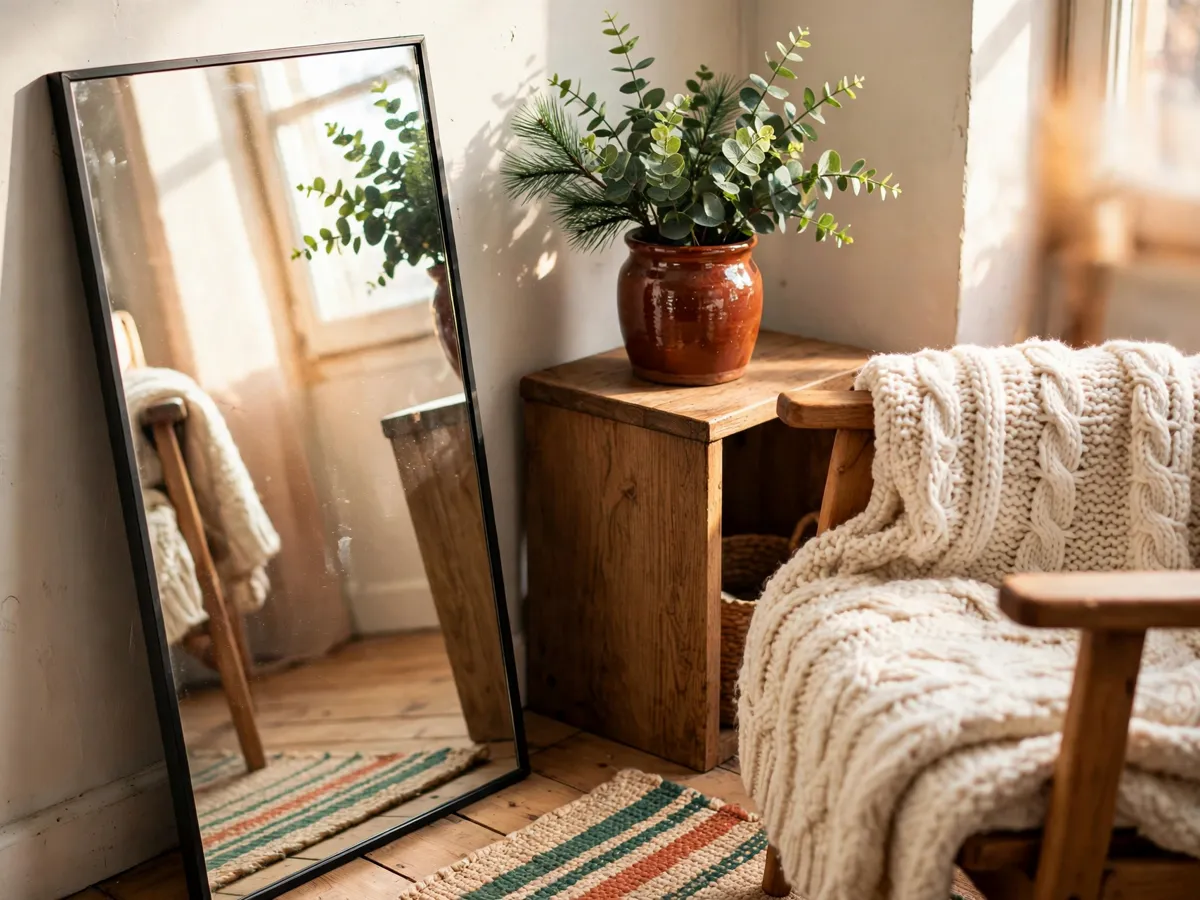
The rule is three textures per surface, varied in scale: the chunky knit throw on the sofa arm, the flat linen cushion behind it, the woven basket at the floor. The throw folded over the arm does more for the room than the blanket box in the corner, because it is where the eye already lands. One plant buys living texture for the price of a pot — the green corner the lamp can bounce off — and the fabric of the window, the bed and the seat carries the mid color from the one-color rule without a new object.
Cost: $35–$90 for a throw, two cushions and a plant. Time: 20 minutes to layer.
9. Storage that doubles as decor
In a small room, storage has to look like decor or hide inside it. The lidded bin ends the visual noise of open shelves — the pile of cables and the stack of papers read as clutter at any color, and as one clean shape at any height. The woven basket holds the throw and counts as texture at the same time, which is the double-duty principle in action: one object, two jobs, zero extra borders for the eye.
The seat with a lid is the small room's secret closet — an ottoman at the foot of the bed holds the off-season fabric the wardrobe gave up. Flat bins slide under the bed frame and vanish. A thrifted solid-wood side table with drawers outworks the new particleboard one at the same size, and the shelf styling rule keeps the open shelves decor instead of inventory: two objects, one box, and a third of the shelf left empty.
The under-bed band is the largest unused space in most small rooms — 12 to 14 inches of flat square footage doing nothing. Low bins with lids take it for the off-season bedding, and the wardrobe gives up a shelf in return. Storage solved upward and downward never eats the walking room.
Cost: $25–$80 for bins, baskets and one lidded seat. Time: an afternoon, including the edit it forces.
10. What to skip in a small room
The skip list is shorter than it looks and it saves more than the buy list. The oversized sectional swallows the walking path. The matching bedroom suite reads like a hotel the room cannot afford. Heavy dark curtains across every window cut the daylight the walls are borrowing. Wallpaper on every wall turns the box smaller — one wall is the dose, and the rental gets the peel-off kind or nothing. The collector's shelf of small objects is clutter at eye level, which is the worst address in the room.
Skip the all-white minimalist box too: a room with zero texture reads clinical, and cozy is what the small room needs to be. Skip the second coffee table, the accent chair that matches the throw, and the trend piece you will drop in a year — borders the eye catches, one per sentence above. Buy for the room you live in, not the feed you scroll.
Cost: $0. Time: the decision, and the money it does not spend.
11. The weekend plan, room by room
The plan runs in the order the room needs it, because each step makes the next one visible. Edit and measure first — the light and the color decisions both depend on knowing what the floor is doing. Furniture placement second, so the rug anchor and the walking path exist before anything decorative lands on them. Light third, color and texture last: the layers change what the paint and the fabric look like, and buying the cushion before the lamp is buying twice.
- Saturday morning. The job list, the edit, and the tape measure: paths, door swings, maximum widths on paper.
- Saturday afternoon. Furniture in, rug anchored with the front legs, the two-inch gap behind the sofa.
- Sunday morning. Bulbs swapped warm, two lamps placed, the dimmer on the ambient layer.
- Sunday afternoon. Texture layered, bins and baskets filled, the mirror leaned across from the window, and the optional one-hour shelf for the wall that needs a DIY answer.
The budget splits four lines: light $40–$120, textiles $35–$90, mirror $40–$150, storage $25–$80. Pick the three lines the room actually needs and the total lands inside $60–$250 with the edit doing the rest. The room-by-room versions of every step live in the Small Room Decor collection.
Cost: $60–$250 total. Time: two days, four unhurried hours each.
Common questions
How much does it cost to decorate a small room?
$60–$250 for the whole plan, and the range is carried by the lamp and the mirror. The edit costs nothing, the color story costs a sample pot, and the texture layer costs one throw and two cushions. A room that buys the three lines it needs — light, texture, storage — lands at the bottom of the range and reads finished.
What is the biggest mistake in a small room?
Buying before measuring. The oversized sofa is the expensive version of the mistake, and the cheap version is the shelf that blocks the walking path. Thirty minutes with a tape measure, and the maximum width, depth and height written on the cart, prevents both.
Should I paint a small room pure white?
No — a warm off-white or a light mid tone. Pure white reads flat under warm bulbs at night and harsh in daylight, and the small room needs the walls to hold the light gently, not bounce it like a phone screen. The base of the one-color rule can be a color: linen, oat, sage or a putty tone all work as the 60 percent.
Can I decorate a rental without losing the deposit?
Yes. The mirror leans instead of hanging, the shelf leaves quarter-inch holes that spackle closes in a minute, and the curtain rod on brackets above the frame is the same patch. Keep the finish within one shade of the original wall, photograph every wall before the first stroke, and the room returns to the lease as found.
What size rug works in a small living room?
The one that fits the front legs of the sofa and the two chairs, usually a 5x8, with 10 to 12 inches of floor showing on every side. Wall-to-wall carpet is the safe choice and the flat one; the floor at the edges is what tells the eye the room has size.
What order should I decorate a small space in?
Edit, measure, place the furniture, set the light, then bring in color and texture last. The order matters because every step changes what the next one should be: the light layers decide whether the walls need to be pale, and the seating only fits once the sofa is where it will stay. Buying decorative pieces first is the fastest way to decorate around a problem instead of fixing it.
How low can furniture go without making the room feel cramped?
Lower is safer than taller in a small space. A seat under 30 inches and a bed frame under 12 inches keep the eye's horizon clear, and the ceiling reads taller for it. The one exception is the piece against the window wall — keep that one low enough that the daylight still reaches the middle of the space.
Do I need to furnish every wall in a small room?
No. Two walls carrying the focal corner and the storage is a finished room; the rest can stay plain, and the empty expanse is what makes the furnished parts read calm. Leave at least one wall mostly clear and the space gets the breathing room the floor cannot.
Save these on Pinterest
Pin the order of the plan — edit, furniture, light, color, texture — because the order is what makes the small room work. The mirror step has its own guide in the mirror placement guide, the light layer has the warm lighting guide, and every room-by-room version lives in the Small Room Decor collection.