 Plant As Deco
Small Room Decor
Vintage Decor in a Small Room: One Era, Not a Shop
By Plant As Deco · Updated 28 November 2026
Vintage in a small room works when it is one dialect rather than a theme. This guide picks the era first, names the three objects where an older piece genuinely beats a new one, and then handles the part nobody tells a renter: a found painted piece is itself an old painted surface, so you buy it, wipe it, and lean it, and you do not sand it.
Weekend-ready: $103–$485 for one room, two weekends. Renter-safe: every step leans, sits, or hangs from hardware you can take with you. The illustrations are styled renders that show a finished setup, not photographs of specific pieces.
1. What vintage reads as, and why era beats age
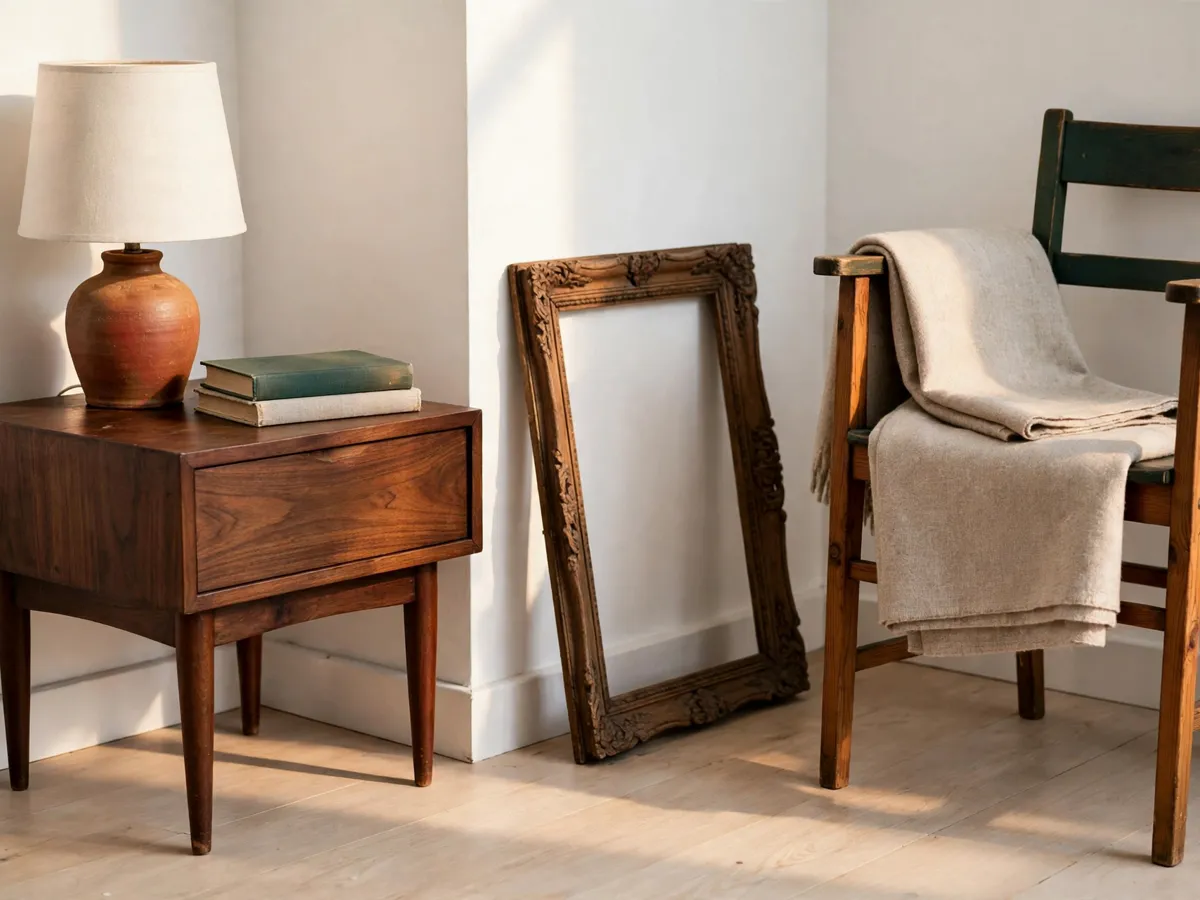
Vintage is a design language, not a birthday. A room reads vintage from three visible things: the finish on the wood (warm, slightly uneven, never a printed laminate sheen), the profile of the edge (a shaped molding instead of a square one), and the hardware (a pulled brass handle, a turned iron hook, a keyhole plate). Take those three away and the age of the object changes nothing, which is why a shelf that is genuinely old can still read as nothing at all.
That distinction is what saves a small room from the thrift-shop aisle. Shoppers buy age, because age is what the price tag implies, and then wonder why the shelf looks crowded instead of styled. You are buying a look. The year is only evidence for it, and evidence you cannot verify is not worth paying extra for.
So sort every candidate into one of two piles: it carries the language, or it is merely old. Only the first pile is allowed to cost you wall space, because in a small room every piece competes with the floor it eats.
Cost: $0. Time: 15 minutes. Sort what you own and what is in front of you by the language it carries, not by how dusty it looks.
2. One era per room: the discipline that stops the shop floor
A big house can hold two dialects because the rooms are separated by doors. A studio, a bedroom, or a small living room holds one, and the reason is simple: the eye has a narrow field to read, and two vocabularies inside it do not blend, they argue. Pick one and let every object in the room speak it.
How to pick without calling in an expert: look at what you already own the most of and choose the dialect that describes it. Dark stained wood, brass, and heavy molding is one family. Pale painted wood, floral calico, and wicker is another. Lacquer, chrome, and tinted glass is a third. You are not dating anything, you are grouping by how a surface looks, and that is a call you are entitled to make because it is your wall.
The broader case for buying used belongs elsewhere. The style argument for secondhand pieces — texture, color, and why a plain rental can borrow them — is made properly in the modern organic guide. What stays here is the part that belongs to old painted furniture specifically: the era discipline here, and the paint rule that waits in section 5.
Cost: $0. Time: 20 minutes. Write the one dialect for this room in five words and keep it in your pocket. It is the fastest no in any aisle.
3. The three objects where old beats new: frame, table, lamp
Most objects have no reason to be old. These three do, and each reason is about something a new budget version cannot copy at the same price.
The frame. Older frames were cut from solid wood and shaped, then finished in gold leaf, oxidized silver, or painted composition, and the corners were joined rather than stapled. A new frame at the same money is a printed molding with butt joints. In a small room the frame is the largest vertical surface you own, so it carries the era harder than the picture inside it, and a found frame with a plain print in it does more work than an expensive print in a new frame.
The side table. A bedside or sofa-end table is a small piece with a big visual weight. Older ones came in solid wood or real veneer with a shaped apron and a turned leg, built to be moved. New ones at the same price are honeycomb-filled board that chips at the edge on the first knock.
The lamp base.Glass, ceramic, and metal bases from older stock have thickness and color that flat molding does not. The shade is the cheapest part of any lamp and swaps in minutes, so the base is the only piece you actually need to hunt.
Where new wins, in the same breath: anything you sit on, anything that holds water, and anything with a cord. Upholstery hides what you cannot see, a vessel that leaks is a floor problem, and wiring ages invisibly. Buy those three new and put the vintage budget into the three above.
Cost: $43–$195 for all three secondhand, $210–$540 if you buy the lamp and the table new. Time: one market morning. Only these three earn the hunt.
4. Where to look, and what to walk past: the honest hit rate
Estate sales carry the best furniture and the clearest single-era rooms, because a house is usually sold as one collection rather than as a mix, and the weekday before the public day is when the good tables are still standing. Thrift chains carry volume and inconsistency, so you are paying for patience. Flea markets carry negotiable prices and weather. Local online marketplaces carry speed and friction, since plenty of listings are called vintage when they are twenty years old and dusty. Curbs and donation bins carry the lowest price and the highest luck.
The honest ratio is about twenty candidates passed per keeper, and that is the cost of the discipline in section 2 rather than a bad morning. The walk-past list is short and it is not about taste: pass on anything with a smell you cannot air out, anything padded and fabric-covered, anything with a cracked or wobbling joint, and anything whose only merit is that it is advertised as old.
Soft goods deserve their own line, because they tempt a vintage buyer most and survive laundering least. Curtains, table linen, and the occasional bag are cheap and they read as an era at once, but if you cannot wash something you cannot make it yours. The pass-along half of the same habit is worth knowing — for worn-out pairs that leave the rotation, the Goodwill donation guidelines accept clothing you no longer need and welcome shoes, handbags and jewelry. Donation rules vary by location: what items you can bring to a donation center will depend on the Goodwill organization you are donating to.
Cost: $0 to browse, plus whatever the one keeper is priced at. Time: three hours. Bring the five-word era note and a tape measure, and leave the rest on the floor.
5. Before you sand, scrape or strip: the pre-1978 paint rule
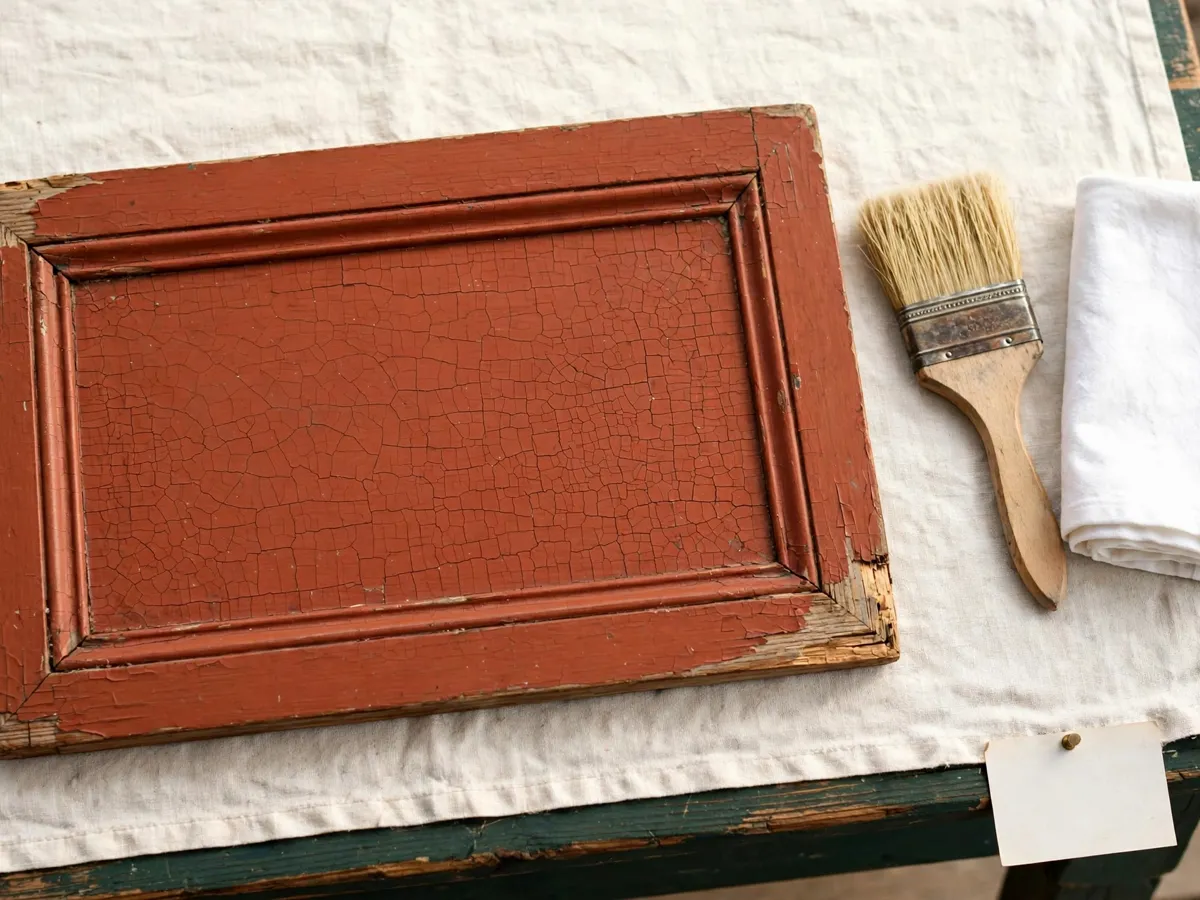
This is the section that separates a vintage buyer from a renovator. Renters hear the pre-1978 rule in the context of a renovation, so they assume it has nothing to do with an object they carried home in a car. It has a great deal to do with it, because the thing you bought is itself an old painted surface, and you are about to handle it in the room where you live.
The rule starts with a building and it travels with the paint: if your home was built before 1978, it is more likely to have lead-based paint. Open the EPA guide to protecting your family from lead exposures. A found painted drawer, chair back, or sign is a piece of a surface of unknown age, and nobody dates it by looking, so the year in that rule is the only threshold worth using.
The second half is about what disturbs a surface. Renovation or repair activities that disturb painted surfaces in older homes, buildings and structures may create large amounts of lead dust. Read the EPA page on lead exposures in homes. Dry-sanding a found piece in a small room is exactly that shape of activity: the surface is disturbed, the room is where you live, and the dust goes onto the floor, the shelf, and the things you touch.
So the buying rule mirrors the working rule. Do not dry-sand, scrape, strip, or run a heat gun and a chemical remover over a painted find you cannot date. Want bare wood? Buy a piece that is already bare. Want a different color on something you love? That is a finish job on old paint, done by someone who works on old paint for a living, and it is not a weekend project in an apartment.
Cost: $0. Time: 10 minutes, spent before you buy rather than after. Ask the one thing that matters at the counter: is this painted, and does anyone know how old the paint is. An empty answer means you keep the finish as it came or you leave the piece.
6. Dust and chips: what reaches you, and the wipe that counts
The problem is not the object sitting on a shelf. It is what comes off it, and the source names the route plainly: one of the most common sources of lead exposure in homes is dust and paint chips from lead-based paint. See the EPA list of important sources of exposure to lead in homes. Read that sentence closely and one reassurance falls out of it: an intact painted surface you are not touching is not the same situation as the same surface being sanded, chipped, or dry-dusted.
What follows is a handling habit, not a product pitch. Keep intact finishes intact. When you wipe a painted find, use a damp cloth rather than a dry feather duster, because a dry wipe lifts whatever sits on the surface and drops it into the air of the room, while a damp cloth carries it off the object and into the cloth. Work over a towel so the runoff has one place to land, rinse the cloth when you finish, and wash your hands.
The corollary belongs back in the walk-past list. A piece that is actively flaking or powdering is shedding, and no wiping settles something that keeps coming off, so buy the sound surface and leave the one that needs stabilizing.
Cost: $0 if you own cloths, a few dollars for a pack if you do not. Time: 15 minutes per piece. Damp cloth, towel underneath, hands washed, nothing dry-swept.
7. Cleaning a piece you cannot refinish
The point of buying the finish is that you are not going to change it, so the cleaning has to be gentler than what you would give a new piece. Test where the surface hides — the back of a drawer, the underside of a top — and let it dry before you decide. Mild soap, warm water, a cloth wrung out until it is barely damp, and a second cloth to dry it immediately cover most painted and varnished wood. What you are avoiding is standing liquid: it creeps into joints and under edges, and the damage shows up weeks later as a swell or a lift.
By material, the short version. Metal: keep it dry and work a soft brush into the crevices where grit sits. Glass and mirror: any standard glass cleaner and a lint-free cloth, but spray the cloth and not the frame, so liquid never runs onto wood or backing. Wicker and rattan: a dry brush first to lift dust out of the weave, then a barely damp cloth, then air. Paper, cardboard, and fabric-covered items: no water at all, and a brush or a vacuum hose on low is the whole method.
If your honest reaction is that you would rather the piece looked different, that is not cleaning, that is flipping, and it is a separate decision with its own steps. The thrift-flip guide covers changing an object; this page covers picking one and handling it as it arrived. A flip on old paint runs straight into section 5, so the two are not interchangeable.
Cost: $5–$15 for cloths and mild soap. Time: 30 minutes per piece. Test hidden, stay barely damp, dry immediately.
8. Hanging an old frame: eye level, and the weight you cannot see
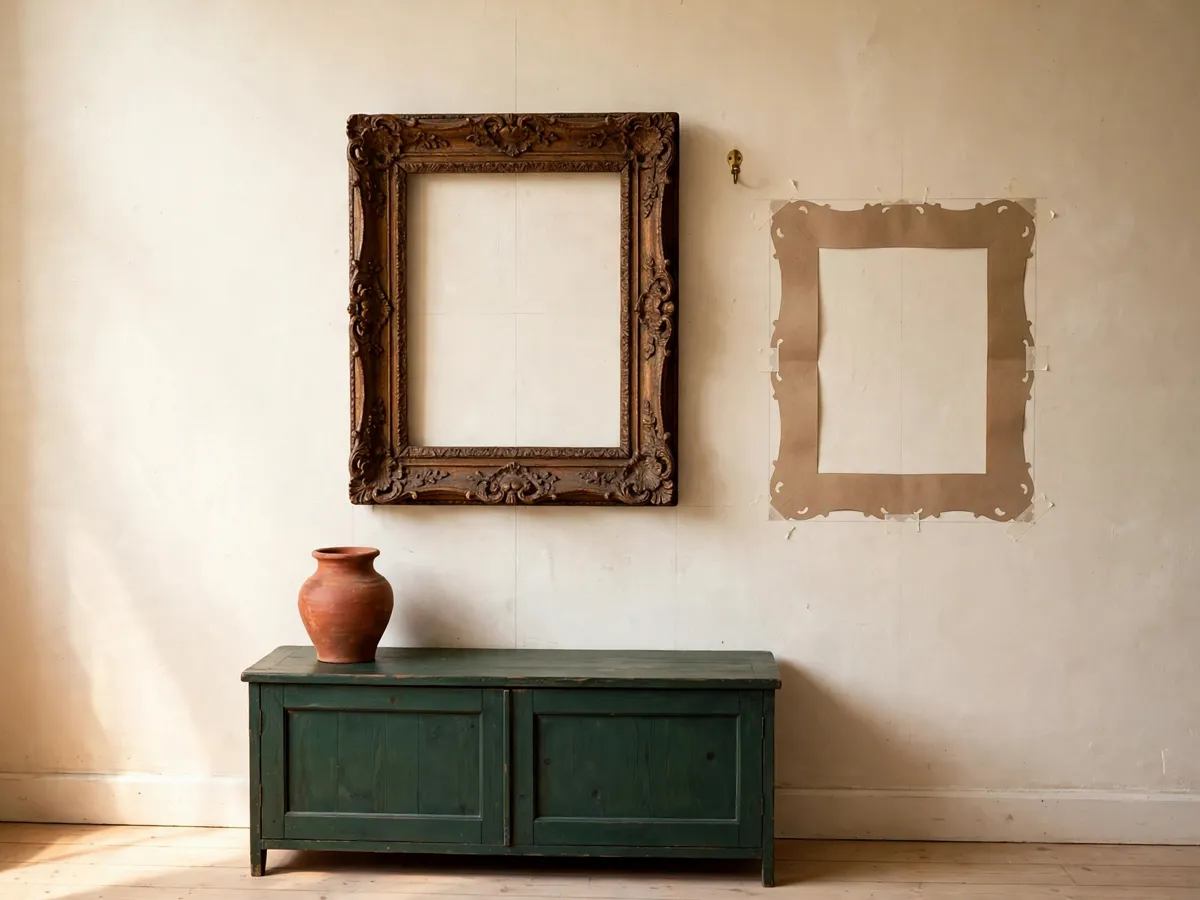
Height first, because there is a real convention to borrow. The Delaware Art Museum hangs two-dimensional works of art at a 58-inch center, so the middle of each piece sits at a general eye level. Open the museum's caring-for-collections guidance. That number is a starting height for where the middle of a picture belongs in a room where people stand and walk. It is not a rule your wall has to obey, and it says nothing about what holds the picture up.
The second half is where a vintage buyer gets surprised, and it is why this sits in its own section. An old frame is heavier than its size suggests, and an old mirror heavier still: solid molding, a sheet of glass, a backing board, and decades of added hardware. The weight is invisible in a shop, obvious in your arms, and completely invisible in a listing photograph, so nobody can tell you from a screen what a particular piece will feel like on your wall.
What holds a heavy old frame depends on your wall, the piece, and the hardware in front of you, so take it to a hardware counter with the frame in your hand, or pay someone who hangs art for a living. Either way, inspect the original wire and fittings on a found piece before you trust them, because they are as old as the frame.
Meanwhile, the small-room move that sidesteps the whole matter: lean it. A framed print or an old mirror resting on a sideboard, a console, or the floor against the wall is a styling choice rather than a compromise. It keeps the wall unmarked for the deposit, it lets you change the height whenever the room changes, and it removes the hanging question altogether. Hang the light pieces and lean the ones you are unsure about.
The hanging method itself is a separate problem, and it has a no-drill answer worth reading before you commit to a wall: the no-drill wall decor guide. It covers leaning, working out eye level, and swapping a piece without starting a new hole every season, which is the half a found frame cannot tell you. Arrange more than one frame and the layout becomes an exercise of its own.
Cost: $0 to lean one, and whatever a hanging job costs if you fix it to the wall. Time: 10 minutes for the lean. Set the middle around eye level, then step back and look before you commit to anything.
9. Mixing vintage with the modern pieces you already own
Almost nobody starts from an empty room. You start from a sofa with a warranty, a bed in a metal frame, and a rug from a big-box sale, and the question is what the vintage buys do alongside them. The ratio that works in a small room is one vintage note in a modern field, not the reverse. The modern pieces carry comfort, current safety standards, and the clean lines that keep a small space reading open. The vintage pieces carry the era, the finish, and the reason the room is not interchangeable with a showroom.
Color is the bridge that makes two families read as one room. Find one hue that already appears in both — the brass of an old handle and the warm edge of a new lampshade, the faded green of a painted drawer front and the green in a houseplant — and let it recur three times. Repetition is what turns a borrowed object into a plan.
The failure mode is the museum corner: a shelf where every object is old, nothing is doing a job, and the eye reads inventory instead of a room. If a surface has four vintage things on it, take two away and give the remaining two space to be seen.
Cost: $0. Time: 20 minutes. Count the vintage objects per surface, keep it at two or three, and make one of them useful rather than decorative.
10. Placement: one large vintage piece beats five small ones
Small rooms lose to quantity, not to style. Five small vintage objects on one shelf do not read as a theme; they read as clutter, and clutter costs a small room the two things it cannot spare — visible floor and clear negative space. One large piece does the same job at a fraction of the noise, and it also does a job: a mirror gives you light and depth, a sideboard gives you storage, a framed print gives the wall a focal point.
The old mirror is the highest-value single object in this look for a small room, for a reason that has nothing to do with its age. It doubles whatever sits behind it, it bounces the lamp across the room, and its molding carries the era on a surface large enough to notice from the doorway. Buy the mirror first and let the smaller finds arrange themselves under it.
The placement rule that follows: one hero per surface, and never on the same vertical line as another hero. Negative space is part of the look rather than the leftover from it, and an era is only legible when the eye has somewhere empty to rest between objects.
Cost: $0 to rearrange, plus the price of whichever anchor you settle on. Time: 25 minutes. One hero per surface, where the doorway sees it, and the small stuff around it goes.
11. What we would skip, and the finds not worth the shelf space
The rule for a small room is blunt: if it does not earn a spot in this room today, it is not a find, it is storage. On that basis, skip anything you would have to repair before using it, because the repair is the project you will not do and the object will sit unusable in the corner where you can see it every day.
Skip the single chair from a pair. Skip the set that needs four more pieces to make sense. Skip anything padded, anything smelly, and anything with a flaking painted surface, for the reasons in sections 4, 6, and 5. Skip the piece whose only story is a date somebody gave you at a market: you cannot verify it, it is not a reason to spend the wall space, and paying a premium for a claim is how a thrift haul stops being a bargain.
Buy on what the object looks like in your room this month. A small room has no space to hold things you are afraid to use.
Cost: $0, and the money you did not spend. Time: seconds, once the five-word era note is in your pocket.
12. The one-room starter plan, priced and timed
Everything above, in the order that gets a room done in two weekends rather than two years.
- Write the five-word era note for this one room. Free, and it is the filter every later step runs through.
- Buy the anchor: an old mirror, a sideboard, or a large framed print. $60–$220 secondhand.
- Wipe it the damp-cloth way from section 6 before it goes on the wall or the shelf. Free, 15 minutes.
- Add the frame with a plain print in it, set so the middle sits around eye level, or leaned. $15–$70.
- Add the lamp base and a new shade. $20–$90 for the base, and the shade is bought new on purpose.
- Add one vessel — a ceramic jug, a glass bottle, a metal tray — so the era recurs a third time. $8–$35.
- Remove two small objects from the surfaces you just populated. Free, and it is the step that makes the room read styled instead of stocked.
Total: $103–$485 depending on how much of the anchor you buy new, across two weekends of market mornings. Nothing in the plan needs a drill, a finish job, or a piece of hardware you cannot take with you.
Cost: $103–$485 for the room. Time: two weekends, about three hours each. Do the anchor piece first and let the rest arrange itself around it.
What renters ask about vintage in a small room
How many vintage pieces does a small room need?
One anchor and two or three supporting objects, with a maximum of three on any single surface. The anchor does the style work because it is large enough to read from the doorway, and the small pieces only have to repeat one color or one material to tie the room together. Five small pieces with no anchor is the shape that reads as a shop.
Is it safe to keep old painted furniture in a rental?
Keeping a piece is a different situation from disturbing it, and that difference is the whole basis of the handling rule here. A piece with an intact, sound surface that you wipe with a damp cloth is not the same as one you sand, scrape, or strip. A piece that flakes or powders is shedding onto everything around it, so that one gets passed on rather than kept.
Can I mix two eras if I really want to?
In one small room, not convincingly. The eye has a limited field, and two vocabularies in it read as a mistake rather than as an eclectic choice. What works is one era over a modern base, which is the ratio in section 9, and one era per room across the flat, so the bedroom and the living area can disagree and nobody sees them at the same time.
What should I buy new instead of secondhand?
Anything you sit on, anything that holds water, and anything with an electrical cord. Upholstery hides damage you cannot inspect, a leaking vessel damages a floor, and wiring ages in ways the outside of a lamp will not show you. The shade on a vintage base is fine to buy new too, and cheaper than replacing the base.
How do I know a piece is actually from the era I want?
Usually you cannot, and paying for a date you cannot verify is the expensive version of this mistake. What you can judge is whether it carries the language: the shaped edge, the finish, the hardware, the proportion. Buy on that, and refuse the premium that comes attached to a story.
Save these on Pinterest
Pin the three objects where old beats new, the pre-1978 paint rule, and the one-room plan, because the plan is what turns a market morning into a finished corner. More small-room guides for plain apartments live in the Small Room Decor collection.