 Plant As Deco
Gardening & Planting Tips
Colorful Indoor Plants: Foliage Color That Stays
By Plant As Deco · Updated 22 November 2026
Most houseplant color comes from flowers, and flowers are a part-time job. This list is the other kind: plants whose leaves carry the pink, red, purple and patterned show, all year, with zero blooms involved. Eight colorful houseplants for ordinary apartments, each one honest about the light it needs to keep its color, how fussy it really is, and whether it is safe around a cat or dog.
Weekend-ready: $30–$75 for three starter plants with pots and mix, one afternoon to pot them up and place them.
1. Why color fades indoors (read this before you buy anything)
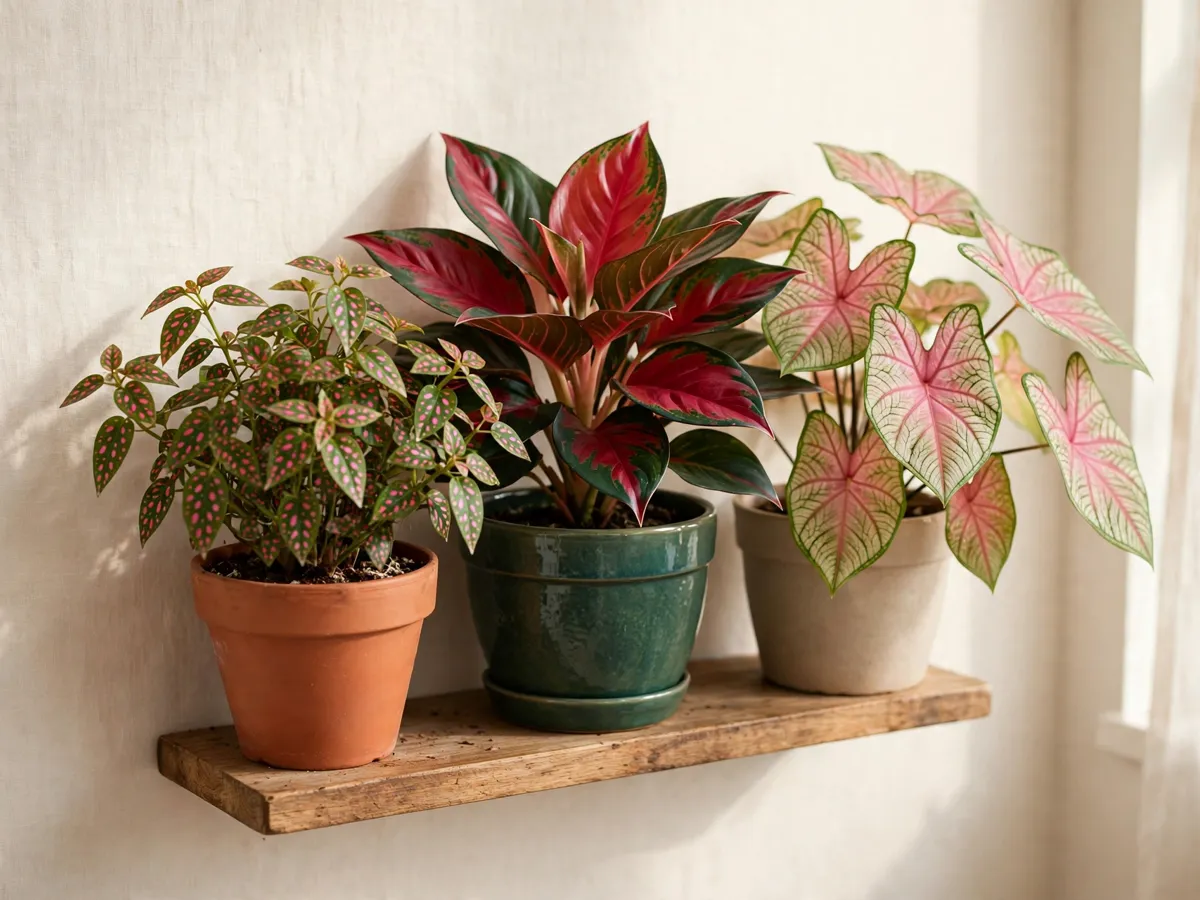
Every colorful leaf on this list runs on the same trade. The pink, red and purple tones in foliage come from pigments the plant makes on top of its green chlorophyll. Making those pigments costs energy, and the plant only spends that energy when light is plentiful. In dim light the rules reverse: survival beats display, chlorophyll takes over, and the leaf reverts to green.
That is the single rule behind everything below. In a bright east or south window (with the direct sun softened), a polka dot plant blushes deep pink and a croton burns red and orange. Move the same plant three feet back into a dim hallway and within weeks the pink washes out and the croton puts out plain green leaves. The plant is fine. It just stopped paying for a costume it cannot afford.
So the honest promise of this list is conditional, and it is worth saying plainly: these plants are colorful in good light, and in low light most of them go green. The buy is not "which plant is prettiest." The buy is "which window do I actually have, and which plant can hold its color there." Section 10 covers what to do when the windows you have are not enough. A north-facing window, the dimmest orientation, will keep the green-and-patterned players on this list (aglaonema, nerve plant) but will fade the heavy hitters.
Cost: $0 to read your light. Time: 10 minutes to watch where the sun actually lands in your rooms. Caveat: assess the window at the time of day you are home, because a room that feels bright at 7pm may be dim at noon.
2. Polka dot plant: pink splashes on a plant that wants a haircut
Hypoestes, sold everywhere as the polka dot plant, is the cheapest way into foliage color. Small green leaves are freckled and splashed with pink, and some cultivars run to deep rose or white splash. In bright indirect light the pink deepens until the leaf looks dip-dyed. It is widely available, usually under ten dollars, and grows fast enough that you see results within weeks.
The honest difficulty is easy, with one habit to learn: pinching. Left alone, a polka dot plant stretches into a tall, sparse stalk with leaves far apart, and the pink thins as it goes. Pinch the growing tips every few weeks in the growing season, just above a pair of leaves, and the plant branches low and stays a dense, colorful clump. The trimmed tips root in a glass of water if you want free plants. Water when the top inch of soil dries; it wilts dramatically when thirsty and pops back within hours of watering, which makes it a useful plant for learning what thirst looks like.
Pet households should know it is considered toxic to cats and dogs if eaten, with mostly mild effects, so it belongs on a high shelf in a home with a chewer. The full pet-safe alternative list lives in the pet safe low light houseplants guide.
Cost: $5–$12. Time: 15 minutes to pot up, plus a two-minute pinch every couple of weeks. Caveat: skip it if your only spot is a dim north window, because the pink will fade to green there.
3. Caladium: the showpiece that takes a winter nap
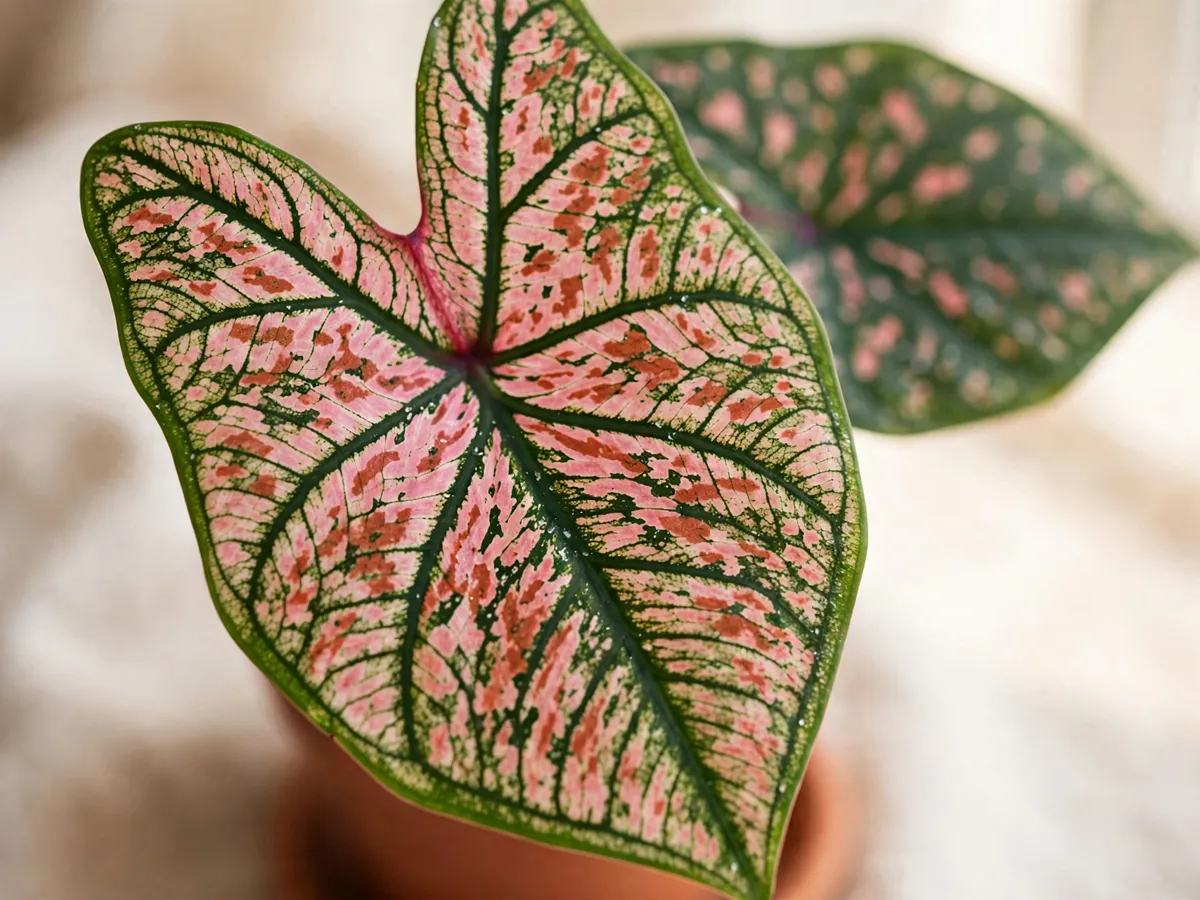
No common houseplant out-visuals a caladium. Heart-shaped leaves in flushes of pink, red and rose, veined in darker or lighter tones, some nearly translucent white. It looks like a plant a set designer ordered. In bright, warm, humid conditions the color is so strong the plant reads artificial from across a room. Several varieties stay compact and fit a windowsill pot.
The honest difficulty is moderate to fussy, for one structural reason: a caladium is a tuber, not an evergreen. It grows from stored energy in the bulb, and when days shorten or temperatures drop, the whole plant dies back to the soil line. That is the normal cycle, not failure. Keep the pot barely moist and warm through the winter, and it regrows in spring. Before that drama, it wants what most US apartments do not have by default: steady warmth (roughly 65°F and up), air that is not bone dry, and bright indirect light with no direct sun on the leaves.
Buy one in spring or early summer rather than autumn, so you get a full growing season before the nap. Every part of the plant, and the tuber itself, is toxic to pets if eaten, and the sap can also irritate skin, so this is a high-shelf plant in a pet household.
Cost: $12–$25. Time: 20 minutes to pot up, with a seasonal die-back to plan around. Caveat: a caladium bought in November will start dying back within weeks, which looks like you killed it and is actually just the season.
4. Aglaonema: red color on the most forgiving plant here
Aglaonema, the Chinese evergreen, is the bridge between "I want color" and "I also forget to water." The green forms are common mall-plant furniture, but the red and orange hybrids (Siam Aurora and its relatives) carry pink-red midribs, blushed stems and leaves that shade toward red at the edges. Against green foliage the red reads strongly even at room distance, and it keeps color on a plant that shrugs off beginner mistakes.
The honest difficulty is easy. It tolerates the lowest light of any plant on this list, holding its pattern in a dim room where the polka dot and croton would wash to green. It forgives missed waterings (water when the top two inches dry) and dislikes cold drafts more than anything. The one trade: in low light the red tones soften and the leaves trend greener, so for the fullest red show, give it the brightest spot you can spare without direct afternoon sun. Red aglaonema varieties cost more than the plain green ones, usually $15–$30 in a six-inch pot.
Cost: $15–$30. Time: 15 minutes to pot up. Caveat: it is toxic to cats and dogs if eaten, and it hates cold window drafts in winter, so keep it back from the glass.
5. Croton: the boldest color, the strictest light
A croton in full color is the loudest plant in any room: waxy leaves in yellow, orange, red and near-black, often all on one plant. No foliage houseplant matches its saturation. That is exactly why it fails in apartments, because every one of those pigments is bought with light, and a croton spends light like a plant three times its size.
The honest difficulty is the highest on this list, and the failure mode is specific. It needs several hours of bright light daily (a south or west window, sun softened by a sheer curtain), and it drops leaves hard in response to cold drafts or a change of position. The classic croton story: bought in full color at a store, carried home in a cold car, set in a dim corner, and it sheds half its leaves in two weeks. That shedding is the plant telling you the light deal was broken, not that you watered wrong. Keep it warm, keep it in one spot, and give it the brightest window you have. New leaves arriving green are the early warning that light is short.
Cost: $15–$40. Time: 15 minutes to pot up. Caveat: the milky sap is mildly toxic to pets and can irritate human skin, so wear gloves when pruning and keep it out of reach.
6. Rex begonia: pattern instead of blooms
Rex begonias are grown for swirls, not flowers. Each leaf is a metallic spiral of silver, rose, burgundy and green, and no two cultivars look alike. On a shelf they read as a collection of painted objects. The flower is beside the point (small and unremarkable), which is why rexes belong in this foliage guide and not a blooming-plants list.
The honest difficulty is fussy, the second-hardest on this list after croton. Rexes want bright indirect light with no direct sun, a chunky airy mix, watering when the top inch dries, and humidity above what a heated apartment usually offers. Their classic failures are powdery mildew on crowded, wet leaves and rot in dense soil. Good airflow and watering the soil (never the leaves) prevent both. The full routine, including the mildew fix, is in the begonia care guide, which covers rexes and their cane relatives.
Cost: $10–$25. Time: 20 minutes to pot up into an airy mix. Caveat: like most begonias, rexes are toxic to cats and dogs if eaten.
7. Purple passion plant: velvet that needs the window seat
Gynura, the purple passion plant (also sold as purple velvet plant), is covered in fine purple hairs that give every leaf a soft, plush look, green underneath and glowing violet at the edges. It is the only genuinely velvet texture on this list, and in bright light the purple is saturated enough to read across a room.
The honest difficulty is easy on care and unforgiving on placement. Water when the top inch dries, keep it from overwatering, and it grows fast and trailing. The catch is that the purple depends entirely on bright light. In dim corners the new growth comes in plain green and stays that way, so this is a directly-in-the-window plant, ideally east-facing morning sun, rather than a shelf plant. Another honest note: older stems lose the velvet and the plant gets leggy with age, so most growers take cuttings every year or two and restart fresh. It is generally considered non-toxic to cats and dogs, which makes it one of the safer colorful picks, though the sap has been reported as mildly irritating to some people.
Cost: $8–$18. Time: 10 minutes to pot up. Caveat: do not mist it. Water on the dense fuzz sits and causes rot or leaf spots, and misting does nothing for the air anyway.
8. Wandering dude: purple undersides on the fastest grower here
Tradescantia zebrina, widely sold as wandering dude (and formerly as wandering Jew), is the fastest, cheapest, most forgiving plant on this list. Silver-green striped leaves with deep purple undersides, so a trailing mass reads purple-green from below and shimmering silver from the side. In bright light the whole vine deepens toward plum. It roots from cuttings in days, grows inches per week in season, and a single starter pot fills a windowsill within a summer.
The honest difficulty is easy, with two quirks. First, the stems are brittle: they snap if brushed, so give it a hanging pot or a shelf edge where nothing crowds it. Second, the color bargain applies strongly. In dim light the purple drains and the vine goes plain green, and it also gets sparse, so keep it in bright indirect light, ideally with some direct morning sun, and rotate or pinch it. Water when the top inch dries. Old center growth goes bare after a year or so, which is not decline, just the plant spending its energy on the new tips; pinch or restart from cuttings to keep it dense. Its sap can cause mild skin irritation on sensitive people and in some pets, so wash hands after pruning and keep nibbling pets away.
Cost: $6–$15. Time: 10 minutes to pot up. Caveat: prune with gloves, and expect to restart the plant from cuttings every couple of years to keep the look dense.
9. Nerve plant: vein patterns and the dramatic faint
Fittonia, the nerve plant, delivers color as fine veins: bright pink, red or white lines over deep green small leaves, dense and low-growing. It is the most compact plant on this list (usually under six inches tall), which makes it the color pick for desks, terrariums and small shelves. In decent indirect light the veins glow; there is no bloom involved.
The honest difficulty is moderate, driven by two wants: steady moisture and humidity. Fittonia has thin leaves and shallow roots, and it faints. When the mix dries, the whole plant collapses flat within hours, and it usually stands back up within hours of watering. Let it collapse occasionally and the habit teaches you the watering interval, but repeated drought stress browns the leaf tips for good. Keep the mix evenly moist (never soggy), group it with other plants or run a small humidifier nearby, and keep it out of direct afternoon sun. It is generally considered non-toxic to cats and dogs, so it is one of the two safe colorful picks here alongside purple passion plant.
Cost: $6–$15. Time: 10 minutes to pot up. Caveat: the faint is a signal, not a schedule; wait for real dryness at the top rather than watering a still-damp mix on reflex.
10. Light strategy: how to actually keep the color
Everything above said the same word, so here is the practical version. Place the pot directly beside (or very near) your brightest window, usually east or south facing, with direct sun softened by a sheer curtain where the species wants it. Light intensity drops off steeply with distance, so a pot three feet back from the same window gets a fraction of the light of a pot on the sill. Every foot matters with these plants.
Rotate pots a quarter turn each week so growth stays even instead of leaning one-sided toward the glass. Watch the new leaves: if they come in greener and wider spaced than the old ones, or the plant visibly stretches, the light is short and the color is going with it. That read takes about ten seconds a plant.
When the windows themselves are not enough (a north-facing room, a shaded yard outside, deep eaves), a small grow light is the honest fix, and a cheap one: a clip-on or strip LED run eight to ten hours a day on a timer gives foliage plants the light budget they need to keep spending on pigment. The grow lights for indoor plants guide covers picking and placing one without overbuying. Treat the grow light as buying the color back, not as a decoration accessory; on a dim shelf it is the difference between the pink polka dot plant you bought and a green one.
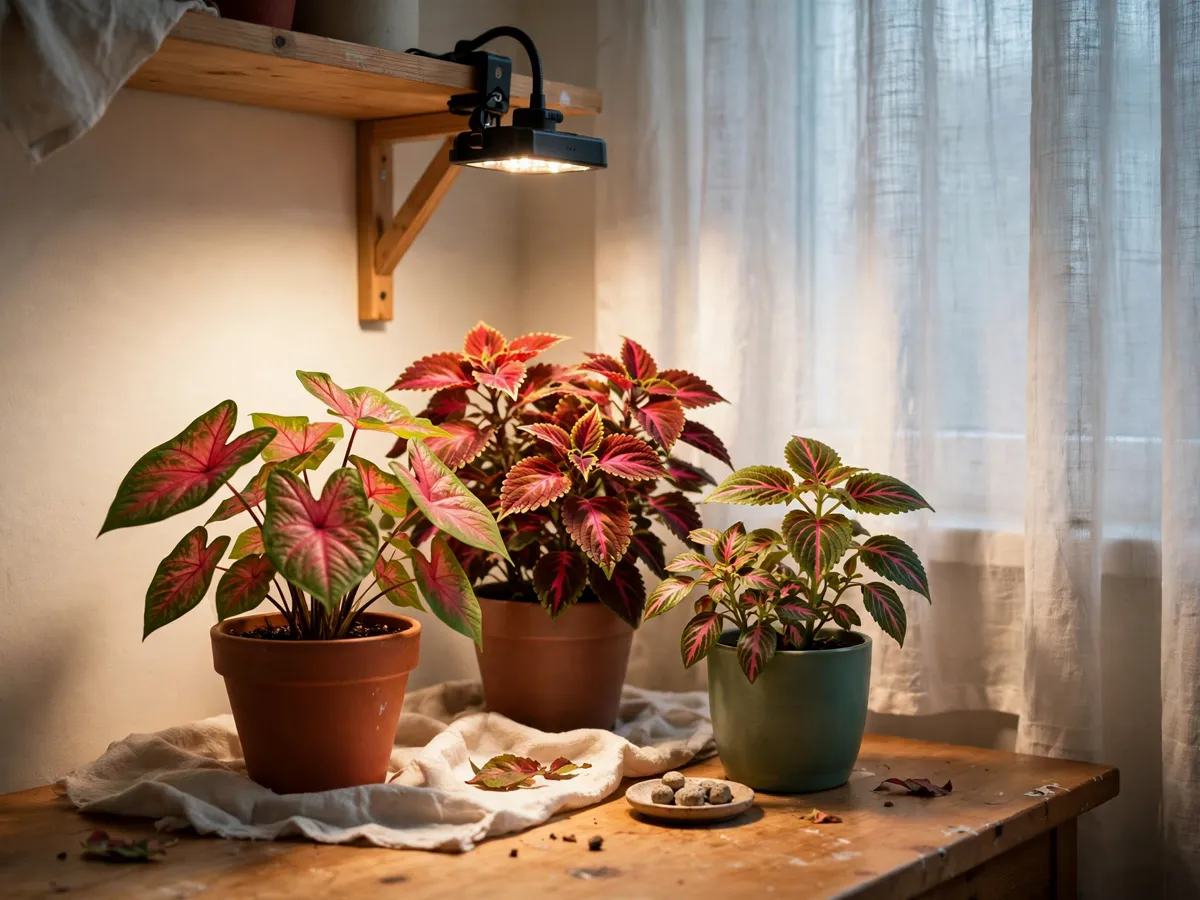
Cost: $0–$45 (a basic clip-on LED runs $15–$45). Time: 20 minutes to place and set a timer. Caveat: a grow light run only while you remember to switch it on will not hold color; it needs the daily hours, which is what the timer buys.
11. Care that is the same for all of them
The eight plants above differ on light and fussiness, but the base routine is one routine. Pot everything into a container with a drainage hole (a plain terracotta pot with a saucer does the job) and use a light, airy houseplant mix rather than dense garden soil. Water by feel, not by calendar: check the top inch or two with a finger and water thoroughly when it is dry, letting water run from the hole. Empty the saucer after ten minutes.
Feed only during the growing season, roughly April through September, with a balanced liquid feed diluted to half the label strength every third watering. Stop feeding entirely in winter, when growth slows and unused salts build up in the mix. If the watering and feeding logic feels thin, the care of houseplants guide walks through the full weekly routine that underlies every plant on this page, and the indoor plant food guide explains the half-strength habit in detail.
One shared ban: no misting on this list. Most of these plants want higher humidity than a heated apartment gives, and misting feels like the fix, but the water lands on leaves for under a minute and does nothing to the air. On fuzzy leaves (purple passion plant) it invites rot and spots. Group plants together or run a small humidifier instead.
Cost: $10–$25 for pots and a bag of mix. Time: 30 minutes for the whole set. Caveat: the two humidity lovers (caladium, nerve plant) need the grouping or humidifier treatment, not just the watering routine.
12. Pet safety: the short version
Colorful foliage and pet safety overlap poorly, so here is the straight list. Toxic to cats and dogs if eaten: polka dot plant, caladium, aglaonema, croton (the sap as well), and rex begonia. Tradescantia (wandering dude) carries mildly irritating sap that bothers some pets and people. Generally considered non-toxic to cats and dogs: purple passion plant and nerve plant. Caladium and croton also irritate human skin on contact, so gloves when pruning.
"Toxic" in houseplant terms mostly means mouth and stomach irritation, drooling or an upset gut after chewing, not catastrophe, but the caladium and croton rank among the more irritating ones, and a chewer changes the placement math. In a home with cats or dogs, the two non-toxic picks on this list are the safe starting point, and the pet safe low light houseplants guide covers the wider non-toxic list for dim rooms.
Cost: $0. Time: 2 minutes to check your placement plan. Caveat: any suspected chew of caladium, croton or aglaonema is worth a call to your vet, and this page is not veterinary advice.
Common questions
Why is my pink houseplant turning green?
The light dropped. Pigments like the pink on a polka dot plant are expensive for the plant to make, and in dim light it stops spending on them, so chlorophyll takes over and the leaf reverts to green. Move the pot closer to the brightest window you have, and new growth should come back colored. Old leaves that already went green usually stay green.
Which colorful plants work in a north-facing window?
The forgiving ones: aglaonema keeps its pattern in the lowest light of anything on this list, and nerve plant holds its vein color in decent indirect light. The heavy color players, croton and caladium especially, fade or decline in a north window without a grow light supplement.
Are colorful houseplants safe for cats and dogs?
Mixed. On this list, purple passion plant and nerve plant are generally considered non-toxic. Polka dot plant, caladium, aglaonema, croton and rex begonia are toxic if eaten, and tradescantia sap irritates some pets. Section 12 has the full split, and the pet-safe guide covers non-toxic plants for dimmer rooms.
Do colorful indoor plants need a grow light?
Not if you have a bright east or south window. A small grow light becomes the honest fix when your windows are dim or north-facing, because the pink and red pigments need a real light budget. A clip-on LED on a timer, eight to ten hours a day, is enough for the plants on this list.
Why did my croton drop its leaves after I brought it home?
Crotons hate two specific things: cold drafts and being moved. The ride home in a cold car, a drafty window, or a new spot with less light than the store gave it, any of those can trigger a heavy leaf drop within two weeks. Keep it warm, give it the brightest spot you have, and let it settle without moving it again. It usually regrows from the stem.
How much should I spend to start with colorful plants?
Three starter plants, their pots and a bag of mix run roughly $30–$75, depending on how showy the picks are. A polka dot plant, a nerve plant and an aglaonema sit at the low end; a caladium and a croton push it up. That covers the first afternoon and the first few months of feed.
Save these on Pinterest
Pin the plant list and the color-fade light rule, the two things that decide whether the pink and red actually show up in your rooms. This guide and the rest of the gardening tips live together there.