 Plant As Deco
Home Organization & Storage
Laundry Basket Storage for Small Apartments: Six Spots That Hide It
By Plant As Deco · Updated 27 November 2026
Most apartments have no laundry room, so the basket ends up in the bedroom, behind a door, or in the hallway where everyone walks past it twice a day. The fix is rarely a better basket. It is a spot chosen before the buy, measured against three numbers: the clearance under the bed, the gap inside a door, and the footprint the basket leaves when it is empty. This page is about where the basket lives. Which hamper to buy for a sorting station is a separate decision, and it belongs to the laundry corner itself.
Weekend-ready: $0–$45, one afternoon. Measure first, buy second — renter-safe throughout.
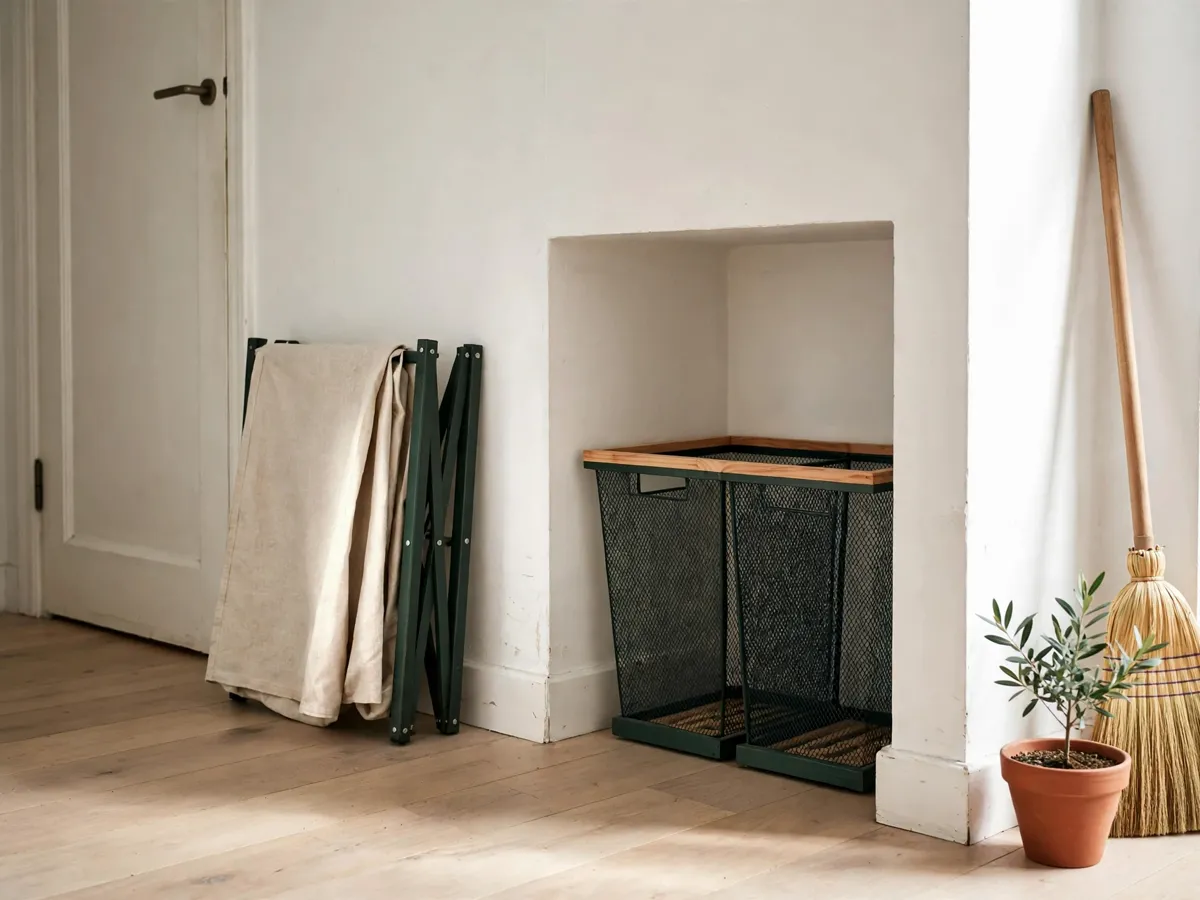
At a glance
- Who it is for
- Anyone whose washer is in a closet, a bathroom, or under a kitchen counter, and whose basket currently lives in a room people see.
- What you need
- A tape measure, the basket you already own, and one of six spots: under the bed, inside a door, flat on a closet shelf, behind an opening, under a lid that is furniture, or low enough to drop below the sightline.
- What it costs and takes
- $0 to re-spot the basket you have, up to about $45 for a low-profile or over-door style, and one afternoon.
1. What the basket has to survive before it holds anything
A basket in a small apartment is not only a container. It is bumped by ankles in a hallway, kicked open under a bed, pressed flat against a door that has to close, and left standing with damp clothes in it for an hour after a shower. Every placement decision below follows from that list, not from how the basket looks on a shelf in a store.
So start with the abuse, not the aesthetic. If the spot closes a door against it, the wall has to be rigid or it will bow and stop zipping. If the spot is under a bed, it has to be pulled out with one hand while the other holds a load. If the spot is a bathroom corner, it has to breathe, because that is the one room where a damp load sits overnight more often than anywhere else.
Cost: $0. Time: 10 minutes. Write the four abuses your real spot puts a basket through, and throw out any style that fails one of them before you look at prices.
2. Measure the three numbers, in this order
A basket fails in a small apartment on shape long before it fails on quality, and a shape problem is measurable in ninety seconds. Take these three numbers with a tape measure and a pencil before any purchase.
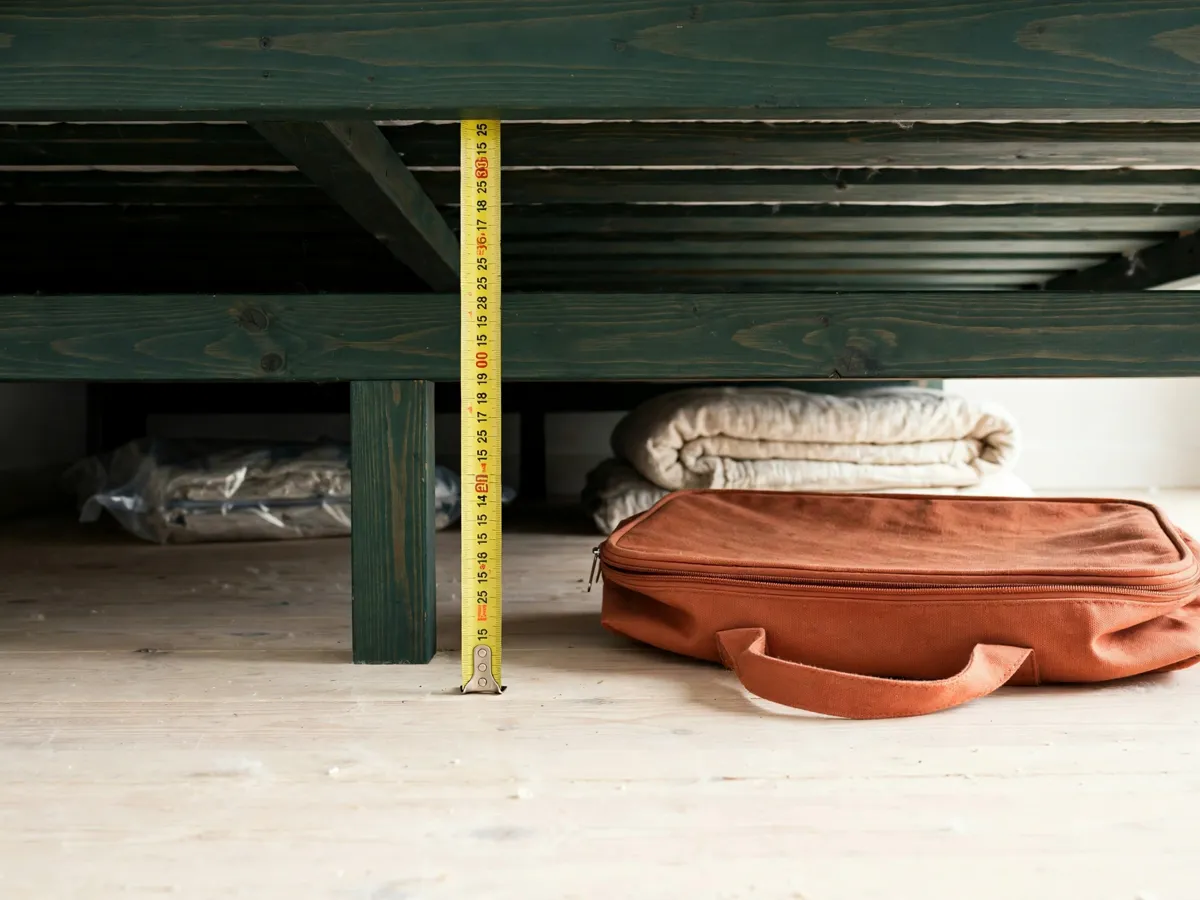
- Clearance. Floor to the lowest thing above the spot: the bed rail, not the mattress, and not the storage the bed advertises. Measure at two points along the length, because a frame that sits level on a flat floor tilts on a rug, and the lower of the two numbers is the one that matters.
- Travel gap. The depth a door, a drawer front, or a curtain has to pass through on its way shut. Measure the gap with the door open, then subtract the thickness of the door itself. Whatever is left is the most a basket can stick out.
- Folded footprint. The height and the diameter of the empty basket, not the full one. Soft-sided hampers read correctly on a product page only when someone remembers that the listed number is the filled shape.
Then apply the lid allowance. A container that measures exactly the clearance cannot be pulled out with a load in it, because the lid or the rim catches on the rail. Leave about an inch of slack between the tallest container and the clearance, and the same inch between the folded footprint and the shelf it has to slide under. The under-bed guide has the full clearance math already, so read it once and reuse the numbers.
Cost: $0 if you own a tape measure. Time: 15 minutes. Two measurements at each point, and the smaller number wins. Skipping the slack inch is the single most common reason a basket goes back.
3. Under the bed: the roll-out that nobody sees
This is the highest-value spot in a one-bedroom apartment, and it is the one most people get wrong by buying a tall hamper and discovering it will not fit. The move is a low-profile basket that lies flat, roughly the height of a stack of folded towels, with a lid that zips rather than lifts. A lifting lid needs vertical clearance to open, and under a bed there is none, so the zip is not a preference, it is the requirement.
Wheels or runners change the job. A basket on a hard floor with no rug slides on its own base if the base is smooth plastic, and drags if it is fabric. The honest test: put the empty basket down, load it with ten pounds of something soft, and pull it out with one hand while holding the bed steady. If that takes two hands, the spot is wrong, not the basket.
One caution about what goes in it. The under-bed basket should hold dry clothes waiting for a wash day and nothing else. A damp load left in a shallow closed container under a bed is in the warmest, still-air spot in the apartment, and that is a different problem from the one the spot solves.
Cost: $0 to re-purpose a fabric storage box you already own, $20–$45 for a low-profile zippered hamper. Time: 10 minutes to place. One inch of slack under the rail, and dry loads only.
4. On the inside of a door: the column nobody sees
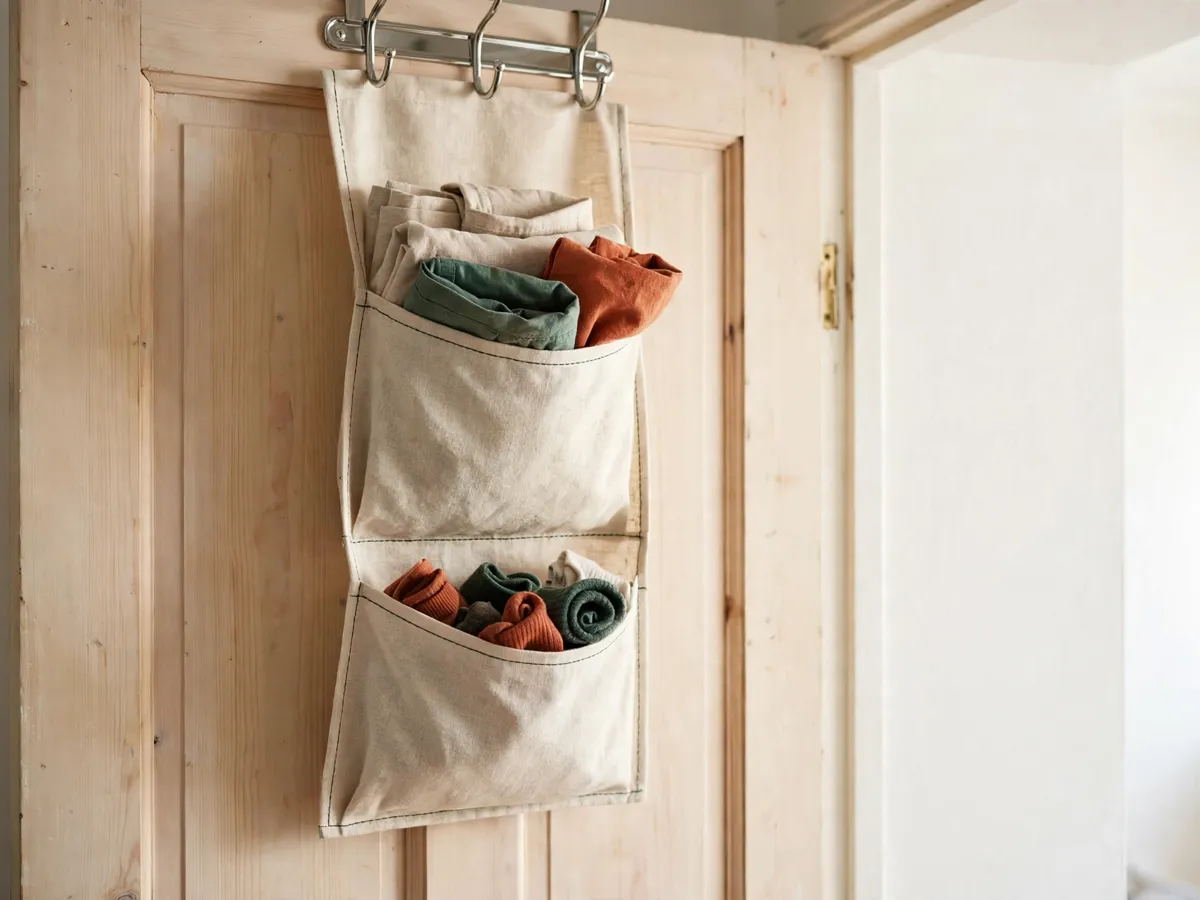
A door leaf is the largest unused vertical surface in most apartments, and it takes a laundry column without eating floor space. The format that works is a hanging fabric organizer with two or three deep pockets, hooked over the top of the door, with the bottom pocket ending above the swing of the handle. Dry clothes go in the top, socks and small items in the middle, and the bottom pocket becomes the one that travels to the machine.
Two measurements decide whether this spot exists at all. The first is the top gap between the door leaf and the frame, because a hook needs to clear it and still hang square; a door with a storm seal or a closer arm will not take one. The second is the travel gap from step two, measured again with the organizer on the door, because fabric loaded with clothes is deeper than the empty organizer the listing describes.
The failure mode is a swinging door in a narrow hallway: the organizer turns the door into a wall that clips people walking past. If the hallway is tight, put the column on the inside of a closet door instead, where the swing goes into a dead space rather than into traffic.
Cost: $15–$30 for a hanging organizer, or $0 for a set of over-door hooks and a fabric bag you own. Time: 10 minutes. Check the hook clearance before buying, and load the top pocket only with dry clothes.
5. Fold-flat: when it earns its shape and when it sags
A collapsible basket is the right answer for exactly one problem: the spot is shared. It folds into a hallway closet shelf in the week you are not washing, and it stands up on wash day. If no spot in your apartment is shared, a rigid basket is better in every way except storage, because it holds its shape when half empty.
The thing to test in the shop, or in the first week at home, is the half-empty collapse. A soft basket with no internal frame bulges at the waist when it holds two shirts, and the bulge is what stops it from going back into the shelf. Panels that stay stiff top and bottom, or a frame of rods you thread before the first use, are the two designs that survive it. A basket that is only fabric, with nothing at the base, will not.
Budget the assembly honestly. The fold-flat styles that hold their shape take a few minutes of threading supports and tightening straps before the first load, and they take those minutes again after every deep clean. If you will not do that, buy the rigid one and give it a spot of its own.
Cost: $18–$40. Time: 20 minutes including the first assembly. Choose fold-flat only when the spot is genuinely shared, and test the half-empty bulge before committing.
6. Lidded or open: the damp-load rule decides it
A lid is a concealment feature, and concealment is the reason most people buy one. It also closes the only airflow path a basket has. So decide the lid by what the basket actually holds, and treat the two cases as different objects.
Dry clothes waiting for a wash day: a lid is free, and in a bedroom or a shared living space it is the difference between a tidy room and a visible pile. Use the lid, and open it once a day so the load is not sitting in still air.
Damp clothes, towels straight out of a shower, swimwear, gym kit: these need an open weave and they need it fast. The EPA mold course notes that moisture is the most important factor influencing mold growth indoors. The EPA mold course also notes that a little condensation can be enough for indoor mold growth. Open the EPA mold course chapter on moisture. A bathroom with a shower and no window is the place this shows up first, which is why the basket in that room should be mesh or woven, never a lidded box.
The practical rule: damp items go into an open bag or basket that you carry to the machine within the hour, and the lidded hamper stays for the dry accumulation. Two containers, one of them a $6 mesh bag, beats one expensive hamper that has to do both jobs.
Cost: $0–$12 for the mesh bag. Time: 5 minutes. Never leave a damp load in a closed container overnight, and keep the lidded hamper for dry clothes only.
7. Material decides the airflow, and the airflow decides the smell
Four materials, four jobs, and only two of them suit a damp load.
| Material | Airflow | Best spot | Weakness |
|---|---|---|---|
| Open mesh or netting | Highest of the four | Bathroom, gym bag, damp towels | Shows every item in it, so it loses on concealment |
| Canvas or polyester over a frame | Moderate through the weave | Bedroom and hallway, dry accumulation | Holds a spill mark, and the liner needs washing |
| Rigid plastic with vent slots | Only what the slots give it | Hallway closet, a shared laundry corner | Scratches, and it is the heaviest to carry |
| Woven seagrass or paper cord | Low, and the weave holds dust | A visible room where the basket is the decor | Cannot be washed, and a damp load stains it |
The Weakness column also decides the cleaning. Mesh and canvas take water, so their liners can come out and be rinsed. Rigid plastic wipes down but holds scratches where soil sits. Woven fiber takes neither: a wet towel marks it and the stain stays. Whatever the material, the maintenance is one full empty a month. A fabric liner holds what the clothes leave behind whatever the load is doing, so it comes out, gets rinsed, and dries completely before the next load goes back in.
One warning about the fully closed end of that table. Museum textile guidance says not to store textiles in plastic dry-cleaning bags or plastic tote boxes, because they contain plasticizers that can harm fibers. The same guidance notes that sealed plastic containers can create microclimates that are perfect environments for mold. Read the textile care guidance from NC Historic Sites. Those are conservation standards for garments being stored for years, not rules for a week of shirts, and nobody needs to move their laundry into acid-free paper. What carries over is the direction of the risk: the more a container seals, the less it breathes, and the more it traps whatever moisture the load brought with it.
Cost: $0. Time: 5 minutes. Pick the material from the damp-load rule in step 6 first, and only then from how it looks.
8. One basket doing the job of a sort station
If the spot is small, a single basket with two compartments can carry the sort that a laundry corner normally builds as three bins. The split that earns its space is not lights and darks. It is everyday and everything-else: one side takes the normal load, the other takes the towels, the gym kit, the delicates and the items that need a colder wash or a line rather than a dryer.
That split works because it matches how a small apartment actually washes: one full machine of everyday clothes, and a second small load that is handled differently. Two dividers inside one footprint costs less floor space than two baskets, and it removes the second pile that forms on a chair when there is only one hamper.
Where the spot is a closet footprint with room for three streams, the station build is a different project, and it is already written up with shelf heights and supply zones. Read the small laundry corner when the machine is in a closet of its own; read this page when the basket is the thing that has to disappear.
Cost: $0 with a divider you already own, $10–$25 for a two-section hamper. Time: 10 minutes. Two compartments is the ceiling in a small spot; a third stream belongs in the laundry corner, not the bedroom.
9. Hiding it in a room people see
Sometimes the only spot is a visible one: a studio, a bedroom with no closet, a hallway with a radiator where the basket would stand. Then concealment is a covering problem rather than a placement problem, and three moves cover it without buying a second hamper.
- Behind an opening. The plane of an open door, the far side of a wardrobe leaf, the gap behind a hanging coat rack. Zero cost, and it uses space that only exists when something else is closed.
- Under a lid that is furniture. A bench with a lift seat, an ottoman, or a storage stool does the hamper job and reads as a seat. The catch is the airflow: it is a closed box, so dry loads only.
- Low instead of tall. A basket that is wider than it is high disappears below the sightline in a room where a tall hamper cannot. This is the same shape that fits under a bed, so one buy covers two spots.
Cost: $0 for the first and third, $30–$60 for a lift-seat bench if you want it to double as seating. Time: 5 minutes to re-spot, an afternoon for the bench. The lid-that-is-furniture route is dry loads only.
10. What we would skip, and the mistakes that send baskets back
Skipping is a decision, not a compromise. These are the buys that look reasonable in a small apartment and fail in it.
- A second hamper for a spot that already has one. If the problem is placement, a second container doubles the footprint and solves nothing. Fix the spot first.
- Anything rigid for a shared spot. A rigid plastic basket cannot fold, so it occupies its full volume in the week you are not washing.
- Woven decor baskets for damp loads. They cannot be washed and a wet towel marks them, which is the opposite of what a bathroom basket has to do.
- A tall narrow hamper for a hallway. It reads as furniture in a shop photo and becomes an ankle hazard in a corridor you cross in the dark.
Four ways a spot fails a good basket, in order of how often they bite: the clearance is measured at the mattress instead of the rail, the lid lifts rather than zips so it cannot open under a bed, the door hook will not clear the frame, and the fold-flat basket bulges when half empty and will not go back on the shelf. Every one of those is a measurement you could have taken in the ninety seconds from step two.
Cost: $0. Time: 5 minutes. Buy nothing until the three numbers are written down, and re-measure the spot if the floor has a rug.
11. Total cost, time, and the weekly reset that holds it
The whole plan, priced honestly, is mostly a tape measure.
| Move | Cost | Time |
|---|---|---|
| Measure the three numbers, list the four abuses | $0 | 25 minutes |
| Re-spot the basket you own | $0 | 10 minutes |
| Mesh bag for damp loads | $6–$12 | 2 minutes |
| Low-profile zippered hamper for under the bed | $20–$45 | 10 minutes |
| Over-door column with deep pockets | $15–$30 | 10 minutes |
Pick two rows, not five. The realistic small-apartment plan is the free re-spot plus one buy, and the total lands between $6 and $45 depending on whether the second container is a mesh bag or a hamper.
The reset is one line and it is the thing that keeps the spot working: on wash day, the basket goes back empty to the same place it came from. A basket that gets left where the laundry machine is has, within a week, become a second pile in a room that has no spare floor. The spot only hides the basket if the basket returns to it.
Cost: $6–$45 for the whole plan. Time: one afternoon, then 2 minutes per wash day. Two rows of the table is the honest scope, and the reset only holds if the empty basket goes back.
Common questions
Where does a laundry basket go in a studio apartment?
Under the bed, in the lowest profile you can fit, because a studio has no hallway and no spare door. If the bed has no clearance, the inside of the bathroom or closet door is the next spot with dead space in it. A fold-flat basket is the third answer, and it lives on a closet shelf between wash days.
Can I keep a damp load in a lidded hamper overnight?
Do not, and this is the one rule on the page that is not a preference. A lid closes the only airflow path the basket has, and a damp load brings moisture with it. Towels and gym kit go in an open mesh bag and to the machine within the hour; the lidded hamper holds dry clothes waiting for wash day.
What size basket fits under a standard bed?
Smaller than the number on the bed listing, by about an inch. Measure floor to the lowest rail at two points, take the lower reading, and subtract an inch so the rim clears the rail when you pull it out loaded. A lifting lid cannot open in that space at all, so the container needs a zip or a roll-top.
Is one hamper with dividers as good as three bins?
In a small spot, yes, and it is better on floor space. Two compartments cover the split that matters, everyday versus everything that needs a different wash or a line. A third stream earns its place only where the machines sit in a closet of their own, and that is a sort station rather than a basket.
Why does my basket smell even when the clothes in it are dry?
Usually the basket is holding one damp item, or it has never been washed. Fabric liners hold skin cells and body oil whatever the clothes are doing, and a mesh or canvas liner can be rinsed and hung dry. Empty it fully once a month, rinse the liner, and let it dry completely before the next load goes in.
Save these on Pinterest
Pin the two measurements before you buy anything, and pin the under-bed and over-door spots for the day the basket finally goes back on the floor. The rest of the storage work lives in the Organization & Storage collection, including the under-bed clearance math and the closet sort station.