 Plant As Deco
Home Organization & Storage
Laundry Room Makeover Ideas for Small Spaces: A Weekend Plan
By Plant As Deco · Updated 18 November 2026
A small laundry room makeover starts where the room actually starts: the machines. Their footprint, their door swing, and their hookups decide every layout move you get to make, and most small-space laundry rooms fail because the plan fights the machines instead of following them. This page owns the design dimension — layout by machine type, basement laundry, one styling direction, damp-room wallpaper, and the line between a makeover and a remodel — with honest cost bands and a weekend plan you can run on a room you rent or own.
Weekend-ready: $150–$800, one weekend. Renter-safe throughout.
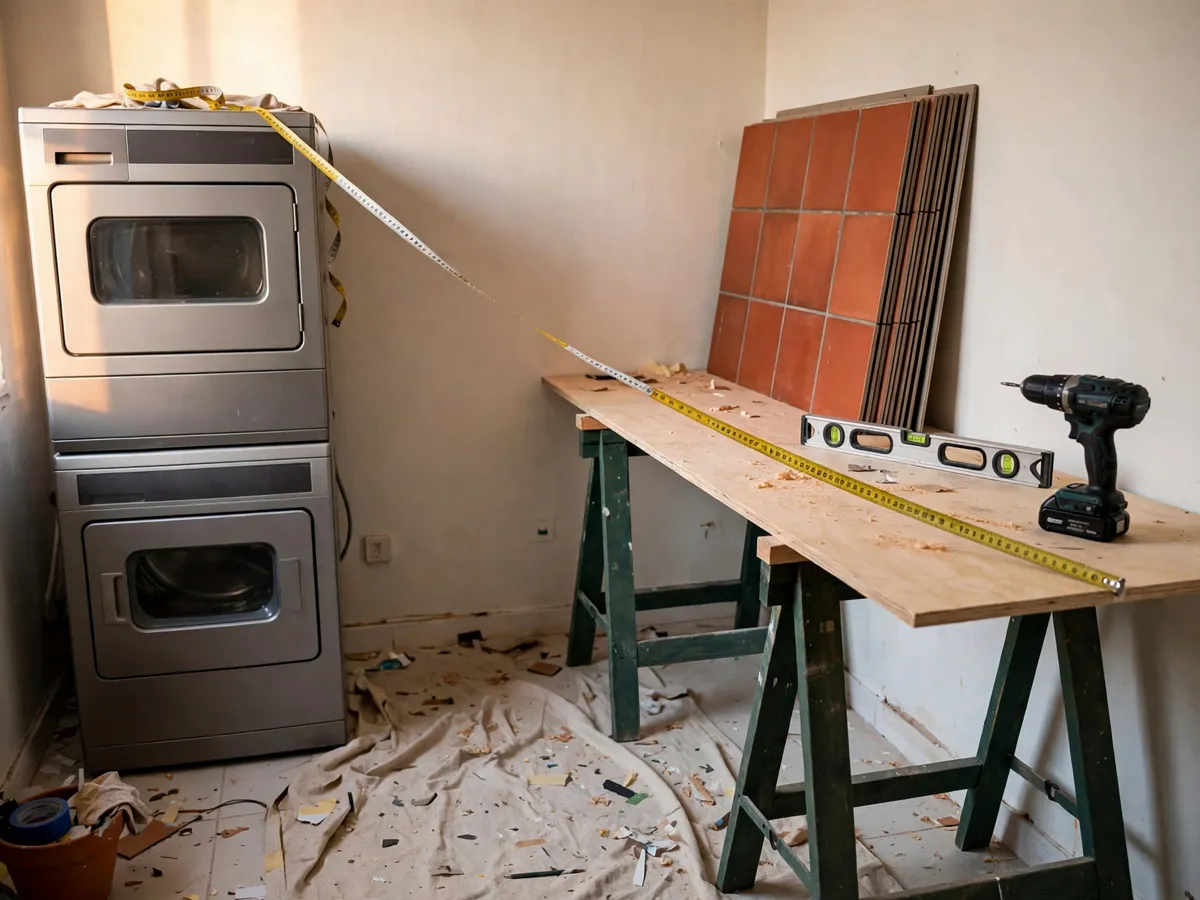
1. Start with the machines, not the mood board
Every laundry room layout decision flows from one measurement: the combined footprint of the washer and dryer. A standard top-loading pair sits side by side at about 54 inches wide and 30 inches deep, and the lids swing up so nothing can sit above them. A front-loading pair side by side takes roughly the same 54 inches but the doors swing out, so you need 20 inches of clearance in front of each door to load and unload without twisting. A stacked front-loading pair takes only 27 inches of width but needs 70 to 75 inches of vertical clearance — measure the ceiling before you stack.
In a room that is five to six feet wide, side-by-side machines eat most of the floor and leave a 12-to-18-inch strip for a walkway and a fold. That strip is where a folding counter goes, but only if it is 12 to 16 inches deep — anything deeper blocks the walkway, and anything shallower will not hold a full basket. When the strip is under 12 inches, the fold moves to a wall-mounted counter that drops down, or to a folding rack on the wall opposite the machines.
A utility sink is the one fixture that changes the layout more than the machines do. A wall-hung or freestanding utility sink adds 20 to 24 inches of width, and it needs its own supply and drain lines. In a five-foot room with a side-by-side pair, the sink leaves no room for a fold surface — the sink is the fold surface, covered with a cut board when not in use. In a six-foot room, the sink fits at one end and a 12-inch counter fits between it and the machines.
Closet-depth machines — the 24-inch-deep front loaders marketed for tight spaces — save six inches of depth but cost capacity and run shallower drums. They are the right call when the room is a hallway closet under 30 inches deep, and the wrong call when a full-depth pair fits and you wash for more than two people.
2. What can move and what cannot: machine and hookup tips for renters
A makeover moves surfaces, styling, and storage. It does not move the three things that make the machines work: the water supply lines, the electrical hookup, and the dryer vent. These are fixed by the building, and moving any of them is a remodel, not a makeover.
Water supply lines — the two braided hoses behind the washer — reach about four to six feet from the shut-off valves. You can slide the washer a few inches left or right within that hose reach, but you cannot move it to the opposite wall without extending the lines, which a renter never does and most owners leave to a plumber. The drain standpipe sits beside the valves and has the same constraint.
The electrical hookup decides whether the dryer can move at all. A gas dryer needs a 120V outlet and a gas line, both fixed. An electric dryer needs a 240V outlet — the large single receptacle, not a standard wall plug — and that outlet stays where the electrician put it. If the dryer cannot reach its outlet without an extension cord, the dryer stays put.
Venting is the last fixed point. A vented dryer needs rigid metal duct to an exterior wall, and the duct run should be as short and straight as possible. A condenser or heat-pump dryer needs no vent and can go anywhere there is power, which is why they are the default in apartment closets. Do not run a vented dryer without a duct to the outside, and do not use flexible plastic or foil duct — it collects lint and restricts flow.
When to ask the landlord: any time a move requires extending a supply line, relocating an outlet, or cutting a wall for a vent. Also ask before stacking machines you do not own. When you move the machines to clean or paint behind them, shut off the water at the valves first, disconnect the hoses carefully, and slide — never lift alone — because a full-size washer weighs 150 to 200 pounds.
Cost: $0 to check. Time: 20 minutes to trace the hoses, the outlet, and the vent before planning any layout move.
3. Basement laundry rooms: moisture, cold floors, and carrying baskets upstairs
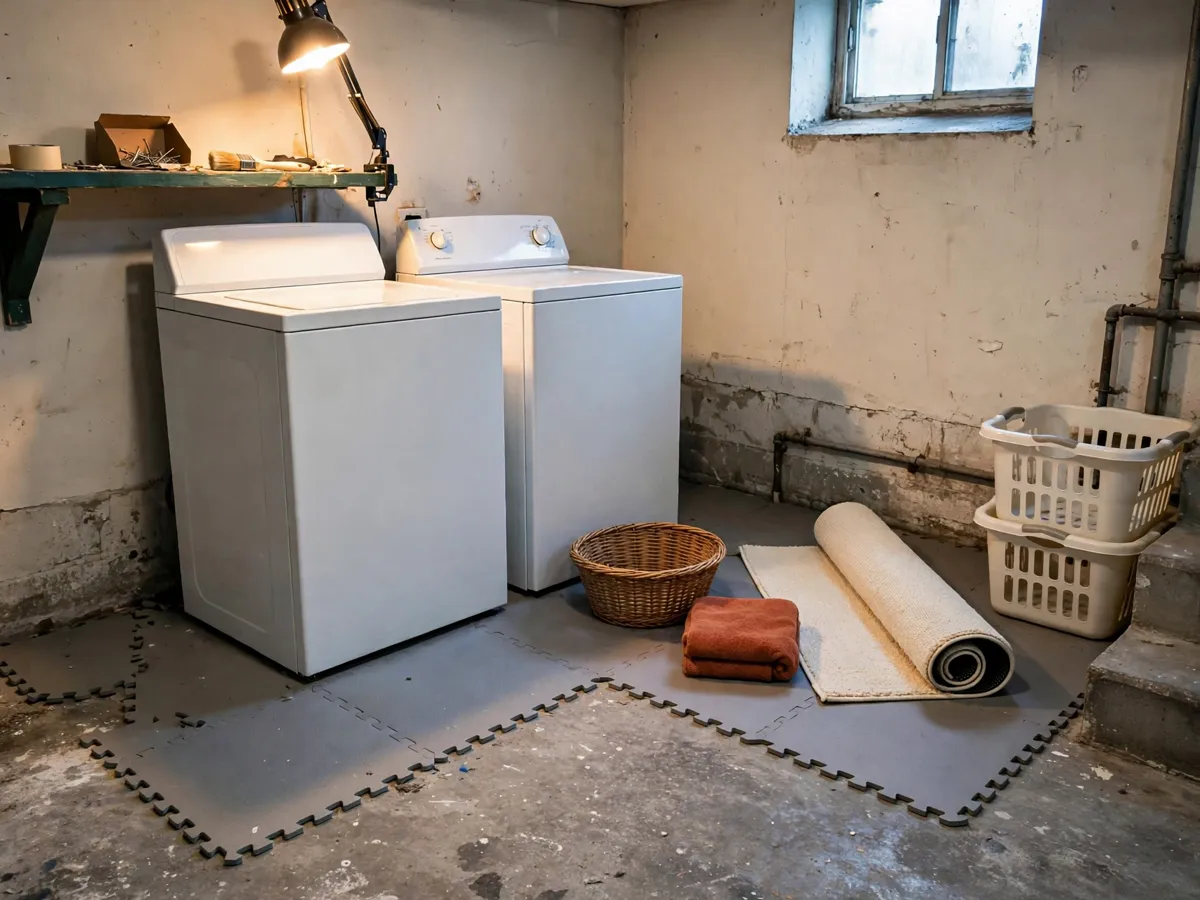
A basement laundry room has three problems the upstairs corner does not: moisture that never leaves, a concrete floor that stays cold year-round, and a basket of clean clothes that has to ride a staircase. The makeover handles each one.
Moisture first. Basements hold humidity the upstairs room sheds through windows and vents, and a washer and dryer add gallons of warm damp air to a space that already starts above 60 percent relative humidity. A dehumidifier pulls water out of the air, but it does not fix the source — a leaky standpipe, a sweating cold-water pipe, or foundation seep. Check the standpipe connection and the hose clamps first, and leave the room door open when the dryer runs.
Cold floors second. Concrete at 55 degrees pulls heat from feet and from a damp basket set on it. A low-pile rug with a rubber backing insulates the standing zone in front of the machines and wipes dry when a splash lands. Foam interlocking floor tiles under the machines cut vibration and cold, and they cost $20 to $50 for a small area.
Lighting third. Basements run a single bare bulb on a pull chain, and that bulb is usually cool and fluorescent, which is the fastest way to make a warm-styled room look like a utility tunnel. Swap to a warm LED bulb — 2700K, reading the number on the package — and add one plug-in task light near the fold surface. Basement lighting runs $30 to $80 for a bulb swap, a clip lamp, and a plug-in ceiling fixture.
The basket problem last. Carrying a full laundry basket up a flight of stairs is the part of basement laundry that breaks the routine, and no makeover fixes gravity. What helps is a dedicated basket station at the foot of the stairs — a shelf or a hook where the empty basket lives, so the trip down carries the basket and the trip up carries the basket full.
Cost: $30–$80 for lighting, $20–$50 for floor tiles, $15–$35 for a backed rug. Time: one afternoon for the bulb swap, the rug, and the basket station.
4. Pick one styling direction and stay with it
A six-foot laundry room is too small to carry two styling directions. Pick farmhouse, modern, or warm-minimal before you buy anything, and let that single direction decide every surface, every fixture, and every container in the room. The room reads finished when the pieces agree; it reads messy when they argue, and in a small utility room the argument is louder than it is in a living room because there is nowhere for the eye to rest.
Farmhouse leans warm and tactile: beadboard or shiplap on one wall, oil-rubbed bronze or matte black hardware, wire or woven baskets, a wood-toned fold surface, and a tongue-and-groove or paneled door. It reads cozy in a basement or a standalone laundry room with a door that closes. It reads wrong in a closet off a hallway, where the texture crowds the opening.
Modern leans flat and clean: slab cabinet doors or flat panels, brushed nickel or chrome hardware, matte white or grey containers, a laminate or stainless fold surface, and a flush door with simple trim. It reads calm in a closet or an open hallway corner.
Warm-minimal is the middle and the one most renters land on naturally: flat painted walls in warm linen or soft cream, light-wood or white-laminate shelves, one natural texture — a woven basket, a linen hand towel — and no more than that. It borrows the calm of modern and the warmth of farmhouse without the beadboard or the chrome, and it is the direction that survives a move, because the pieces travel.
Why not mix? In a six-foot room, a farmhouse wire basket next to a modern matte-white container reads as two rooms stacked in one. Pick one, name it, and let it govern every purchase. If you cannot decide between two, warm-minimal is the one that lets you add either direction later.
Cost: $0 to choose. Time: 10 minutes to name the direction before the first buy. The cost is in the pieces — the decision itself is free and it saves the wasted purchase.
5. Wallpaper in a damp, warm room: what holds and what peels
A laundry room is warm on one side and damp on the other, and wallpaper has to survive both. Three types work, each with a different commitment level, and the renter lens decides which one you pick because removal at move-out matters as much as installation today.
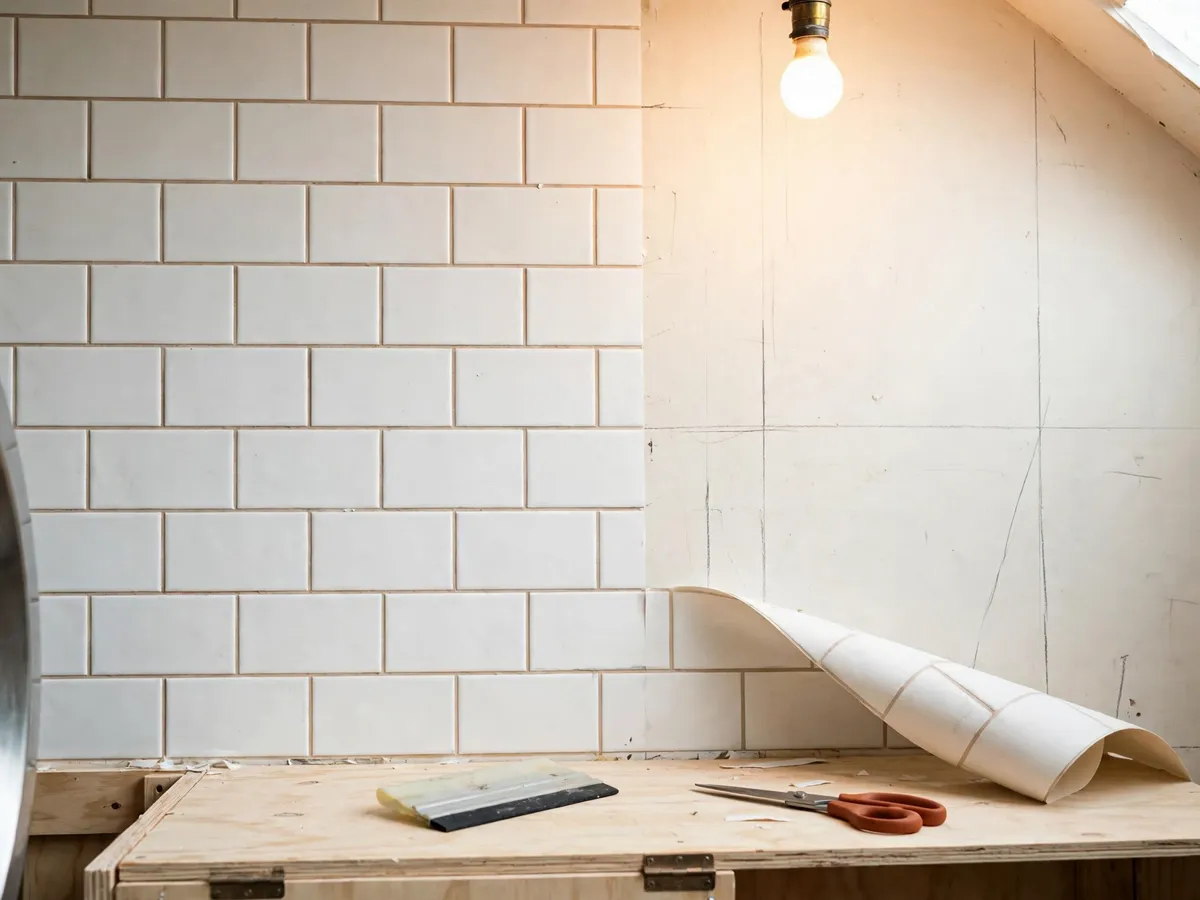
Peel-and-stick is the renter default. It goes on a flat, clean painted wall — never over texture, never over flat paint that is chalky, and never over a wall that has been painted in the last two weeks, because the adhesive bonds to uncured paint and peels it off on removal. Smooth the sheet from the center out with a flat edge, overlap seams by a quarter inch, and keep the sheet at least six inches from the dryer exhaust path. Removal is slow heat from a hair dryer and a steady peel at a low angle — a heat gun melts the adhesive and damages the wall.
Paste-the-wall non-woven wallpaper is the middle commitment. It goes on smoother than peel-and-stick, breathes better in a damp room, and strips off in full sheets when the adhesive is dampened. The adhesive is applied to the wall, not the paper, so a mistake is fixable before the sheet sets. It runs $25 to $60 per roll and covers about 25 square feet.
Tile-look panels are the third route and the one that reads as a design decision in a small room. Rigid PVC or composite panels in a subway-tile or shiplap pattern attach with construction adhesive or a track system, cover a full wall without seams every few feet, and survive heat and damp without warping. They run $30 to $80 per panel, need a level and a saw to cut, and are the most permanent of the three — removal means prying panels and patching adhesive, so they suit an owned room more than a rented one.
Where the seams sit matters. Never run a wallpaper seam directly above the dryer — the heat and vibration work the seam apart within months. Keep seams on the wall opposite the machines, or on the wall you face while folding, where heat and vibration are lowest. If the whole room is one wall of machines, the wallpaper goes on the one remaining wall and nowhere else.
Cost: $25–$80 for peel-and-stick, $25–$60 per roll for paste-the-wall, $30–$80 per panel for tile-look. Time: 2 to 4 hours for one wall. Renters: peel-and-stick is the one that comes off clean.
6. Remodel vs makeover: where the line is
A makeover changes what the room looks like. A remodel changes what the room is. The line between them is the line between surface work and systems work, and most renters and most owners should stay on the makeover side.
A weekend makeover covers: paint on one wall, peel-and-stick wallpaper or tile-look panels on another, a folding counter mounted or freestanding, hardware swaps on existing cabinets, a backed rug, a warm bulb, and the storage systems — sort bins, a shelf above the machines, a drying rack — that the laundry room organization guide covers in detail. All of it is reversible, all of it travels with a renter, and all of it fits the $150–$800 band.
A remodel covers: moving or extending water supply lines, relocating or adding a drain, running a new 240V circuit for an electric dryer, cutting a new exterior vent for a vented dryer, moving a load-bearing or partition wall, installing built-in cabinetry that is fastened to framing, or pouring a new floor. None of these is a weekend job, all of them need permits or a licensed trade in most jurisdictions, and none of them should be attempted in a rental.
Why renters stay on the makeover side: the lease, the deposit, and the fact that the plumbing and the wiring belong to the building, not the tenant. Why most owners stay there too: a laundry room remodel runs $2,000 to $8,000 and up, takes one to three weeks of the room being unusable, and returns less at resale than a kitchen or bathroom remodel of similar cost. The makeover changes how the room feels and functions for a tenth of that.
Cost: $150–$800 for the makeover. Time: one weekend. The remodel is a different project with a different budget — this page does not cover it.
7. Budget tiers: what each level changes
Three budget tiers cover the makeover, and each tier changes a different layer of the room. Spend at the tier your room needs, not the tier a pin suggests, and the money goes where it earns its keep.
$0–$50: surface and clean. Pull everything out, wipe the machines and the floor, swap the cool ceiling bulb for a warm one, add one backed rug at the standing zone, and reorganize what you already own into the sort-and-fold layout from the organization guide. This tier changes how the room reads and how it functions, and it costs almost nothing.
$51–$150: surface plus hardware and one fixture. Everything in the first tier, plus a folding counter — a wall-mounted drop-leaf or a narrow freestanding table — and a hardware swap on any existing cabinets or a magnetic rail on a front-loading steel panel. A peel-and-stick wallpaper panel for one wall lands here too. This tier is where the room starts to look designed rather than cleaned.
$151–$800: the full makeover. Everything above, plus tile-look panels on one wall, a freestanding fold counter with storage below, a plug-in ceiling fixture to replace a pull chain, foam floor tiles under the machines, and a utility sink cut-board fold surface if the room already has a sink. This tier reaches the ceiling of what a makeover does without touching plumbing, wiring, or walls.
What no tier on this page buys: a new machine, a new circuit, a moved drain, a vent cut through an exterior wall, or built-in cabinetry. Those are remodel moves, and they live outside this weekend plan.
Cost: $0–$800 across three tiers. Time: one weekend at any tier, with the $0–$50 tier finishing in an afternoon.
8. What we skip
These moves look good in a pin and fail in a small laundry room. Every one ignores the machines, the damp, or the lease.
- Vented dryer performance claims. No page on this site claims a vented dryer dries faster, saves energy, or outperforms a condenser model. Dryer performance depends on the machine, the load, and the vent run — none of which a makeover changes.
- Utility rebates. Some utility companies offer rebates for ENERGY STAR appliances, but the programs, the amounts, and the eligibility vary by region and change quarterly. This page never quotes a rebate because the number is never stable and the reader’s utility may not offer one.
- Moving plumbing. Extending supply lines, relocating a drain, or adding a new standpipe is a remodel move that needs a plumber and a permit. A makeover does not touch it, and a renter never touches it.
- Stone counters in a utility room. A granite or quartz fold counter costs $300 to $800 installed, weighs more than the cabinets below it can carry without reinforcement, and reads as a showroom move in a room that makes lint and spills detergent. A laminate or wood fold surface does the same job for $40 to $120 and wipes clean.
The pattern: anything that ignores the machines, the damp, or the lease is a remodel wearing a makeover’s price tag. Skip it, spend the money on the fold surface and the lighting instead.
Cost: $0 to skip. Time: 2 minutes to cross them off the list.
9. One weekend plan: Friday, Saturday, Sunday
The makeover fits one weekend when it runs in order: empty and clean first, layout and surfaces second, styling and finish third. Each block names the hours it takes.
Friday evening, 2 hours. Pull everything out of the room — supplies, baskets, the drying rack, anything on top of the machines. Wipe the machine tops, the fronts, and the floor behind them. Trace the supply hoses, the outlet, and the vent, and note what can move and what cannot. Take the before photo from the doorway. Name the styling direction.
Saturday, 4 to 5 hours. Set the layout: slide the machines within their hose and outlet reach, level the feet with a wrench and a spirit level, and place the fold surface in the strip the layout leaves. Mount the folding counter or set the freestanding table. If wallpaper or tile-look panels are going on one wall, this is the day — prep the wall, apply, and smooth. Clear the folding strip and the shelf first, and keep the whole room on the weekly cleaning schedule so the storage layer goes in with the surfaces.
Sunday, 3 hours. Style the room in the one direction you named: hardware on the cabinets or the magnetic rail on the front loader, the backed rug at the standing zone, the warm bulb in the ceiling fixture, and the one or two decor pieces that finish the wall you face while folding — covered in the laundry room decor guide. Take the after photo from the same doorway, same hour. Run one load to confirm the machines still sit level and the vent still clears.
Total: 9 to 10 hours across three days. Cost: $150–$800 depending on the tier.
10. Common questions
How much does a small laundry room makeover cost?
Plan $150–$800 for a full makeover: $0–$50 for cleaning and a bulb swap, $51–$150 for a fold surface and a wallpaper panel, and $151–$800 for tile-look panels, a plug-in ceiling fixture, floor tiles, and a freestanding counter with storage. A remodel — moving plumbing, running a new circuit, cutting a vent — runs $2,000 and up and is a different project.
Can you makeover a laundry closet, not a room?
Yes, and the makeover is smaller. A closet with stacked front-loaders gets a warm bulb, a peel-and-stick panel on the wall opposite the doors, a magnetic rail on the steel front, and a fold-down shelf above the dryer at chest height. Skip the rug and the freestanding counter — there is no floor and no strip to place them in. Budget $50–$200 for a closet makeover.
Does peel-and-stick wallpaper hold in a laundry room?
It holds on a flat, clean, fully cured painted wall that is at least six inches from the dryer exhaust path. It peels on textured walls, on flat paint painted within two weeks, on walls with direct heat from the dryer, and on walls where humidity sits above 70 percent without a dehumidifier. Smooth from the center out, overlap seams a quarter inch, and keep the sheet off the wall behind the dryer.
Farmhouse or modern for a small laundry room?
Pick one and stay with it. Farmhouse — beadboard, wire baskets, oil-rubbed hardware — reads cozy in a standalone room with a closing door. Modern — flat panels, chrome hardware, matte containers — reads calm in a closet or an open hallway corner. Warm-minimal — flat paint, light wood, one natural texture — is the middle and the one most renters choose because the pieces travel. Mixing two in a six-foot room reads messy before it reads either direction.
How do you makeover a basement laundry room on a budget?
Start with moisture and light. Swap the cool bulb for a warm one and add a plug-in task light at the fold surface ($30–$80). Lay foam floor tiles under the machines and a backed rug at the standing zone ($20–$50). Run a dehumidifier if the room reads above 65 percent humidity, and check the standpipe connection first. Set a basket station at the foot of the stairs so the full basket rides up, not down.
Save these on Pinterest
Pin the weekend plan and the budget tiers first, because those are the two you will need when the next laundry room comes along. The rest of the small-space resets live in the Home Organization & Storage collection, and the small living room makeover guide and the bedroom makeover guide carry the same weekend method for the rooms next door.