 Plant As Deco
Home Organization & Storage
Laundry Room Decor Ideas: Six Moves That Calm a Utility Room
By Plant As Deco · Updated 17 November 2026
Laundry room decor ideas, for the room that still has to work. You have a washer, a dryer, and one wall you are allowed to make beautiful — so here is how to pick that wall, what paint survives the damp and the heat, and what art actually lasts in here. Nothing on this page moves a storage decision out of the room.
Weekend-ready: $18–$160, one afternoon. Renters-safe.
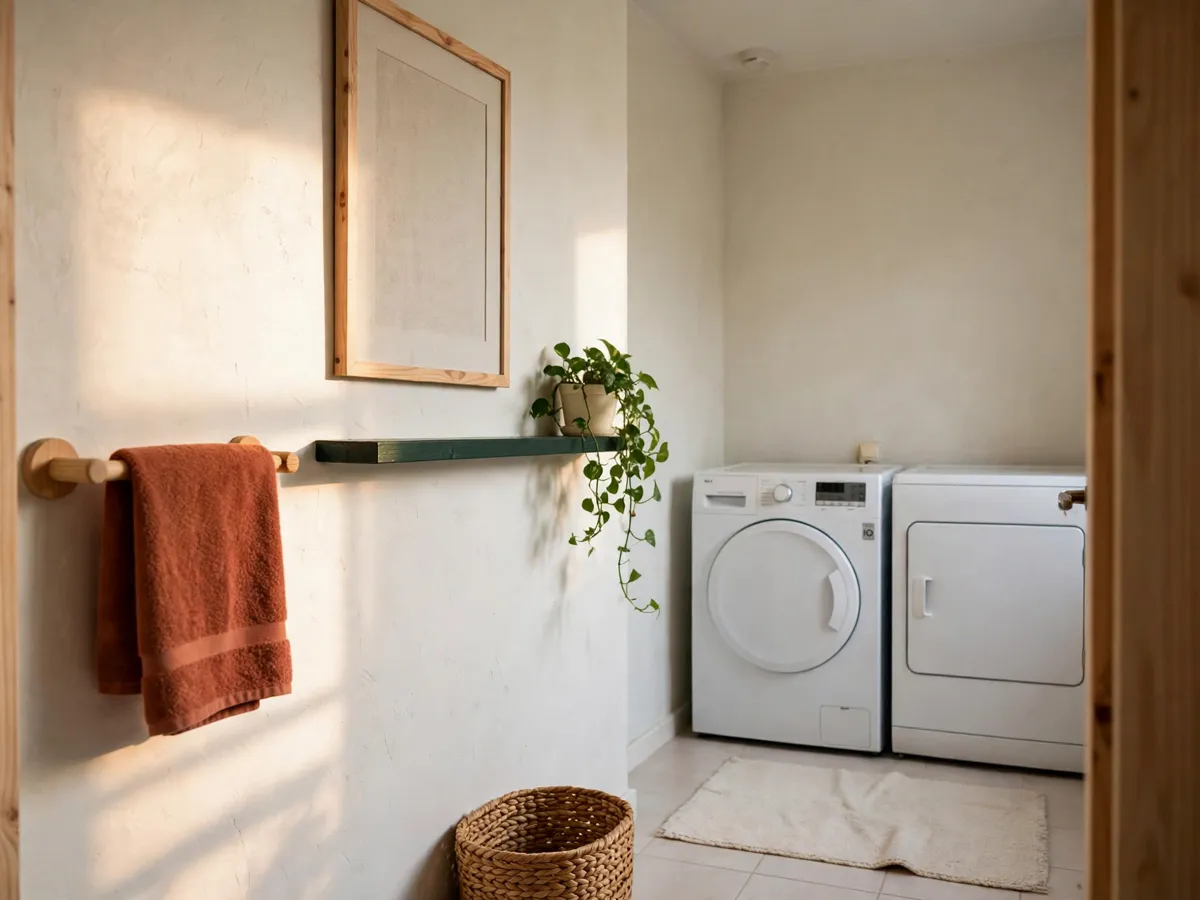
1. Decorate the wall you face, not the wall that is empty
Pick the wrong wall and you spend real money decorating a surface you never look at. Most people pick the emptiest one — usually the wall behind the machines or the strip above the door. Neither is where your eyes are. Your eyes are where your body is while you work.
So the rule is one sentence long. Decorate the wall you are facing when your hands are idle. Fold on the dryer lid and that is the wall in front of the dryer. Fold at a counter or a small table and it is whatever that surface faces. Have no folding surface and you lean against the washer, so it is the wall beside it.
Mime one load before you buy anything. Empty the machine, walk to where you actually fold, fold one shirt there, and notice which wall your eyes stayed on. That is your decor wall.
Why one wall and not three? This room is small, dark, and full of appliances you cannot hide, so every extra decorated surface competes with the first instead of supporting it. One wall done properly reads as a finished room; three walls done thinly read as a storage closet with things stuck on them. It is also the renter’s move — one wall means one set of holes to fill when the lease ends.
Cost: $0. Time: 10 minutes. The caveat: if your folding surface is the washer lid, you are looking down rather than across, so use the wall you face walking out of the room instead.
2. Paint for a damp, warm room: where light earns its keep and where dark is safe
A laundry room is the warmest, dammest, least-ventilated room you will paint. One machine runs wet, the other runs hot, and the door spends most of the day shut. So the finish comes before the color. Choose satin or eggshell — both wipe clean with a damp cloth. Flat paint marks here: a damp sleeve, a wet basket set down, a hand reaching for a shelf.
Then the light, which is the part most decor advice gets backwards. A light wall is not a style choice in here; it is a rationing decision. With no window and one ceiling bulb, the walls are the only thing bouncing that bulb back into the room, and a dark wall eats the light you already barely have. Go light in that room — warm linen, soft cream, pale putty — and keep the ceiling in the same family so the corners do not go muddy.
A dark wall is safe under two conditions. The room has a window, so daylight dilutes the paint through the day instead of fighting a bulb. And the door closes, so the dark reads as a deliberate, enclosed room rather than a gloomy closet you walk past. Meet both and a deep pine looks calm. Miss either one and the room feels smaller and dirtier than before, because a dark wall shows dust and this room makes lint the way a workshop makes sawdust.
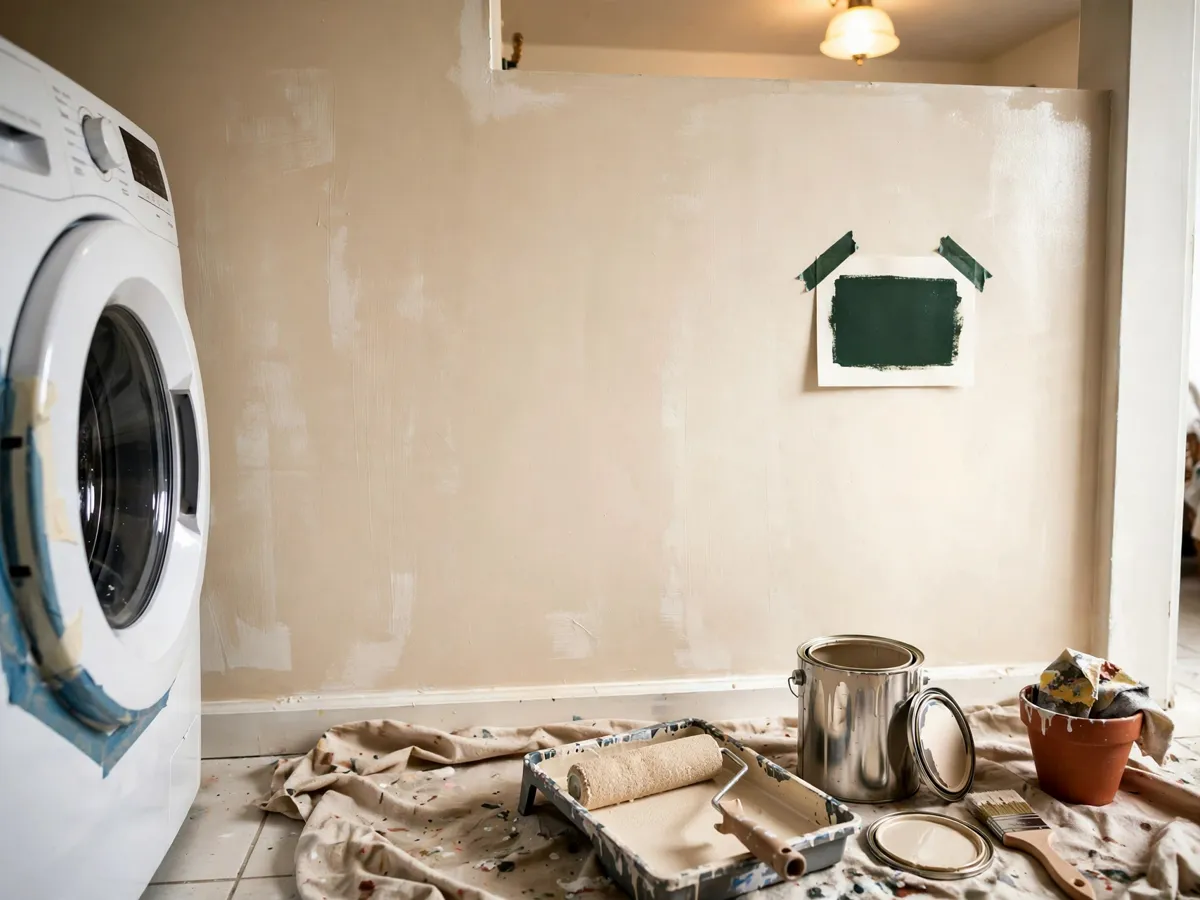
The middle road, and for most renters the right one: keep the walls light and put the dark somewhere small and controllable — the door, the trim, one shelf. One dark object in a light room reads as a decision. One dark room reads as a mistake you live with for a year. Paint your test square on stiff paper rather than on the wall, tape it up, and check it twice: once in daylight, once under that bulb at nine at night.
Cost: $18–$40 for a sampler pot, a small roller and a trim brush; add $30–$60 for a gallon if you are doing the whole wall. Time: 90 minutes plus drying. The caveat: one wall, not four — you can undo one wall in an afternoon and you cannot undo four before a deposit.
3. Wall art that survives humidity, vibration and heat
Everything else here can be swapped in a weekend. Wall art has to survive the room, and this room is hostile: damp on one side, heat on the other, a machine that shakes on every spin. The failure is not that the art looks bad. It is that the print waves, the paper sticks to the glass, and the frame drops off the wall one load later.
So the rule is glazing. Under glass or acrylic a print is sealed from the damp and cannot wave. Skip the card mat — a rag or linen mat holds flat, a plain paper mat browns and ripples. Then seal the back: kraft tape along the rear edges keeps damp air from working in behind the glass, which is where the browning starts.
Now the clearance, because this is where laundry art actually dies. Hang nothing directly above the dryer — it is the hottest surface in the room and it shakes on every load, so a frame over it gets both and its screws work loose in drywall nobody re-tightens. Leave a hand’s width of bare wall between the frame and the top of either machine, and keep it out of the vent path. Too narrow for that clearance? The art goes on the wall you chose in section one, which is exactly why that wall comes first.
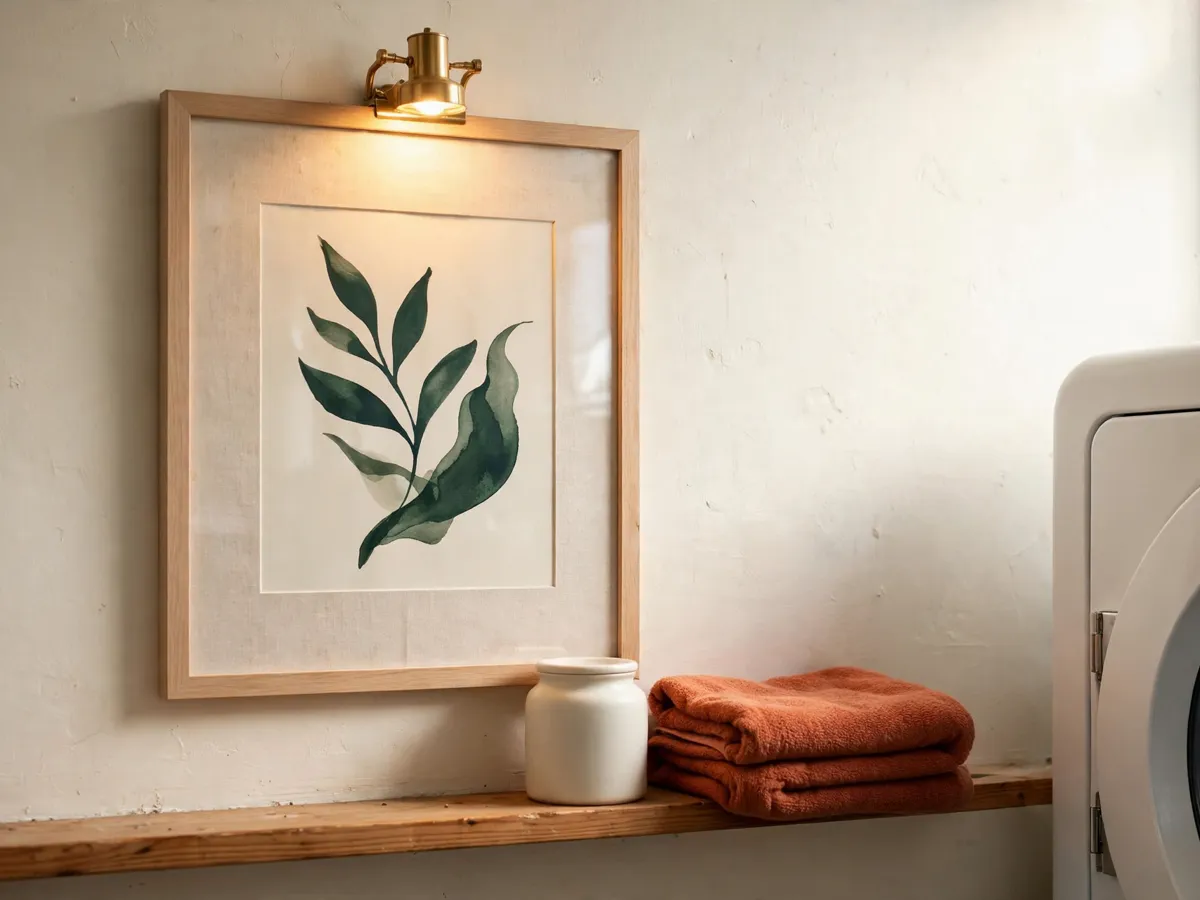
If you want paper, or a print you cannot frame, laminate it. A cold-laminate pouch turns a poster into a wipeable sheet that ignores damp, for less than one frame; mount it on putty so it lifts off clean. What stays out: unframed paper, anything pinned to cork, fabric hangings that collect lint, and any original you would not hang in a bathroom.
Cost: $12–$45 for one glazed frame, or $6–$14 to laminate a print you already own. Time: 45 minutes. The caveat: one good frame on the right wall beats four thin ones, and four thin ones are what make a small room look like a noticeboard.
4. Top loader or front loader: which surface you get to decorate
This sounds like an appliance question. It is a decor question, and it decides how much of the room you get to touch. A front loader gives you a flat vertical face and a wall above it. A top loader gives you a lid, and a lid is a working surface, not a canvas.
With a top loader, the lid swings up and you lean over it to sort, to hand-wash a collar, to fish out the sock that has been there since Tuesday. Nothing goes on top that you cannot move in one second — no tray, no plant, no framed photo lying flat. What you get instead is the front face and the wall behind it, and that wall is usually clear because nothing needs to hang over a lid you open. So decorate vertically: one rail on the front, a shelf or hanging organizer behind. Two top loaders side by side give you two lids and one continuous wall, and that wall is your one wall.
With a front loader, each face is a flat steel panel, and steel takes a magnetic rail. One rail across the dryer front buys a home for the scissors, the stain pen, the lint brush, and a hook for the folding rack — and it slides off in one move when you relocate. A small framed photo on a magnet lives safely at hand height instead of on a wall. What a front loader will not take is anything over the door: it swings or rolls open, and the hinge side is not a shelf.
One limit applies to both. Never cover the machine’s own panel — not the vents, not the controls, not the seam where the door meets the body, and nothing adhesive on the door glass. If hiding the appliances feels necessary, that is a storage problem rather than a style one.
Cost: $10–$28 for one magnetic rail, or $0 if the fronts are steel and you already own a fridge magnet. Time: 15 minutes. The caveat: a rail only holds on steel, so test the front with a magnet you own before buying anything for it.
5. Light and sound: the two that make a room feel finished
Two things make a room read as finished rather than utilitarian, and neither is on the wall: the light you look at, and the noise the room makes while you stand in it. Fix both and a nearly bare room starts feeling designed.
The light first. This room usually runs one ceiling fixture with one cool bulb, and cool light is the fastest way to make a warm-toned room look like a garage. Swap in a warm bulb — 2700K, and read the number on the bulb rather than the word on the box, because brands disagree about the words. If that fixture is the only light and there is no window, add one plug-in layer: a small picture light over the frame from section three, or a clip lamp on the ledge. Two warm sources at two heights reads as designed. One cool source overhead reads as a utility, whatever is on the walls.
The sound second. A laundry room is loud in a specific way: a metal door slamming, a spin cycle humming, a rack rattling against the wall. Soft materials absorb exactly that, and they are also what make the room look finished, so this is one buy doing two jobs. A low-pile rug with a rubber backing. A folded towel in a basket rather than sprawled on a machine. A felt pad on the door frame where the door shuts. You will not silence the dryer; the goal is that the room stops clanging every time you open and close it.
Scent gets one honest line. Do not buy a plug-in air freshener for a room with a dryer vent in it, and do not decorate over a smell coming from the machines — that is a maintenance problem wearing a decor hat.
Cost: $6–$22 for a warm bulb and one plug-in layer; $0 for the door left open while you work. Time: 20 minutes. The caveat: a picture light over a frame in a warm room needs a bulb that stays cool, so an LED there is not optional.
6. The $25 version: three touches that survive a move
If you have one afternoon and twenty-five dollars, skip the paint and skip the frame. Buy three things that travel with you, because in a rental the decor you can carry out the door is the only decor worth buying in a room you will leave behind.
One: a basket with a lid, sized to a load, that holds the daily kit and gets off the floor when you need the floor. Two: a hand towel on a bar, hung where you stand to fold, so something soft sits at the height your eyes are already at. Three: one plant that tolerates low light and warm air — a pothos or a ZZ is the honest answer here — in a plain pot, on the ledge rather than on top of a machine.
And the order matters. Do not buy decorative boxes first, do not buy a matching set, and do not buy art before the wall is clear enough to hang it on. The $25 version of this room is one clear surface, one soft thing, and one living thing.
What those three do not solve is where the detergent lives, how the sorting works, and what you fold on. That is the other half of this room, and it is done properly in the laundry room organization guide: the sort station, the shelf above the machines, the supply zones and the drying rack. Read it before you buy anything decorative, because a beautiful wall above a cluttered machine top is still a cluttered machine top.
Cost: $18–$25 for the basket, the towel and one plant in a plain pot. Time: 60 minutes. The caveat: nothing here is mounted, so all of it comes with you when you move, which is the entire point.
What we would skip
These three look good in a pin and fail in this specific room. Every one ignores damp, heat, or vibration.
- Open shelving above the dryer. The most pinned laundry idea and the worst one for this room. The dryer is the hottest thing in it and it shakes on every load, so the shelf holds dust you cannot wipe off the backs of what stands on it, and the fasteners work loose in drywall nobody re-checks. Want a ledge? Put it on the wall you face while folding, low enough to see behind everything on it.
- A rug with no backing on a floor that gets wet. Laundry floors get wet — a splash at the washer door, a drip from a damp load, the mop that finally reaches this corner. An unbacked rug on tile slides, holds that damp against the floor, and starts smelling within a week. Buy the low-pile version with a rubber backing, or skip the rug and hang a towel on a bar instead.
- Paper prints with no glazing. A bare print hung here waves, browns, and sticks to whatever it touches, because the room is damp on one side and warm on the other. If the frame has no glass or acrylic over the print, it does not belong in this room. Laminate it, or spend the same money on one glazed frame instead of three bare ones.
The pattern: anything that ignores heat, damp or vibration is an idea for a different room. Skipping it is free; undoing it is not.
Cost: $0 to skip, and $30–$90 left in your pocket. Time: 3 minutes to strike them off the list.
Laundry decor checklist: copy this before you start
- Chose the wall you face while folding, not the emptiest wall
- Picked satin or eggshell so the wall wipes clean
- Kept the walls light in a room with no window and one bulb
- Saved a dark wall for a room with a window and a closing door
- Test-painted on paper and checked it under the bulb at night
- Hung art under glass, never bare paper in this room
- Left a hand’s width of wall between frame and machine
- Kept everything out of the dryer vent path
- Put nothing on a lid you have to open, nothing over the panel
- Matched the plan to the machine: rail on a front, wall behind a top loader
- Swapped the cool bulb for a warm one and added one plug-in layer
- Bought the $25 version first: lidded basket, hand towel, one plant
- Left the storage decisions to the organization guide
Cost: $18–$160 depending on how far down the list you go. Time: one afternoon.
Questions people ask about laundry room decor
How do I decorate a laundry room with no window?
Keep the walls light, because in a windowless room the walls do the only light-bouncing available and a dark wall eats it. Satin or eggshell so the paint wipes clean. Swap the cool ceiling bulb for a warm one, add one plug-in layer at a second height, then decorate one wall only — the wall you face while folding.
Is a dark laundry room always a bad idea?
No, but it needs two things: a window, so daylight dilutes the paint instead of fighting a bulb, and a door that closes, so the dark reads as an enclosed, deliberate room rather than a gloomy closet. Miss either one and the room feels smaller and dirtier, because a dark wall shows the dust and lint this room makes. The safer route is light walls with one dark element you control.
What kind of wall art lasts in a laundry room?
Anything under glass or acrylic, with the back sealed, hung with a hand’s width of bare wall between the frame and the top of either machine. Nothing above the dryer, nothing in the vent path. If you cannot frame it, laminate it and mount it on putty. Bare paper, cork boards, fabric hangings and original pieces stay out of this room.
What can I put on top of a washing machine?
On a top loader, nothing you cannot move in one second — the lid opens upward and you lean over it to sort and hand-wash. Use the front face and the wall behind it instead. On a front loader, the steel face takes a magnetic rail, but nothing over the door, and never anything covering the vents, the controls, the door seam or the glass.
Can I do all of this without drilling?
Most of it. The $25 version mounts nothing at all: a lidded basket, a towel on a bar, a plant in a pot. A magnetic rail needs no hole, and a laminated print lifts off clean on putty. The paint is the one decision that is harder to undo in a rental, which is why this page keeps it to one wall and tells you to test on paper first.
Save these on Pinterest
Pin the one-wall rule and the light-versus-dark paint call — those are the two you will need again in the next room. The humidity list in the art section is worth saving too, because it is the one that stops you hanging a print somewhere it will not survive. The rest of the small-space resets live in the Home Organization & Storage collection.