 Plant As Deco
Small Room Decor
Vanity Ideas for a Small Bedroom: The Corner That Gets You Ready
By Plant As Deco · Updated 14 November 2026
A vanity corner is the one square foot in a small bedroom that is only for you, and it earns its space every single morning. The mistake almost everyone makes is buying the vanity first and then hunting for somewhere to put it — by then the only corner left is the one the door swings into. The corner comes first: the patch of floor nobody walks through, near a window if there is one, because a mirror in a dim corner is a mirror you lean toward and squint into. Get the corner honest and the setup itself can be cheap. Some rooms need a piece of furniture; plenty of rooms need nothing more than a mirror hung in the right place and one tray.
Weekend-ready: $30–$200, one afternoon. Measure the corner before buying anything — renter-safe throughout.
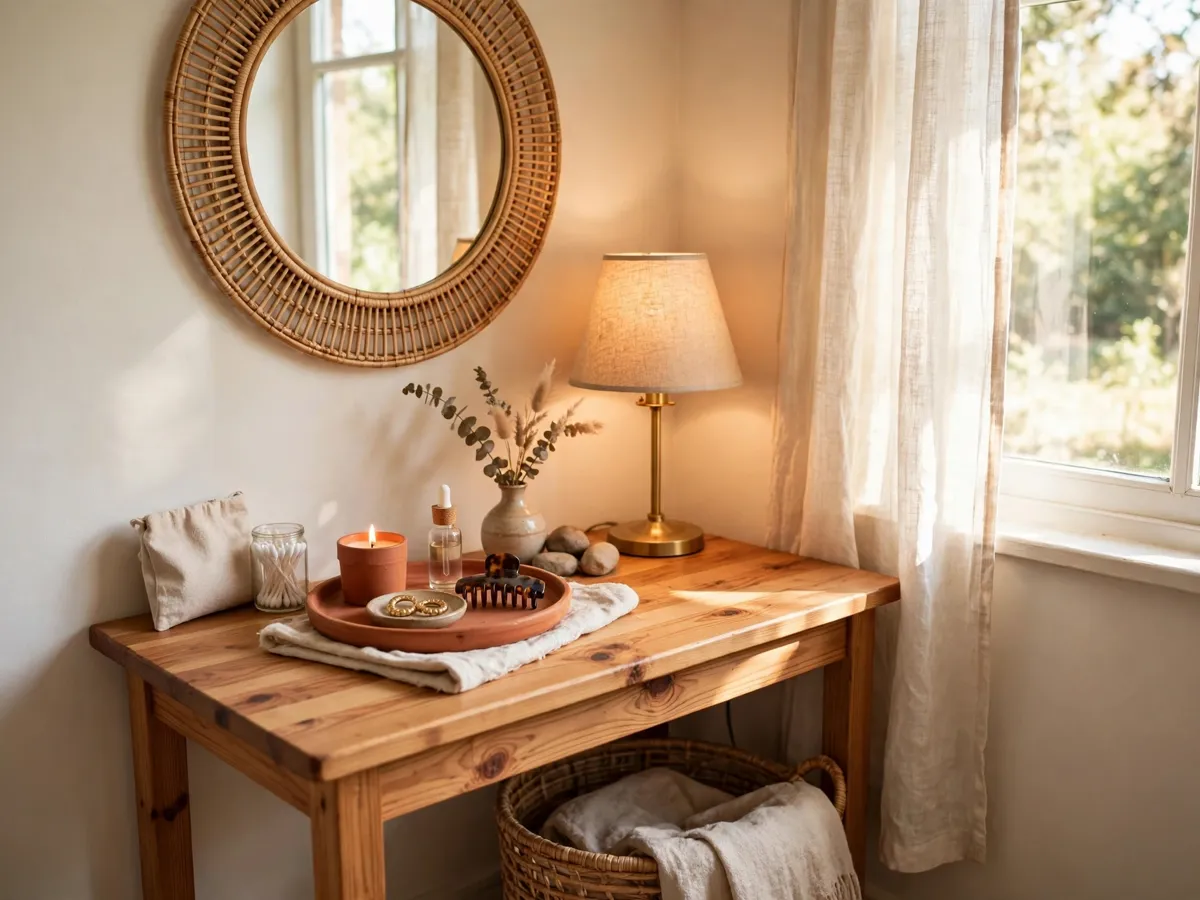
1. Pick the corner nobody walks through
Walk the room the way you actually move through it in the morning: bed to door, door to closet, closet to bathroom. Every corner those paths cross is a corner where a stool becomes something you kick in the dark, and those corners are off the list before any shopping starts. What is left is usually one of two places: the corner beside the window, or the corner on the far side of the bed from the door. The window corner wins whenever it exists, because light arriving from the side of the mirror is what a face actually needs; a vanity placed with its back to the window puts you between the light and the glass, and everything in the mirror ends up in shadow. If the corner has no window, the light has to be brought in, and that is the third section of this page. The same path test decides where a chair survives in the corner seating guide, and how much clearance the bed itself needs is in the bedroom layout guide. Before anything else, measure the winner: the width, the depth, and how far the door swings into it.
Cost: $0. Time: fifteen minutes of walking the paths, before a single purchase.
2. Three setups, picked by the floor space you can give up
The setup follows the depth, and there are three honest tiers. The first tier buys no furniture at all: a mirror hung or leaned above the dresser you already own, with a tray organizer on top holding the daily things. That is a complete vanity — it just lives on furniture that is already in the room, and it costs the price of a mirror and a tray. The second tier gives up zero floor: a floating shelf mounted on the wall with the mirror above it, about ten to twelve inches deep, wide enough for the tray, a cup for brushes and a small lamp. Nothing touches the floor, so the walkway stays exactly as wide as it was, and a stool that lives elsewhere can be carried over for the ten minutes it is needed. The third tier is for a corner that genuinely has around thirty inches to spare: a mini vanity about sixteen inches deep, built like a desk with a drawer under the top. The proportions to shop for are the same ones in the small desk guide, because a vanity that size is a desk with better lighting — the depth, the legroom and the reach all follow the desk rules. Pick the tier the tape measure says, not the tier the photo shows.
Cost: $0 for the dresser route, $40–$80 for the shelf route, $80–$150 for a mini vanity. Time: one afternoon for any of them.
3. The mirror height and the light beside it
Sitting or standing decides how high the mirror goes. A seated routine at a shelf or a mini vanity wants the centre of the glass at seated eye level, which lands around forty-eight to fifty-two inches from the floor for most people — high enough that a whole face fills the mirror instead of a forehead and the ceiling. A standing routine at the dresser wants the centre nearer sixty inches, and a leaning mirror set against the wall handles its own angle. The light matters more than the mirror. Two warm bulbs flanking the glass at face height beat an overhead light and beat a ring light too: side light is what keeps a face looking like a face instead of a product photo, and a ring light in a bedroom announces a studio rather than a room. Any warm bulb works; the layering plan — which light, where, at what hour — is laid out in the warm lighting guide. One more thing the mirror does: it reflects the whole room behind you, so the walls it doubles are part of the corner. Keeping those walls quiet with the ideas in the neutral color scheme guide makes the corner look twice as calm.
Cost: $20–$60 for two bulbs and their mounts, less if a lamp already exists. Time: an hour, after the mirror is up.
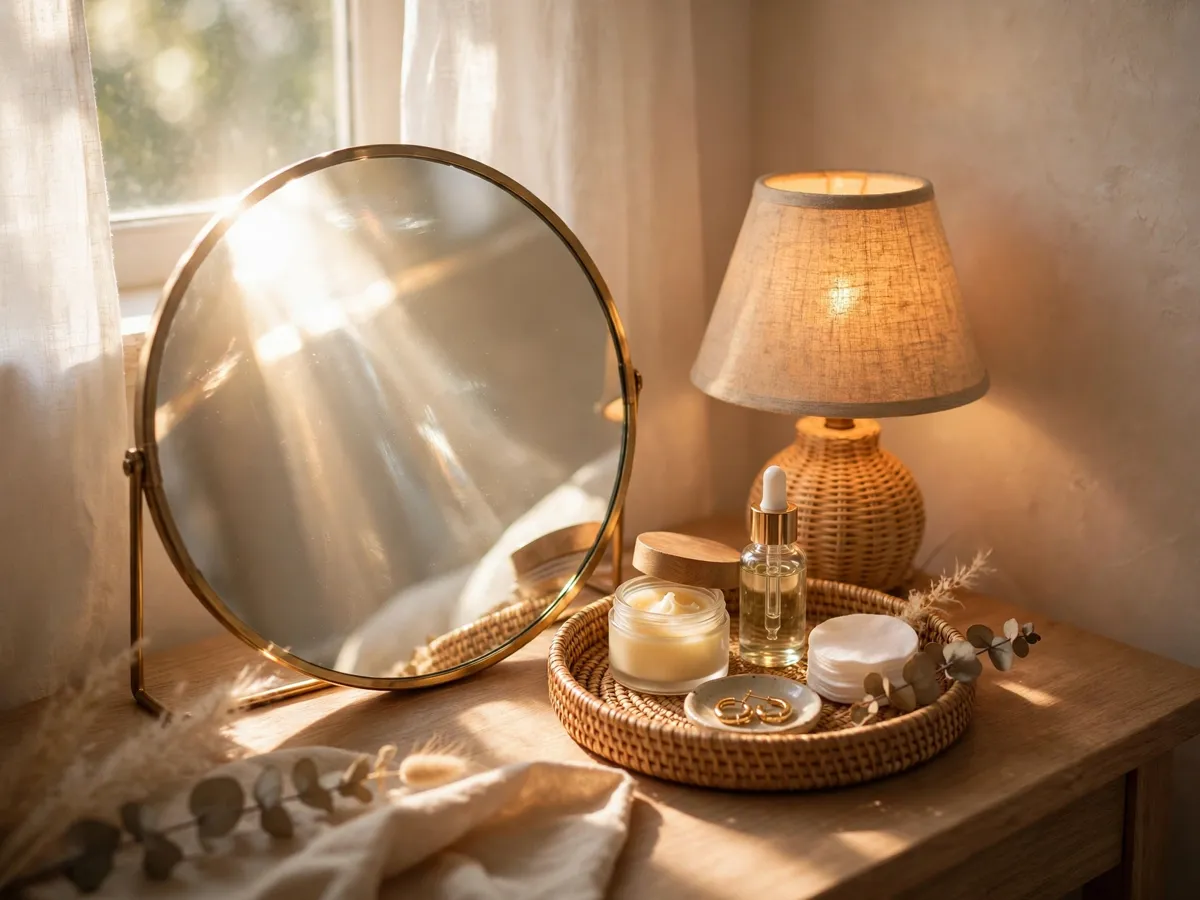
4. Keep it from turning into a shelf
A vanity corner fails slowly. It starts as a mirror and a tray, gains a hair tie, a screwdriver, last month's mail, and within a season it is a shelf with a mirror above it. The fix is the one-tray rule: everything loose lives on that single tray, and when the tray fills up, something leaves the room. Daily things that need hiding get one drawer — a vanity drawer, a dresser drawer, a small box inside it — and that one drawer is the whole allowance. Once a week, take everything off the surface, wipe the glass and the shelf, and put back only what was used that week. Five minutes, and it is the difference between a corner that looks deliberate and a corner that looks accumulated. The stool, if there is one, carries nothing on its seat when the corner is not in use; a stool with a sweater on it is a laundry basket with legs.
Cost: $10-$20 for the tray, $0 for the rule. Time: five minutes a week, every week.
What we would skip
Skip the Hollywood mirror with the bulbs around the frame. The ring of lights glares straight back off the glass, the look belongs to a backstage dressing room rather than a bedroom, and in a small room it dominates whatever corner it lands in. Skip the vanity set that arrives with a wide stool or an upholstered chair — those sets are sized for a room twice this one, and the chair spends its life parked in the walkway. Skip the multi-tier glass shelves too: three tiers of glass in one corner gather dust, crowd the mirror, and display exactly the things that should have gone in the drawer. A mirror, one shelf or tray, and one drawer do the whole job with a quarter of the surface.
Cost: $0. Time: the decisions that keep the corner to one tray.
Honest costs: where the money actually goes
Three routes, priced as they actually land. The dresser route: a round wall mirror at $25–$45, a wooden tray at $10–$15, adhesive hooks if the lease says no holes — $35–$60 total, on furniture you already own. The wall-mount route: a floating shelf and its brackets at $40–$70, a mirror at $30–$60, two wall lights or bulbs at $20–$40, and the hardware if the wall takes it — call it $90–$160, and the walkway stays untouched, which is the whole point of this route. The mini-vanity route: a sixteen-inch vanity or small desk at $80–$150, a stool at $25–$40, a lamp at $15–$30, landing at $120–$220 with the tray. Whichever route the tape measure picks, buy the mirror last; the mirror size follows the wall space and the stool, and the mirror is the piece that gets returned when it is bought first.
Cost: $30–$200 across the three routes. Time: one afternoon for any of them.
Before anything goes on the wall: copy this
- The corner picked from the walking paths, with the door swing checked
- The depth measured: zero, twelve, or thirty inches of floor to spend
- The mirror centre marked at eye level for the routine you actually have
- Two warm lights at face height, never one overhead
- One tray for everything loose, one drawer for the daily things
Cost: $0 to check. Time: fifteen minutes, before the first purchase.
Questions renters ask
Which corner should a small bedroom vanity go in?
The corner the morning paths never cross — usually the corner by the window, or the far corner of the bed on the wall away from the door. Any corner sitting between the bed and the door turns the stool into something you kick on the way to the bathroom.
What if there is no floor space for a vanity at all?
Then the vanity goes vertical. A mirror hung above the dresser with a tray on top of the dresser is a complete setup, and a floating shelf with a mirror above it gives the same routine without giving up a single floor inch. The stool can live somewhere else and come over when it is needed.
How high should the mirror hang over a vanity?
Centre the glass at eye level for how the corner gets used: around forty-eight to fifty-two inches from the floor if you sit at it, closer to sixty if you stand at a dresser. The number is measured to the centre of the mirror, not to the hook.
Can I set up a vanity without drilling into the walls?
Yes, along the whole route. A leaning mirror needs no holes, adhesive strips hold a light frame within the weight limit printed on the packet, a freestanding shelf replaces the floating one, and a plug-in sconce or a small lamp replaces the wall light. Only the drilled shelf is off the menu, and it is the least important piece of the setup.
Save these on Pinterest
Pin the one-tray rule first — it is the line between a vanity corner and a shelf with a mirror over it. The lighting plan that makes the corner usable before the sun is up is in the warm lighting guide, the furniture proportions for a mini vanity come from the small desk guide, and the corner test that starts all of it is in the corner seating guide. All of them sit in the Small Room Decor collection for the next corner the room frees up.