 Plant As Deco
Small Room Decor
Wall Decor Above the Bed: What Actually Works There
By Plant As Deco · Updated 14 November 2026
The wall above a headboard is the most looked-at wall in a small bedroom and the least forgiving one, because whatever hangs there hangs over your head while you sleep. That single fact narrows the choice more than any style question does: the decor has to hold its weight, survive a knocked headboard, and still look deliberate from the pillow. Most bedrooms get it wrong in one of two directions — a cluster of small things that read as clutter, or one oversized bargain piece held up by hope. This page is about the middle ground: the forms that reliably work above a bed, the no-drill options when the wall cannot take a nail, and the pieces to walk past entirely.
Weekend-ready: $25–$200, one weekend. Nothing structural — renter-safe throughout.
1. Three forms hold up over a bed
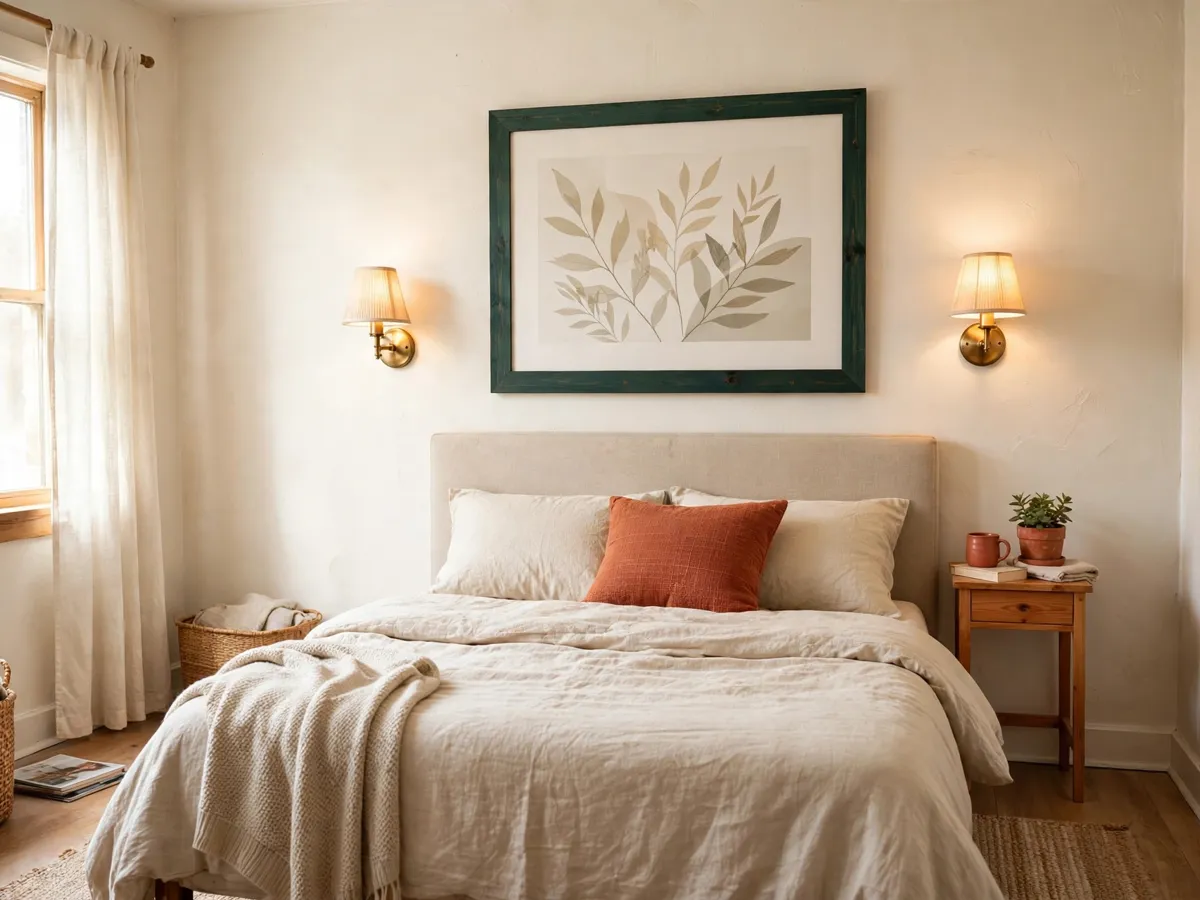
The first is a single large piece — one framed print, canvas or woven wall hanging, centered on the headboard and running about two thirds of its width. The math is the same reason a large rug makes a small room look bigger: one object reads as calm, and the wall behind the bed is the one place in a small bedroom where calm pays twice, because the bed is already the busiest thing in the room. Pick the piece first at the size the wall wants, then hang it — not the reverse, which is how bedrooms end up with three small frames patching the space one oversized print should have filled.
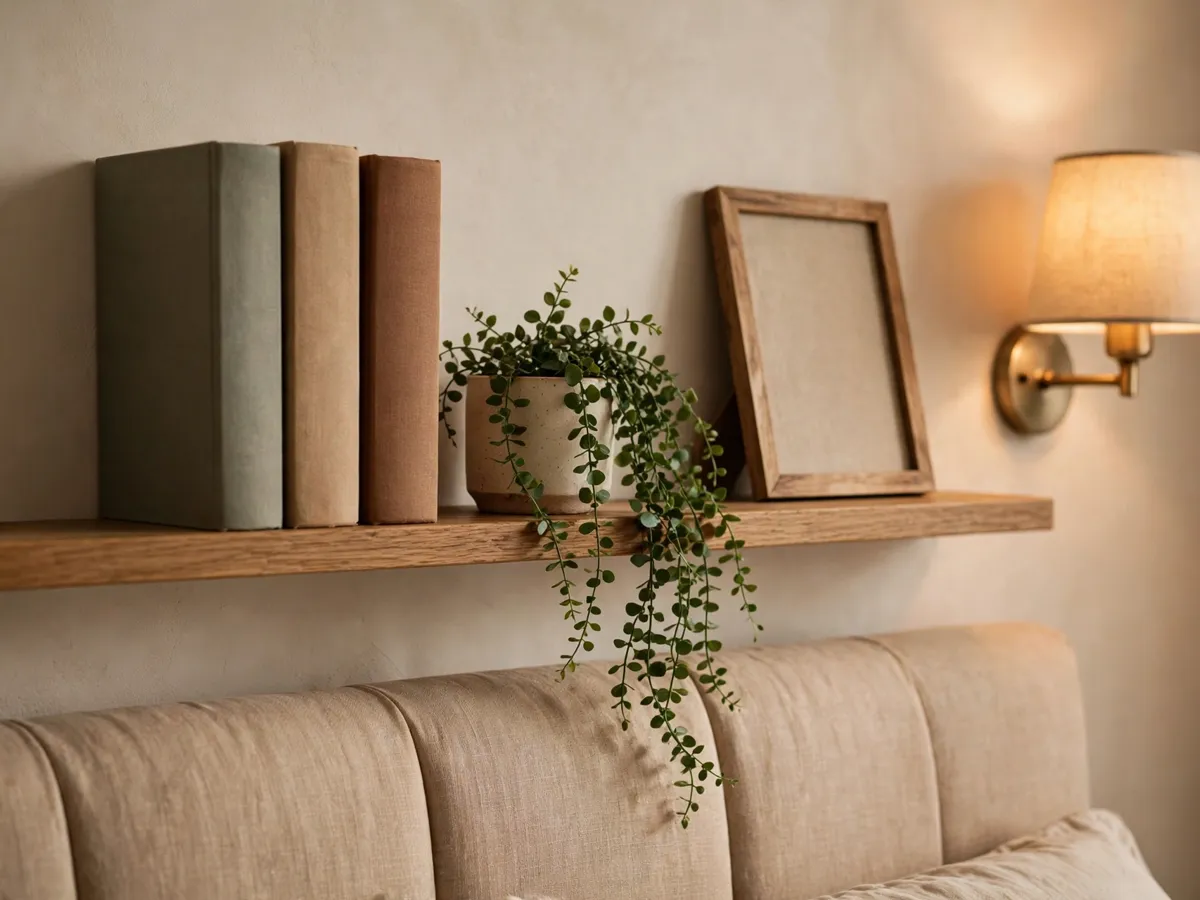
The second is a matched vertical pair: two identical frames, hung one above the other on the headboard's center line. This is the form for a tall narrow wall or a low headboard, because it stacks the interest vertically without spreading sideways past the bed, and the matching frames do the quiet work a gallery does with none of the layout decisions — which live in the gallery wall guide if that route ever calls. The third is a thin wood shelf, mounted level above the headboard, holding a short row of standing things: a few books, a small plant, one small frame leaned against the wall. The shelf turns decor into something you can rearrange from the bed, which is the whole reason it survives years while a hung arrangement stays frozen.
Whichever form you pick, the height is one sentence: the gap from the top of the headboard to the bottom of the piece runs six to eight inches, with the center of the whole arrangement at fifty-seven inches from the floor — the full measuring walk-through, including the paper template, is in the hanging height guide.
Cost: $20–$90 for the piece or the pair, $25–$60 for the shelf. Time: half an hour to hang, and the bed stays in its final spot.
2. The no-drill route for rentals
When the wall cannot take a nail, the strongest option is the leaning mirror: a tall mirror standing on the floor behind the headboard, tipped back to rest on the wall. It covers the whole headboard wall with one object, its weight rides on the floor instead of the wall, and it gives a small bedroom the depth a flat print cannot — the room reflects itself and reads twice its size. Bed the mirror feet on a folded towel so it cannot skate on hard floors, and pull the headboard back to touch the frame so nothing rocks between them.
The second no-drill option is a large woven textile — a heavy macramé or a proper woven tapestry — hung from a single adhesive hook or a tension rod set inside the window reveal when one sits behind the bed. A textile weighs almost nothing, so it is the one thing above a bed whose worst case is landing softly on the duvet. The third is light frames on self-adhesive strips, and the strip packet is the honest limit: a frame under the rated weight, pressed on for the full thirty seconds, holds for years, while a glass frame nudged past the rating does not. The full hardware walk-through, including the strips worth buying, is in the no-drill wall guide.
Cost: $0–$120 for the mirror route, $30–$80 for a woven textile, $10–$15 for strips. Time: an hour, and nothing to patch at move-out.
3. What slips at 2 a.m.
Some pieces fail specifically over a bed, and the pattern is always the same: the headboard takes a knock, the wall takes the vibration, and the fixture that was fine on a hallway wall lets go. Floating shelves are the leading case — the adhesive-mounted ones and the under-anchored ones both walk out of level over months, and a shelf that tilts two degrees over a sleeping head is a shelf planning its exit. If the shelf is the form you want, screw it into a stud or proper wall anchors, use the bracket screws that came in the box, and level it twice.
Frames on generic double-sided foam tape are the second case, because foam tape ages warm, and the wall above a bed is the warmest wall in the room. The strips rated for framed art hold; the tape from the drawer does not, and the difference announces itself at night. The third case is the thin printed sheet sold as a tapestry — the sheer white polyester one with a printed pattern. It is too light to hang flat, so it lifts at the edges every time the door moves air, and within a season it reads as a bedsheet pinned to the wall rather than decor. A real woven piece has the weight to fall straight and stay put; the printed sheet never does. When a frame does come down over a bed, the fix is two D-rings and the height re-checked against the hanging height guide, because re-hanging at the old mark repeats the old mistake.
Cost: $5–$15 for proper anchors and strips. Time: 20 minutes, and it is 20 minutes spent once.
4. The headboard wall that works built in
The strongest version of this wall stops hanging things on it and builds the decor in. A wall sconce mounted on either side of the headboard, at reading height, replaces the two bedside lamps that eat the nightstands — the cord-in-wall versions need an electrician, but the plug-in swing-arm ones clip to a bracket and take an afternoon. The light lands exactly where a book is held, the wall above the bed stays clear, and the pair of sconces becomes the decor. What sits under them, and how narrow a nightstand the swap allows, is laid out in the nightstand guide.
The second built-in move is the headboard with shelves — a low bookcase headboard, or a shallow shelf unit straddling the bed — which puts the standing objects at hand height and leaves the wall itself blank. Where drilling is off the table entirely, a thin wood panel leaned behind the headboard does the same job: it reads as a finished headboard wall and takes the sconce brackets or a leaning mirror on its face. And when the wall above the bed stays empty on purpose, the wall itself can carry the room — the paint route is in the accent wall guide and the peel-and-stick route, including the patterns that suit a low ceiling, is in the renter wallpaper guide.
Cost: $40–$90 for a plug-in sconce pair, $60–$150 for a shelf headboard. Time: an afternoon per piece, and no frame over your head at all.
What we would skip
Skip the 3D wooden name or sign — your own initials in chunky letters above your own head is the piece that dates a bedroom fastest, and it is the heaviest object per square inch on this list. Skip the big-letter quote decal, because a whole sentence in vinyl on the wall behind the bed gives the room nothing to rest on and peels at the edges within a year. Skip the scatter of four-plus small frames: above a bed, small things multiply visually and the wall reads nervous where it should read calm — one large piece or one matched pair does the same job with a tenth of the decisions. And skip any heavy shelf that goes up without wall anchors, whatever the listing picture shows; a shelf over a bed is either anchored or it is a countdown.
Cost: $0. Time: the decisions made before anything goes over the bed.
Honest costs: where the money actually goes
Rearrange-only route: $0, one afternoon, and the wall reads calmer the moment the scatter of small frames comes down — a bedroom with a bare headboard wall is a finished look in a way most people do not expect. The honest middle route runs $25–$90: one large unframed canvas or print, or a pair of matching frames, plus the hanging hardware, and the wall is done in half an hour. The full route — leaning mirror or woven textile, or the sconce pair plus shelf — lands at $90–$200, and that is the ceiling for a small bedroom; above it you are buying furniture, not decor. Secondhand frames are the quiet bargain here, because a large frame is wood and glass that outlives whatever print it came with, and the print is the cheap half to replace.
Cost: $25–$200 all-in. Time: one weekend, and the test is lying down and looking up.
Before anything goes over your head: copy this
- One form only: a single large piece, a matched vertical pair, or a level thin shelf
- The piece runs about two thirds of the headboard width, six to eight inches above it
- Screws into a stud or rated anchors for anything with weight; strips only under their rated load
- No-drill wall: leaning mirror or heavy woven textile before a light frame
- Check the whole wall once from the pillow, not just once from the door
Cost: $0 to check. Time: 15 minutes, before the first hole.
Questions renters ask
What wall decor will not fall on me while I sleep?
A heavy woven textile hung from a single hook, a large light piece on two screws in a stud, or a leaning mirror whose weight rides the floor. The failures all share a cause: adhesive doing a screw's job, or a shelf that skipped its anchors. Match the fixture to the weight and the wall, and the piece stays where it went up.
Is a mirror above the bed bad luck?
Luck is not the useful way to decide it. The practical case is weight and light: a hung mirror is heavy glass riding on two points over your head, so if you want one, lean it on the floor behind the headboard instead, where the weight sits on the ground. Light is the second half — a mirror facing a window throws a moving glow across the bed at night, and across from a lamp it doubles the brightness in exactly the place you are trying to dim. Either way, the answer is physics, not folklore.
Is a tapestry above the bed a good idea?
A real woven one, yes — it weighs almost nothing, hangs from one hook, softens the wall behind the headboard, and its worst failure mode is landing on the duvet. The thin printed polyester sheet is the version to skip: it is too light to hang flat, lifts with every draft, and reads as fabric pinned to a wall within a season.
Are shelves above the bed safe?
Yes, when they are screwed into a stud or proper wall anchors and hold light standing things — a few paperbacks, a small plant, a leaned frame. The unsafe version is the adhesive-mounted shelf or the bracket-free one carrying books, glassware or anything with real mass. And the sitting-up test is part of safety: if your head can reach the shelf edge from the pillow, raise the shelf or lose it.
Save these on Pinterest
Pin the three-forms step first, because choosing the form is the decision every other one follows from. The height math that hangs whatever you choose is in the hanging height guide, and the no-drill hardware for a rental wall is in the no-drill wall guide. Both sit in the Small Room Decor collection for the next wall you dress.