 Plant As Deco
DIY Home Projects
Couch Reupholstery: Fabric Math, Cushions and When to Call a Pro
By Plant As Deco · Updated 22 November 2026
A couch that fits the room but fights the color scheme does not have to be replaced. It needs one of four recoveries, and which one depends on the frame under the fabric, the yardage budget and how much sewing sounds like a good weekend. This guide walks the whole ladder, with the fabric arithmetic shown and the pro fork marked plainly.
Weekend-ready: $150–$380 for the mid path (new cushion covers plus a cleaned frame), one weekend. The clean-only refresh is $10–$25; the full recover is a different decision, covered in section 11.
1. Recover or replace: the fork comes first
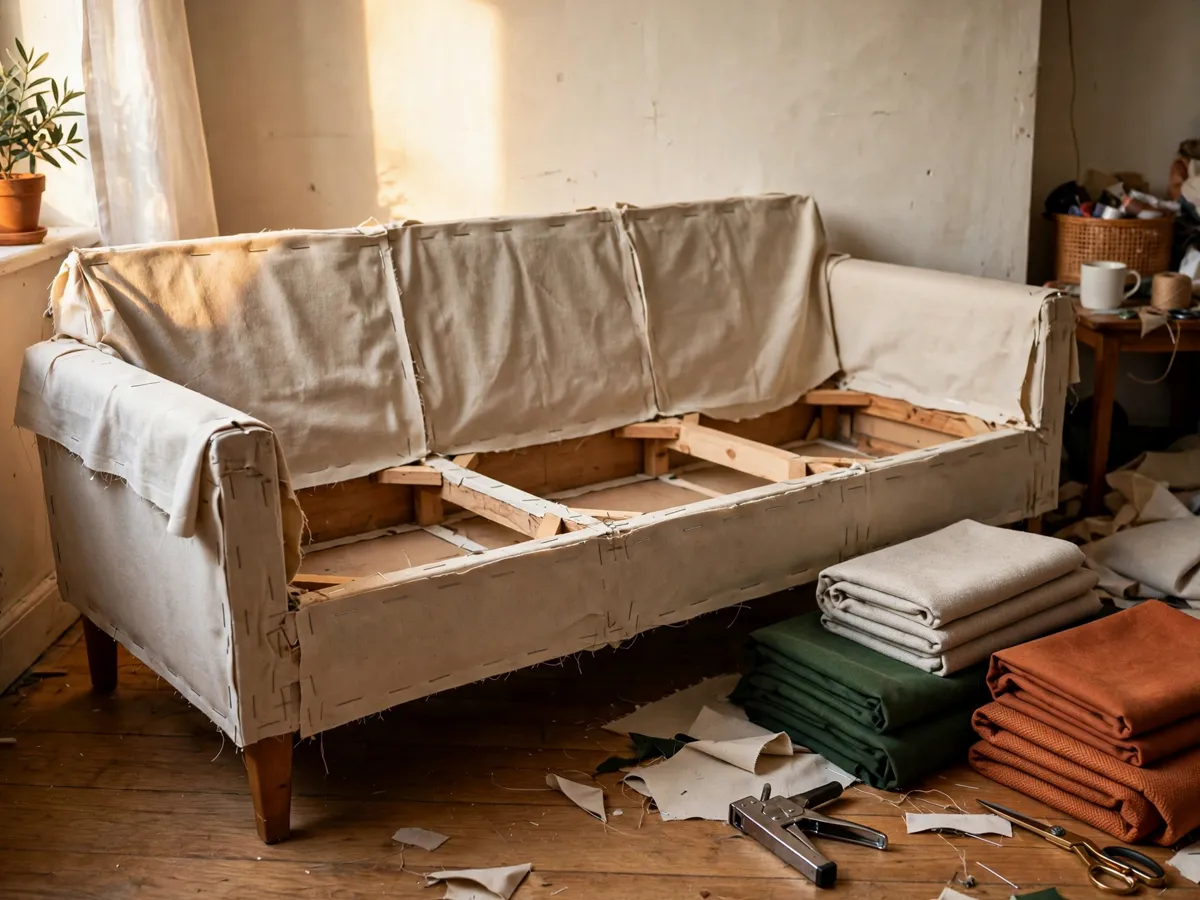
Reupholstery spends money on fabric and hours on labor, so judge the frame first. The fabric on a cheap couch is the cheap part. A couch worth recovering is one whose skeleton would cost real money to buy again.
- Weight. Lift one end. A hardwood frame takes effort; a foam-block or particleboard couch lifts easily with one hand. Heavy bones are the first sign the piece is worth fabric.
- Springs. Take a seat cushion off and look at the deck. Coil springs tied with twine at eight points each (eight-way hand-tied) sit at the top of the ladder. Zigzag sinuous wire is the middle. A flat foam slab over a webbing grid is the bottom, and a bottom-tier deck is rarely worth recovering.
- Joinery. Tip the couch and look at a corner. Corner blocks, dowels and screws mean a frame built to be re-covered more than once. Staples and glue on particleboard mean a frame built to be replaced.
The math at a glance: a clean-only refresh is $10–$25 and an hour; a slipcover is $60–$250 with no sewing; the cushion re-cover is about 6.25 yards, $150–$380, one weekend. A full reupholstery is 12 to 18 yards plain (15 to 25 or more with patterns), 20 to 40 hours of labor, and usually a decision about a professional, which section 11 settles with numbers.
When replacing simply wins: the couch cost around $300 new, the deck is a foam block, and an equivalent replacement costs less than the fabric alone. Also replace when the frame is cracked or wobbling, or the piece will be left behind in a move within the year. Fabric is an investment in a frame, and investments want a stay.
Cost: $0 to run the frame test. Time: 10 minutes, plus the effort of tipping one end of the couch. One caveat: judge springs and joinery from two corners, because mass-market couches mix good and cheap parts in the same piece.
2. The method ladder, easiest to hardest
Most couches people want to "reupholster" actually need a lower rung, and starting one rung too high is the most expensive mistake in this guide. Climb in order and stop at the first rung that solves the actual problem.
- Rung 1, the clean-only refresh. Vacuum, spot-clean, treat the whole couch once. Solves dinginess, odor, dust. $10–$25 and one to two hours. Zero skill, zero risk.
- Rung 2, the washable slipcover. A fitted cover in fabric you can actually launder, cut to your couch's measurements. Solves wrong color, uncleanable fabric, pets. $60–$250, an hour of measuring and ordering, no sewing.
- Rung 3, re-cover the cushions only. New permanent covers for the loose seat and back cushions plus a deep-cleaned frame. Solves worn or dated cushions on a good frame. About 6.25 yards, $150–$380, one weekend, straight-line sewing.
- Rung 4, full reupholstery. Strip the couch to the frame, replace batting and foam, pull new fabric over every panel. Solves everything, including torn arms and sagging decks. 12 to 18 yards (more with patterns), 20 to 40 hours, and a real decision about hiring it out.
Rungs stack, they do not exclude. A rung 3 re-cover on a freshly cleaned frame reads as close to a new couch as anyone but the owner can tell, at a fifth of the fabric of a full recover, and the measuring discipline of rungs 2 and 3 is the same discipline rung 4 demands, on more panels.
Cost: $0 to choose the rung. Time: 15 minutes with the couch and a notepad. One caveat: pick the rung that matches the frame verdict from section 1, because a $380 cushion job on a foam-block frame is money the couch cannot pay back.
3. Fabric choices, honestly
Two numbers decide a fabric: weight and wear. Weight first. A couch takes upholstery-weight fabric, the heavy rolls meant to be pulled taut and sat on. Apparel and drapery weights are lighter, and on a seat they pill, shine and wear through at the front edge within a season or two. When in doubt, the weight in the hand settles it.
Wear is rated with a double-rub count. The test rubs a cotton pad back and forth across the fabric, and one back-and-forth is one double rub, so higher means more abuse before the surface shows it. An everyday couch lives comfortably in the 15,000 to 30,000 zone, where most mid-priced upholstery rolls sit. Use the count to compare, not to shop by a single number.
Patterns cost more than looks. A patterned roll has a repeat, the vertical distance before the design starts over, and every cut has to start at the same point in that repeat so cushions match. On the worked example, a plain fabric needs 5.5 yards net and a 12-inch repeat pushes that to 8.17. Stripes behave like small patterns and plaids like large ones.
Velvet and pile fabrics have a nap, so every piece has to be cut running the same direction or two cushions read as two colors. Performance weaves, the stain-resistant synthetics sold for families and pets, clean up well and skip the dry-clean-only care label, which matters most at rung 3, where the covers you sew are the covers you live with.
Cost: $18–$45 per yard for honest upholstery weight at the mid-price tier. Time: 20 minutes of label reading per roll. One caveat: a sale bin of drapery-weight fabric at half the price is still the wrong buy for a seat cushion.
4. Fabric math, step by step
Upholstery fabric is sold by the yard, cut from a roll 54 inches wide, and every yardage mistake traces to the same error: guessing from the couch's outside dimensions instead of listing the pieces. The honest method is four rules and a sum.
- List every piece. A cushion cover is three pieces: a top panel, a bottom panel, and a boxing strip that runs around the edge and gives the cushion its depth. A cushion 36 by 24 inches means two panels plus one strip, not "a square of fabric."
- Add 2 inches to every dimension of every piece.Seam allowance at each edge plus a little ease so the cover pulls over the foam. A 36 by 24 panel is cut 38 by 26.
- Cut boxing crosswise and join it. Boxing runs the long way around a cushion, longer than the roll is wide, so it is cut across the 54-inch width in pieces and joined end to end. Count on losing about 2 inches at every join.
- Add 10 percent at the very end. Not per piece, once, on the total. This is the shrink, the miscut and the seam you sew twice.
The worked example, the mid path: a generic three-seat couch with two loose seat cushions, each 36 inches wide by 24 inches deep by 5 inches thick (the pair makes a 72-inch seat run), and two back cushions, each 24 by 20 by 5.
One seat cushion. Top and bottom panels, each cut 38 by 26 (36 plus 2, 24 plus 2). Nested side by side across the roll, 26 plus 26 is 52, which fits the 54-inch width, so the pair uses 38 inches of roll length. Boxing: 2 x (36 + 24) + 2 = 122 inches long, cut 7 inches wide (5 plus 2). Two 54-inch strips joined give 106 usable inches, not enough; three give 158. So three strips, stacked 3 x 7 = 21 inches. The cushion totals 38 + 21 = 59 inches of a 54-inch roll.
One back cushion. Panels cut 26 by 22, nested 44 across, so 26 inches of length. Boxing: 2 x (24 + 20) + 2 = 90 inches; two strips give 106 usable, so two strips, stacked 14 inches. The cushion totals 26 + 14 = 40 inches.
The sum: 2 x 59 + 2 x 40 = 198 inches of 54-inch fabric, which is 5.5 yards net. Add the 10 percent for 6.05 and round up to the quarter-yard increments fabric is cut in: buy 6.25 yards, or 6.5 for one spare panel's worth of slack.
The same couch with a 12-inch repeat: the eight panels each need one full repeat added so every cut begins at the same point in the design, 8 x 12 = 96 inches, about 2.67 yards more. Net becomes 198 + 96 = 294 inches = 8.17 yards, plus 10 percent is 8.98, so buy 9 yards. And if the couch has a single bench cushion 24 by 72 instead of two seat cushions, the arithmetic shifts only at the edges: boxing 2 x (24 + 72) + 2 = 196 inches needs four strips, 102 inches for that cushion against the pair's 118, so a single bench saves nearly half a yard.
Cost: $0 and a tape measure; 6.25 yards at $18–$45 is $112–$281. Time: 30 minutes to measure and list every piece. One caveat: measure the cushions as they are, seams and all, and write each number down twice, because the memory of "about 24 inches" is where yardage math goes wrong.
5. The detach-and-wash trap
Many couches have cushion covers with zippers, and the zipper suggests a wash. This is the most common way a recover project becomes a replacement project, because of how those covers are made.
A factory zip-off cover is cut to fit fabric that has never been washed, pulled over the cushion with exactly the tension the shape needs. Machine washing shrinks the fabric, and a cover that comes out of the dryer even a little smaller than the foam it was cut for will not go back on. Not "goes on with effort." Will not go on, because there is no excess in the cut to give. The zipper is there for the factory's assembly line, not for your laundry.
The honest routine is spot-cleaning. Vacuum the cushion first with the upholstery brush, which removes the grit that otherwise grinds into the weave when rubbed. Mix a drop of mild dish detergent in warm water, dampen (never soak) a microfiber cloth, and blot the soiled area from the outside edge inward so the ring does not spread. Rinse the cloth, blot with clean water, press a dry towel in, and let the cushion air dry fully before anyone sits on it.
When the real wish is a couch you can wash, the honest answer is the slipcover, rung 2. A slipcover is cut with more fabric than the cushion needs, sewn in a washable upholstery weight, laundered before it is sewn so the shrink already happened, and it comes off and back on. If you sew your own at rung 3, that pre-wash rule is the whole trick: wash and dry the fabric before cutting anything. The no-sew pillow cover guide shows the same spot-clean-versus-wash thinking on a smaller piece.
Cost: $5–$10 in detergent and microfiber cloths. Time: 15 minutes per cushion to spot-clean, plus drying. One caveat: test the detergent mix on the zipper placket or under a cushion first, because some upholstery dyes water-mark even when the care label allows cleaning.
6. The mid path: new cushion covers in one weekend
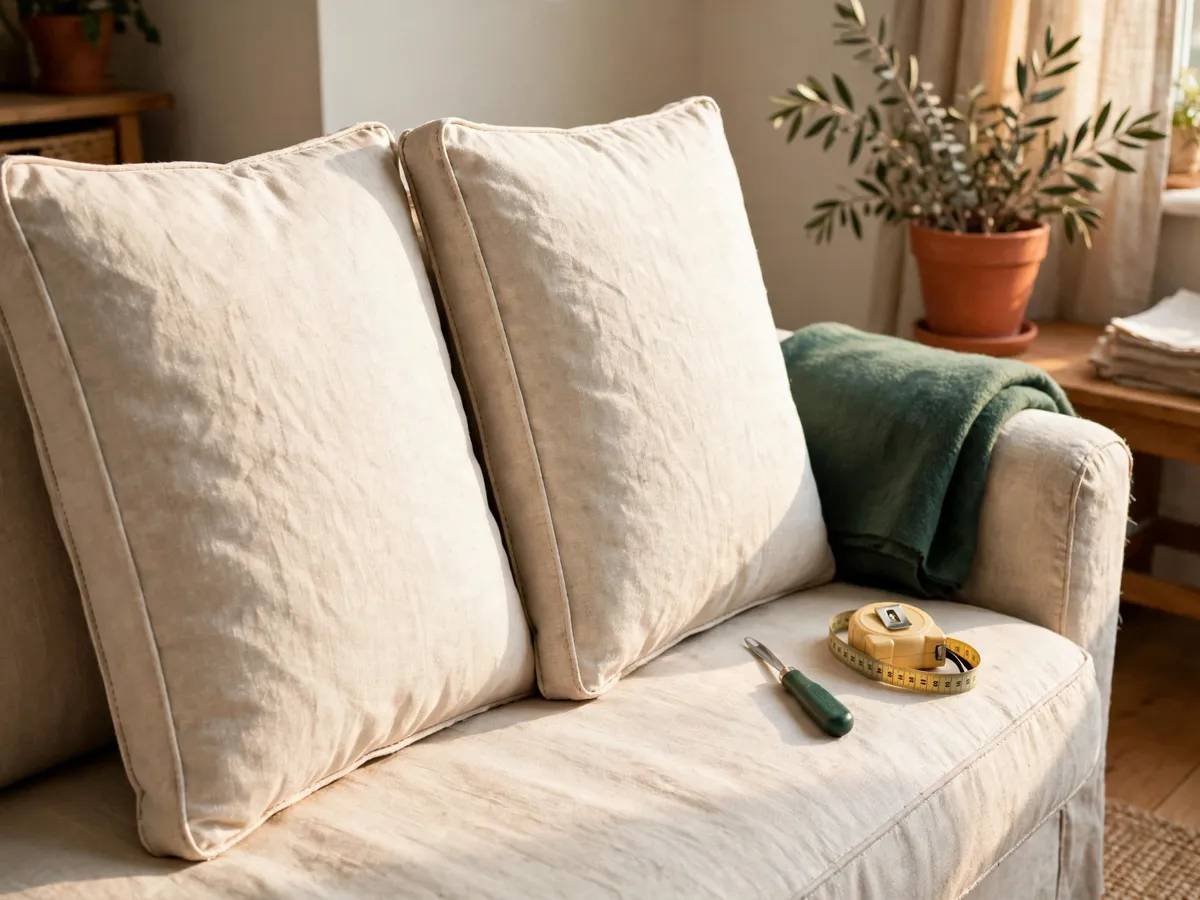
This is the rung this guide recommends first for a couch with good bones and tired cushions: new permanent covers on the loose seat and back cushions, plus a cleaned frame. It needs a sewing machine that straight-stitches, a seam ripper and one weekend. Saturday is demolition and cutting, Sunday is sewing and fitting.
- Take the old covers off and keep them. Open the seams with a seam ripper, working from the inside so the show face stays intact. The old cover is a proven pattern: it already fits this foam. Mark the top, the front edge and the grain direction on each piece as it comes apart.
- Lay the old pieces on the new fabric as templates.Add the 2 inches per dimension from section 4, align the grain the same way, and add a full repeat per panel if the fabric is patterned. Cut with fabric shears, not scissors from the junk drawer, because a wandering edge shows on every seam.
- Pin-fit before sewing. Wrap the new top panel and boxing around the bare foam with upholstery pins, wrong sides out, and adjust until the fit is snug. A cover sewn from an accurate flat pattern still benefits from one live check; foam varies, and this is the step that catches it.
- Sew the boxing between the panels. Straight seams, a half-inch allowance, the boxing sandwiched between top and bottom. At the corners, clip into the boxing's seam allowance and ease it around the curve so it lies flat rather than bunching.
- Close with a zipper or an envelope back. A zipper in the boxing (sewn with a zipper foot) makes the next recover a ten-minute job instead of a seam-ripper job. An envelope back, two overlapping panels, needs no zipper and still comes off, and it is the beginner's friend.
Clean the frame while the covers are off: vacuum the deck, spot-clean the fixed fabric as section 5 describes, and check the cushion foam. Foam that has gone flat or crumbles at a corner is the real reason the couch reads tired, and replacing it is a cut-to-size order, not a skill. The straight-seam discipline here is the same one the tote bag sewing pattern builds, on shapes with less consequence.
Cost: $150–$380, fabric and thread at the honest mid-price range, assuming a borrowed machine. Time: two afternoons, about 8 hours for four cushions. One caveat: sew one cushion completely and put it on the couch before cutting the second cushion's panels, because any fitting error repeats four times if you batch everything.
7. The deep path: full reupholstery
A full recover strips the couch to its frame and rebuilds every layer. It is 12 to 18 yards plain, 15 to 25 or more with patterns and piping, and 20 to 40 hours for someone practiced, which realistically doubles for a first time. What follows is the shape of the job, so the decision in section 11 is informed.
- Strip in reverse, and photograph every layer.A couch is upholstered inside-out: inside arms first, then the deck, then outside arms, back, and the dust cover last. Removal goes in the opposite order. Photograph each layer before it comes off, number the old panels as they come free, and keep them: every old piece is the template for its replacement.
- Rebuild the padding. This is the once-a-decade chance to replace flattened batting and dead foam. New batting wraps the arms and back; new seat foam, cut a touch oversize so the cover tensions it, restores the sit. This layer does more for comfort than any fabric.
- Cut and sew the new panels. Old panels as templates, 2 inches added per dimension, grain aligned, one repeat per panel for patterns. Piping (a fabric-wrapped welt cord sewn into the seams with a zipper foot) hides seam lines and costs a few extra yards.
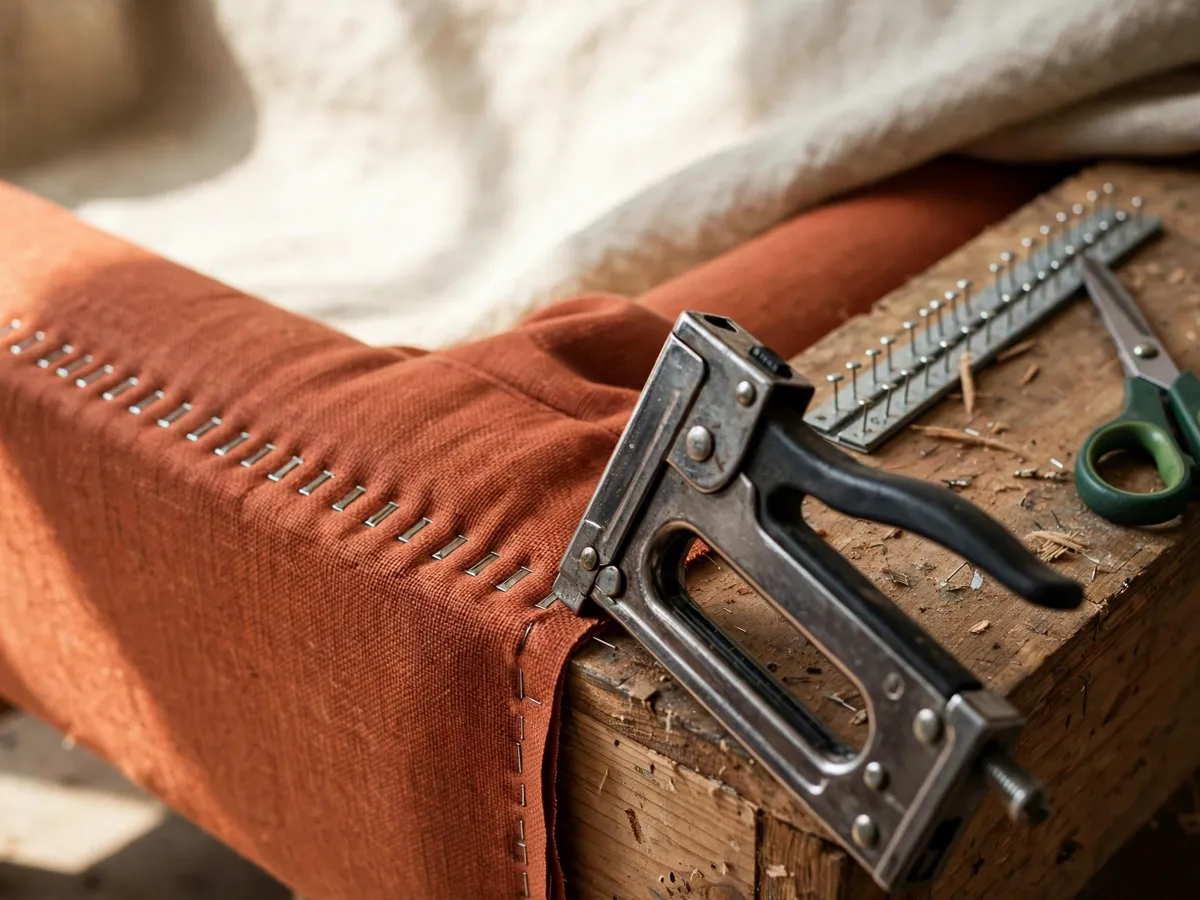
- Staple back on in reverse order. Inside arms first, pulling the fabric taut and stapling into the frame, working outward to the visible panels last, so every raw edge ends up hidden under a later layer. Straight show edges get a tack strip, the cardboard-backed gripper strip that holds a clean line, set with C-clamps while it is positioned.
- Finish with the dust cover. The black fabric on the underside goes on last, stapled to the frame's bottom, and it closes the job.
A sagging seat deck on a spring couch is its own sub-job: re-tying or re-webbing with a webbing stretcher, the lever tool that pulls the strap taut so it can be tacked. It is honest, restorative work, and it is also the point where most first timers call a shop, which is a reasonable outcome, not a failure.
Cost: $400–$1,200 in materials at DIY scale, fabric, batting and foam. Time: 40 to 80 hours for a first full recover, spread over several weekends. One caveat: strip and photograph on day one even if the sewing waits a month, because a reassembled couch with no photo record of its layer order is a puzzle nobody wants to re-solve.
8. Tools for each rung
Tool lists scale with the rung, and over-buying tools is how a $150 cushion job quietly becomes a $400 one. Buy the small permanent things, borrow the big occasional ones.
- The slipcover kit (rung 2): a tape measure, a notepad, and patience with measuring forms. If the slipcover is sewn rather than ordered, add fabric shears, pins and a machine that straight-stitches.
- The sewing kit (rung 3): a seam ripper, fabric shears, upholstery pins, a fabric marking pencil, thread, a zipper foot, and the machine. Everything but the machine fits in a shoebox and lasts decades.
- The full kit (rung 4): all of the above, plus a heavy-duty staple gun and staples, tack strips, a webbing stretcher if the deck is re-webbed, C-clamps for positioning, pliers for pulling old staples, and a rubber mallet.
Borrow versus buy, honestly. Borrow the sewing machine (a straight-stitch machine covers rung 3 entirely) and the staple gun if the full recover is a one-time adventure. Buy the shears, the seam ripper, the pins and the tape measure, because dull shared tools waste more fabric than they save. The thinking behind the order is the same one in the beginner tool kit checklist, and the fabric crafts collection shares the small sewing kit across several projects.
Cost: $35–$120 to own the rung 3 sewing kit outright, machine aside. Time: one shopping trip. One caveat: fabric shears are a dedicated tool, and the first paper cut with them starts the blade on the path to eating cloth instead of cutting it.
9. The small-space version
A loveseat or a single armchair runs the same ladder with the numbers scaled down, and an apartment with a reading chair and a loveseat has no reason to skip the techniques above.
What changes is mostly yardage. The worked example's chair, one seat cushion 20 by 20 by 5 and one back cushion 18 by 18 by 5, totals 36 + 34 = 70 inches of a 54-inch roll: 1.94 yards net, 2.14 with the 10 percent, so buy 2.25 yards. A loveseat's two seat cushions and two smaller backs land near 4.5 to 5 yards. Everything else transfers unchanged: the 2-inch rule, the crosswise boxing, the repeat-per-panel, the pre-wash.
A single chair is the right first project, and not as a consolation. It carries every skill the couch demands, panel fitting, boxing corners, a closure, at a quarter of the yardage. A mistake on a chair costs one panel; the same mistake discovered on the fourth couch cushion costs the batch. Do the chair first, then decide about the couch with a sewn cushion in hand and a real sense of the hours.
Cost: $45–$110 in fabric for the chair at 2.25 yards. Time: one afternoon for the pair of cushions. One caveat: measure the chair's cushions the same twice-each way, because rounded and tufted chair cushions hide their real dimensions better than flat couch cushions do.
10. The renter version
The renter rule is a boundary line: recover what you own, leave what the landlord owns. A freestanding couch you bought and will move with is fair game for every rung. Attached upholstery, a built-in window bench, a banquette bolted to the wall, belongs to the apartment, and re-covering it is an alteration the lease, not this guide, gets a vote on.
Within that line, the ladder is fully renter-safe. The refresh and the slipcover touch nothing. The rung 3 re-cover is reversible with a seam ripper and the saved old covers, so keep them: stored flat in a box with the foam's measurements on the outside, they restore the couch to its delivered state in an afternoon, which is exactly what a deposit walkthrough wants.
Two cautions worth their own sentence. Nothing here drills, glues or fastens into a wall or floor, and the full recover of rung 4, while technically reversible, is a lot of hours to spend on a couch a next apartment's doorway may not fit. Rung 3 is the renter's sweet spot: the fabric leaves with you, and the couch goes back the way it came.
Cost: $0 to draw the own-versus-landlord line. Time: 10 minutes with the lease's alterations clause open. One caveat: photograph the couch's original state before the first cushion cover comes off, so the deposit conversation is pictures rather than memory.
11. When a pro is cheaper
Professional reupholstery is priced as fabric plus labor, and the labor is the honest shock: a full recover of a three-seat couch is 20 to 40 shop hours, which at typical shop rates runs $600 to $1,500 before fabric. A complete job lands in the $900 to $2,500 range once materials and new foam are counted.
Put that next to the fabric math and the fork is sharp. The fabric for a full recover, 15 to 25 yards at $20 to $45 per yard, is $300 to $1,125 on its own. On a couch whose replacement costs $400, the fabric alone exceeds the couch, and the honest move is a new couch or a slipcover. On a couch whose frame would cost $1,500 or more to buy new, the same quote is competitive with replacement and the couch keeps its better bones.
The decision rule, stated once. A quality hardwood frame with eight-way hand-tied springs, a shape the room already works with, and a sit you like: get quotes, because recovering it is usually cheaper than buying its equal. A $300 foam-block frame from a box store: replace it, because no amount of fabric fixes the part you actually sit on.
Getting quotes well: two or three shops, the couch photographed and measured before you call, and an ask for an itemized quote that separates fabric, labor and new foam. Ask whether you can supply your own fabric and how that changes the price, because sale fabric bought carefully takes a real slice off the total.
Cost: $0 for the quotes themselves. Time: a week of calls and visits. One caveat: the cheapest quote is the one to interrogate, because a shop that undercuts the labor math usually recovers fewer layers or skips the re-padding that makes the job worth doing.
12. Common failure modes, and the fix for each
The five ways a first recover goes wrong
- The shrunken cover. A zip-off cover goes through the wash and will not go back on the foam. Cause: the cover was cut to fit unwashed fabric, and the wash removed the slack it never had. Fix: there is none for that cover. Make a new one from it as the template, following the pre-wash rule from section 5.
- Visible staples. Bright staple legs show along a show edge. Cause: staples aimed where the next layer would not cover them, or fired proud of the wood. Fix: pull them, re-staple into the frame at a slight downward angle, and use a tack strip on any straight edge the eye rests on.
- Bunching at the corners. The boxing gathers and puckers where the cushion rounds its corner. Cause: the seam allowance was not clipped and eased around the curve. Fix: clip into the boxing's allowance at each corner, space the fullness with pins, and sew slow, easing as you go.
- Sagging new foam. The fresh cover goes on but the cushion reads loose and soft. Cause: the replacement foam was cut to the exact old dimensions, so there is no tension. Fix: order foam half an inch oversize per dimension, and the cover's own snugness does the rest.
- Pattern misalignment. Two cushions read as different fabrics. Cause: panels cut without starting each at the same point in the repeat, or cut running different directions on a napped fabric. Fix: undo is rarely worth it; order the extra quarter yard and re-cut the offender, matching the repeat and the nap this time.
Cost: $0 to read; the fixes above cost between nothing and one re-cut panel, which is what the 10 percent rule exists to cover. Time: 10 minutes to check a project against this list before the fabric order. One caveat: every failure here is cheap at the measuring stage and dear at the sewing machine, so the checklist belongs at the start, not the end.
13. Cost and time, honestly
Every rung, one line each, using the numbers already shown. Fabric prices assume the $18 to $45 per yard mid-range, and the low ends assume borrowed tools and no new foam.
- Clean-only refresh: $10–$25 and one to two hours. Worth trying before any fabric is bought.
- Washable slipcover: $60–$250, an hour of measuring and ordering; workroom-sewn custom versions sit at the top of that range and take weeks to arrive.
- Cushion re-cover (the mid path): 6.25 yards bought, $150–$380, one weekend of about 8 hours for a four-cushion couch, assuming a borrowed machine.
- Full DIY recover: $400–$1,200 in materials across 15 to 25 yards plus batting and foam, 40 to 80 hours for a first-timer, spread over several weekends.
- Professional recover: $900–$2,500 all-in on a three-seat sofa, 20 to 40 shop hours, and the couch is at the shop, not the living room, for a few weeks.
The pattern is the honest one: each rung costs roughly double the one below it, and each rung buys roughly double the change. Where a household lands depends on the frame verdict from section 1.
Cost: $10–$2,500 across the whole ladder, rung by rung above. Time: one hour to several weekends, rung by rung above. One caveat: regional labor rates move the professional line more than any other number here, so treat that line as a comparison aid and the local quotes as the truth.
14. Five questions this guide already answers
How many yards of fabric do I need to reupholster a couch?
It depends on the rung. For the cushion re-cover, the worked three-seat example (two seat cushions 36 by 24 by 5, two back cushions 24 by 20 by 5) nets 5.5 yards, and with the 10 percent rule you buy 6.25. For a full recover, a plain three-seat sofa is quoted at 12 to 18 yards, and patterns, piping or tufting push it to 15 to 25 or more.
Can I machine wash zip-off cushion covers?
No. Factory zip-off covers are cut to fit fabric that has never been washed, so a machine wash shrinks them enough that they no longer fit the foam. Spot-clean them instead, and if washability is the real goal, a slipcover in a washable fabric, laundered before it is sewn, is the honest route.
Is it cheaper to reupholster or buy a new couch?
Test the frame first. A quality hardwood frame with eight-way hand-tied springs is usually worth a recover quote, because buying its equal costs more than the job. A $300 foam-block couch is not, since the fabric alone for a full recover, $300 to $1,125, can exceed the replacement.
What fabric should I use to recover a couch?
Upholstery-weight fabric, sold by the yard off a 54-inch roll, with a double-rub count in the 15,000 to 30,000 zone for a daily-use seat. Apparel and drapery weights pill and wear through. Patterns need one extra repeat per panel, and velvet's nap means every piece is cut running the same direction.
Can I recover just the cushions?
Yes, and it is the recommended first project: the mid path in section 6. Remove the old covers with a seam ripper and keep them as templates, add 2 inches per dimension, sew the boxing between the panels, and close with a zipper or an envelope back. One weekend, about 6.25 yards, straight-stitch sewing.
Save these on Pinterest
Pin the fabric math and the failure-modes list, the two things you will want open mid-project: one to buy the right yardage the first time, one to diagnose what went wrong when a cover fights back. The rest of the DIY home projects collection sits alongside, with the sewing and tool guides that share this kit.