 Plant As Deco
Gardening & Planting Tips
Outdoor Herb Garden Ideas: 5 Layout Shapes for the Yard You Have
By Plant As Deco · Updated 17 November 2026
This is for anyone planting herbs outside — a patch of yard, a narrow side strip, a path edge, or a concrete patio with no soil at all. An outdoor herb garden is decided before anything goes in the ground, and the four decisions are the ones most people skip: which ground, which spot in the yard, how far apart, and where mint lives. Below is each one, then five named layout shapes so you can pick the one your yard already has.
Weekend-ready: $20–$180, one afternoon. Renters can do the pot version.
1. Pick the ground first: in the soil, raised, or pots
Almost everything downstream — spacing, watering, what you can even plant — follows from this one choice. And the choice comes down to two facts about your yard, not three: what the soil under the grass actually is, and how far the kitchen door is from the spot you are considering.
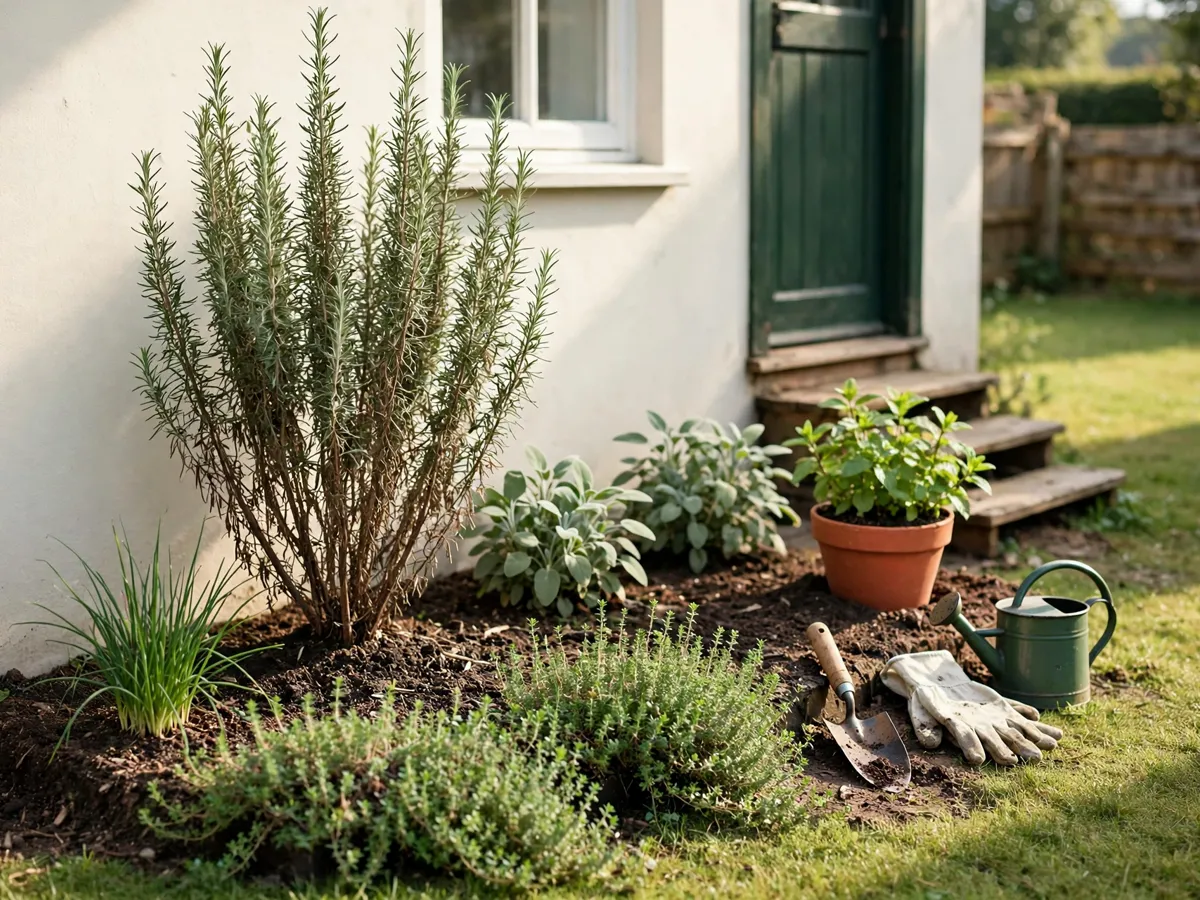
- In the ground. You dig where the yard already is. This is the cheapest way to get the most plant per dollar: no lumber, no bought fill, and the roots go down as far as they want. That is why a rosemary in the ground outgrows the same plant in any pot you can buy. What it forbids: you inherit whatever is there. Heavy clay, rock, compacted builder soil, or a lot paved years ago with rubble buried under it — none of that fixes itself in a weekend. If a spade is a fight, this is not your ground.
- Raised. A wooden frame filled with soil you bring in. You are buying a soil you did not have, and that is the entire value of it. What it forbids: it is fixed where it goes, so a placement mistake stays a placement mistake; it drains faster than the surrounding ground, which makes it thirstier through a hot stretch; and the fill is where most of the money goes, not the frame.
- Pots. The only renter-safe option, the only shape you can move, and the only one that gives a concrete patio any herbs at all. What it forbids: pots dry out. A terracotta pot of basil in August sun can go bone dry by evening, and a pot you forget is a plant you replace. It is the most forgiving shape to start and the least forgiving to neglect.
One honest tiebreaker: the ground you choose decides how much you water. In the ground, almost nothing after the first month. Raised, a check every few days in heat. Pots, a daily one. If you know you will not walk out with a watering can, that sentence rules out two of the three. And if the honest answer is that you will only ever water what sits next to the sink, the kitchen window is a real ground too — the indoor version covers light, one-herb-one-pot and the no-window case.
Cost: $0 for in-ground, $50–$180 for a small framed bed with fill, $30–$90 for a first row of pots and mix. Time: one afternoon. Pick on your soil and your patience for watering, not on which one photographs better.
2. Where it goes: count the steps, then walk the line
Two questions decide the spot, and neither of them is about the sun. Sun is the second filter; these come first, because a perfect sunny corner in the wrong part of the yard grows weeds, not herbs.
How many steps from the kitchen door. Herbs get used when they are on the way to something else — the door, the clothesline, the bin, the gate. A bed you have to cross the whole yard to reach becomes a plant you look at instead of a plant you cook with, and it happens slowly enough that you never notice you stopped. Put the herbs within a short, boring walk of the door you actually use.
Which line you already walk. Look at where the grass is worn flat. That is your path, and the bed belongs on it, not in the empty far corner that only looks empty because nobody goes there. The same reasoning works against a bed placed where you mow: if the herbs sit inside a turning radius, you will be trimming around them all season.
Where the water is. Measure the hose run, not the bed. If every watering means dragging a hose across the yard and back around a fence corner, you will water on the days it is easy, which is rarely. A spot two steps from a spigot beats a prettier spot forty steps away.
The traps that look fine at noon. Four spots fool people every time: under a dripping eave, where leaves stay wet and the woody herbs hate it; beside an air-conditioning condenser, which blows hot exhaust across the bed through the hottest hours and sits in the one area you cannot dig; in the rain shadow of a tall fence, where nothing reaches the roots; and under a mature tree, which drops sap and drinks the water first.
The careful version of this — walking the yard at nine, at noon and again at four, marking what is genuinely lit at each pass, and drawing the bed at its real finished size on paper — is the sun-map and one-page-plan method in the garden planning guide. Worth one pass before you commit a spot you cannot move.
Cost: $0. Time: 30 minutes with a tape measure and a phone camera. The caveat: a spot you chose from a window is a guess about shade, and shade is the one thing you cannot fix later.
3. Sun, honestly: six hours is the floor, and a wall beats a lawn
Herbs split into two groups outdoors, and they want different things, which is why “full sun” on a plant tag answers half the question. The woody Mediterranean group — rosemary, sage, thyme, oregano, lavender — wants six hours of direct sun as a floor and more as a bonus, plus the lean, fast-draining end of the bed. The soft-leaved group — basil, parsley, chives, mint — tolerates a little less, and does best with morning sun and some relief in the worst of the afternoon heat.
Now the part most plans get wrong: a south- or west-facing wall usually beats an open patch of lawn. Two reasons. A wall casts no shade of its own, ever, while a fence, a tree or the house itself will move a shadow across an open bed as the day goes on. And a wall gives back the heat it stored, so the air right against it stays warmer later into the season. That is why herbs planted along a wall look thicker, and keep producing long after the same plants out in the middle of the yard have slowed down.
The trap is the afternoon. A bed that reads as blazingly sunny at noon can sit in fence shade by three, and a woody herb in four hours of shade instead of six grows leggy, holds water at the base, and gives you leaves instead of flavor. Judge a spot by its worst hour, not its best one — walk it late, once, before you dig.
One expectation to set here, because it changes what you buy. Basil is grown as an annual in most of the country: you plant it once the weather has properly warmed, you cut it all season, and you start again next year. Rosemary is the woody one people most often try to carry year over year, and the honest trick is a pot by the wall that you can drag onto a porch or into a stairwell when the cold gets serious. Plan the bed around the plants that stay in the ground, and treat the annuals as the seasonal fillers they are.
Cost: $0. Time: 20 minutes, one late afternoon. Six hours is the floor for the woody group; if no line in the yard clears it, the pot row in section 6 is the shape that still works.
4. Spacing: the number is the plant in late summer, not the plug
This is where almost every outdoor herb garden goes wrong, and it goes wrong at the shop. Every spacing figure that matters is the width the plant will reach at the end of the season, not the size of the plug in the tray. A rosemary bought as a small plug is a handful of green inches wide. The same plant in September is a two- or three-foot wooden shrub. If you plant to what you are holding, you have designed a bed that will suffocate itself by August.
| Herb | Width by late summer | Where it sits | What crowding does |
|---|---|---|---|
| Rosemary | 2–3 ft | Back of the bed, or its own pot | Woods out and goes bare in the middle, then shades everything planted in front of it |
| Sage | 2–3 ft | Back or middle, dry end | Sprawls woody and holds damp air at the base, where the leaves rot first |
| Lavender | 2–3 ft | Back, the driest leanest corner | Becomes a bare wooden ball that no trim puts leaves back on |
| Thyme | 12–18 in | Front edge, as the ribbon | Fuses with oregano into one mat you cannot tell apart at the kitchen door |
| Oregano | 12–18 in | Front edge or the side strip | Flops over a crowded neighbor and flowers early, which is when the leaves taste least |
| Chives | 12–18 in, as a clump | A corner, or the path edge | Thins to wiry strands nobody wants to cut, because the clump never got room to fatten |
| Parsley | 8–12 in | Middle, the moister end | Stays small and yellows; the crowded ones bolt to flower instead of making leaves |
| Basil | 12–18 in | Middle, the moister end | The fastest one to suffer — no air movement and it mildews at the base within weeks |
| Mint | Not a spacing question | Inside a boundary, never loose | It does not space, it spreads — see section 5 |
How to get it right without doing any math: set every plant out on the bed in its tray, unpotted, at the spacing above. Stand back. Walk the path you will actually use. Move them until the gaps look right at the finished size, then dig the holes where the trays are sitting. Two plants that will be touching by late summer are planted too close no matter how much soil you can see between them today.
Outdoors, the same rule reads differently in pots than in a bed. In a bed, spacing buys you air. In a pot, the width the plant reaches tells you the pot is too small long before the roots are packed — a rosemary heading for three feet across will lift a small pot over, and the fix is a bigger container, not a trim.
Cost: $12–$30 for starts, bought at the count the spacing allows rather than the count the tray offers. Time: 30 minutes to lay the bed out before digging. The caveat: fewer plants, spaced, beats more plants crowded — the crowded bed grows less.
5. Mint is a boundary problem, not a plant
Mint is the most common way a beautiful herb bed becomes one plant. It travels on runners that push sideways just under the surface, and each one roots wherever it touches soil — so it does not spread in a clump that gets bigger, it spreads in a colony that gets wider. Give mint a foot of the bed and by the end of the season it has taken a yard of it, threading up through the thyme and out over the edge. Pull the visible shoots and you leave the fragments underground, and every fragment is a new plant. This is the classic destroyed herb bed, and the fix is structural, done once, at planting.
Fix one: sink a pot rim-high. Plant the mint in a container, then bury that container so its rim sits exactly level with the surrounding ground. The roots stay inside the pot, a spade turned nearby misses them, and the mint looks like part of the bed instead of a thing sitting on top of it. Rim-high matters: a pot perched on the surface dries out faster, tips over, and leaves a gap at the soil line for runners to slip under.
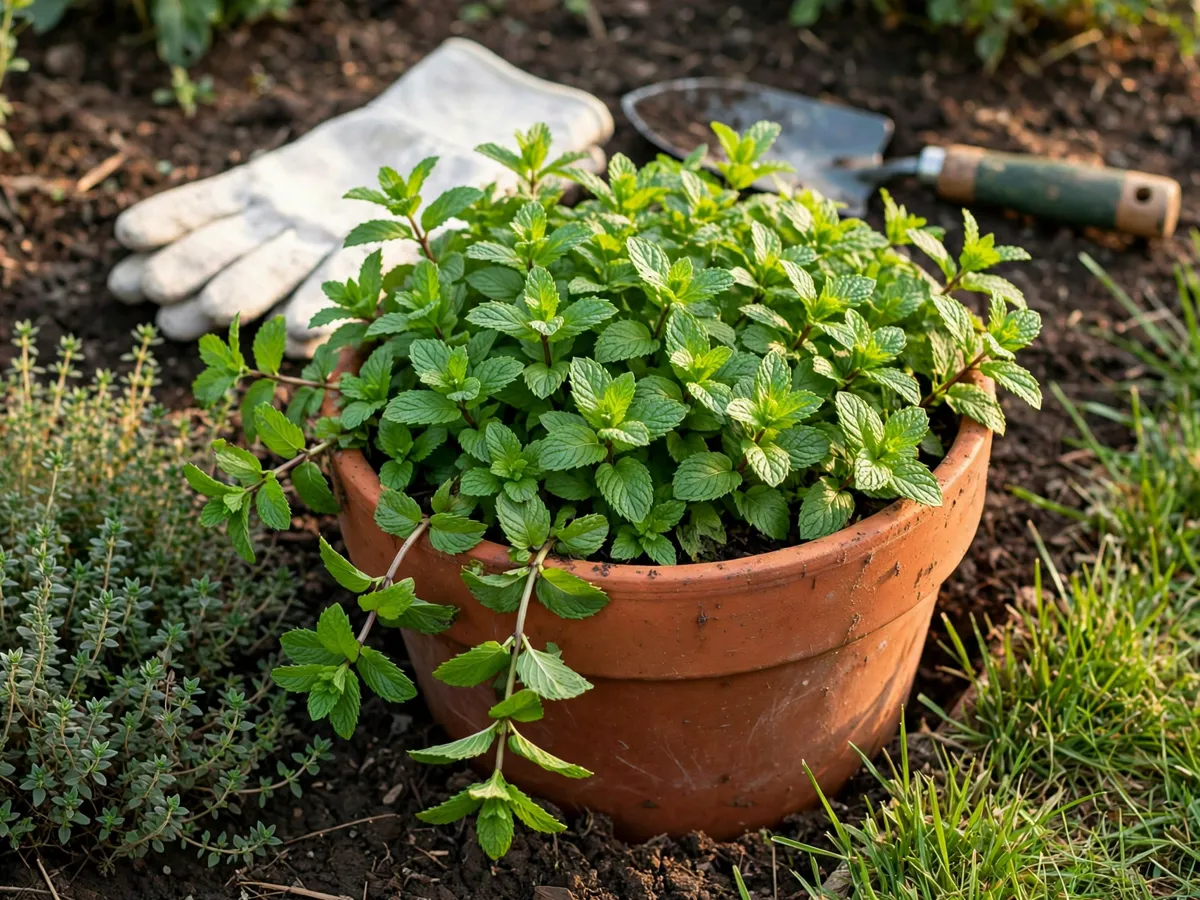
Fix two: bury a barrier. If you want mint in the bed itself, ring the patch with rigid plastic or metal edging set about 6 inches deep, all the way around, with the seams closed. Mint escapes through a gap the way water does. This is the cheaper fix in a new bed and the harder one to retrofit, which is why the boundary goes in when you plant rather than after.
What does not work: a ring of stones on the surface, edging pressed into the top inch of soil, or the plan to “just pull the extras out” every spring. None of them stops a runner that goes underneath. What does work without any of the above: mint at an edge where one side is lawn or paving, so you mow or walk against it. That is the one placement where mint is genuinely well-behaved, and it is a placement, not a variety.
The neighbors, in one move. Rather than giving each plant its own conditions, split the bed into two ends. The woody group — rosemary, sage, thyme, oregano, lavender — takes the dry, leaner, faster-draining end, usually the side against the wall. The soft-leaved group — basil, parsley, chives, mint behind its boundary — takes the moister end. Then plant by height: tallest at the back of the bed, low spreaders along the front edge. A rosemary at the front is a rosemary shading three smaller plants all season, and it is the most common ordering mistake after spacing.
Cost: $5–$12 for a pot or a length of edging. Time: 20 minutes at planting. The caveat: moving a barrier into an established bed means digging out the mint you were trying to contain, so do it before, not after.
6. Five layout shapes, and the yard each one fits
These are the shapes people actually plant, named by the yard that fits them. Pick with the two numbers you already have from sections 2 and 3: how many steps from the door, and how many hours of sun on that line. Do not pick by which corner is empty.
| The shape | The yard it fits | What goes in it | What breaks it |
|---|---|---|---|
| The rectangle by the door | A yard with a kitchen door opening onto six hours of anything | Rosemary and sage at the back, chives at one corner, thyme along the front, mint in a sunk pot at the other end | A slope with no retaining side, or a spot directly under a dripping eave |
| The L around the corner | A side yard where a house wall meets a fence, and you walk past that corner daily | The tall woody one in the corner where two warm walls meet, mid-height plants down both arms, the low ribbon along the fronts | One arm sitting in shade — then plant only the sunny arm and leave the other as path |
| The fence-side strip | A narrow side yard, two or three feet wide, that still gets sun on the fence line | A run of pots or a narrow trough: chives, parsley, oregano, one basil, thyme at the ends | The fence’s own afternoon shadow — check which end of the strip loses the sun first and plant the woody group at the sunny end |
| The edging ribbon | An existing path with no room for a bed, but with a sunny edge along it | Thyme or oregano along the line, one plant every 12–18 in, filling into a mat you walk up to, not on | Putting rosemary or basil in it — the ribbon is only for the low spreading ones |
| The pot row | A patio with no soil at all, or a rental you cannot dig in | A line of pots against the wall, sized to what each plant reaches, and movable into the sun as it shifts | Forgotten watering — this is the thirstiest shape here and the only one you can rescue by moving it |
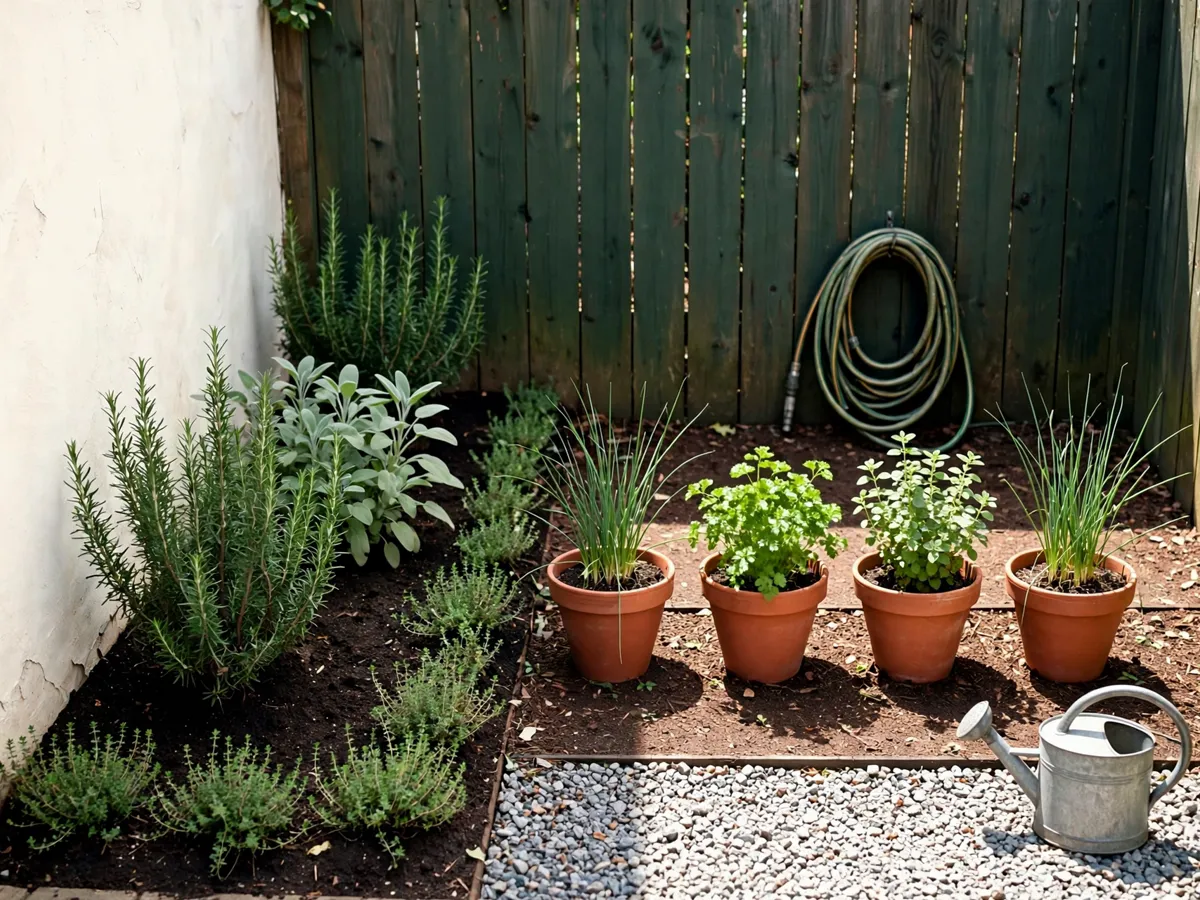
If the honest answer to both questions is bad — the sunniest line is far from the door, or nothing clears six hours — the pot row wins, and it wins because it is reversible. You can chase the sun across the seasons by dragging a pot two feet, and you cannot do that to a bed. Start there, learn where your light actually falls, and put a permanent bed in the spot the first year has already chosen for you.
One shape worth naming because people ask for it and we would not build it: the masonry herb spiral. It is in the skip list below, and the short version is that it is the most expensive way to plant the same number of herbs into the least usable geometry.
Cost: $30–$90 for the pot shapes, $0–$60 for the ones planted in the ground, $50–$180 for a framed bed. Time: one afternoon for any of them. The caveat: build the shape you can water from the door, not the shape that fills the empty corner.
What we would skip
- Mint loose in the bed. Even “a small corner” of it. The runners go under everything and the only fix later is digging the whole bed up.
- A bed on a slope with no retaining side. Water runs off it, soil washes to the low end, and the plants at the top dry out while the ones at the bottom sit in the drainage. Build a level bed or use pots.
- The masonry herb spiral. Three problems. It costs more in stone and fill than a flat bed of the same footprint. Wet mortar and freezing weather crack it and wash the joints out over a couple of winters. And the geometry works against the plants: the top of the spiral is the driest, windiest, most exposed spot, the tall woody herbs up there shade the low ones on the north face, and you cannot reach the far side without stepping into the bed.
- Ornamental grasses or dwarf conifers as filler.They are not herbs. They take the sun and the water you bought for the kitchen, they outgrow the edge you planned, and they turn a cooking garden into a front-yard planting.
- Buying what looks pretty on the shelf instead of what you cook. A herb nobody uses dies of neglect, not of drought. List the three dishes you actually make, and buy those.
- Five kinds of rosemary, four kinds of basil. More varieties means more spacing, more watering and less of any one plant in the kitchen. One good bush of each beats a labeled collection you never harvest.
- A bed in the far corner because it is empty. Empty corners are empty for a reason. Section 2 is the whole argument.
Cost: $0 to skip, and the spiral is the dearest option on this page by a wide margin. Time: 3 minutes to strike them off.
The outdoor herb bed checklist
- Chosen the ground by the soil and by how much you will water
- Counted the steps from the kitchen door to the spot
- Placed it on the line you already walk, not the empty corner
- Checked the hose run from the spigot before digging
- Walked the spot late in the day, not only at noon
- Kept it clear of a dripping eave and the condenser pad
- Six hours on that line for the woody group, morning sun for the rest
- Set every plant out in its tray at its late-summer width first
- Tall at the back, low spreaders along the front edge
- Dry lean end for rosemary, sage, thyme, oregano, lavender
- Moister end for basil, parsley, chives
- Mint in a sunk pot rim-high, or ringed with buried edging
- Bought the count the spacing allows, not the count the tray offers
- Watered in once, at planting, whether or not rain is forecast
Cost: $20–$180 all in, depending on the ground you picked in section 1. Time: one afternoon.
Questions people ask about outdoor herb gardens
Can I do a whole outdoor herb garden in pots?
Yes, and the pot row is one of the five shapes here. It is the only renter-safe option, the only one you can move, and the one that works on a patio with no soil at all. The trade is watering: pots dry out faster than a bed, so this is the shape you have to check through a hot stretch. Size each pot to the width the plant reaches by late summer, not to the plug you bought.
How far apart should I plant herbs outdoors?
At the width each one reaches at the end of the season: rosemary, sage and lavender at two to three feet, thyme, oregano, chives and basil at twelve to eighteen inches, parsley at eight to twelve. Mint is not a spacing question, it is a boundary question. Set the plants out in their trays at those distances before you dig anything.
Why does my mint keep taking over the bed?
Because it travels on runners just under the surface, and each one roots where it touches soil. Pulling the shoots leaves fragments behind, and every fragment grows. The fix is structural and goes in at planting: a pot sunk rim-high, or edging buried about six inches deep with the seams closed. Otherwise give mint an edge with lawn or paving on one side.
Is a shady side yard a reason not to grow herbs at all?
It rules out the woody group, which wants six hours. The soft-leaved ones — basil, parsley, chives, mint — tolerate less, especially with morning sun and some relief in the worst afternoon heat. And before you give up on the spot, check the walls: a south- or west-facing wall casts no shade of its own and gives its heat back, so it often beats the open lawn next to it.
Should I plant a big bed now so it looks full this year?
No. A bed planned at mature spread looks bare for the first weeks, and that bareness is correct. A crowded bed looks full in week one and needs rescuing in week ten — damp air at the base, everything flowering early, and the tall plants shading the low ones. Fewer plants, spaced, grows more than more plants, crowded.
Save these on Pinterest
Pin the mature-spacing table and the five-shape table — those are the two you will want open at the shop, when every tray in front of you looks far too small to need two feet. The sunk-pot photo is worth saving too, because it is the one image that stops mint going loose in a bed you just built. The Gardening & Planting Tips collection holds the rest of the beginner growing ideas for small yards, balconies and windowsills.