 Plant As Deco
Gardening & Planting Tips
Indoor Herb Garden Ideas: The Kitchen Setup That Actually Grows
By Plant As Deco · Updated 16 November 2026
An indoor herb garden is a light problem before it is a plant problem, and most kitchen sills fail on the day of purchase rather than weeks later. This plan is for renters and small-apartment cooks who want five herbs by the window — not a greenhouse — and it decides the spot and the lamp first, then the pots, then the watering, then the cutting. Five pots, one plant in each, in the brightest place you have. Done in an afternoon, and the checks are the kind you can run with a mug and a finger.
Weekend-ready: $25–$70, one afternoon. Pots, saucers, potting mix and five small plants, plus a lamp if the sill falls short — renter-safe, nothing drilled or mounted.
1. Start with the light, not the herbs
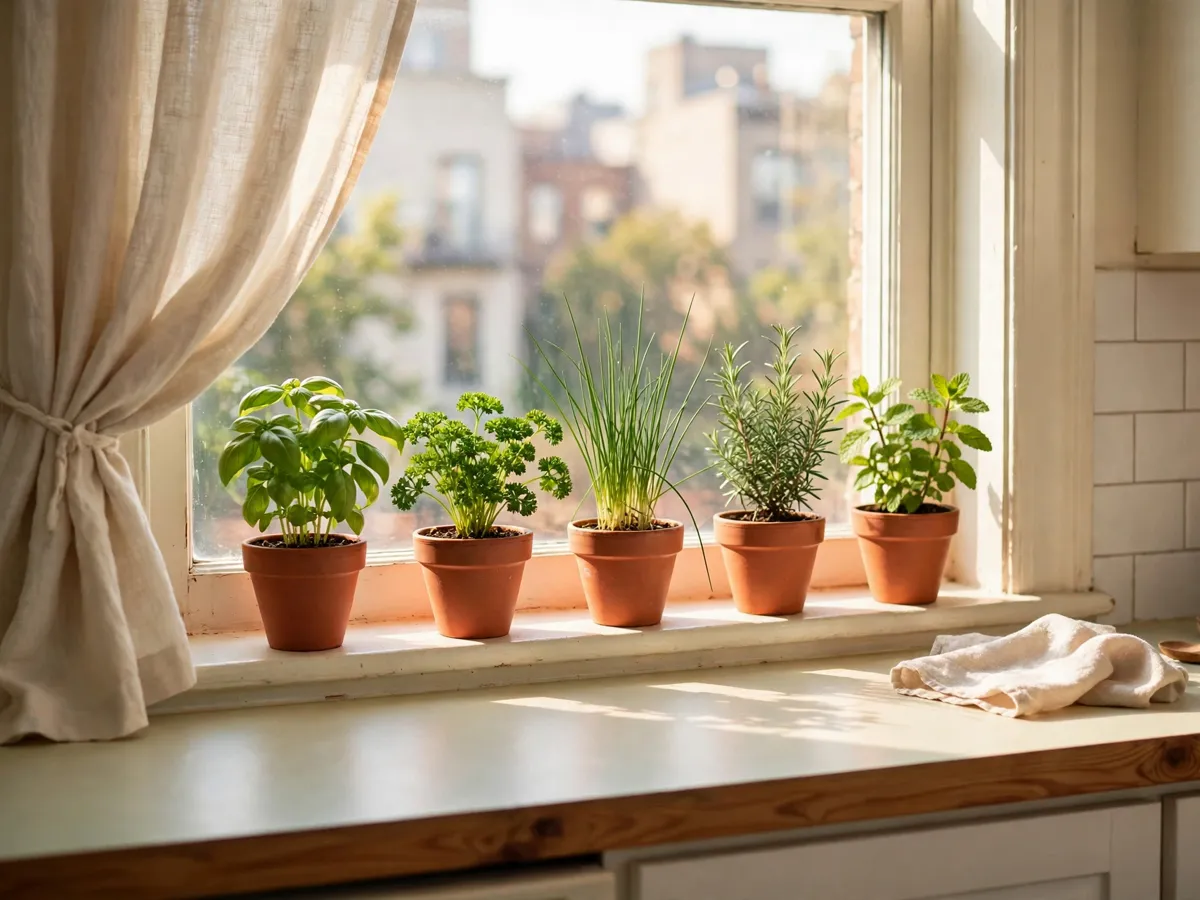
Every herb sold on a grocery shelf — basil, parsley, chives, rosemary, thyme, mint — grew up outdoors in full sun, and the small pot it arrives in is a starting pot, not a home for the season. Six hours of direct sun on the leaves is the working minimum, and in the US only a south-facing window reliably delivers it. East and west windows collect a few strong hours at one end of the day. A north window collects none, however bright the room feels. Brightness is what your eye reads; direct sun on the glass is what a leaf gets.
So run a shadow test before you spend anything. Put a mug on the sill and check it three times in one sunny day — mid-morning, midday, mid-afternoon. A sharp, dark shadow on the counter means direct sun is landing there right now; soft, fuzzy light means it is not. If the sill holds direct sun for most of those checks, it is a herb sill. If it catches one or two bright hours, it is a shady sill with a good reputation.
Here is the rule that saves the most money on this page: if the sill misses six hours, buy the grow light before you buy the herbs. Do not buy the plants and wait to see whether they adjust. A herb that is short of light leans toward the glass, pushes thin pale stems instead of full leaves, and never fills out. By the time the problem is obvious, the plant is already weak, and one weak plant teaches you less than five bought in the right spot. The lamp also costs less than replacing five plants twice. Which lamp, how far above the pots it hangs and how the timer should run are all in the grow lights for indoor plants guide; on this page the lamp only has to do one job — stand in for a south window on any sill that cannot.
Two smaller checks belong in the same visit. First, the stove: a sill directly over or beside the hob runs hotter and dries pots faster than the end of the counter, so keep the plants a counter's width away. Second, the glass: in winter the pane itself gets cold, and a plant pressed against it fares worse than one sitting a hand's width back, where the air still moves. Neither check costs anything, and both decide whether the spot you picked is the spot the plants can live in.
Cost: $0–$45, the range between a sunny sill and a lamp with a bulb and timer. Time: 20 minutes across one day, plus the shop trip. A bright room is not the same as direct sun on the glass.
2. One herb, one pot
The most common purchase for this shelf is the long ceramic planter with four herbs already planted in it, and it is the setup that dies first. Not because any one of those herbs is difficult, but because a shared planter forces a wet plant and a dry plant into one root zone, and the watering that keeps the basil happy is the watering that rots the rosemary. One plant per pot is the whole rule. Four to six inches across is the right size for the herbs sold at a grocery or nursery: small enough that the root ball nearly fills it, big enough to hold a couple of days of water.
Each pot needs a drainage hole and a saucer under it. A pot with no hole is a vase — water collects at the bottom, the roots sit in it, and the plant declines while the surface still looks dry. The mix is potting mix, not soil dug from outside: garden soil compacts in a pot and drains poorly, while potting mix is built to hold air as well as water. The kit is short:
- Five 4–6 inch pots, each with a drainage hole, and a saucer for every one
- One small bag of potting mix — not garden soil
- A spoon or a small trowel for filling
- Masking tape and a marker for pot labels
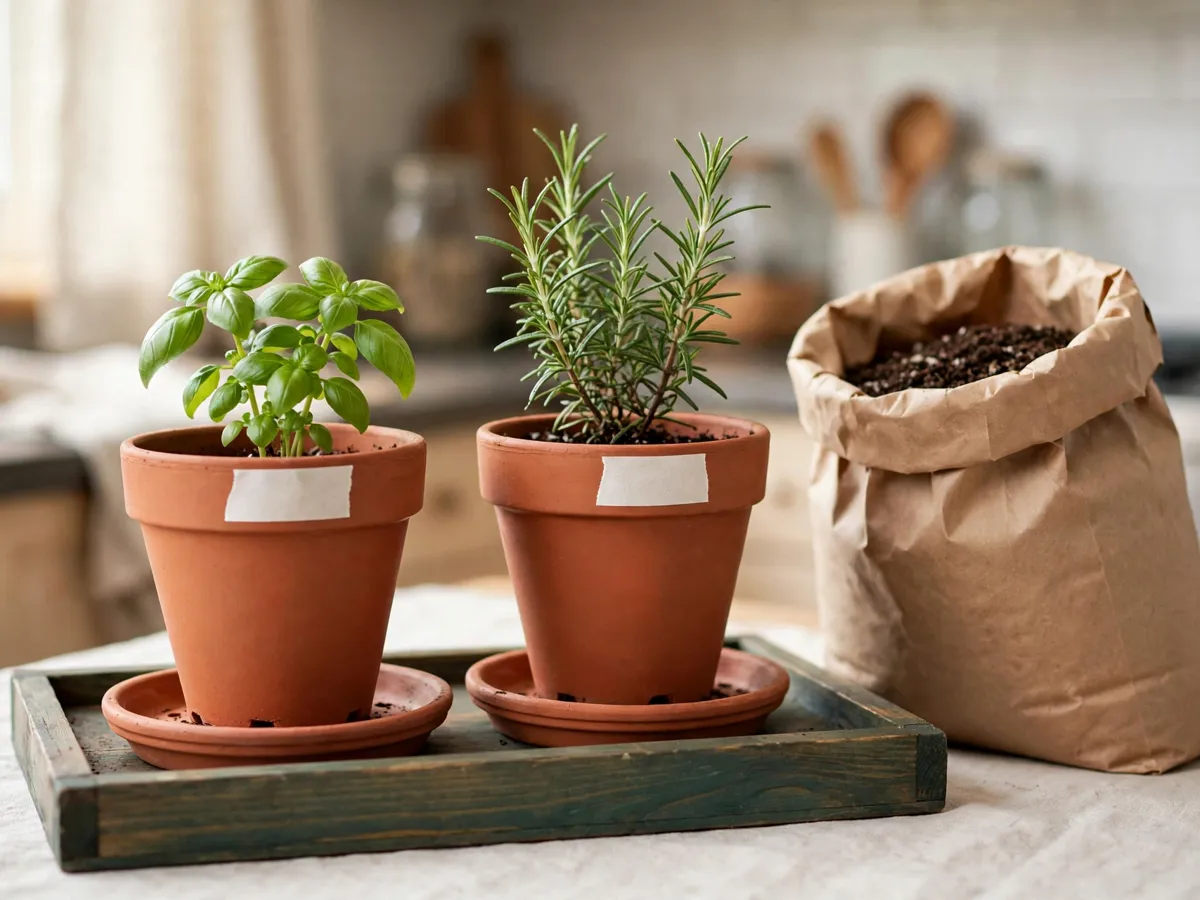
Potting is a five-step job and none of the steps is optional. Set a saucer under each pot and fill the pot about half full of mix. Take the plant out of its nursery pot and loosen the root ball gently with your fingers — roots that circle the old pot keep circling unless they are opened up. Set the plant so the top of its root ball sits an inch below the rim; that inch is the watering space that stops the pot overflowing every time. Fill around the root ball, firm the mix with your palms rather than your fingertips, then water slowly until water runs into the saucer. Empty the saucer after twenty minutes, and label the pot with the herb name and its watering group.
- Saucer under every pot; fill each pot half full.
- Loosen the root ball with your fingers before it goes in.
- Top of the root ball an inch below the rim.
- Fill, firm with the palms, water until it drains.
- Empty the saucer and tape on the label.
Overpotting is the quiet failure. A twelve-inch planter around a three-inch seedling holds water the roots never reach, and the mix stays wet for days in the middle of the pot while the surface dries — the roots drown in a pot that looks dry. Pot size runs the opposite way from ambition, and it is the same logic that sets pot depth for vegetables, where carrots want ten to twelve inches of it: the first question is the size the roots actually need, and the growing vegetables in pots guide applies it at the other end of the scale.
Cost: $10–$30 for five pots, five saucers and a bag of potting mix. Time: 30 minutes to pot five plants. A pot without a drainage hole is a vase, whatever the label says.
3. The thirsty group and the dry group
Watering is where the shelf splits, and it splits by the ground each herb comes from, not by what you cook with it. The thirsty group is basil, parsley and chives — kitchen garden herbs that expect soil to stay evenly moist, so they want the top inch of mix to dry and no more. The dry group is rosemary, thyme and oregano, with sage alongside them: herbs that expect dry, stony ground and want the mix to dry out completely between waterings. In doubt, wait a day — the dry group will forgive a late watering far more easily than an early one.
Mint belongs in neither rotation, because it is not a watering problem but a space problem. Mint drinks like the thirsty group, yet its roots run along the surface of the pot and will fill any space they share, crowding out a neighbour within a season. So mint gets a pot of its own — kept with the thirsty group for watering — and a hard pinch every week to keep it from running. A mint sharing a pot is the second way a shared planter fails, even when someone avoided the first.
The check is a finger, not a schedule. Push a finger into the mix to the second knuckle. Damp at the tip: wait. Dry all the way down: water. In a warm kitchen a small pot of basil can need water every two to three days, while rosemary in the same spot may go a week between drinks; that gap is the reason the groups exist. Water the thirsty pots from the top until it runs through, or from the saucer and let them pull it up for twenty minutes. The dry group never sits in water: pour through the top, let it drain, and empty the saucer. A long shared tray under all five pots spreads water sideways from pot to pot, so give each group its own saucers.
The failure mode is one watering can on one routine. The dry group gets the basil schedule and rots at the crown; the thirsty group gets the rosemary schedule and crisps from the bottom up. Neither looks dramatic at first, which is why the labels matter: write the group on the pot, not the name alone, and the can goes to the thirsty four first, the dry three second, with the tap turned off in between. When the herbs outgrow a sill, the same read — sun first, watering second, one decision at a time — is how the balcony garden plan starts outdoors.
Cost: $0–$8 for a second small watering can, if you want one. Time: five minutes twice a week, plus a finger check in between. One can and one schedule will kill one of the two groups.
4. Harvest so it grows back
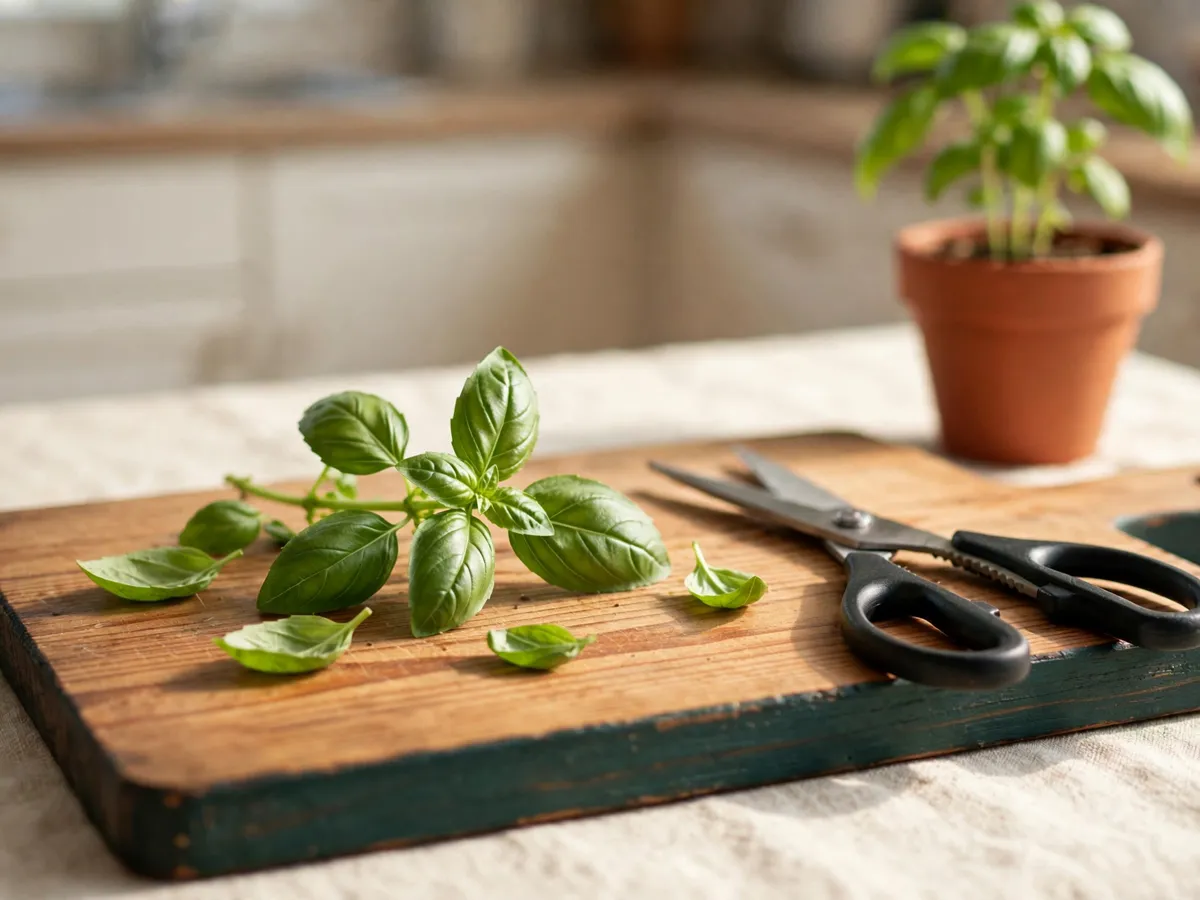
The first cut decides whether the plant keeps producing. One rule covers all five herbs: never take more than one third of the plant at once, and cut just above a pair of leaves. The two tiny leaves at that joint are already there and waiting; cutting above them wakes the pair, and the stem answers with two new shoots instead of one. Cut further down a bare stem and nothing comes back, which is why "trim it shorter" is the most expensive haircut a herb can get.
Week one is for watering, not harvest. Let the plant grow past its nursery size — roughly a third taller than the day it was potted — before the first proper cut, and take only the top pair or two while it fills in. From then on each herb has its own cut. Basil is pinched or snipped just above a leaf pair, never stripped along a whole branch; the growing tip stays, and flower buds come off as soon as they form, because a basil in flower slows its leaf growth. Parsley gives up its outer stems first, cut at the base, while the crown in the middle keeps pushing new ones. Chives are cut in a clump, two inches above the mix — trimming only the tips leaves a pot of brown stubs that never recovers its look.
The woody three — rosemary, thyme, oregano — take soft green tips only. Their old grey wood does not push new growth from a bare cut, so a hard prune into the woody base leaves a permanent gap. Take the tips, keep the shape, and let the plant replace what you took from the ends. Scissors kept beside the sill make the cut a ten-second job while the pot of water is coming to the boil, and a plant that is cut little and often stays bushy while a plant left alone grows tall, thin and woody. A spare tip cutting does not have to go in the pan the same day — the water-and-soil rooting guide shows which cuttings root in a jar first, so a good stem never goes to waste.
Cost: $0–$6 for a pair of kitchen scissors if you do not have one. Time: five minutes a week. A plant cut back to its base in the first week has nothing left to grow from.
5. The no-window version
A kitchen with no usable window is not a herb-free kitchen; it is a shelf with a lamp. The setup stays small: a two-foot shelf or the end of a counter near an outlet, one small grow light on a timer, and the same five pots. The lamp stands in for the window rather than supplementing a dark corner, so it runs every day on the timer and every pot sits inside the pool of light, not beside it. Hang the light low over small plants and raise it as the herbs grow, keeping the same distance that the lighting guide in section one describes. The only added rule for this shelf is size: five pots need a lamp wide enough to cover all five, or two lamps rather than a shuffle.
Watering does not change: same two groups, same finger test, same saucer rules. What does change is the drying rate — a lamp warm over the pots dries the mix a little faster than a window, so check a day earlier for the first two weeks and then settle into the rhythm your kitchen actually runs. Keep the shelf off the steamiest corner and a counter's width from the stove, and the rest of the plan transfers intact. If the kitchen is genuinely windowless and the shelf is the only option, this version is not a compromise; it is the base case with the light made explicit.
Cost: $20–$45 for the lamp, bulb and timer, plus the pots from section two. Time: 45 minutes to clear a shelf and set the timer. In a windowless kitchen the lamp is the window — without it no herb holds.
What we would skip
Skip the shared trough planter and any kit built around one long box. A kit with five separate pots is fine — a kit with one tray is the same mistake in a gift box. Skip growing from seed for the first month: seeds add weeks and need the light sorted before they are worth starting, so learn the spot with small plants first. Skip self-watering globes and wick inserts, which keep the mix evenly wet all the way down, exactly wrong for the dry group. Skip the twelve-inch statement planter for a starter herb, since a big pot around a small root ball stays wet in the middle. Skip decorative pots with no hole unless a draining pot sits inside and you empty the cover pot every week. Skip feeding for the first month — fresh potting mix is already charged, and feeding a plant that is short of light only makes it stretch faster. And skip buying eight herbs: five pots is a kitchen sill, and a crowded sill shades its own plants.
Cost: $0 to skip. Time: the decisions that keep the five pots alive past the first month.
The before-you-buy checklist
- The sunniest sill shadow-tested for one day: six hours of direct sun, or a lamp already planned
- Five 4–6 inch pots, each with a drainage hole, and a saucer for every pot
- Potting mix, not garden soil — one small bag
- Herbs chosen from the two watering groups, mint in a pot of its own
- A tape label on every pot, with the group written on it
- The shelf a counter's width from the stove
- Kitchen scissors within reach of the sill
- A first-week plan: water by finger test, no harvest until the plant is a third bigger
Cost: $0 to check. Time: 10 minutes, before the order goes through. Five pots bought with the checklist beat eight bought without it.
Questions renters ask
How much sun does an indoor herb garden need?
Six hours of direct sun on the leaves, which in practice means a south-facing window. Test the sill with a mug and watch the shadow three times in one sunny day. If the sill falls short, start with a grow light rather than buying herbs and hoping they adapt.
Can I plant all my herbs in one long planter?
No. A shared planter puts the thirsty group — basil, parsley, chives — on the same watering as the dry group — rosemary, thyme, oregano — and one of them always loses. Use one 4–6 inch pot per plant, each with a drainage hole and its own saucer, and give mint a separate pot because its roots run.
How often should I water kitchen herbs?
By finger, not by calendar. Push a finger in to the second knuckle: damp means wait, dry all the way down means water. The thirsty pots drink sooner and keep the top inch from drying out; the dry group should dry completely between waterings and never stand in a saucer of water.
Where do I cut basil so it keeps growing?
Cut just above a pair of leaves and take no more than one third of the plant at a time. The pair at the joint answers with two new shoots, so the plant bushes out instead of stopping. Pinch off flower buds as they form, and leave the woody herbs — rosemary, thyme, oregano — to soft tip cuts only.
Save these on Pinterest
Pin the five-pot plan — light check first, one herb per pot, two watering groups, and a one-third harvest rule — because that is the whole shelf in one picture. When the herbs are settled, the balcony plan is the next step outdoors, and both sit with the rest of our beginner planting guides in the gardening and planting tips.