 Plant As Deco
Home Organization & Storage
Bathroom Closet Organization: Zones, TP and Hair Tools
By Plant As Deco · Updated 23 November 2026
The bathroom closet is the dampest closet in the house, and that one fact decides everything in it. This guide sorts what the bathroom uses by what tolerates steam, zones the shelves by how often you reach for them, keeps the toilet paper count honest, cools the hair tools before they are stored, and does the whole reset in one afternoon for a two-digit budget.
Weekend-ready: $30–$75 for bins, turntables and a first aid box, one afternoon. Renter-safe: everything sits on shelves, in bins or over the door, nothing in the wall.
1. The Damp Rule Decides First
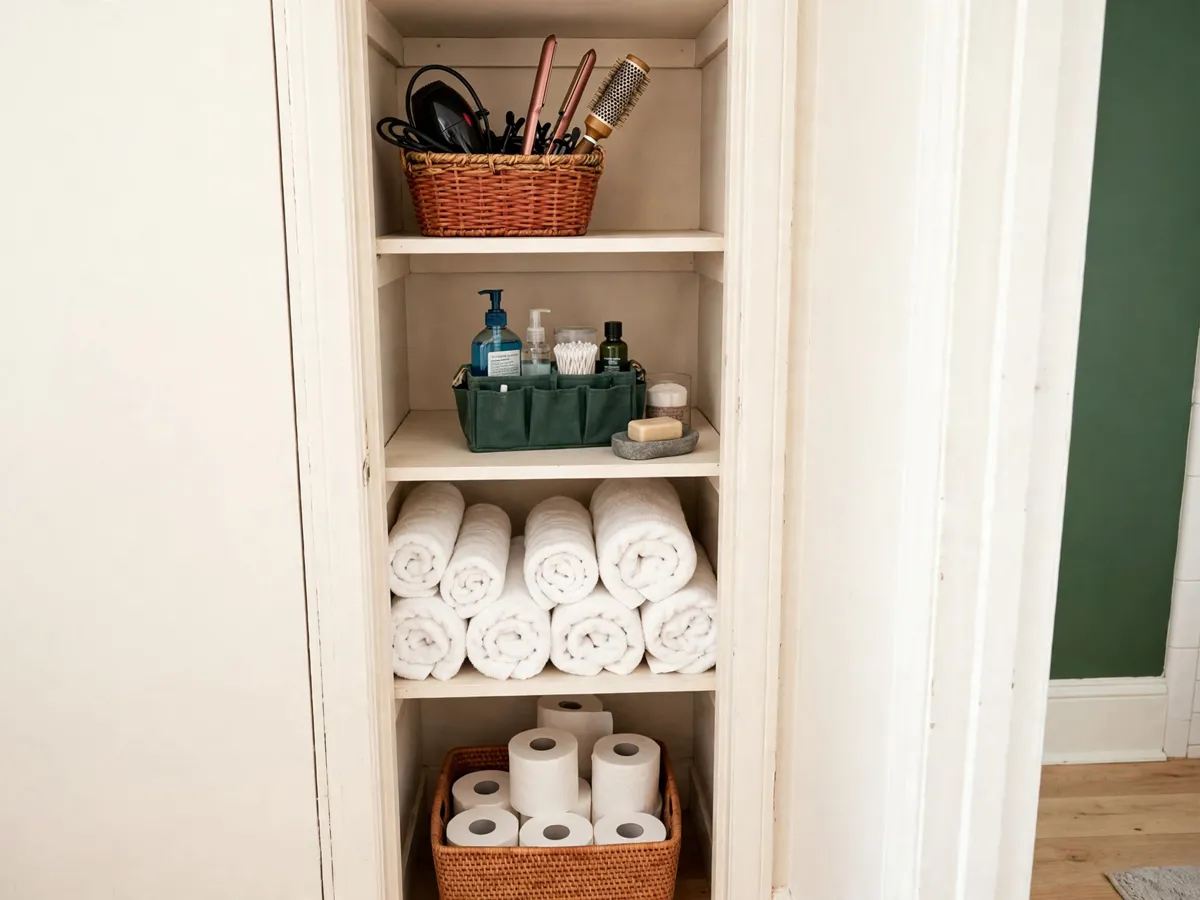
Every closet in a small home is a storage decision, but this one comes with a condition attached. The bathroom closet is the dampest closet in the house. Showers run hot, sinks splash, and the door closes on all of it, so the air inside stays wetter than anywhere else your toiletries could live. That single fact drives every decision on this page.
It decides what goes in. Things that tolerate damp and get used every day belong inside the bathroom: sealed bottles, the daily caddy, the backup bin, the first aid box. Things that damp ruins belong down the hall: paper stock past a few rolls, fabric beyond the hand-towel layer, anything that molds when it sits in humid air for a season.
So the order of work is fixed. Sort by damp tolerance first, zone by frequency second, contain in bins third. Buying the bins before the sort is how a damp closet stays a damp closet, just a tidier one.
Cost: $0. Time: 15 minutes to empty the closet and sort it into keep-in and move-out piles.
2. The Split: Bathroom Closet vs Linen Closet
The bathroom closet holds what the bathroom uses. The linen closet holds what the house stores. That one sentence settles most of the arguments about where a thing lives.
Inside the bathroom closet: daily toiletries, hair tools, the open roll of toilet paper plus one backup bin, the first aid box, and the cleaning chemistry this room needs. In the linen closet: sheet sets, the full towel stock, and anything held back for guests. The hall side is its own project, and the linen closet guide covers it end to end, from the fold to the shelf counts.
The rule that keeps the split honest: anything paper or fabric beyond one week's supply leaves the bathroom. Hand towels and washcloths stay, because they are the layer the bathroom actually goes through daily. Bath sheets, spare towels and all the sheets live down the hall, dry and folded.
Cost: $0. Time: 10 minutes to walk the overflow to the hall closet, in whatever container you already own.
3. The TP Math: How Many Rolls Belong in the Room
Toilet paper is the thing every bathroom closet is really holding, so it deserves actual math. A two-person home works through roughly 8 to 12 rolls a month, and a household of four can double that. Count what your own bathroom really goes through over a month before you size the storage for it.
The number that belongs in the room is small: one roll open in use, plus one bin holding 4 to 6 backup rolls. That is a week and a half of paper in the dampest room, which is as far as honest storage goes. The 24-pack belongs in the hall closet or under the bed, where dry air and spare floor keep it safe and out of the way.
The reason is boring and real. A slow leak, one splash from the sink, or a season of steam ruins paper in a way it never ruins tile. Keeping the bulk stock somewhere dry means the closet never holds more paper than a steamy room can keep dry.
Cost: $8–$14 for one lidded bin. Time: 5 minutes, plus one trip to move the bulk pack out.
4. The Frequency Zones: A Shelf Map
A bathroom closet organized by height is organized by how often you reach. Four zones cover it, and the map stays the same whether the closet is a narrow tower beside the shower or a wide cabinet over the toilet.
The grab zone sits at eye level and below, at the front. It holds the daily products: the caddy or the two front bins, labeled, with nothing buried behind anything. A product you use every morning should come out in one motion with the door half open.
The mid shelves hold the weekly routine: the hair tools basket, skincare backups, the spare soap waiting to come downstairs, and the hand towels and washcloths in their small stack. The top shelf is the rarely-touched zone, first aid and long-term stock, up where little hands do not browse. The floor zone belongs to the cleaning caddy alone, because wet things and heavy things live low, where a spill is a mop job and not a shelf rebuild.
One sentence carries the whole map: the things you touch with wet hands never live above eye level.
Cost: $12–$28 for the bins that hold the map. Time: 20 minutes to zone four shelves.
5. Wet Hands Never Reach High
The wet-hand rule earns its own section because it is the difference between a closet that works at 7 a.m. and one that fights you. Shampoo, body wash, the razor, the face wash, the toothpaste tube you grab mid-shower: all of it lives at grab height or below, in front.
The cleanest way to hold that layer is a handled caddy or two open front bins. A caddy moves to the shower edge and back in one trip. Two open bins, one per person, keep the morning routine from tangling, and open beats lidded here because wet hands and clasps do not mix.
If the vanity drawers are the real daily shelf in your bathroom, the under-sink organization guide does the same zoning for the cabinet below the sink.
Cost: $10–$22 for a caddy or a pair of open bins. Time: 10 minutes, and about two minutes a month to wipe them dry.
6. Hair Tools: Cool First, Then the Basket
Hair tools are the one category with a safety step before the storage step. A curling iron or flat iron goes into storage only after it cools. A hot barrel in a bin, resting against bottles or a cord, is a real fire risk, so the cooldown comes first and the basket comes second.
Give the hot tool a decided place to cool: a heat-safe wall pocket near the outlet, or a fixed spot on the counter away from the faucet. When the tool is cool, the cord wraps around the barrel and stays put with a Velcro tie or a simple loop, and the whole set lives in one basket, the dryer, the iron, the brushes, all of it together.
The basket sits on a mid shelf or up top, wherever it fits, because nothing in it is grabbed with wet hands. If the tools have spread across the vanity instead, the vanity drawer guide covers the counter layer.
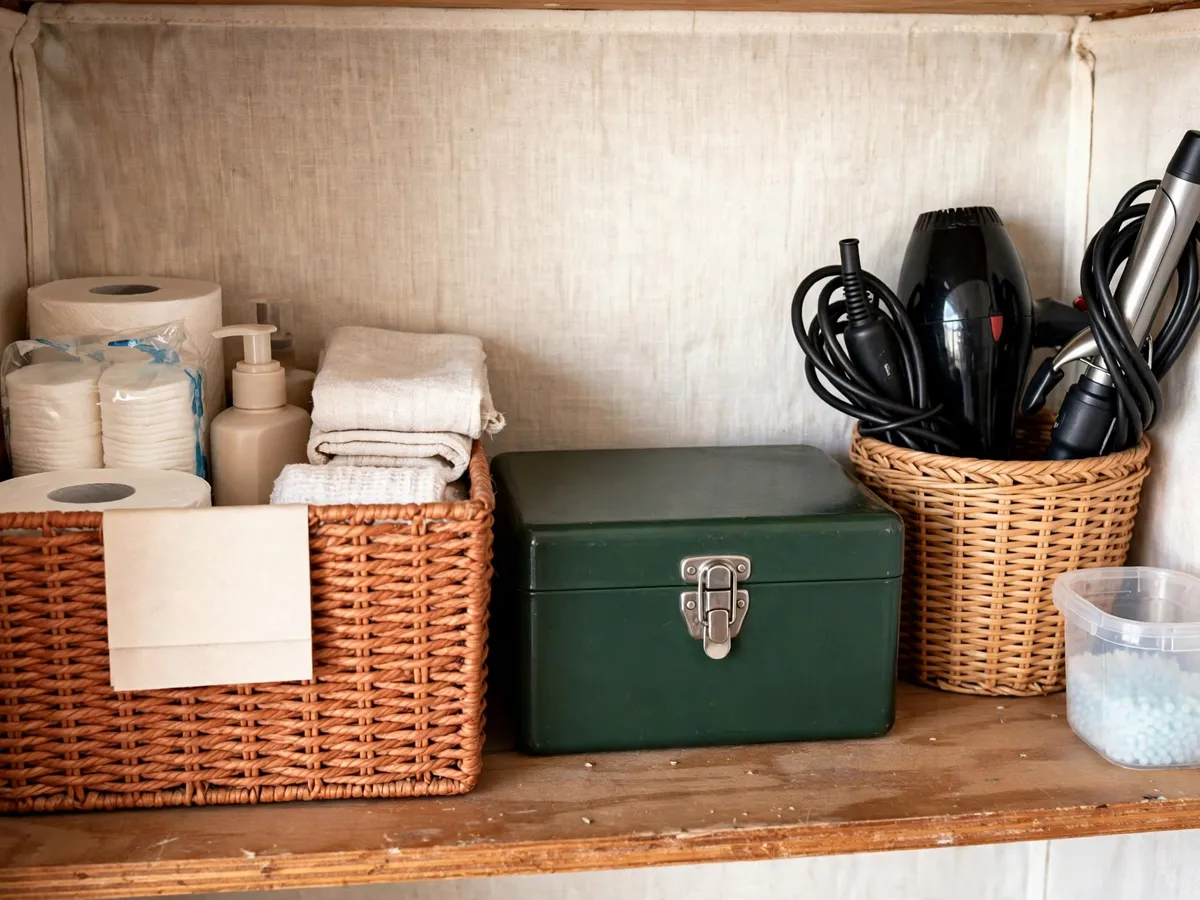
Cost: $8–$16 for the basket, $6–$12 for a heat-safe pocket, $5 for cord ties. Time: 10 minutes.
7. First Aid: Latched and High
The first aid box earns its own shelf or its own container, and it should latch. Bandages, gauze, tweezers, the thermometer, the antiseptic: one box, labeled on the front, so the person reaching for it late at night does not have to dig through bins.
It lives on the top shelf, out of kid reach, and it gets checked twice a year, the same weekend the smoke alarm batteries do. Anything expired gets replaced, and anything missing goes on a list for the next store run.
The bathroom closet is the right room for it. Most small household injuries happen around water and hard edges, in this room and the kitchen, so the kit lives close to where it is needed. Storing it is the whole job here; what goes inside it and how to use it belongs to the kit instructions, not to a closet guide.
Cost: $10–$20 for a latched first aid box. Time: 15 minutes to assemble, 10 minutes twice a year.
8. The Moisture Absorber and the Pill Question
The cheapest item on this page does the most work. A moisture absorber tub, the $5 to $10 kind with the lid off, sits in the corner of the closet and quietly pulls water out of the air. In a bathroom that steams daily it fills within a month or two, and swapping it is the entire maintenance.
Two more damp rules, stated once. Keep pills and vitamins out of the bathroom closet if the room steams up every day, because heat and humidity break them down faster than most people expect. And crack the closet door open after showers whenever it is holding paper stock, so the steam has a way out instead of a place to settle.
Cost: $5–$10 per absorber tub. Time: 2 minutes to set, 2 minutes a month to swap.
9. Chemistry: Never Mixed, Always Low
Cleaning chemistry belongs in the bathroom closet only when it follows three short rules. Bleach-based products and ammonia-based products never share one bin or one shelf, because a leak that mixes them is a real hazard, and closet shelves leak at the worst possible times.
Toilet cleaners live low, on the floor zone, and away from anything oral, so the toothpaste and the mouthwash never share a shelf with them. Nothing caustic lives above eye level, where a tipped bottle has a face to land on.
The wider version of this, the full cleaning closet with the mop clips and the caddy, is the job of the broom closet guide.
Cost: $0. Time: 10 minutes to re-shelf what you already own under the three rules.
10. The Deep Closet and the Turntables
A deep bathroom closet is a different problem wearing the same name. It hides its back half, and a closet that hides its back half becomes a place where things go to be forgotten, so the fix is mechanics, not willpower.
Three tools work. Pull-out bins ride on the shelf and bring the back row to the door. Stackable clear drawers turn one deep shelf into three shallow ones you can see into. And the two-turntable trick, one lazy susan at the front and one at the back, makes every bottle reachable with a spin instead of a reach-and-guess.
Turntables run $10 to $20 each and earn their cost in the first month, because a bottle you can see is a bottle you use. The honest limit: a deep closet organized to the back wall is a closet you will not maintain. Organize the front two-thirds properly and give the back third to the rarely-touched stock, or the whole shelf slides back into the dark.
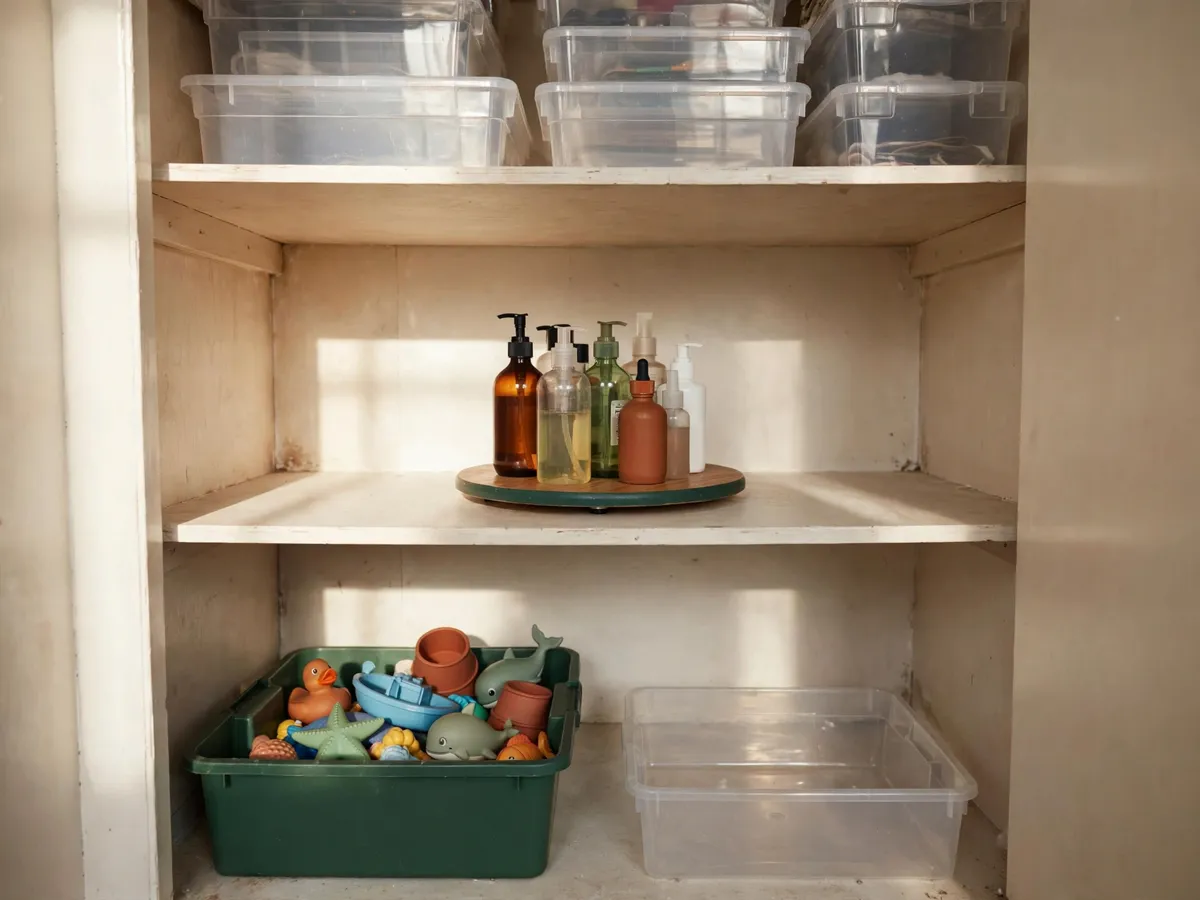
Cost: $20–$40 for two turntables, $10–$20 for a pull-out bin. Time: 25 minutes.
11. The Kid-Height Layer
If kids use this bathroom, the bottom of the closet belongs to them. One open bin at kid height holds the bath toys and the washcloths, and open matters: a child who can drop toys into a bin will do it, and a child facing a latch will leave them in the tub.
The safety side is one rule. In a bathroom children share, nothing caustic, nothing breakable and nothing with a job beyond bath time lives below adult waist height. That includes the cleaning caddy, which normally wants the floor: in a shared-kid bathroom it moves to the top shelf or out of the room entirely, and comes back only for the cleaning session.
Cost: $6–$12 for one open bin. Time: 5 minutes, plus a habit week to make the drop-in stick.
12. What Not to Buy in a Steamy Room
A steamy room deletes half the storage aisle. Closed wooden cabinets warp in a bathroom that steams daily, and the doors stop sitting square within a season or two. Fabric bins hold up fine, but never for anything chemical, because the weave absorbs whatever leaks and holds onto it.
Drawer towers with unlined cardboard backs fail the same way: the cardboard softens where the steam reaches it and the drawers skew. And over-the-door racks, useful nearly everywhere else, are wrong on a hollow-core bathroom door. The door flexes when it swings, the hooks gouge the skin of it, and the rack walks off the top edge before spring.
What survives is the short list: plastic and resin bins, clear stackable drawers, wire baskets, turntables, and one metal heat-safe pocket. Every one of them shrugs off steam, and none of them costs cabinet money.
Cost: $0, this is a do-not-buy list. Time: 5 minutes to read before you shop.
13. What It Costs and How Long It Takes
Here is the honest full reset, priced the way the storage aisle actually sells it. Pick the lines your closet needs; most bathrooms use four or five, not all six.
- Pack of six labeled bins for the grab and weekly zones: $12–$28.
- Two turntables for a deep shelf: $20–$40.
- Latched first aid box: $10–$20.
- Moisture absorber tub: $5–$10.
- Heat-safe wall pocket for the hot tools: $6–$12.
- Lidded backup bin for the TP: $8–$14.
The honest line: this is the one closet where the $5 moisture absorber does more than a $50 organizer. The damp is the underlying problem, and the clutter is just what it gets into first. Buy the absorber before the hardware, and spend the saved money on nothing.
Time breaks down like this: 15 minutes to empty and sort, 10 for the split walk to the hall closet, 20 to zone the shelves, 10 for the caddy and the wet-hand layer, 10 for the hair tools, 15 for the first aid box, and 25 for a deep closet with turntables. About two hours with a break, which is one afternoon, declutter pass first.
Cost: $30–$75 for the whole list, $5–$15 if you start with the absorber and two bins. Time: about 2 hours.
Common questions
How many rolls of toilet paper should stay in the bathroom?
One roll open in use, plus one bin of 4 to 6 backups. A two-person home goes through roughly 8 to 12 rolls a month, so that bin carries a week and a half of paper in the dampest room, which is enough. The bulk pack belongs in the hall closet or under the bed, where steam cannot reach it.
Should towels live in the bathroom closet?
The hand towel and washcloth layer, yes, because the bathroom goes through it daily. Bath sheets, the spare towel stock and the guest set belong in the linen closet, folded and dry. The split is the one-week rule: fabric beyond a week of use leaves the room.
How do I store a curling iron safely?
Let it cool completely first, on the counter or in a heat-safe wall pocket, and never drop a hot barrel into a bin. Once it is cool, wrap the cord around the barrel, secure it with a Velcro tie, and keep all the hair tools in one basket so the cords stop tangling with everything else.
Where should the first aid box go?
Top shelf of the bathroom closet, latched, labeled, out of kid reach. The room is a good home for it because most small household injuries happen around water and hard edges. Check the contents twice a year and replace what has expired.
How do I organize a deep bathroom closet?
Pull-out bins, stackable clear drawers, or two turntables, one front and one back. The honest limit is the front two-thirds: organize that properly and give the back third to rarely-touched stock, because a deep closet organized to the back wall is one nobody maintains.
Can cleaning products stay in the bathroom closet?
Yes, with three rules: bleach-based and ammonia-based products never share a bin or a shelf, toilet cleaners sit low and away from anything oral, and nothing caustic goes above eye level. The floor caddy holds them together only when small children are not using the room.
Save these on Pinterest
Pin the zone map and the wet-hand rule, plus the TP count and the two-turntable trick for a deep shelf. Those are the numbers and the rules you will want when everything is out on the bed and the closet is standing empty in front of you. This guide and the rest of the organization and storage collection live together there.