 Plant As Deco
Home Organization & Storage
Linen Closet Organization: Stock Counts for a 24 Inch Closet
By Plant As Deco · Updated 18 November 2026
A linen closet holds inventory instead of belongings, and that difference changes the whole job. Every other shelf in a small apartment files things you own; this one counts things you use. So the work is arithmetic: how many sheet sets each bed needs, how many towels each person carries, how much depth a shelf wants before a stack stops being reachable, and what leaves when something new arrives. Get those numbers right and a 24 inch closet holds a household's linen without an overflow bin. Get them wrong and the door will not close, however neatly you fold.
Weekend-ready: $0–$45, one weekend morning of 2–3 hours. Renter-safe: no drill and no new shelving, so the closet stays as the landlord left it.
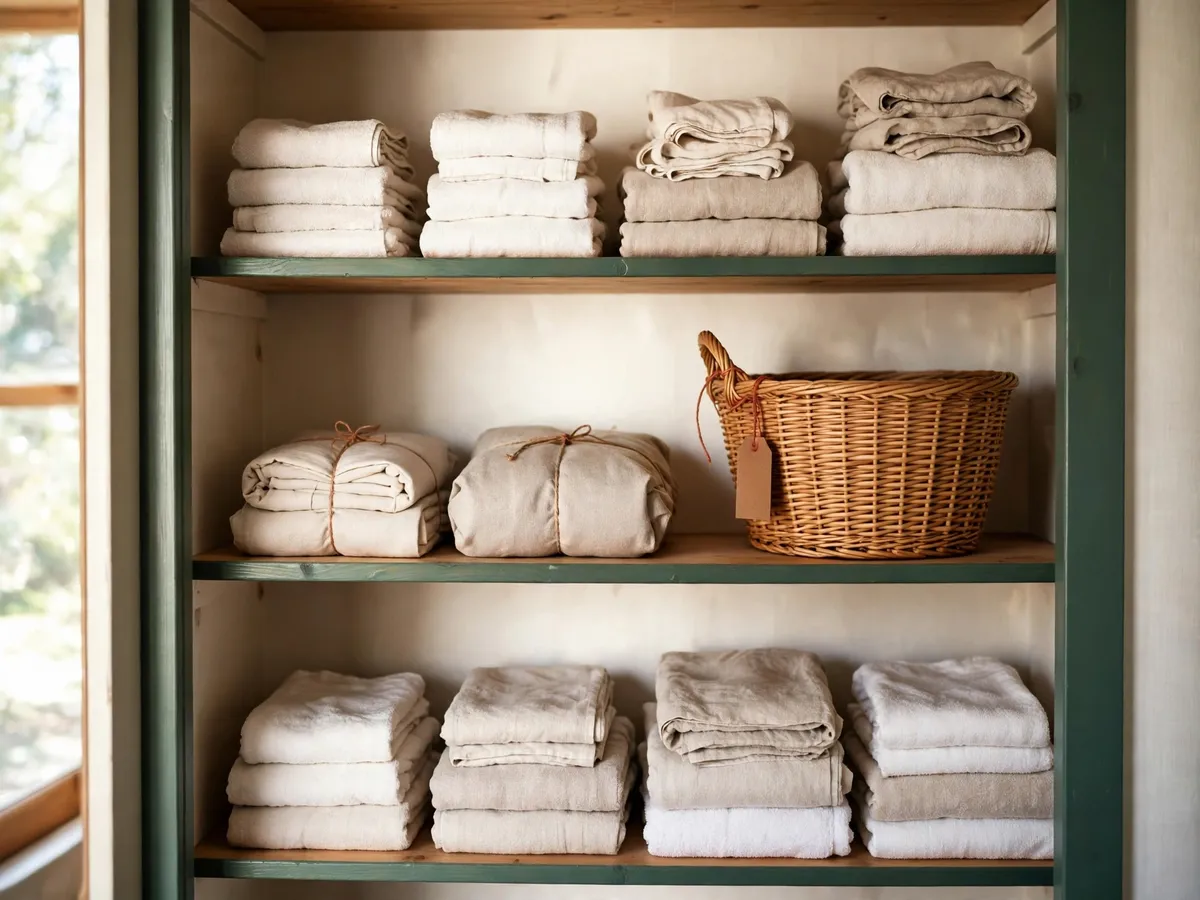
Inventory, not belongings: what that changes
Belongings sort by category. Inventory sorts by count. A towel shelf carries a number per person: two bath towels and two hand towels in rotation, plus one spare that is genuinely clean. Write that number down and the shelf arranges itself. A sheet shelf carries a number per bed: three sets, one a spare you hope never to open.
Units keep the rest of this page short. One unit is one set: a fitted sheet, a flat sheet and two cases that live inside one pillowcase, carrying a label that names the bed size. Three questions do the work. How many sets does each bed need? How much depth does the shelf have? What leaves when a new set arrives? Bins, labels and the restock bin are plumbing for those answers, which is why they come last here.
Cost: $0 if you reuse the bins you own, up to about $45 for four labelled fabric or wicker bins and a roll of shelf paper. Time: 2–3 hours, shopping included.
Measure the closet before you buy a single bin
A standard linen closet is 24 inches wide and 12 to 16 inches deep, with four to six adjustable shelves riding on metal tracks. Two numbers decide how it holds up, and the second is the one people skip. Width tells you how many stacks fit side by side: two 12 inch stacks across a 24 inch closet, with an inch between them. Depth tells you how many fit front to back, and depth is where a linen closet quietly dies.
A 12 inch shelf holds one front-to-back stack, so everything stays visible and one reach away. A 16 inch shelf holds two, and the back one stops existing the week the front one fills. You forget it is there, then buy a spare set you never needed. The rule: the front stack is the rotation, the back is the spare, and a spare you cannot see is not a spare. On a deep closet the back row only counts if it lives in a basket you can pull forward.
Measure in this order. Fold one sheet set and one towel stack on the floor and measure their height: that is your tallest stack. Set the spacing to that plus one inch of lift, never to the shortest. Then check depth against a folded bath towel, which runs about 16 inches across and hangs over a 12 inch shelf. Only now write the bin list.
Cost: $0. Time: 15 minutes with a tape measure. Caveat: measure the inside, not the door opening. The frame steals an inch per side, and a bin cut to the door width will not go through it.
Stock numbers: how much linen a household actually keeps
The working count, per bed: three sheet sets, four pillowcases per sleeper, one duvet cover with one insert, two blankets. Three is not a luxury figure. Two live in rotation, one on the bed while the other is in the wash, and the third covers a spill or a guest who stayed longer than planned. A fourth adds no rotation; it adds a stack you never open, and it eats the tier a blanket needed.
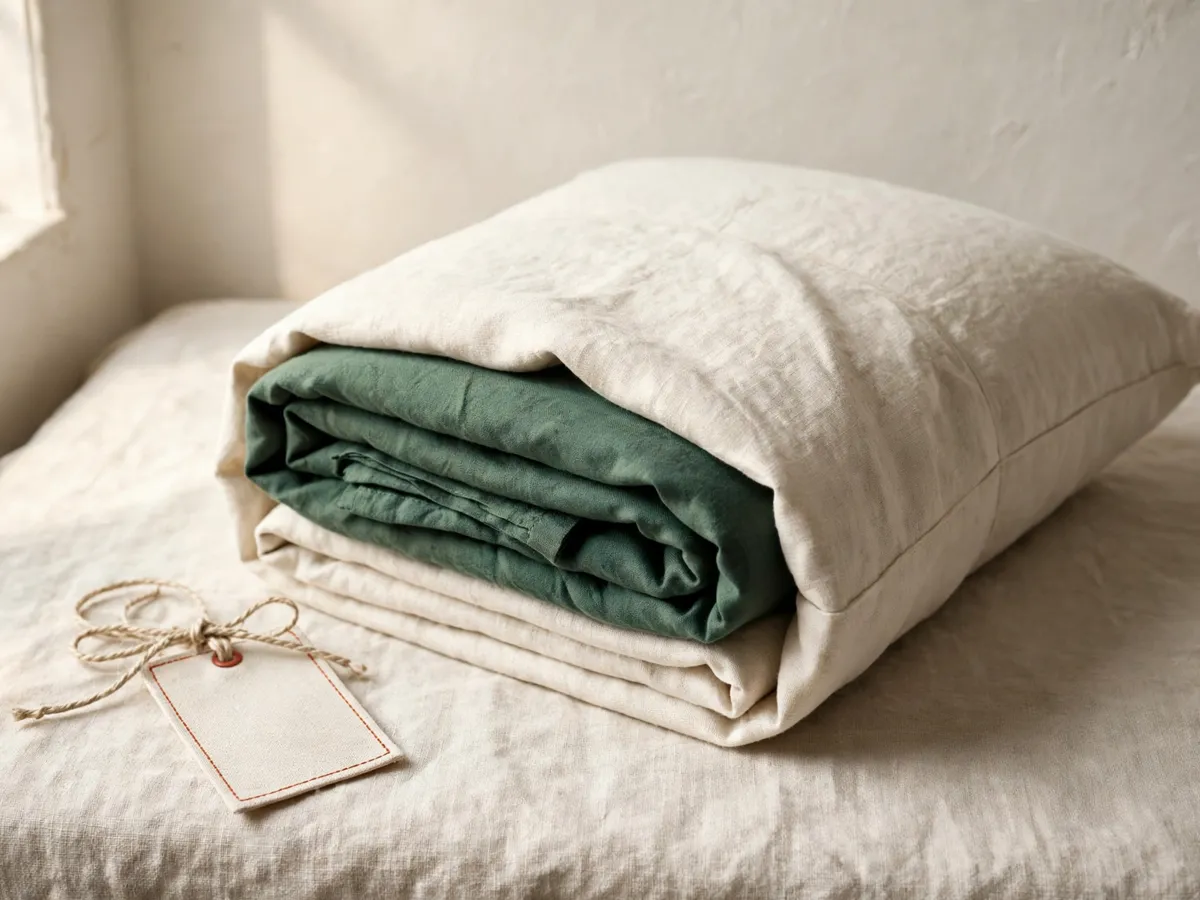
Cases run per sleeper rather than per set: four each, two on the bed and two in the closet. Households get this wrong because a pillowcase wears out faster than a sheet and most people buy them in pairs. Four per sleeper means eight for a couple, with no orphan case left in a drawer.
Bath linen runs per person: two bath towels, two hand towels, four washcloths. A household of two therefore carries four bath towels in rotation, not twelve. The extra eight came from a family house or a big-box clearance aisle, and each one takes shelf height a sheet set could use. Add a third only if you shower away from home, if hard water stiffens towels, or if family sleeps over monthly.
- One bed, two sleepers. 3 sheet sets, 8 cases, 1 duvet cover plus 1 insert, 2 blankets. Two shelf tiers and one 16 inch tier.
- Two people, bath linen. 4 bath towels, 4 hand towels, 8 washcloths. One shelf tier plus one wicker bin for the washcloths.
- Guest allowance. 1 extra sheet set per guest bed you actually make up. Two sets cover most households, and a fifth is a shelf tax you never spend.
- Total shelf demand. Four to five tiers for a couple with one guest set, inside a 24 inch closet at 12 inch depth. That is the whole budget.
The guest rule needs its own sentence, because guilt lives there. Stock for the guest bed you make up, not the guest you imagine. If a sofa is the only spare bed, one set handles it. If you use a real spare room, the linen belongs near it, and the room itself is covered in the small guest room guide. This page only counts the sets, and for most readers the answer is two.
Cost: $0 to count. Time: 10 minutes, pen and tape. Caveat: these numbers assume a normal laundry rhythm. If your wash runs twice a week instead of four, add one set per bed and drop one blanket stack.
How a sheet set stays a set
A sheet set is one fitted sheet, one flat sheet and two cases that only work as a unit. Stored loose they separate inside a month, and unmatched fabric quietly forces you to buy again. So the set travels as one bundle. The classic fold: lay the flat sheet face down, set the fitted sheet on top with its corners tucked in, slide both cases inside, then bring the flat sheet over the parcel. You end up with a rectangle that holds itself shut.
The faster way, and the one that wins in a shallow closet, is to put the whole set inside its own matching pillowcase. Fold the fitted and the flat to the width of the case, push them in, stuff the second case on top. Twenty seconds, and the bundle cannot come apart on a shelf. The pillowcase in your hands is obviously part of the set because it is the outside of it. Use it when depth runs under 14 inches and every stack has to survive being lifted out.
Either way the bundle gets one label, and it carries the bed size and nothing else: TWIN, FULL, QUEEN or KING. Write it on the spine facing out, large enough to read from the doorway, because you read a linen closet standing up and looking down. Folded sets look identical, so a closet overflows almost always because a KING set holds a tier a TWIN set should have.
Cost: $0, using the pillowcase you own. Time: 20 minutes to re-bundle a closet. Caveat: a bundle is only a bundle if the label sits on the outside. A label tucked under a stack is not a label.
The shelf-by-shelf map of a 24 inch closet
Three heights cover everything: 10 inches for a sheet-set stack, 12 to 14 inches for towels, 16 inches for a folded blanket or comforter stack. Set the shelves after measuring your tallest stack, never before, and the closet draws its own map. The mistake is spacing every gap to 12 inches because that is how the builder left it, then forcing a blanket under a sheet tier and crushing the one item you need in January.
Read it from the floor up. The bottom shelf carries weight: the blanket stack, the comforter, the guest set you open twice a year. Eye level is the working shelf, the one you hit every laundry day, holding the two sheet sets in rotation plus the everyday towel stack. Above the eye line sits the spare, one set per bed and one towel bundle. The top shelf is dead space at six feet, so give it one lidded bin for guest linen and nothing you need at midnight.
Keep the lower tiers for heavy fabric and the middle ones for light, and the closet stays stable when you pull something out. A folded towel stack weighs roughly 5 to 8 lb, so a shelf that sags has a span problem rather than a linen problem. The fix is the bracket, and this page does not teach shelving hardware.
One depth rule. On a 16 inch closet, put the rotation stack at the front and the spare in a basket behind it, keeping the front stack short enough that the basket label stays readable. On a 12 inch closet everything is a front stack, which is why a shallow cupboard is easier to keep honest than a deep one.
Cost: $0 to re-space tracked shelves. Time: 30 minutes, two people if the closet is full. Caveat: load the bottom tier first. A closet filled from the top down always ends with the heaviest stack on the weakest shelf.
Fold or bin: which linen goes which way
Flat stacks and bins answer different questions. Fold flat anything you pull as a whole unit: sheet sets, blanket stacks, the guest set. A flat stack shows its own height, so you can see whether a shelf will take it, and a bundle lifted out does not disturb its neighbours. Fold suits anything that travels as a set, which is most of the closet.
Bin anything you pull one piece at a time: washcloths, hand towels in a busy house, spare cases waiting to be paired. A bin keeps loose items from turning a shelf into a mess the second you take one out, and it survives being dragged off a 16 inch back row. The trade is honest: a bin hides its own fullness, and towels packed inside one crush the bottom towel. Choose by how the item leaves the closet, not how the shelf photographs.
One hybrid is worth naming. A deep closet can take a towel stack laid on its side, folded lengthwise, so the fold runs front to back and every towel edge shows from the doorway. It costs two inches of height and buys reach. A wicker or cotton basket also beats plastic on any shelf holding a towel, because the fabric needs air between washes. Folding inside a drawer is its own craft: a drawer has walls, a shelf does not.
Cost: $0 for fold, $6–$14 each for a fabric or wicker bin. Time: 40 minutes to convert a closet from one method to the other. Caveat: do not mix methods on one shelf. Half stacks and half bins reads as clutter from the doorway even when every item is counted.
Containers and labels: breathable or sealed
Three materials, three jobs. Cotton and linen baskets suit bulky items and anything against your skin, because the weave lets air move while keeping dust off. Wicker takes the same load with more structure: it holds its shape on a 16 inch back row and reads as full or empty from the front. Plastic has one job, the spare set that will not see damp, sealed against dust in a closet that stays dry.
Say the plain part once and move on. A sealed plastic tub around a towel stack keeps whatever damp is already in the fabric there, because a towel out of a normal wash is never bone dry in its fibres. Sealing it in holds that moisture against cotton for months. Towels, and any linen that has touched skin, go in a breathable basket or stay an open stack. Plastic is for the wrapped spare sheet set and the guest set, and for nothing you dry yourself with.
A good label matters more than a good container here, because a closed linen closet has no visible contents to navigate by. Two label fields are worth writing and the rest is noise: the bed size on every sheet bundle, in capitals you can read at arm's length, and the rotation date on the spare, a month and a year. A hand-written card on cotton twine, a strip of masking tape, or a paper tag looped through the pillowcase cuff all work. The medium is not the decision; the placement is, and it goes on the spine facing out.
Skip the laminate and the printed icon set. Both break the moment a set changes size. A $10 roll of shelf paper at the back of a tier is the only extra buy worth making.
Cost: $25–$45 for four labelled fabric or wicker bins, about $10 for shelf paper, $0 for tape and twine. Time: 30 minutes. Caveat: buy the bins after the closet is measured and emptied, because a bin sized to a store shelf rarely fits a 24 inch one.
The restock bin and the one-in-one-out rule
Every closet drifts the same way. A clean item leaves the laundry with no home yet, lands on the chair, and the chair becomes the second closet you were trying to fix. The restock bin stops that: one basket, by the closet door or the laundry exit, holding anything clean that has not been bundled, counted or shelved yet. Treat it as a three-inch-tall deadline rather than a storage system.
The rule that makes it work is one-in-one-out. A new sheet set comes onto the shelf only when a worn one leaves, and the same goes for a towel bundle. Buy a fourth set and the third becomes the spare, the second becomes the rotation, the oldest goes to the rag bin. The count stays at three and the closet cannot grow sideways. Without the rule, every warehouse sale adds a stack, and within a year the depth is gone.
Two operating details. Empty the bin the day it fills, or at the end of the laundry session that filled it; a bin that sits for a week has become the shelf it was meant to protect. Keep it open-top, low and shallow, because a lidded bin hides exactly what you need to see. A flat wicker tray or a cotton basket 10 inches tall suits a shallow cupboard.
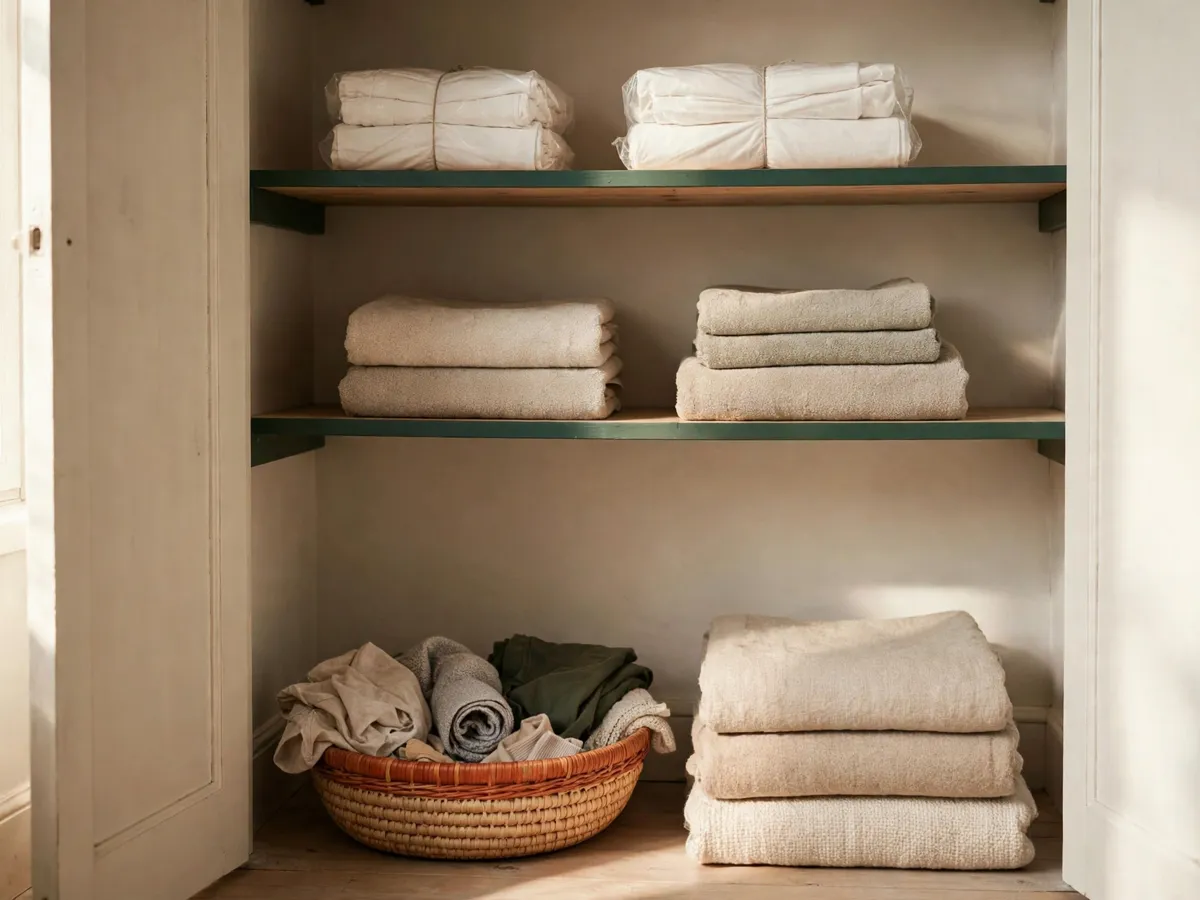
Cost: $0 if a basket already lives here, $8–$14 for a shallow wicker one. Time: five minutes a week. Caveat: one bin only. A second basket in the laundry splits the pile and you will check neither. Bundle and label at the washer, and the bin stays empty.
Air, damp and the twice-a-year count
Linen is fabric waiting to be used, and fabric sitting in a dark narrow cupboard wants two things: air moving past it and a wall that stays dry. Leave an inch between any bin and an exterior wall, so winter condensation on the cold side has somewhere to go instead of soaking into the back of a towel stack. Leave a hand's width under the top shelf so the door's air path stays open. Do not pack a closet to the ceiling; the last six inches are where air stalls and a musty smell starts.
The bathroom is the one location this page rules out. A bathroom cupboard cycles between dry and steamy several times a week, and linen stored there picks up moisture it never fully loses, giving you a musty towel and, inside a sealed tub, mildew within a month. Keep the stock in a hallway or bedroom that shares the home's dry air, and let the bathroom hold only the towel in use today.
Twice a year, at the seasonal swap, run the count. Pull every set out, lay them on the bed, and check three things: elastic, seams, and whether a towel still dries you. A fitted sheet whose band has gone will ride off the corner every night. A seam that has split will not survive one more wash. A towel through its two hundredth load leaves skin damp even though it looks fine. Retire those, write the replacement on the laundry list, and the count returns to what the stock section set. That is the honest end of the purge conversation for linen.
Everything heavier than a sheet, the comforter and the winter blanket, leaves at the same swap and comes back six months later. Where it sleeps for those six months is a different job with its own guide.
Cost: $0. Time: 25 minutes twice a year. Caveat: if a set comes back smelling, wash and dry it fully before it re-enters the shelf. Returning damp linen to a closed closet restarts the problem inside a week.
What we skip
Five adjacent jobs look like they belong in a linen guide and do not. Each has its own page, and the hand-off keeps this one to one weekend morning.
- Off-season storage. The comforter and the winter blanket leave the closet twice a year, and where they sleep for those months is the job of the off-season swap guide, rotation calendar included.
- The closet your clothes live in. Hanging zones, the nightly reset and the shelf units that hold garments belong to the small closet reset. This page fills the shelves around it.
- The towel in use today. A rack, a hook and the under-sink basket are the bathroom's business, covered in the small bathroom guide. This page owns the stock while it is unused.
- The keep-or-let-go decision. Linen gets counted and retired twice a year, nothing more. The rule for every other object is the room-by-room declutter.
- Folding inside a drawer. The vertical file-fold, the divider grid and the shallow tray are the drawer guide. Here, fold means flat stacks on an open shelf.
The weekend checklist: 2 to 3 hours, $0 to $45
Run it in this order. Every step names its minutes, so you can stop at the halfway point on Saturday and finish on Sunday.
- 0:00–0:15 — Empty the closet onto the bed: every set, every towel, every bin. Nothing stays on a shelf to be judged later.
- 0:15–0:30 — Measure width, depth and the tallest folded stack, and write the three numbers down before you touch a shelf.
- 0:30–0:45 — Set the shelves to 10, 12–14 and 16 inches, heaviest tier at the bottom.
- 0:45–1:05 — Count against the stock list: 3 sheet sets per bed, 4 cases per sleeper, 2 blankets, 2 bath towels per person.
- 1:05–1:25 — Bundle every set inside its own matching pillowcase and label the spine TWIN, FULL, QUEEN or KING.
- 1:25–1:40 — Send the wrong-size sets and dead elastic out that morning, into one rag bin or one donation bag.
- 1:40–2:00 — Place the stacks: rotation at eye level, spare above, blankets and guest linen on the bottom shelf.
- 2:00–2:15 — Set the restock bin by the closet door and write the one-in-one-out rule inside it, in pencil.
- Twice a year — Recount, check elastic and seams, and retire what no longer dries you.
Cost: $0 if the baskets are already in the apartment, $25–$45 with four labelled fabric or wicker bins and $10 of shelf paper. Time: 2–3 hours. Caveat: shop only after step three. Buying bins first is how a closet ends up with three sizes of basket and a door that will not close.
Linen closet questions, answered
How many sheet sets should I keep per bed?
Three. Two in rotation, one on the bed while the other is in the wash, and the third covers a spill or an unexpected guest. Add one only for a guest bed you actually make up. A fourth set on the same bed is a stack you never open, and it takes the tier a blanket needed.
What height should linen closet shelves be?
10 inches for a folded sheet-set stack, 12 to 14 for towels, 16 for a blanket or comforter stack. Measure your tallest stack first, add an inch of lift, then set the shelves to that. Spacing every gap to 12 inches because the builder left it that way is why a blanket ends up crushed under a sheet tier.
Should towels live in plastic bins?
No. A towel out of a normal wash is never bone dry in its fibres, and a sealed tub holds that damp against cotton for months. Towels and anything that has touched skin go in a breathable cotton, linen or wicker basket, or stay an open stack. Reserve plastic for the wrapped spare sheet set and the guest set.
What do I do with a fitted sheet whose elastic has gone?
Retire it, and the set with it if the flat and the cases are the same age. A band that has gone will ride off the corner every night, and no fold fixes it. Cut the flat into cleaning cloths if the fabric is sound, slide the replacement into its own pillowcase the day it arrives, and the count returns to three at the next restock instead of dropping to two.
How often should I count the linen stock?
Twice a year, at the seasonal swap: about 25 minutes each time. Count the sets against the per-bed and per-person numbers, check elastic and seams, and feel for a towel that no longer dries you. Between those passes the restock bin and the one-in-one-out rule do the work, and all you owe the closet is emptying the bin the day it fills.
Save these on Pinterest
Pin the stock numbers first, because the count is the one move that stops a linen closet creeping back to four shelves in a month. The rest of the Organization & Storage collection holds the closet map, the container ladder and the room-by-room reset this page hands off to.