 Plant As Deco
Home Organization & Storage
Vanity Drawer Organization for Makeup and Jewelry: Fit What You Own
By Plant As Deco · Updated 18 November 2026
A vanity drawer is a box with three numbers in it, and almost every messy makeup drawer we have opened failed on one of them: a bottle two inches taller than the divider, a palette that will not lie flat behind standing tubes, or a jewelry pile that has braided itself for a year. This page works with the drawers you already have, and no acrylic set gets ordered until the layout has held for two weeks. Measure the box, purge what has finished, build dividers from an egg carton and a jam jar lid, then lay the makeup out by how often you reach and the jewelry by how badly it tangles.
Weekend-ready: $0–$35, one evening. Renters: no new drawers, no drilling, nothing glued to the veneer, every piece removable at move-out.
Measure the drawer box before a divider enters the room
Three numbers per drawer, and the third is the one everybody skips. Interior width left to right, interior depth front to back, and clear height from the drawer floor to the underside of the vanity rail, not the wood you see when the drawer is shut. On most vanities the box sits above the visible front line, so usable height runs an inch and a half under what the front suggests.
Write the numbers on masking tape inside the drawer, because you will shop from a phone and remember none of them. A small bedroom vanity commonly runs 16 to 24 inches of interior width and 10 to 14 of depth, and on a two drawer vanity the top box usually gives 3 to 4 inches of clear height against 5 to 7 below.
Then check the front edge. Plenty of drawer boxes have a scalloped rail that swallows the first inch and a half, so a tube standing flush at the front rolls under the curve every time the drawer shuts. Slide a ruler in until it hits the rail, tick that point on the sidewall, and keep the first row behind it. A divider picked from a store photo, with no number behind it, is why a drawer still reads as cluttered after you have paid for one.
Cost: $0. Time: 10 minutes with one tape measure. Caveat: a curled liner corner reads as depth you do not have, so measure with the liner lying flat.
The purge: what has finished, and what is only sleeping
Organizing expired makeup is organizing a pile you will re-sort in a month, so the purge runs first. The rough clocks: mascara and any wet wand every 3 to 6 months, liquid foundation and cream blush around 12, lipstick one to two years, pressed powders and eyeshadows longer. Treat those as habits, not laws. The check that decides is sensory: if the smell is off, the texture has gone grainy, separated or sticky, or the color has shifted, let it go.
Do not taste-test anything, and do not keep a product because it is "probably" still fine. Twenty-two products you reach for twice a week are worse than nine you actually use, and the doubt items are precisely the ones you never open again.
The second pile is harder because nothing is wrong with it: the unopened birthday palette, the bright shade bought for one wedding, the travel size waiting for a trip never booked. That is sleeping makeup, not expired makeup. It leaves the drawer for a backup box on a high shelf, date on the lid, and returns only when something in the drawer retires. Keeping both in one compartment is why the drawer floods again by spring.
If the pile on the bed is bigger than two drawer loads, the vanity is not the problem. The room-by-room declutter checklist owns that job; this page only needs the makeup and jewelry subset cleared before the dividers go in.
Cost: $0. Time: 20 to 30 minutes with everything out on the bed. Caveat: a purge done in dim light keeps the tubes that look fine and loses the ones that are not, so work at the mirror with the lamp on.
Dividers you already own, before you spend a cent
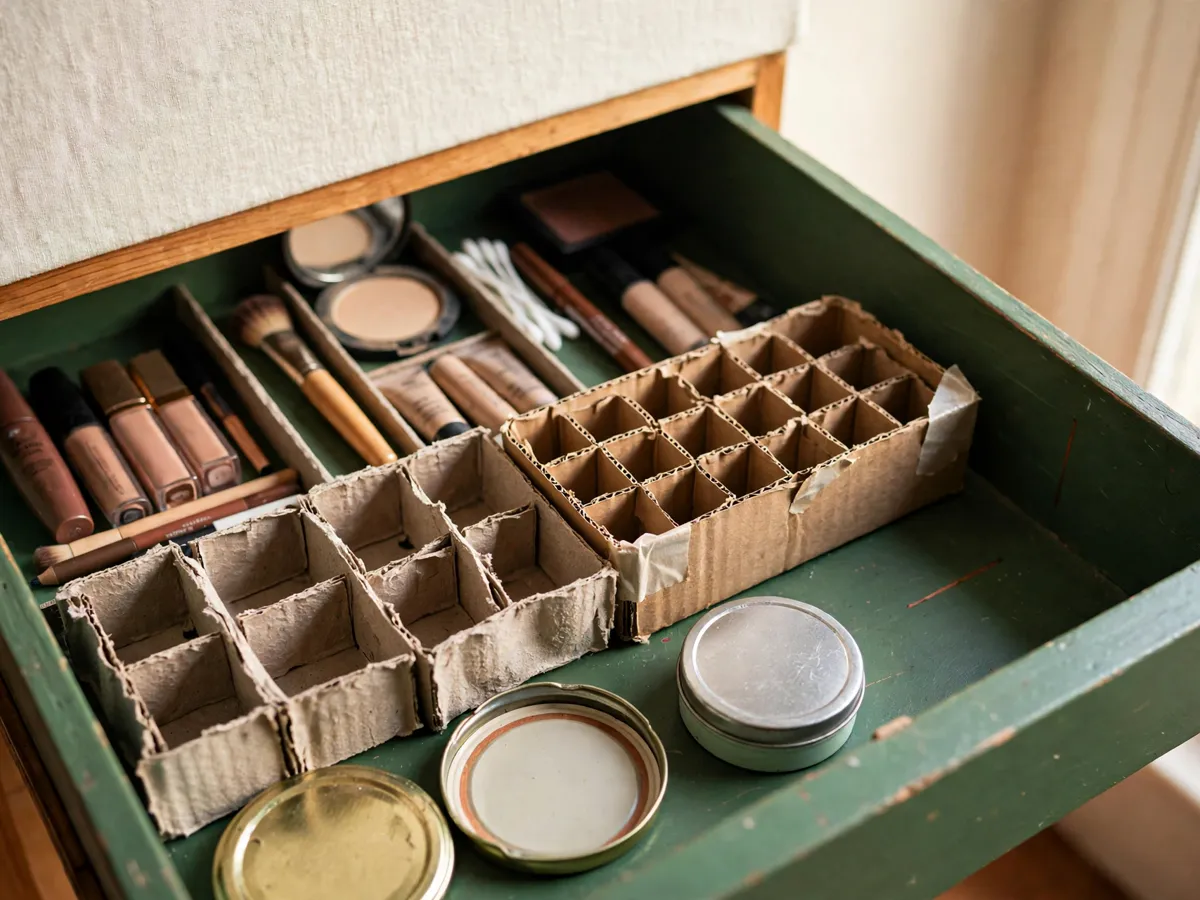
Compartments come out of the recycling bin more often than out of a store. A blister-pack pill organizer is a set of shallow compartments sized for lip products. A mint tin holds rings, studs and hair pins at the front of the drawer. A jam jar lid, flat on the floor, is an earring dish. An egg carton cut to a strip of six cups is the cheapest divider wall in the house, and it gives a compartment to every pair of earrings you own.
Yogurt lids and the plastic rings from a jar multipack stack flat and grip without adhesive. The cardboard insert from a wine bottle is a straight divider wall two inches tall, right for a compact row. And check whether the vanity shipped with a lift-out tray, because plenty of two drawer vanities have one and it is the best compartment you already paid for.
Cut carton strips to the interior width you measured, never to a guessed one. Half an inch short and the strip floats, an inch long and it wedges under the rail and bows the tray. The honest limit: carton and tin do not survive a wet cloth. If the makeup drawer gets wiped monthly, carton is a six-month solution, bamboo a five-year one, and acrylic a lifetime one you have not earned yet.
Cost: $0 from the recycling bin, $8–$18 for a bamboo insert set. Time: 15 minutes. Caveat: a divider taller than the front row hides the products lying flat, and a product you cannot see is a product you buy twice.
Sort the makeup by how often you reach, not by what it is
Sorting makeup by category, all eyes together and all face products together, is how a concealer ends up buried behind three eyeshadow palettes. Sort by frequency instead, in three bands front to back.
The front band, the first four inches behind your pencil tick, is the daily tier: the foundation you use every morning, one brow pencil, one lip color, the mascara in rotation, the powder that keeps the shine down by mid-afternoon. Anything touched in the last seven days lives here, laid flat in one visible layer.
The middle band is the few-times-a-week tier: the eyeshadow quad, the contour duo, the blush you alternate in, the false lashes and their glue. One shallow compartment or carton cup each, sitting low so the daily row stays visible. The back band is the monthly tier and the big items: full palettes, the setting spray, spare cotton pads in a flat pouch.
Tall bottles go at the back of the deep drawer, flat compacts at the front of the shallow one, and nothing sits behind anything taller than itself. Upright or flat is a shape decision: round tubes, wands and brushes stand in a cup or a snug carton strip so they cannot roll, while rectangular palettes lie flat, because a standing palette leans on its neighbor until the lid pops.
Run the one-touch test before calling it finished: every daily item reachable without moving another piece. If lifting a palette is the only way to get the concealer, the concealer is in the wrong band. The same logic scales across the flat, and the drawer guide tapes the eight-drawer version of it.
Cost: $0. Time: 25 minutes to place the three bands. Caveat: a daily band with more than about nine products is really two bands, and the honest fix is fewer products in the front row.
The jewelry drawer: tangles, pairs, and silver that hates damp
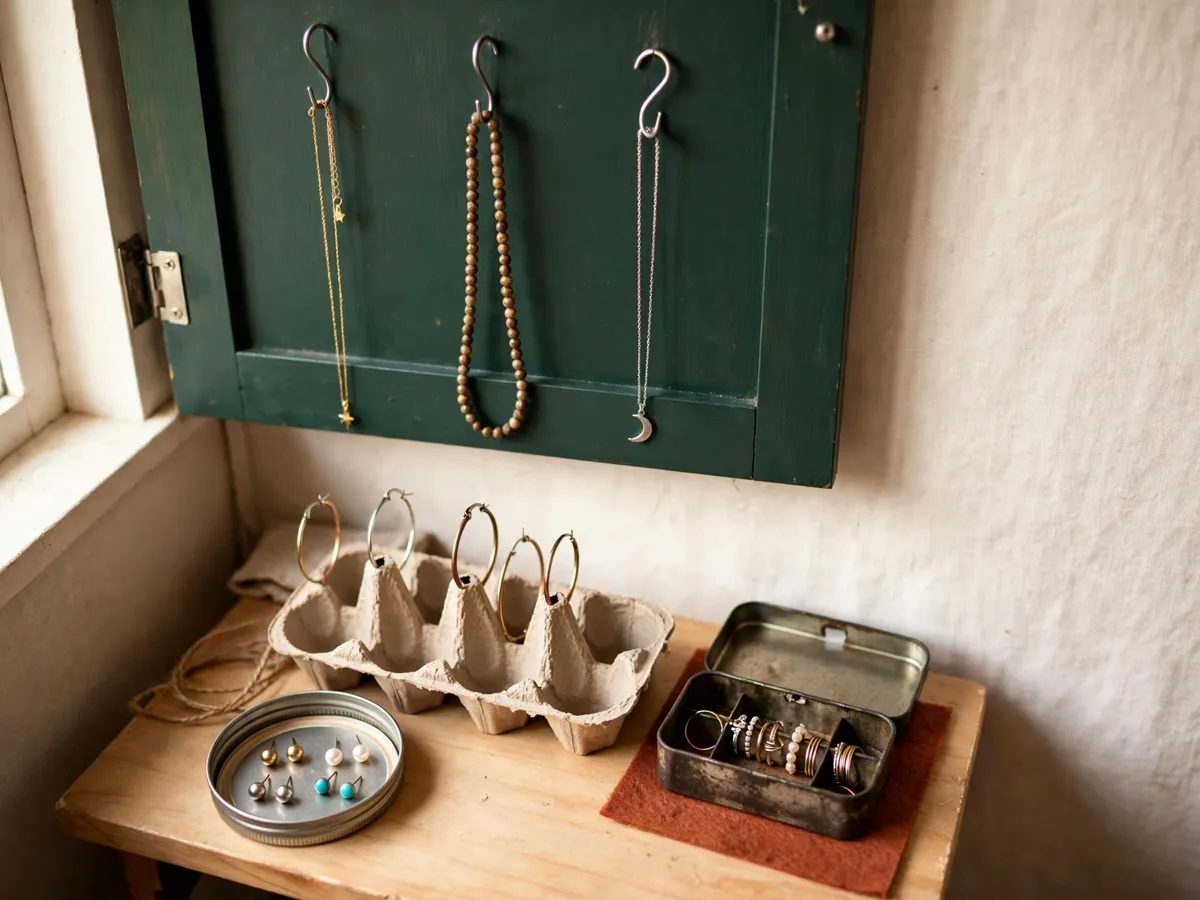
Jewelry fails in a drawer for one reason: contact. Chains rub chains for a year and the result is a knot no careful pinching undoes. So the jewelry zone is built from separation, and the cheapest separator is air. A row of S-hooks inside the vanity cabinet door takes every long necklace out of the box: four hooks, four necklaces, the longer pendants on the outer hooks.
Everything short stays in the drawer, each type in its own compartment. Stud earrings live in a shallow dish, one pair per section, so a match is never hunted twice, and a jar lid is that dish. A pill compartment holds the singles waiting for partners to turn up in a coat pocket. Hoop earrings stand in the cups of the cut egg carton strip, one earring per cup, and a dangle earring hooks over the rim of a tin.
Rings want walls, because a loose ring rolls under a tray and reappears only at cleaning time. A small tin, an ice-cube tray section or a strip of carton glued into squares all work. Keep the ring you wear daily in the front compartment and stand thin bands in a tin so they cannot scratch each other.
Bracelets stand rather than lie. A chain bracelet coiled flat knots by spring; wound around a short carton tube, or over two carton rings, it stays open and readable. A bangle keeps its circle, which is why a mug on the vanity top holds them well. Cuff and beaded bracelets lie flat in one row at the back, separated by a divider strip.
Silver and most costume jewelry dislike damp, and a bedroom vanity against a bathroom wall is the dampest good spot in a small apartment. Keep the silica packet from a shoebox lying flat in the silver compartment, swap it yearly, and leave the drawer cracked open on humid weeks. If the vanity sits inside the damp room itself, the moisture advice in the small-space bathroom guide applies to the drawer contents as much as the shelf.
Cost: $4–$10 for a pack of S-hooks; the dishes, tubes and tins are reuse. Time: 20 minutes. Caveat: an adhesive hook rated for a light necklace still pulls its backing off a textured door panel, so test one hook under load for a week.
Hair ties, clips, and the small kit that keeps disappearing
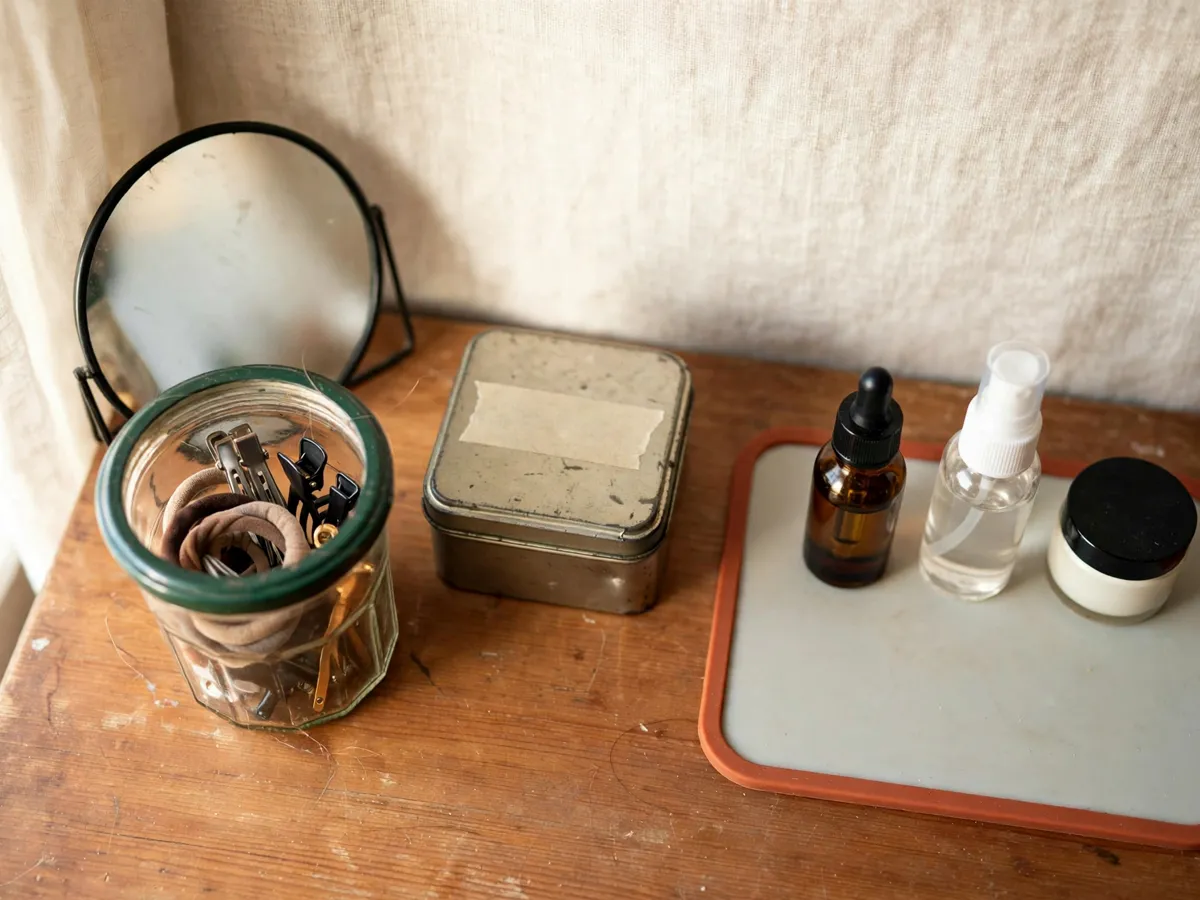
The hair tier loses a drawer fastest, because hair accessories are small, light and shared by everyone in the flat. One cup solves it: a tin can, a jam jar with the lid off, or a ceramic cup at the front-right of the shallow drawer, holding every hair tie, claw clip, bobby pin and scrunchie in one address. Hair does not need compartments; it needs a single named place.
Two rules keep the cup honest. One cup per vanity, not one per person, because three cups in a 20 inch drawer become a new jumble. And empty it once a month: any elastic gone wavy, any clip with a cracked spring, leaves.
Beside the cup sits the small kit: a lidded tin about four inches square holding the needle-and-thread card, cotton swabs, the nail clipper, tweezers, the emery board and the spare earring backs. Put a label on the lid, pen on masking tape, so it survives the wipe-down and tells the rest of the flat what lives there. Bulk cotton pads belong with the rest of the cotton in the under-sink system, and the drawer keeps only the day's worth.
Cost: $0, using a tin and a jar you own. Time: 10 minutes. Caveat: an open cup in a deep drawer tips when the drawer slides hard, so the cup lives in the shallow drawer or on the tabletop.
The 2 inch drawer: lay it flat and build a tier
Some vanities give the top drawer only 2 to 3 inches of clear height, and the instinct is to force bottles upright anyway. Resist it. A 4 inch foundation bottle in a 2 inch drawer lies on its side, rolls every time the drawer moves, collects product in the cap and works through any divider wall in front of it.
Everything in a shallow drawer lies flat: palettes, compacts, blush pans, the tray of rings, the stud dishes. Anything taller moves out, to a cup on the vanity top or the deep drawer below. Then build a tier so the back row stays visible. Two carton trays, one behind and above the other, make a two-step staircase in a minute, and three jar lids on a carton strip lift the front row half an inch. No more than that, or the tray tips when the drawer closes.
A shallow drawer also suits the jewelry zone better than a deep one, because nothing sinks out of sight. Two drawers and one is shallow? Give the shallow one to the jewelry and the daily makeup, the deep one to bottles. That swap fixes more vanity drawers than any divider purchase.
Cost: $0. Time: 15 minutes. Caveat: a loose tier slides forward every time the drawer shuts and buries the front row, so stick the riser down with a tab of putty.
Renter rules: nothing drilled, nothing glued to the veneer
A rental vanity is usually veneer over particleboard, and that finish peels in one sheet when an adhesive strip is pulled at move-out. So the jewelry hooks never go on the drawer box. They go on the inside face of the cabinet door if it is smooth painted wood, they hang over the door edge on an over-door rail, or the necklaces stay coiled in tissue in their own compartment.
Adhesive strips are rated by surface as much as by weight. On a smooth painted panel they hold a light necklace for years; on textured wallpaper or warm veneer against a sunlit wall the rating drops and the strip can take a fleck of finish with it. Test one strip in an unseen corner, load it, and leave it a week. The same leave-no-trace logic runs through the whole renter-friendly guide.
Inside the drawer nothing sticks to the wood. Dividers sit loose, or take one blob of reusable putty per foot that lifts off with a fingernail. A silicone mat under the hair cup and the bottle row stops the cup sliding into the divider and catches the wet base of a bottle before it dries into a ring for the rest of the lease. Everything here packs into one shoebox in ten minutes.
Cost: $0–$10 for a mat and putty. Time: 5 minutes. Caveat: putty left on veneer through one hot summer hardens and can chip the finish when scraped, so use it on painted drawer floors only.
What we skip
Five adjacent jobs have their own pages, and the hand-off keeps this one to two drawers and one evening.
- The full acrylic set. A twelve-piece matching tray set runs $60 and up and is the wrong buy before the layout has run for two weeks. Buy one insert after the carton version has proved its shape.
- The label machine. A pen and masking tape on the backup box does everything a $30 label gun does. Labels earn their place where someone besides you needs to find something, which on a shared vanity means the kit tin and nowhere else.
- The furniture decision. Which vanity to buy, and whether a two drawer model beats a table with one deep box, is the small bedroom vanity guide. This page works with whatever is already against your wall.
- The dresser swap. If makeup has outgrown the vanity drawer, a chest of shallow drawers is the other answer, laid out in the dresser ideas guide.
- The wardrobe side of jewelry. Rings and earrings you wear a few times a year live in a box on a shelf or a hanging divider, and that system is the beginner closet layout. The vanity drawer keeps only what you reach for weekly.
What it costs: $0 to $35, and where the money is not
The free version is complete. Carton strips, a cut egg carton, three jar lids, two tins, the jam jar for the hair cup and the pill organizer you already owned: a working makeup drawer with real compartments, bought with an evening rather than a budget.
The paid version adds durability, not capacity. S-hooks run $4–$10, a bamboo insert set for a 20 inch drawer $12–$22, a silicone mat $5–$10, which is why the ceiling printed at the top of this page is $35. A matching acrylic set for one drawer runs $60 to $90 and arrives in the compartment sizes the store chose rather than the ones your drawer box has.
The money is not in the container; it is in the purge, and the purge is free. A drawer emptied of twenty sleeping products needs fewer dividers than one that keeps them, and a $90 acrylic set inside a drawer that overflows again by February is the most expensive way to organize a drawer that was never going to hold. If the budget stretches to one buy, make it the S-hooks.
Cost: $0–$35 total. Time: one evening, 60 to 90 minutes. Caveat: buy the permanent divider only after two weeks, because the second week is when you learn which band actually needed the wall.
The one-evening checklist: copy this and run it in order
Order matters more than speed here. Measuring before shopping keeps the divider list at three pieces instead of twelve.
- Measure each drawer box: interior width, interior depth, clear height to the underside of the rail. Tick the scalloped front edge on the sidewall and write the numbers on tape inside.
- Empty everything onto the bed in good light. Pull the expired: mascara and wand products past 3 to 6 months, liquids past about a year, anything that smells off. When in doubt, let it go.
- Send the sleeping pile to a backup box on a high shelf, with a label and the date on the lid. It returns only when something in the drawer retires.
- Build the dividers from what you own: carton strips cut to the interior width, six cups of egg carton for the earring row, jar lids for stud dishes, one tin for rings, the jam jar for the hair cup.
- Lay the three frequency bands in the makeup drawer: daily at the front, few-times-a-week in the middle, monthly and the big palettes at the back.
- Separate the jewelry: long necklaces onto S-hooks inside the cabinet door, one compartment per pair for everything else, bracelets standing on carton tubes, the silica packet flat in the silver compartment.
- Test the veneer before committing: one adhesive strip in an unseen corner, loaded with one necklace, for a week. Inside the drawer keep dividers loose and lay the silicone mat down.
- Run the one-touch check, then leave the layout alone for two weeks. Only then buy the bamboo insert or the one extra divider the drawer has actually asked for.
Cost: $0–$35. Time: 60 to 90 minutes. Caveat: if the evening runs long, stop after step five, because a measured drawer with a working makeup layout beats a perfect jewelry drawer at midnight.
Vanity drawer questions, answered
How do I keep earrings paired instead of hunting for the second one?
One compartment per pair, and the pair never splits. A jar-lid stud dish holds two studs side by side, a cut egg carton gives one cup to each earring, hoops stand in their own cups, and dangles lie flat in a tin. If a pair has to share a compartment, the drawer is too small for the collection, and the honest fix is fewer pairs out rather than more dividers in.
Should skincare live in a mini fridge instead of the drawer?
Only for the few products that ask for it. A closed drawer away from a sunlit window and a radiator holds most creams and serums fine, while a mini fridge costs counter space, a plug and a low hum beside the bed. Keep it products-only and leave the vanity drawer to makeup and jewelry.
My vanity has no drawer at all. What now?
Run the identical layout on the tabletop: a front tray for the daily makeup, a middle tin for the few-times-a-week tier, a back basket for palettes and the bottle. The hair cup and the jewelry tin sit at the front edge, the long necklaces on a rail beside the mirror. On a 30 inch tabletop that needs about 12 inches of depth.
How often do I have to redo this?
Twice a year for the layout, five minutes a week for the daily row. The seasonal pass covers the hair tier and the sleeping makeup swapping in and out. A drawer that needs a full rebuild every month is carrying more than the box can hold, and the answer is the backup box again, not a bigger organizer.
Is it a problem to store makeup in a hot room?
Heat wears products down faster, and a closed drawer is usually cooler than a windowsill. Heat softens lip balm and cream blush and separates liquid foundation, so keep the drawer shut through the hottest part of the day, keep the vanity off the sun-facing wall, and move anything that visibly softens to the coolest drawer in the flat.
Save these on Pinterest
Pin the measuring step and the three frequency bands first, because those two decide everything downstream. The rest of the Organization & Storage collection holds the drawer resets, the entryway drop zone and the closet layout this page hands off to.