 Plant As Deco
Organization & Storage
Over-Toilet Storage Ideas for a Small Bathroom: What Fits Above the Tank
By Plant As Deco · Updated 19 November 2026
The wall above the toilet tank is the most underused surface in a small bathroom. It sits empty because nobody wants to drill into tile, and it sits empty because the wrong shelf turns a tight room into a cluttered one. This page plans over-toilet storage on the measurements first — the tank width, the tank height, the wall clearance — and then picks the ladder, cabinet, floating shelf or towel bar that fits the space without crowding the room.
Weekend-ready: $30–$140, one afternoon. Renter-safe: every option here has a no-drill alternative, and the drilling pieces name their renter substitute.
1. Measure the space before you buy anything
Four numbers decide what fits above the toilet. Write each one down before any shelf or ladder shows up, because the wrong dimension is the mistake that turns a storage solution into a return trip:
- Tank width — measure the tank side to side at its widest point. Most tanks run 18 to 22 inches wide; an older compact tank may be 16. The shelf above the tank should be at least as wide as the tank, never narrower.
- Tank height to wall — measure from the top of the tank lid straight up to the ceiling or to the bottom of any existing fixture. This is the vertical space available. Most bathrooms give 28 to 40 inches above the tank before something stops you.
- Wall depth from the tank face — measure how far the tank sticks out from the wall. A shelf that is deeper than the tank sticks into the room and into heads and shoulders. The shelf depth should match the tank depth, usually 7 to 9 inches.
- Distance from the tank to the side wall or vanity — the clearance on each side of the tank. A ladder shelf needs 26 to 30 inches of floor space to stand; a wall unit needs only the wall behind the tank.
The smallest of these four numbers sets the ceiling on what the space can hold. A bathroom with 28 inches above the tank and a side wall 24 inches away cannot take a tall ladder — it takes a wall shelf or a short cabinet. The bathroom organization guide covers the broader room setup; this page focuses only on the zone directly above the tank.
Cost: $0, or $8 for a tape measure if you do not own one. Time: 15 minutes with a tape and a pencil.
2. Choose the style: ladder, cabinet, shelf or bar
Four styles dominate over-toilet storage, and each one solves a different problem. The ladder leans and holds towels; the cabinet hides toiletries behind doors; the floating shelf displays a few pieces; the towel bar does one job and does it well. Pick the style by what the bathroom actually needs, not by what looks best in a catalog:
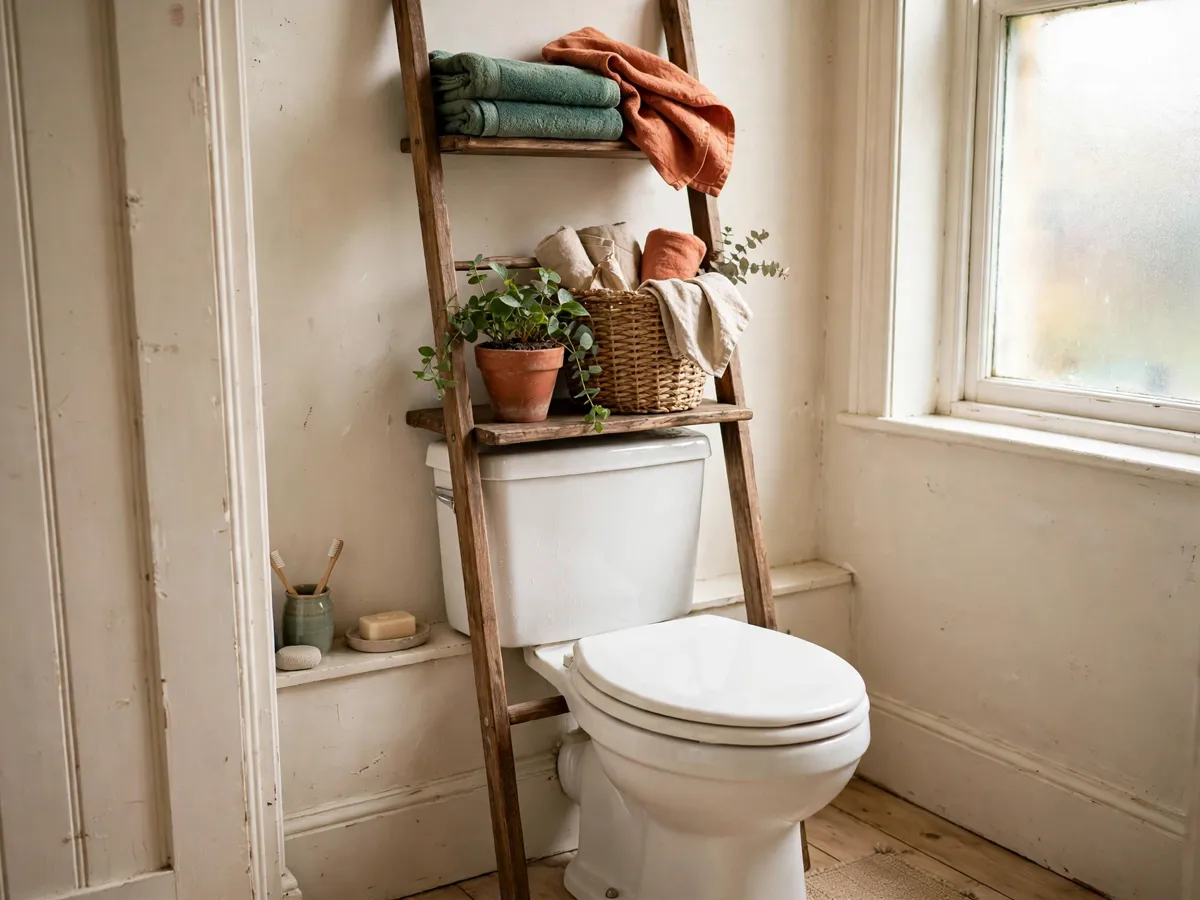
- Ladder shelf — a freestanding A-frame that leans against the wall above the tank. Holds towels, baskets and toiletries on three or four rungs. No drilling, renter-safe, and it moves when you move. The trade: it needs floor space the others do not.
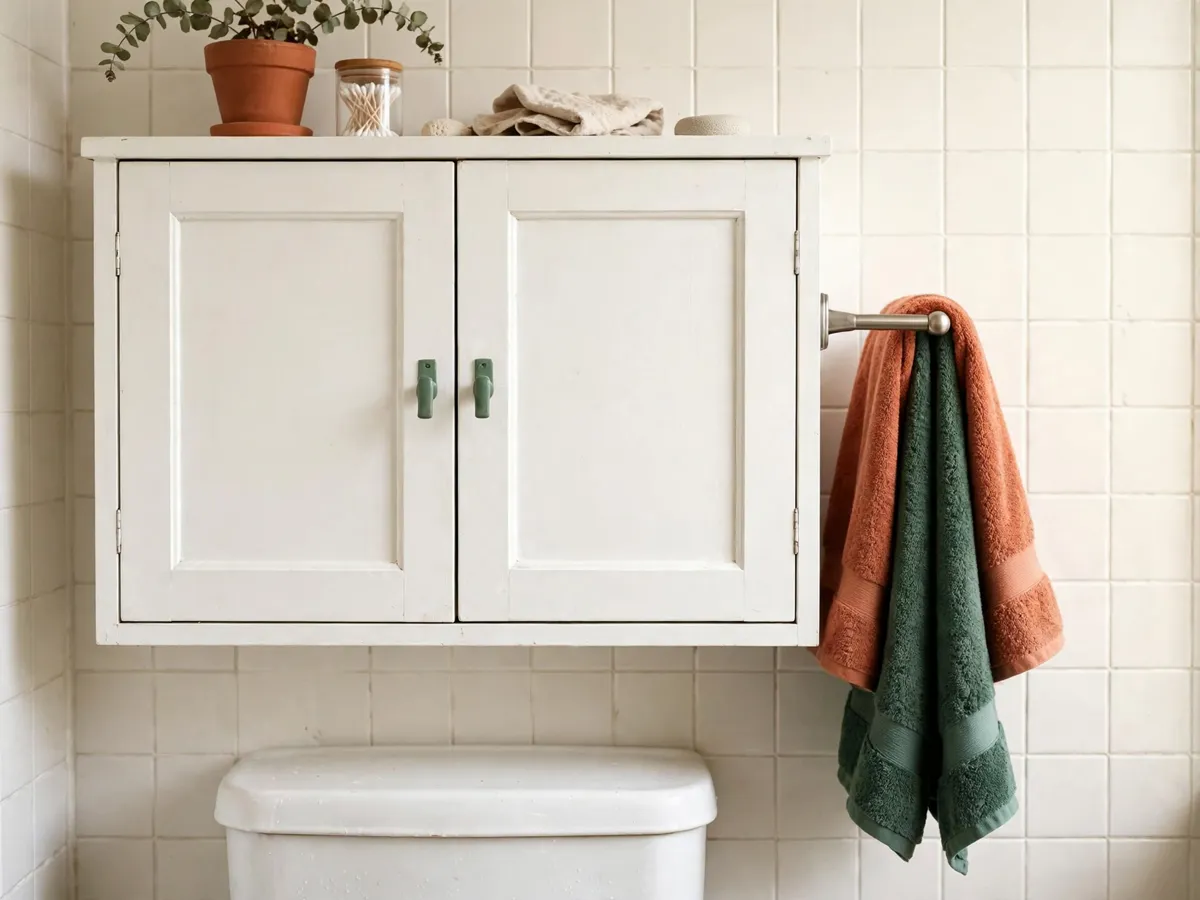
- Wall cabinet — a mounted box with one or two doors that hides the clutter. Best when the bathroom has no medicine cabinet and toiletries live on the counter. Drills into studs or anchors; renter substitute is a tension-rod shelf.
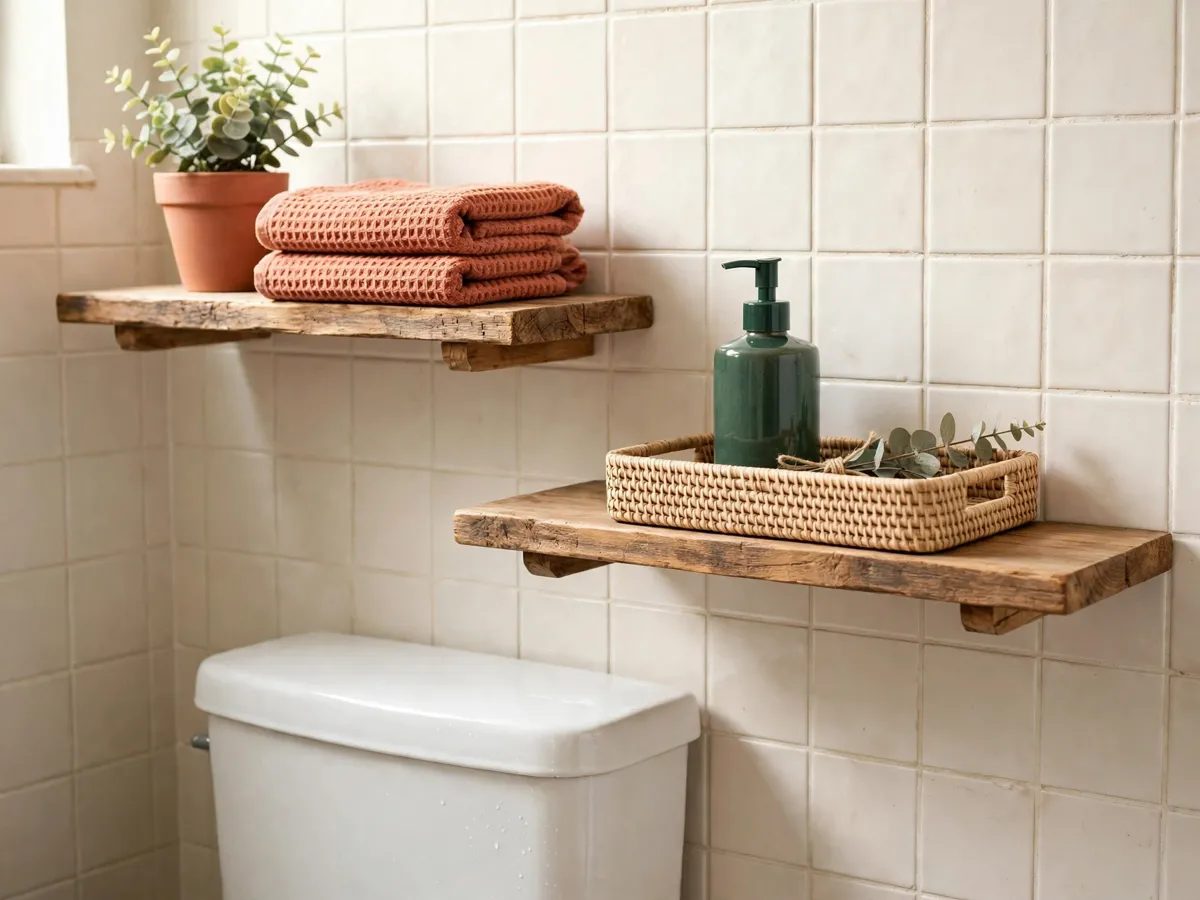
- Floating shelf — one or two brackets hidden in the wall, a single board on top. Best for a bathroom that needs a few pieces displayed rather than a pile hidden. The cleanest look, the least capacity.
- Towel bar with shelf — a bar below a small shelf, mounted above the tank. Towels hang from the bar, a few items sit above. The most specialized of the four, and the cheapest.
Most small bathrooms benefit from one style, not a mix. Two units above the same tank crowd the room and fight for the same wall. If the bathroom needs both hidden storage and towel space, a cabinet with a towel bar on the side is the single piece that does both.
Cost: $25–$140 across styles. Time: 30 minutes to choose, longer to measure twice.
3. The ladder shelf: lean and load
A ladder shelf is the renter's favorite over-toilet solution because it touches the wall without drilling. The A-frame stands on the floor behind the tank, leans against the wall, and the rungs sit above the tank at staggered heights. Folded towels go on the lower rungs, baskets on the middle, toiletries on top.
The dimensions that matter: the ladder base needs to fit between the tank and the side wall or vanity — measure that gap before buying. A standard over-toilet ladder runs 26 inches wide at the base and narrows toward the top; if the gap beside the tank is under 24 inches, the ladder will not stand. The height should clear the tank lid by at least 6 inches so the lowest rung sits above the tank, not against it.
Loading a ladder shelf is a balance exercise. The bottom rungs carry the weight — towels and rolled stock — and the top rungs stay light. A basket on the top rung that is too heavy tips the ladder forward, and a tipping ladder is a bathroom hazard. Keep the heaviest items at waist height on the ladder, the lightest at the top, and the whole unit stable against the wall.
One renter caution: a ladder shelf leans, and leaning means it can slide on a wet floor. A rubber pad under each foot — the same pad you would put under a rug — stops the slide. If the bathroom has tile, the pad is non-negotiable.
Cost: $40–$90. Time: 10 minutes to place and level.
4. The wall cabinet: hide the clutter
A wall cabinet above the toilet is the piece that hides what a shelf displays. Toiletries, spare soap, the first-aid kit, the hair dryer — all the things that pile on the counter disappear behind two doors. The cabinet drills into the wall, and that is the trade: the cleanest hidden storage in the bathroom costs a few holes.
Cabinet width should match the tank or run slightly wider — never narrower, because a cabinet narrower than the tank looks pinned and undersized. Depth is the dimension to watch: a cabinet deeper than 8 inches sticks into the room and into the space above the tank lid. Look for 6 to 7 inches deep, enough for standard toiletry bottles without crowding the room.
Mounting a cabinet above the toilet means finding the studs behind the tile. A stud finder reads through drywall; through tile it reads poorly, and a magnet or a careful tap finds the stud the finder misses. Two screws into studs hold a loaded cabinet; wall anchors hold a lighter load but are not the first choice above a porcelain fixture. If the studs do not line up with the cabinet mounting holes, use a backer board across two studs and mount the cabinet to the board.
The renter substitute for a wall cabinet is a tension-rod shelf: a tension rod wedged between the floor and the ceiling behind the tank, with shelf brackets clamped to the rod. It holds a fraction of what a cabinet holds, and it holds nothing breakable, but it drills nothing and comes down in five minutes.
Cost: $60–$140 for the cabinet, $10 for anchors or a backer board. Time: one hour with a stud finder and a level.
5. The floating shelf zone: display, do not pile
A floating shelf above the toilet is the minimalist move — one board, hidden brackets, a few items on top. It works when the bathroom needs a place for a candle, a small plant, a soap dish, and nothing more. It fails when it becomes a catch-all for every tube and bottle, because a floating shelf that piles is a floating shelf that looks like a pile.
The shelf width should match the tank, and the depth should stay at 6 to 8 inches — the same depth as the tank or slightly less. A shelf deeper than the tank leans into the room, and a shelf above a toilet that leans into the room is a shelf someone bumps into. The bracket height should clear the tank lid by 10 to 12 inches, enough room for a hand to reach the tank without hitting the shelf.
Two shelves staggered at different heights hold more than one long shelf, and they look less heavy than a single deep board. Space them 10 inches apart vertically so a towel folded in thirds fits on the lower shelf standing up. The floating shelf cut list guide walks through the bracket, board and mounting sequence for a shelf that holds weight without sagging.
Cost: $15–$45 per shelf with brackets. Time: 30 minutes per shelf with a stud finder and a level.
6. The towel zone: hang, do not stack
Towels are the one thing every bathroom stores above the toilet, and the one thing most often stored wrong. A stack of folded towels on a shelf collects humidity and mildew within a week; a towel hung from a bar or a hook airs between uses and stays dry. The over-toilet zone is ideal for a towel bar because the wall is empty and the bar sits at a natural reach height.
A towel bar above the tank runs 18 to 24 inches wide, mounted 8 to 10 inches above the tank lid. One bar holds two bath towels side by side, or three hand towels. A double bar — two bars stacked 4 inches apart — doubles the capacity without doubling the wall width, and it is the move when the bathroom has more towels than wall.
Hooks are the renter alternative. Over-the-door hooks drop onto the top of the bathroom door and hold three to five towels; a tension-rod towel bar mounts inside a narrow wall alcove without drilling. Neither holds as much as a mounted bar, but neither leaves a hole, and both come down when the lease ends.
The spare towel supply lives somewhere else, and the over-toilet zone holds only the towels in use. A bathroom that rotates four pairs of towels a week keeps the extras on a shelf in the hallway cabinet, where the linen closet organization guide lays out the folding and stacking order that keeps them dry and visible.
The rule for towel storage above the tank: hang what is damp, stack what is dry, and never stack damp towels. A damp towel folded on a shelf above a toilet stays damp longer than anywhere else in the bathroom because the tank lid blocks the airflow. Hang it, let it dry, then fold it.
Cost: $12–$35 for a bar, $10 for hooks. Time: 15 minutes to mount a bar.
7. Styling rules: what goes above the tank
A shelf above the toilet is a display surface, and a display surface follows rules that a storage bin does not. Three principles keep the over-toilet zone from looking cluttered:
- Group in threes. Three items on a shelf — a basket, a plant, a soap dispenser — reads as styled. Five items reads as stored. Seven reads as a pile. The shelf above the toilet is small; keep the count to three or four.
- Vary the height. A short item, a medium item and a tall item create a rhythm that a row of same-height bottles does not. The tall item goes in the back, the short in the front, and the medium bridges them.
- Use a basket for the small things. Cotton rounds, Q-tips, sample bottles — all the small items that scatter go into one basket, and the basket goes on the shelf. The basket is the single item that replaces five items.
The items that do not belong above the tank: anything heavy, anything breakable, anything that spills. A glass candle above a toilet is a breakage waiting for a foot. A bottle of mouthwash without a cap is a spill waiting for a tank lid. The shelf holds dry, light, non-hazardous items, and everything else goes in a cabinet or a drawer below.
Cost: $5–$15 for a basket or a tray. Time: 10 minutes to style and photograph for reference.
8. Renter options: nothing to drill, nothing to patch
Every drilling piece in this guide has a renter substitute, and the substitutes are good enough that a renter never needs to touch a drill. The ladder shelf leans; the tension-rod shelf wedges; the over-the-door hook hangs. Three options cover most rental bathrooms:
- Ladder shelf — the primary renter move. Stands on the floor, leans on the wall, holds towels and baskets. Rubber feet stop the slide. $40–$90, zero holes.
- Tension-rod shelf — a tension rod from floor to ceiling behind the tank, with shelf clamps at the desired height. Holds lightweight items only. $20–$35, zero holes.
- Over-the-door hooks — hooks that drop over the bathroom door, holding towels and robes. Not above the tank directly, but the towel storage that frees the tank zone for a shelf. $10–$20, zero holes.
The one renter caution: command strips hold light items — a small picture frame, a soap dish — but they do not hold a loaded shelf. A command strip rated for 5 pounds holds a 5-pound item in ideal conditions, and a bathroom is humidity, not ideal conditions. Use command strips for decor; use a ladder or a tension rod for storage.
Cost: $20–$90 for the full renter setup. Time: 20 minutes, no drill required.
What we would skip
- A shelf deeper than the tank. A shelf that juts past the tank face is a shelf that catches an elbow every time someone turns around, and in a small bathroom, someone always turns around.
- A floor cabinet that stands directly behind the tank. It blocks the tank lid for maintenance, it crowds the walkway, and it turns a 30-inch bathroom into a 24-inch bathroom.
- Glass shelves above the toilet. Glass looks clean and breaks clean, and the break happens over porcelain. Use wood, metal or bamboo — anything that does not shatter.
- A mirror mounted above the tank on a swing arm. The arm swings into the room and the glass fogs every shower. Hang it on a different wall, not above the toilet.
- More than one unit above the same tank. A ladder and a cabinet and a shelf is three pieces fighting for 30 inches of wall. Pick one, style it well, and stop.
Cost: $0 to skip. Time: two minutes of reading that saves a cracked lid.
9. What it costs, honestly
Three routes, three bills, at big-box prices for a mid-size US market; treat these as the shape of the spend rather than a quote. Every route fills the same wall above the tank — the difference is capacity, finish and how much of the wall gets drilled.
- Budget route — $30 to $50. One towel bar with shelf ($15–$25) plus two over-the-door hooks ($12). Holds towels and a few items, no drilling, renter-safe. The trade-off: no hidden storage, and the shelf is small.
- Mid route — $55 to $90. A ladder shelf ($45–$70) plus a woven basket ($10–$15) for the small items. Holds towels, toiletries and styled pieces on four rungs. No drilling, and the ladder moves when the lease ends.
- Full route — $90 to $140. A wall cabinet ($70–$120) with a towel bar on the side ($12). Hidden storage behind doors, towel space on the bar, one mounted piece. This is the route that makes the bathroom feel finished.
- Add-ons that apply to any route. A rubber pad set ($5) for ladder feet. A tension rod ($12) as a renter shelf backup. A basket ($8) for small-item grouping.
The organization and storage collection includes the broader bathroom and closet systems these pieces fit into.
Realistic all-in for the mid route plus a basket: $65–$85. Time: one afternoon.
The before-you-buy checklist
- Tank width measured — the shelf or cabinet above matches or exceeds this, never falls short.
- Tank height to ceiling or fixture measured — the vertical space sets the ladder height or the cabinet height.
- Wall depth from tank face measured — the shelf depth stays at or below the tank depth, usually 7 to 9 inches.
- Side clearance measured — the ladder base fits between the tank and the side wall or vanity, minimum 24 inches of floor space.
- One style chosen — ladder, cabinet, shelf or bar, not a mix of all four on the same wall.
- Stud location confirmed if drilling — a stud finder or a magnet, never a guess, and never a wall anchor alone above porcelain.
- Renter alternative named — ladder, tension rod or over-door hook, and the command strip limit respected.
- Towel plan decided — hang damp, stack dry, and the bar or hook is in place before the first towel needs a home.
Cost: $0 to check. Time: 10 minutes before the store run.
Common questions
How high above the toilet should a shelf be?
A shelf above the toilet tank should clear the tank lid by 10 to 12 inches. That gap leaves room for a hand to reach the tank without hitting the shelf, and it keeps the shelf from reading as stacked on top of the tank. A shelf closer than 10 inches crowds the tank; one higher than 14 inches starts to look disconnected from the room.
Can I put a cabinet above the toilet in a rental?
Not a drilled one without losing the deposit. The renter substitute is a tension-rod shelf — a rod wedged floor to ceiling behind the tank with shelf clamps at the height you want. It holds light items only, and it comes down in five minutes. A ladder shelf is the stronger renter alternative: it stands on the floor, leans on the wall, and holds as much as a small cabinet without a single hole.
What is the best over-toilet storage for a very small bathroom?
A towel bar with a small shelf above it. The bar holds the towels that would otherwise pile on the counter, and the shelf holds three or four items — no more. In a bathroom under 30 inches wide, a ladder or a cabinet crowds the walkway; a bar and shelf stay flush to the wall and take zero floor space.
How deep should a shelf above the toilet be?
Six to eight inches. The shelf depth should match the tank depth or sit slightly shallower, never deeper. A shelf deeper than the tank juts into the room and catches an elbow on every turn. Most toilet tanks are 7 to 9 inches deep front to back, and the shelf above should live within that same footprint.
How do I keep towels from mildewing above the toilet?
Hang them, do not stack them. A damp towel folded on a shelf above the tank stays damp because the tank lid blocks the airflow. Hang the towel from a bar or a hook so it airs between uses, and fold it only after it is dry. If the bathroom has no exhaust fan, leave the door open after a shower — ventilation does more for towel longevity than any storage choice.
Save these on Pinterest
Pin the before-you-buy checklist and the four-style comparison — the two pieces you will forget standing in the store aisle, holding a cabinet that is four inches too deep. This guide and the rest of the organization and storage collection live together there.