 Plant As Deco
Home Organization & Storage
Entryway Ideas for Small Spaces: A Renter Drop-Zone Guide
By Plant As Deco · Updated 17 November 2026
A small entryway has one job: catch keys, shoes and bags before they spread through the rest of the home. Most rental halls fail at it because they have no furniture at all — a door, a wall, and a strip of floor about three feet wide. That is enough. This guide builds a working drop zone in one afternoon with a hook line, one tray, a marked shoe line and a lamp.
Everything here is renter-safe: adhesive and over-door fittings, no drilling, nothing that has to be patched before you move out. The order is deliberate — vertical storage first, horizontal surfaces last, because a bench or console added too early becomes the thing everything lands on.
Weekend-ready: $15–$80, one afternoon. Fits a hallway corner as narrow as three feet.
This guide contains an affiliate link. As an Amazon Associate we earn from qualifying purchases, at no extra cost to you.
Key takeaways
- One hook rail at shoulder height, one hook per person plus one spare.
- One tray only for keys, wallet and sunglasses — not three dishes.
- A shoe line with a hard limit beats a pile that grows past the door.
- Go vertical in a three-foot corner: leash hook, mail pocket, mirror.
- Light the hall before you decorate it; a dark entryway never looks tidy.
- A 12-inch-deep bench is the only seat most halls can take.
- A 60-second reset at the door, paired with locking up.
1. One hook line carries the whole entryway
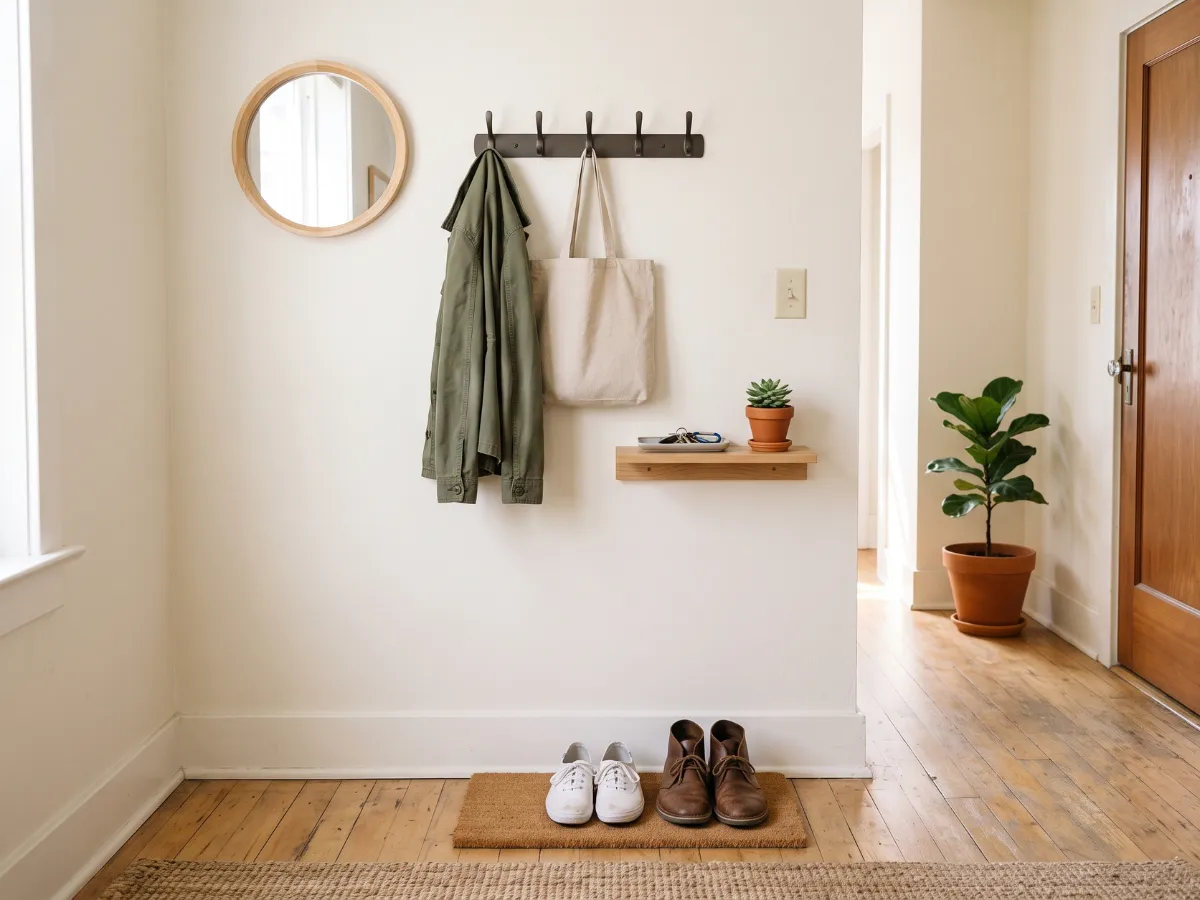
Coats on chairs mean clutter everywhere else. Mount an adhesive or over-door hook rail at shoulder height — one hook per person plus one spare for guests. Bags hang, jackets hang, tomorrow's scarf hangs. The floor stays empty because everything has air to live in, and the rail gives every item a defined place instead of a horizontal surface to colonise.
Height matters more than the rail itself. If the hooks sit too low, long coats drag and the floor fills up again; too high and nobody hangs anything, because reaching up with a bag in one hand is a decision people stop making by week two. Aim so the top of the rail is at roughly eye level for the shortest adult in the house.
Cost: $10–$25. Time: 20 minutes. Adhesive holds for light daily loads; move heavy winter coats to the closet.
2. One tray for keys, wallet, and sunglasses
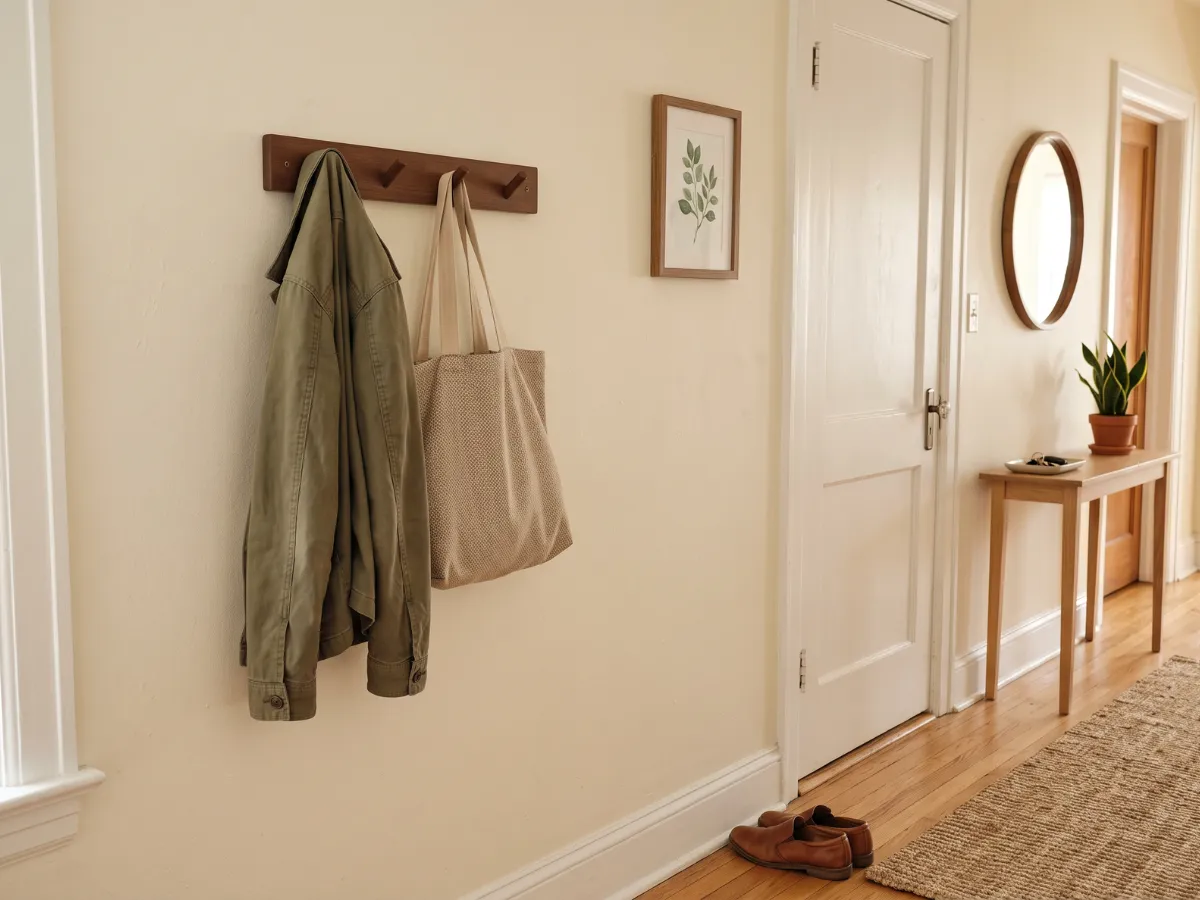
Small items vanish in small entryways. Give them a single tray on a shelf, stool or wall-mounted ledge — one tray, not three dishes. Everything pocket-sized lands there or it does not live in the entryway. The rule is deliberately strict, because the second dish is what turns a system back into a scattering of objects.
Put the tray where you actually empty your pockets, not where it looks best in a photo. For most people that is within arm's reach of the door handle, at hip or chest height. A tray on a high shelf looks tidy and stays empty, which means the keys still end up on the kitchen counter by Thursday.
Cost: $5–$15. Time: 10 minutes. Empty the tray weekly; receipts and dead batteries breed there.
3. A shoe line, not a shoe pile
Shoes multiply past the door unless they have a border. One low tray or mat marks the line: two pairs per person max on it, the rest live in the closet. Guests get the spare corner of the same tray. A visible border does the work here — a mat is a rule you can see from the doorway, while "put them away" is a rule nobody can measure.
If the tray overflows twice in a week, the limit drops to one pair each rather than the tray getting bigger. Rotating pairs is fine: the tray holds what you are wearing this week, and the closet holds the rest. Boots and wet shoes go on the floor beside the mat, never on it, so the tray stays dry and clean.
Cost: $0–$15 for a tray. Time: 15 minutes. For worn-out pairs that leave the rotation, the Goodwill donation guidelines accept clothing you no longer need and welcome shoes, handbags and jewelry.
4. Steal vertical inches in a three-foot corner
No room for furniture means going up: a high hook for the dog leash, a wall pocket for mail, a small mirror to bounce light and check yourself on the way out. Three wall items replace a whole console table, and they take up zero floor space in a hall where floor space is the entire constraint.
Hang the mirror opposite the door if the wall allows it. It catches the light from the room behind you and makes a narrow hall feel deeper, which is the closest thing to free square footage in a rental. Keep the mail pocket below eye level and the leash hook above it, so the things you grab with one hand never sit in front of the things you look at.
Cost: $5–$20. Time: 30 minutes. Adhesive strips rated for the weight — check the package, not the hope.
5. Light the hall before you decorate it
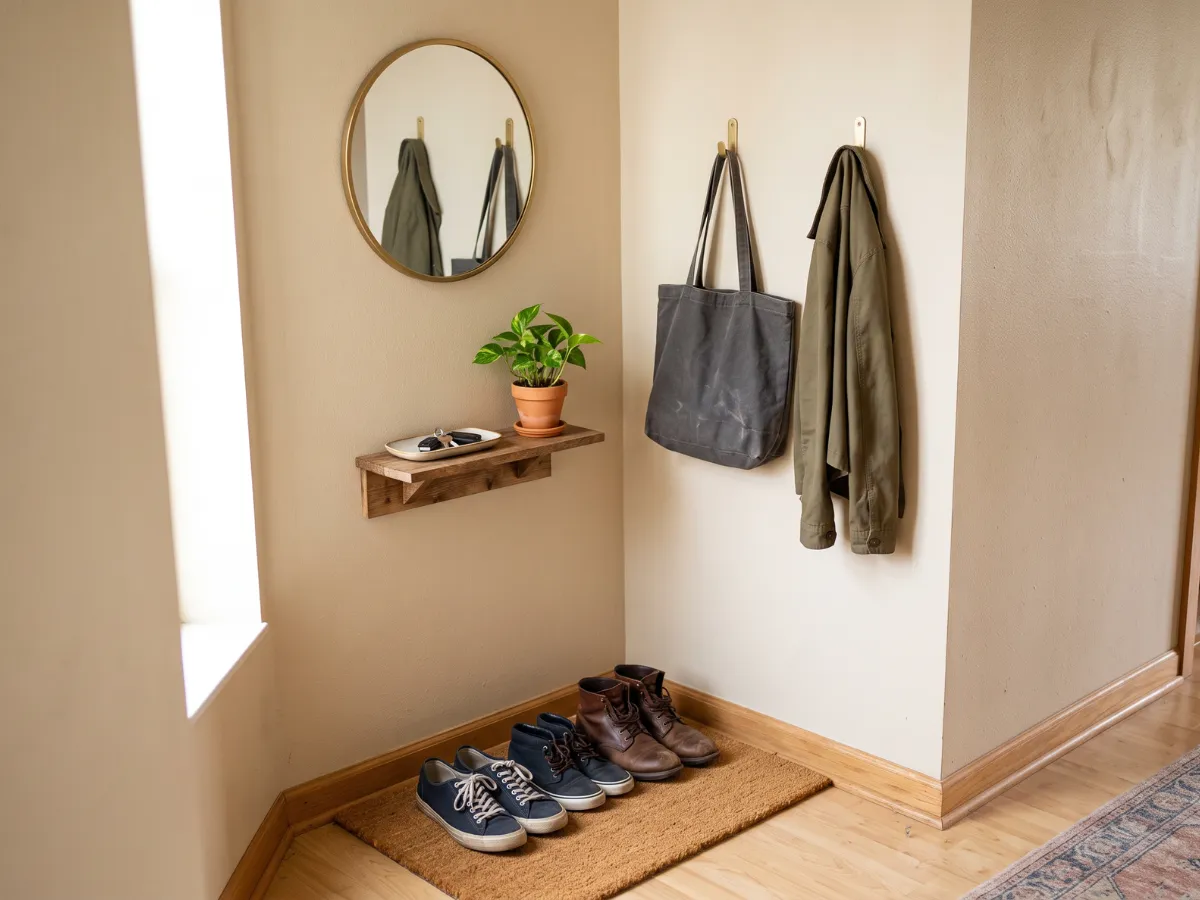
Most rental entryways have one weak ceiling fixture and no switch near the door, so the hall is dark exactly when you need it. Fix that before buying a single hook: a plug-in wall sconce with a cord cover, a rechargeable puck light above the tray, or a small lamp on the shelf if there is one. Warm white, and pointed at the wall rather than into your eyes. If the hall is long rather than just dark, the narrow hallway guide covers the rug and the mirror placement too.
Two small lights beat one bright one here as well. A puck light over the keys and a second point near the mirror means you can find your things and see yourself without turning the hall into an operating theatre. If your only option is the ceiling bulb, a warmer bulb in the same fitting is a two-minute change and often enough.
Cost: $10–$35. Time: 20 minutes. Rentals: plug-in and adhesive fittings only — no hardwiring, no new switch.
6. A bench only if it is twelve inches deep
A bench earns its place when you actually sit to tie shoes. In a narrow hall, that means a depth of about twelve inches and a seat height near eighteen — deeper than that and it becomes a corridor obstacle you apologise for. A slim bench with an open shelf underneath holds the shoe line without adding a second surface to clear.
If the hall is under three feet wide, skip the bench and use a folding stool that lives against the wall and comes out only when someone needs it. The seat is a nice-to-have; the shoe line and the hook rail are the parts that keep the entryway working. Buy the bench last, and only after a week of living with the drop zone tells you the floor is genuinely clear.
Cost: $25–$60 new, often less second-hand. Time: 15 minutes to place. Measure the door swing before you carry it in.
Two open shelves and a seat, if the tape says yes
The rule above is a measuring rule, so apply it before anything else: this bench is 27.6 inches wide with two open shelves under the top panel, and the seat is the top panel itself — a bench, not a shelf you are allowed to sit on by accident. The shelves hold six pairs between them, which matches the two-pairs-per-person limit on the shoe line rather than replacing it.
See the three-tier bamboo shoe bench. The one number the listing does not give in the product title is depth, and depth is the number this whole section turns on — check it against the twelve inches above and against your hall width before you order, because 27.6 inches of bench in a three-foot hall leaves less than half a foot to walk past. The top is rated for 286 pounds so an adult can sit and tie shoes; each shelf holds 22 pounds, which is shoes and not a crate of books.
Price and stock were checked when this guide was last updated; they move. As an Amazon Associate we earn from qualifying purchases.
7. The mudroom look, with nothing built in
A mudroom is not a room, it is a look: one wall near the door that catches everything a household drags in — coats, bags, shoes, wet-weather gear. Houses get that wall with lockers, a bench with cubbies and a utility sink. A rental builds the same look from four movable anchors: a mat with the shoe tray on it, the hook line from this guide, a narrow shelf or floating catch-all at waist height for the drop tray, and one tall spot for boots, even a floor corner kept clear.
Rotation keeps the wall honest: the entryway holds only what the current season uses, and the beginner closet reset covers the seasonal swap so the hooks never hold July in January.
What stays out is the built part: lockers, a bench with cubbies, a garage sink. None of it belongs in a rental without new holes. The honest trade-off is exposure — a mudroom wall sits where everyone sees it, so baskets need lids or the wall reads as clutter.
Cost: $0–$60 — what you may already own, plus a mat and a shoe tray. Time: 30 minutes. Lids on the baskets; the wall is the first thing a guest sees.
8. A 60-second doorway reset ends the day
Entryways rot when today's overflow becomes the furniture. Hang, tray, line — sixty seconds at the door before dinner. Pair it with locking the door so it runs on autopilot, and the reset stops depending on anyone remembering to do it.
The reset is also the test of whether the system is right. If it regularly takes more than a minute, something in the drop zone is in the wrong place — usually the tray is too far from the handle, or the hook count is one short. Move the item, not the habit.
Cost: $0. Time: 1 minute nightly. The entryway is the first thing you see; it sets the whole home's baseline.
What we would skip in a small entryway
- A console table in a hall under four feet wide. It becomes the pile, and you lose the walkway you needed.
- Open shoe racks with five tiers. They advertise every pair and hold more than the door can take.
- Three small dishes instead of one tray. Each dish is a new place for keys to hide.
- A statement mirror with a heavy frame on adhesive. Weight ratings exist for a reason — check the pack or use an over-door hanger.
Drop-zone checklist: copy this before you start
- Hook rail mounted at eye level: one per person plus one spare
- One tray placed within reach of the door handle
- Shoe line marked: two pairs per person max on the tray
- Vertical trio set: leash hook, mail pocket, mirror opposite the door
- Two small warm lights on, none aimed at eye level
- Bench only if it measures twelve inches deep
- 60-second doorway reset paired with locking the door
Common questions
What if my entryway has no wall space at all?
Use the door itself. An over-door hook rack needs no wall and holds coats and bags on the inside face; a hanging shoe organiser on the same door takes the overflow. That pair alone can carry a hall with nothing but a door and a doormat.
How many hooks do I actually need?
One per person plus one spare. More than that invites the rail to become long-term storage, and a rail holding five coats is no easier to use than a chair holding five coats.
Can I use adhesive hooks in a rental?
For light daily loads, yes — follow the weight rating on the pack and clean the wall first. Heavy winter coats, a loaded tote and a framed mirror are the three things that pull adhesive off a painted wall. Move those to an over-door fitting or the closet.
Doormat inside, outside, or both?
Both, if the door clears them. A coarse mat outside takes the grit off, a softer one inside takes the damp. In a narrow hall, use one thin inside mat that the door can swing over — a thick mat that catches the door is the most common reason people stop using it.
Can I get the mudroom look in a rental?
Yes, with movable anchors instead of built-ins: a mat with a shoe tray on it, a hook rail, a waist-height shelf for the drop tray and one tall boot spot. Skip the lockers, the bench with cubbies and the garage sink. Because the wall sits in public view, use baskets with lids so the setup reads as a system, not clutter.
How do I keep the entryway tidy with kids?
Lower one hook to their height and give each child one labelled spot on the shoe tray. A rule a six-year-old can reach and see is the only kind that survives a school week. The 60-second reset works better as a family habit than as a nightly negotiation.
Save these on Pinterest
Pin your drop-zone layout, then browse the Organization & Storage collection for the beginner closet reset and the pantry zone system.