 Plant As Deco
Home Organization & Storage
Purse and Handbag Closet Organization: The Daily 3
By Plant As Deco · Updated 23 November 2026
Bags are the hardest thing in a closet to store: a soft bag squashes, a structured bag scratches, and every bag changes size with the season. This guide sorts a real bag collection by how often each bag leaves the house, gives the three in active rotation the grab-height spots they earn, and picks one honest storage method for the rest, the shelf file, the rod hooks or the wall rail.
Weekend-ready: $15–$60 for hooks, a bin and a rail, one afternoon. Renter-safe: every method is a shelf, a clip or a rail, nothing built in.
1. Count the Bags Before You Buy Anything
A realistic small-home bag collection runs five to twelve bags: a few daily bags, a couple of work bags that fit a laptop, a few special-occasion clutches, and maybe one beach or gym tote. Count yours before you buy any organizer, because the number decides the system. Fewer than five and you need a shelf, not a product. More than twelve and the honest answer is a cull, not a bigger rack.
Most bag collections do not fail on storage. They fail on overlap: three black bags that do the same job, two work bags too similar to choose between, a fourth crossbody you keep forgetting you own. Overlap is what makes the pile feel unmanageable, and no organizer fixes it. The count is also what keeps you from the classic mistake, buying a multi-slot hanger sized for a collection twice yours, then filling the empty slots with bags you were happy to forget.
Cost: $0. Time: 10 minutes. Count the bags on the bed, not in the closet, so nothing hides behind a hanging coat.
2. The Cull: Keep What Left the House This Year
One pass, one rule. A bag you have not carried in the last year is a bag you are storing, not using, and storage costs real closet inches. Pull every bag out, keep the ones that left the house with you in the last twelve months, and put the rest in a consignment or donation bag. If a bag holds sentimental value, it can stay, but it goes in the deep-storage group, not the daily rotation.
The cull runs before any shopping because it changes the shopping list. Twelve bags minus four that never leave the house leaves eight, and eight bags fit on one shelf and one hook strip. This is the only step in the whole guide that shrinks the problem instead of organizing it, and it takes twenty minutes with the same decision every single time. If the whole idea feels heavy, start with the bags that have been sitting under the others, the flat, crushed ones at the bottom. They already tell you what you reach for.
Cost: $0, and a consignment drop can pay you back. Time: 20 minutes. Do the cull on the same day as the count, while the pile is already out.
3. Sort by Use Frequency, Then Pick One Method
Bags are hard to store for three reasons, and they stack. A soft bag squashes flat when empty and creases at the fold. A structured bag holds its shape but scratches when something leans on it, and its shape wastes shelf inches. And every bag changes size with the season, from a slim crossbody in summer to a leather carryall in winter. Sweaters stack, shoes pair off, and clothes hang on a standard rod. Bags do none of those things well, which is why the one-size bin that works for the rest of the closet never works here.
The organizing spine is sorting by use frequency first, before any method talk. Daily bags: the two or three in real rotation. Weekend and occasional bags: the rest of the everyday crew. Special-occasion clutches and minis: the small ones that leave twice a year. Off-season bags: winter leather in July, straw in January. Then pick exactly one storage method per group, and do not mix methods inside a group. A group with one bag hanging, one filed and one lying flat is three systems to remember, and it comes apart in a week.
Frequency-first matters more in a small closet than anywhere else, because the real problem in a rental closet is shelf inches, not hooks. If the setup interests you beyond bags, the small closet organization guide covers the whole-closet version of the same frequency sort.
Cost: $0. Time: 15 minutes to sort the keepers into three groups. Write the groups on paper, the memory will not hold them at the store.
4. The Daily 3 at Grab Height
Here is the most useful idea on this page. Only the three bags in active rotation earn grab-height real estate, a hook, a shelf at hand height, or a clip on the closet rod end. Everything else files away, up high or in the back. Three is not a rule from a book; it is the honest number of bags one person uses in a week, the work bag, the small errand bag and the nice one that goes out on weekends.
Say the next part plainly. A daily bag that does not live at grab height migrates to the chair, the floor, the counter, the doorknob, and it does that within days. The pile on the chair is a storage-design failure, not a discipline failure, and fixing the storage beats fighting the habit every time. When the daily bags have real spots at hand height, the chair clears itself without anyone trying.
Grab height means between knee and shoulder, at the front of the shelf or on the rod end closest to the door. Not the top shelf, which needs a step stool at 7 a.m., and not the floor, which is where a bag gets kicked. The three spots do not even need to match: a hook on the rod end for the work bag, the front of the mid shelf for the errand bag, a wall hook by the door for the weekend one.
Cost: $0 if you free a shelf spot, $6–$14 for a hook pair. Time: 10 minutes. Watch the chair for a week, it proves or disproves the whole thing.
5. Shelf-File: The Free Default
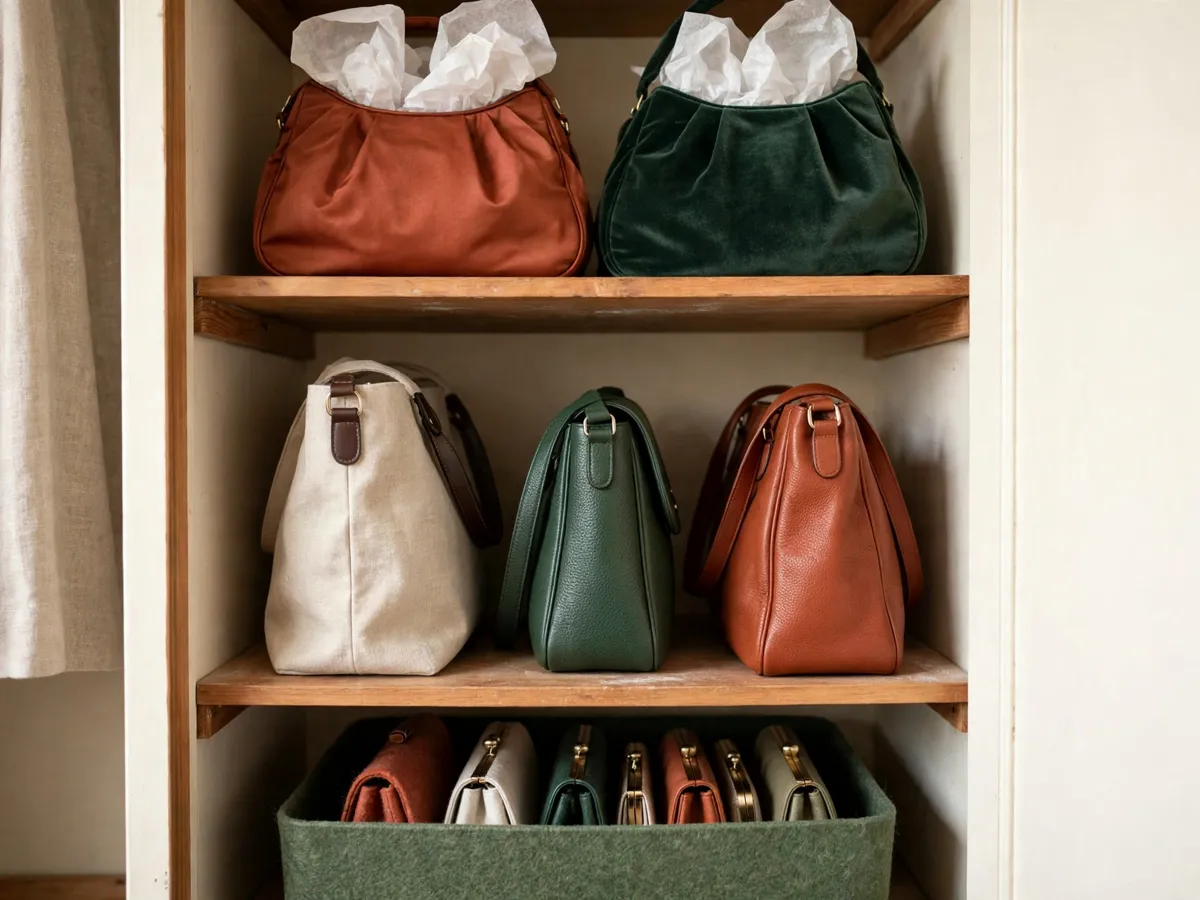
A shelf file is bags standing upright in a row on a mid shelf, tallest in back, handles forward, like files in a drawer. It suits structured bags and daily bags best, because a bag with a frame stands on its own base and a daily bag needs to be pulled with one hand. It is the default answer because it is free: if you have a shelf, you already have the system.
Two details make it work. Face every handle the same way, out, so a grab never turns into digging. And leave a finger of air between bags, because a shelf packed tight transfers scratches from one bag to another, exactly the failure a structured bag cannot forgive. A deep shelf, sixteen inches or more, files a second row behind the first, and the deep back row is also where laptop bags live. For a closet whose shelves are all wrong, the corner closet organizer guide covers adding shelf space without a build.
The failure mode of the shelf file is the slumping soft bag. An empty canvas tote leans, takes its neighbors with it, and the row becomes a pile by the second week. Stuff the soft ones, section 8 below, and the shelf file holds every group except the clutches.
Cost: $0. Time: 15 minutes to clear and re-file a shelf. The shelf must be deep enough for a bag to sit on its base, about 10 inches.
6. Hang: Clips, S-Hooks and the Rod Limit
Hanging works for bags with real straps and for soft bags that refuse to stand up. Clip hooks, the kind with a spring clamp, grip a strap or the top edge of a soft bag. S-hooks slide along the rod and hold a handle directly, and a multi-hook over-door hanger turns the back of the closet door into a wall of hanging spots without a hole anywhere.
The honest weight note, because a closet rod is a wire or a tube, not a beam. Clip hooks and S-hooks sag the rod past a few heavy bags, so hang no more than four or five light bags per rod section, and count a leather carryall as two. The over-door hanger carries the same math through the door: a door holds the weight fine, the hook lips and the hinge pins do the complaining. Spread the bags along the row rather than bunching them at one end, and the rod stays level. A backpack belongs on this row too, hooked by its strap, since backpacks tolerate hanging better than any other bag shape.
Hanging fails two ways. Straps stretch when a heavy bag hangs by them for months, especially thin leather and chain straps, so the occasion bags with delicate straps belong on a shelf, not a hook. And anything clamped shut by a spring clip leaves a pinch line on soft leather over a long stay, so rotate what hangs or pad the clip with a bit of felt. If this is the method your bags point to, the coat closet organization guide covers the rod-and-door math for a whole closet, including the over-door load habits.
Cost: $0 for S-hooks you own, $8–$20 for a clip-hook set or an over-door hanger. Time: 10 minutes. Keep it to four or five light bags per rod section, heavy leather goes on the shelf.
7. Display Rail: Storage That Reads as Decor
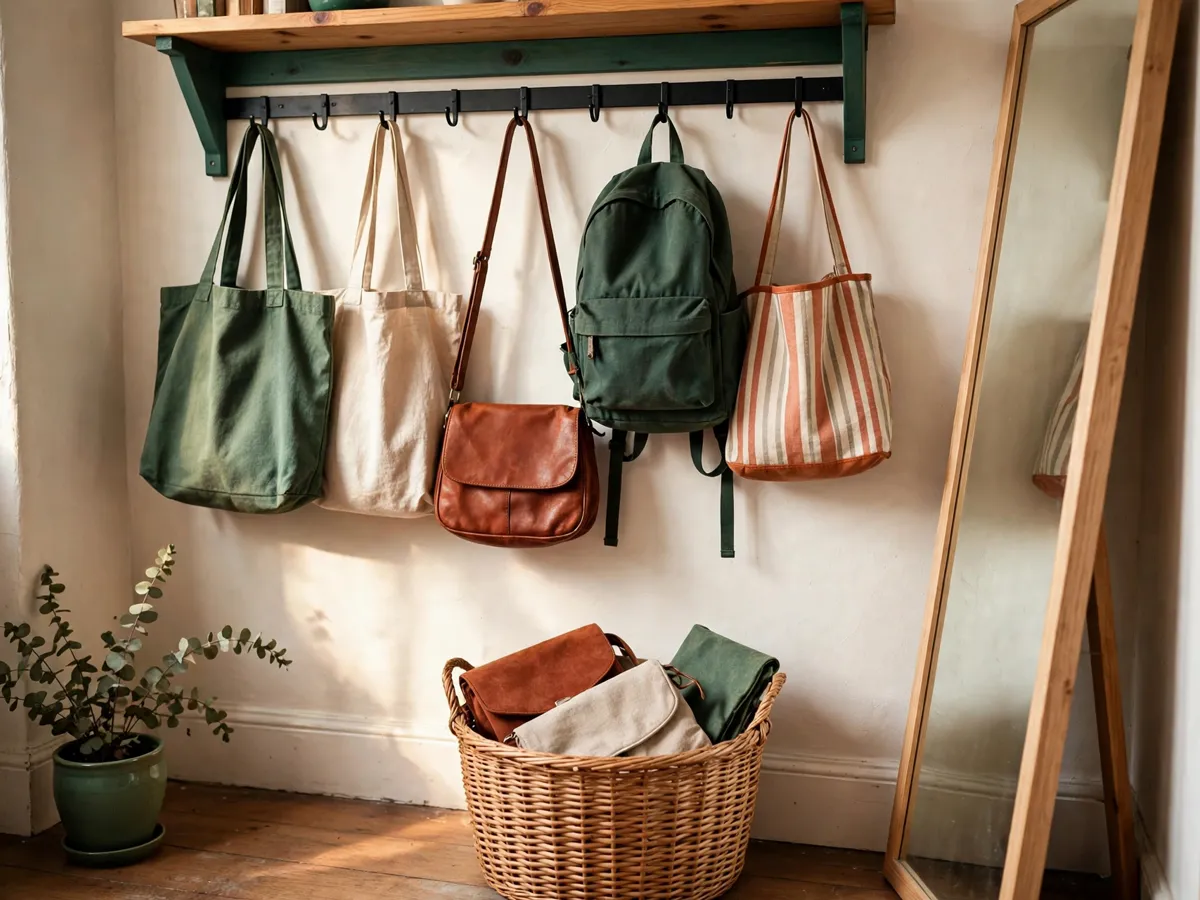
A display rail is a wall rail or a hook strip mounted outside the closet, in a bedroom corner or the entry, where the daily bags hang in plain view. This is the renter-safe favorite for a reason: a row of good-looking bags on a rail looks like a styling decision, so the storage becomes part of the decor. The bags you like looking at are usually the bags you use, so the two jobs line up.
The renter version needs no drill. Adhesive hook strips rated for a few pounds each hold crossbodies and small bags on a smooth wall, and a rail that clamps or leans, a ladder-style rack or an over-the-door strip on a bedroom door, carries more. Fixed rails want a stud and belong to owners. Whatever holds the hooks, keep the display row to the daily three or four: a rail crowded with ten bags stops reading as decor and starts reading as clutter with hangers.
The failure mode is sun. A rail in a south-facing window fades leather and dries straps faster than any closet would, so pick the wall the sun does not sit on, and keep the good occasion bags off the rail entirely. The display row earns its keep when it holds the rotation and looks intentional doing it.
Cost: $10–$40 for adhesive hook strips or a leaning rack. Time: 20 minutes. Keep it to the daily bags and out of direct sun.
8. The Shape Fix: Paper Stuffing and Dust Bags
Soft leather and canvas bags crease and slump when they are stored empty, and a crease set over a summer is a crease the bag keeps. The fix is stuffing. Fill each soft bag with white tissue paper, kraft paper or a clean small towel until it holds its shape, no more, a bag packed hard stretches the seams. Never use newspaper, the ink transfers onto light linings and never fully comes out.
Structured bags live in their dust bags on a shelf, standing, not stacked. The dust bag does two jobs: it keeps scratches off the leather from whatever shares the shelf, and it lets the bag breathe, which a plastic bin never does. If a dust bag went missing years ago, a soft cotton pillowcase does the same job. Fold each dust bag flat and store it inside the bag it belongs to when it is in use, section 10 below.
The whole job takes about five minutes per bag and extends the life of every bag in the closet. Run it the day you set up the storage, then re-stuff whenever a bag comes back from a long stretch on the shelf. It is also the honest difference between a closet that photographs well and a closet where the bags still look right a year later.
Cost: $0 if you have paper or a towel. Time: 5 minutes per bag. Stuff to shape, not to firm, overpacking stretches seams.
9. Clutches: One Bin, Filed on Edge
Clutches and minis are the smallest bags in the collection and the easiest to lose, because they slip behind everything and weigh nothing. One single bin holds all of them. A felt-lined bin or a shallow drawer tray, the size that fits the mid shelf, is the whole system. Line the clutches up on edge like files so every one is visible at a glance, and the right evening bag is a two-second find instead of a shelf-emptying search.
Do not give each clutch its own hook. A hook spent on something used twice a year is a hook taken from the daily rotation, and the frequency sort is what the whole page is built on. The bin also travels well: when a wedding or a holiday party asks for the one clutch, the whole tray comes off the shelf in one hand. A bin with a lid loses the at-a-glance benefit, so open tray beats lidded box here.
Cost: $8–$16 for a felt bin or drawer tray. Time: 5 minutes to file them on edge. Keep the bin shallow, deep bins hide the back row.
10. Straps, Dust Bags and Small Goods
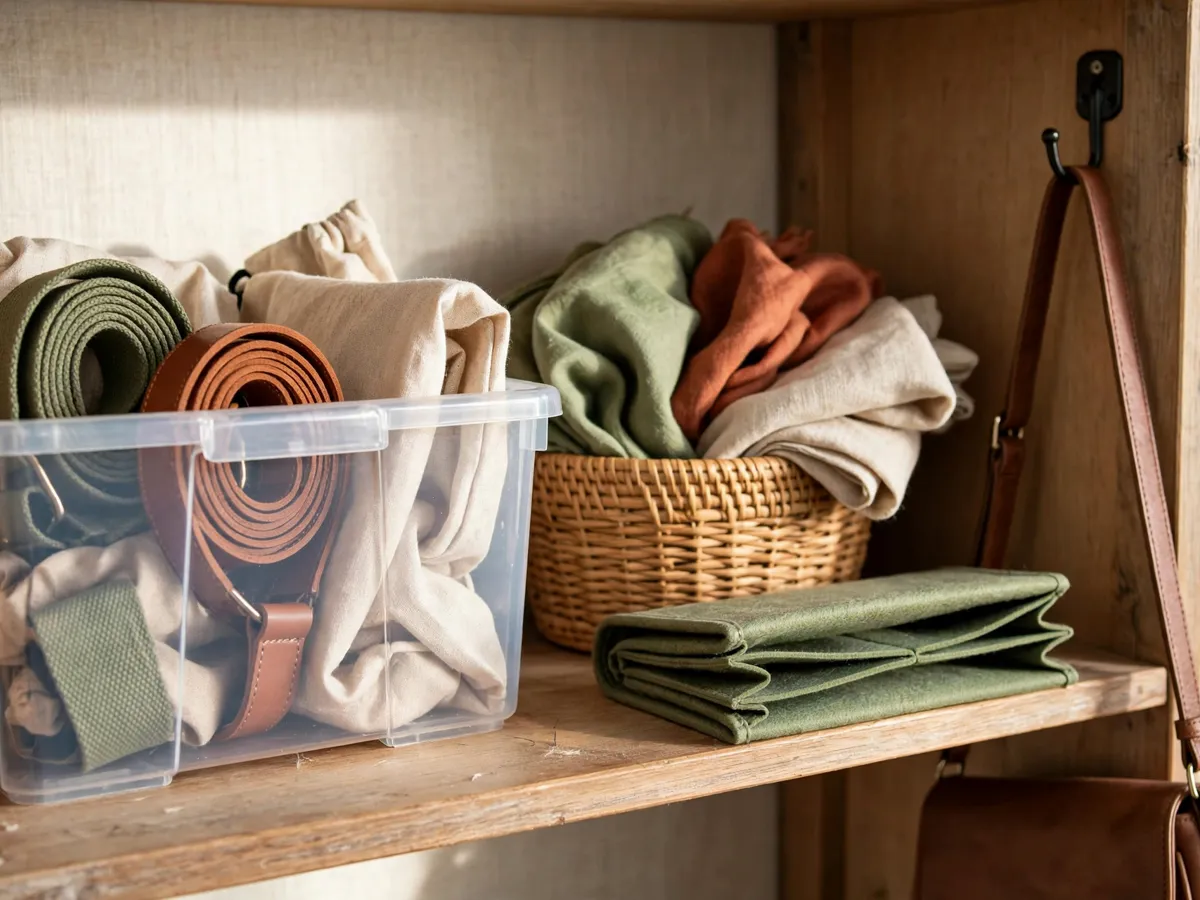
Detachable straps, pouches and small leather goods are the loose change of a bag collection, and a strap without a home is a strap you will not find when you need it. One small labeled bin holds all of them: the spare strap, the coin purse, the cardholder that rotates between bags, the bag charms. Label it, because a bin of unnamed black straps is the one drawer nobody wants to open.
Dust bags follow a different rule: fold them flat and store each one inside the big bag it belongs to. The dust bag then travels with its bag wherever the bag goes, onto the shelf, into seasonal storage, and it is always there when the bag comes off rotation. The small bin sits beside the clutch tray on the mid shelf, and together they clear the last of the bag-bric-a-brac off every horizontal surface in the closet.
Cost: $0–$12 for a small bin. Time: 10 minutes. Label the bin the day you make it, unlabeled bins go unopened.
11. Purses, Backpacks and Totes: The Honest Mix
A modern closet stores a mix, not a purse collection, so the system has to hold three shapes. Laptop bags file upright on the deep shelf, standing like the structured purses, in the back row where their depth does not block anything. A backpack hooks by its strap, on the rod or the over-door hanger, since backpacks tolerate hanging better than any delicate bag and take zero shelf inches doing it.
A gym tote is a different citizen: it lives in the entry zone by the door, not the closet. It comes home damp, it leaves again in the morning, and putting either of those facts inside a bedroom closet is how a closet starts to smell like a locker room. The small entry storage guide covers the drop zone it belongs to. A beach tote can live folded flat on the top shelf out of season, since it spends most of the year empty anyway.
Cost: $0. Time: 10 minutes to split the collection by shape. Damp gym bags never come into the bedroom closet.
12. The Seasonal Swap
Winter bags, leather, dark, structured, and summer bags, canvas, straw, light and floppy, swap twice a year. The off-season group goes to the top shelf in a labeled bin, or under the bed in a flat cotton bag, and the in-season group comes down to the mid shelf. Twenty minutes, twice a year, and the grab-height row always holds bags that suit the weather outside.
Run the swap on a fixed pair of weekends, the same ones you flip the clothes, and it stops being a decision. Empty and re-stuff the paper in anything that sat boxed for six months, check straw for the crush marks a bad storage summer leaves, and keep each bin labeled by season. The off-season clothing storage guide covers the under-bed and top-shelf rotation in detail, and the bags ride the same schedule.
Cost: $0 with bins you own, $10–$20 for a cotton storage bag. Time: 20 minutes, twice a year. Re-stuff the paper after a season in storage.
13. Bins, Honestly
Clear stackable bins look organized on the shelf and hide nothing about what they do to bags. Two honest failures. A bin without dividers turns into bag soup, a soft mass where nothing stands, nothing is findable and the bottom bag carries the weight of the pile. And stacking heavy bins on structured bags flattens them, the exact damage the dust bag was supposed to prevent.
If bins are the only option your closet offers, the rule is one bag per bin slot or shelf slot, never stacked more than two high, with the structured bags on the top of the stack rather than under it. Clear beats opaque, because the whole point of the shelf file is seeing every bag at a glance, and a solid bin returns you to opening everything to find one.
The honest verdict for a small collection: a cleared shelf and two hooks beat the bin wall. Reach for bins when the bags must share the shelf with something else, or when the seasonal swap needs its labeled containers up top.
Cost: $0 for the cleared shelf, $6–$14 per bin. Time: 10 minutes. One bag per slot, two high maximum, structured bags on top.
14. What Not to Buy
The storage aisle has three products built for a bag collection that almost nobody owns, and they fail in predictable ways. Skip them.
Multi-slot purse hanger trees, the standing racks with rows of narrow slots, fit only tiny bags. A slot wide enough for a clutch is too narrow for a daily bag, and the tree spends its life three-quarters empty. Hanging canvas organizers with twenty tiny pockets are for shoes and socks, not bags: each pocket holds one small clutch at best, the whole thing sags off the rod under any real weight, and it never holds the five to twelve bags you actually own. Vacuum bags crush anything structured, and a structured handbag compressed for a season comes out with seams puckered and corners bent, which is damage, not storage.
Cost: $0. Time: 5 minutes to read. If a product promises forty bags in a cubic foot, it is for a store, not a closet.
Common questions
How do you organize purses in a closet?
Sort every bag by how often you use it first, daily, occasional, special occasion. Give the three daily bags a grab-height spot each, a hook, a shelf at hand height or a clip on the rod end. Pick one storage method for each remaining group: structured bags filed upright on a shelf, strap bags on clip hooks or S-hooks, clutches on edge in one felt bin, off-season bags in a labeled bin up top. Stuff soft bags with paper so they hold their shape.
Is it better to hang handbags or put them on a shelf?
Structured bags go on the shelf, standing, in their dust bags, because they keep their shape and scratch when crowded. Strap bags and soft bags hang well on clip hooks or S-hooks, and a backpack hooks by its strap. The one limit is weight: four or five light bags per rod section, since more than that sags the rod, and heavy leather always shelves rather than hangs.
How many bags should a small closet hold?
Five to twelve is the realistic small-home collection: a few daily bags, a couple of work or laptop bags, a few special-occasion clutches, maybe one beach or gym tote. Count yours before buying any organizer. If the number is higher, the honest first step is a cull, keep what left the house in the last year, rather than a bigger rack.
What is the best way to store handbags to keep their shape?
Stuff soft leather and canvas bags with white tissue paper, kraft paper or a clean towel until they hold their shape, packed to shape, not to firm, and never newspaper, the ink transfers. Structured bags stay in their dust bags on a shelf, standing rather than stacked. If a dust bag went missing, a cotton pillowcase does the same job. It is about five minutes per bag.
Where should clutches and small purses go?
One felt-lined bin or a shallow drawer tray on the mid shelf, with the clutches lined up on edge like files so every one is visible at a glance. They are the smallest bags and the easiest to lose, so one shared bin beats spreading them across hooks or shelves. A clutch used twice a year does not earn its own hook.
Do you need an expensive organizer system for handbags?
No. The whole system can be free, a cleared shelf and two S-hooks, or about $15 to $60 with a clip-hook set, a felt bin for the clutches and a wall rail for the daily bags. A full premium closet insert system is overkill for five to twelve bags, and most of its slots sit empty.
Save these on Pinterest
Pin the daily 3, one method per group, paper not newspaper. Those are the three decisions that stop the bag pile for good. This guide and the rest of the organization and storage collection live together there.