 Plant As Deco
Small Room Decor
Small Bedroom Ideas for Men: Dark, Warm, Simple
By Plant As Deco · Updated 14 November 2026
The best small bedrooms belonging to grown men have almost nothing on the walls that a college dorm would recognize. They run dark and warm, the bed is made, the gear has a home, and the whole room reads as one clear idea instead of an accumulation of wins. The look is not a budget bracket — the version below lands anywhere from sixty to three hundred dollars, because the two moves that matter most cost almost nothing: paint the walls one careful dark warm color, and treat the bed like the centerpiece it already is. Everything else is restraint. A small room shows clutter faster than a large one, and a dark warm palette shows intention faster than any accessory you can buy for it.
Weekend-ready: $60–$300, one weekend. Paint and framing carry the change — landlord-safe options throughout.
1. Dark and warm beats dark and cold
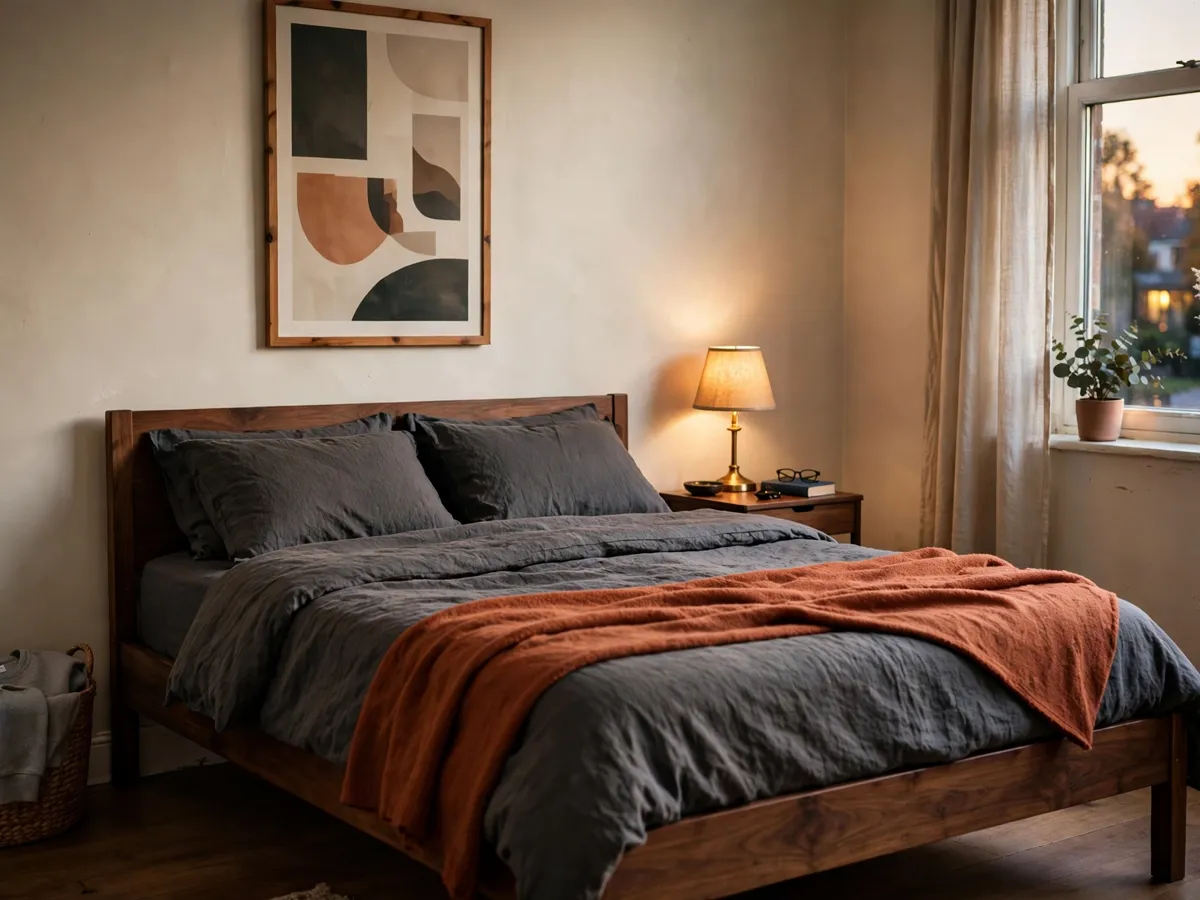
The palette that works in a small bedroom is two or three colors deep. Charcoal, olive, deep green or a dark walnut brown carries the large surfaces — walls, bedding, the biggest piece of furniture — while the ceiling stays off-white or a soft cream, because a dark ceiling in a room with eight-foot walls brings the ceiling down onto the bed. One earthy accent, terracotta or rust or a worn leather tone, appears twice and only twice. The specific shades that hold their warmth at night under a warm bulb are catalogued in the cozy paint colors guide. The mistake worth flagging is the all-black room: black swallows the light a small window already struggles to bring in, every corner goes flat, and the room reads as a den rather than a bedroom. Dark warm colors give the room depth at night and character in the day; black gives it a hole. How the paint sits against the bed and the walkways — which walls carry the color and which stay light — is decided in the bedroom layout guide, and the fuller mood board for the look is in the small bedroom aesthetic guide.
Cost: $40–$70 for a gallon and supplies. Time: a weekend for one room, done around the furniture.
2. The bed is the statement piece
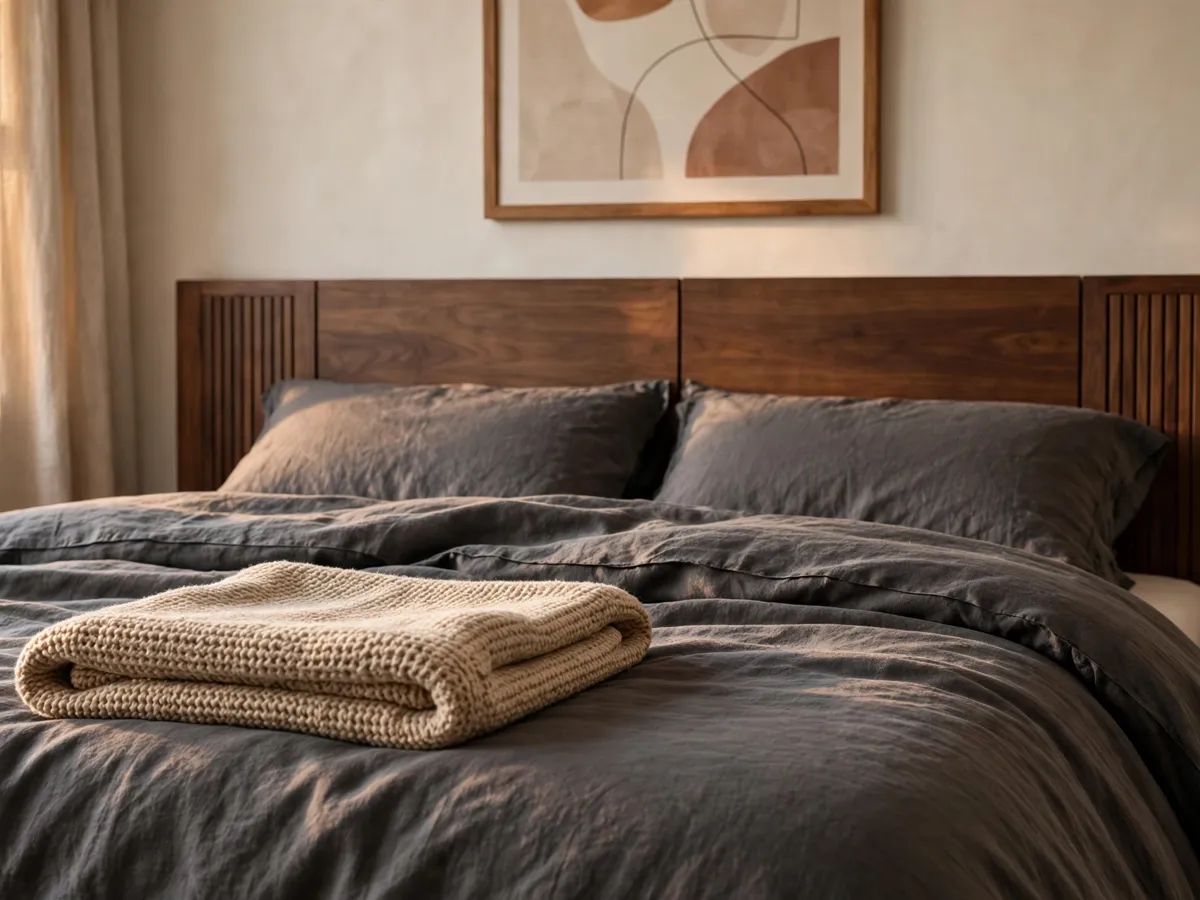
In a small bedroom the bed fills so much of the visual field that it decides the room's character on its own, which makes it the cheapest possible statement wall. The upgrade that carries the most weight is bedding with actual texture — a washed linen set or a chunky knit blanket — because flat dark bedding reads as a sleeping bag while textured dark bedding reads as a room that was styled. Choose one or the other, not both; linen and knit stacked together in a small room looks like a store display. Headboards run the same logic: a walnut or natural wood headboard anchors the room, and going without a headboard at all works cleanly too — one large framed piece hung low behind the pillows does the job of a headboard without spending a floor inch or a paycheck, and the height it hangs at is the fifty-seven-inch rule. The part that costs nothing and matters more than any of it: the bed gets made every day, the throw lands straight, nothing lives on the foot of it. A room with an unmade bed reads as unfinished no matter what the walls are doing, and a made bed in a dark warm room reads as finished even when the rest is empty.
Cost: $50-$120 for bedding, $30-$80 for a large frame if you skip the headboard. Time: two minutes a day, every day.
3. Frame the posters, and keep it to two
The single fastest upgrade in a room full of taped-up posters is frames. A poster behind glass in a plain black or walnut frame stops being decoration and starts being a piece, and it is the difference between a room that photographs like a joke and one that photographs like a home. Buy two large frames — sixteen by twenty or bigger — rather than a grid of a dozen small ones; a wall of twelve frames in a small room turns into visual noise from across the room, while one or two large pieces read calm and deliberate. Which wall: the wall the bed faces, so the art is the first thing seen on waking and the last at night. The spacing rules for any group bigger than two are in the gallery wall guide, and if drilling is off the table the honest adhesive options are listed in the renter wall guide. Old frames from a second-hand shop work as well as new ones once the mats are swapped — the sourcing habit behind that is the thrift flip guide.
Cost: $20–$40 per large frame, $40–$80 for the pair. Time: one hour, including the hanging.
4. Gear gets a home, and the floor is not it
The small room reads as a dorm the moment everyday things live on the floor: the hoodie on the chair back, the gym shoes by the door, the bag wherever it landed. Each of those is a place missing, and each place costs under twenty dollars. Two or three wall hooks at door height take the hoodie and tomorrow's jacket the second they come off, and a single basket by the door or at the foot of the bed collects the things that otherwise pile on the floor, including the gym clothes waiting for the wash. The nightstand stays narrow — fourteen to sixteen inches deep is the full allowance — with a lamp, a phone and nothing else on top; the size and shape rules for that piece are in the nightstand guide. The rule underneath all of it is a one-line rule: the floor holds furniture, and nothing else. Every object that ends up on the floor for a week straight is telling you which hook, basket or shelf the room is missing.
Cost: $15–$25 for hooks, $15–$30 for a basket. Time: half an hour, and the habit from the first morning.
What we would skip
Skip the neon sign. It reads as a bar at ten watts and a bedroom at zero, it fixes the room to one joke, and in a dark warm palette its cold spill ruins the color you spent a weekend choosing. Skip the full sports-memorabilia wall — a jersey and three pennants in a small room crowd every other surface, and one framed piece from the collection lands harder than a dozen. Skip black shag carpet: it shows lint and dust in daylight, it swallows the room's edges, and it is the one rug a landlord remembers at move-out. And skip the adult bunk bed, however efficient it looks; climbing down a ladder at night in the room you chose for calm is a trade nobody makes twice.
Cost: $0. Time: the decisions that keep the room one idea.
Honest costs: where the money actually goes
The sixty-dollar version: a gallon of warm charcoal paint at $40, and the two wall hooks the room was missing at $15. That is a genuinely different room, because the walls carry the change. The one-fifty version adds the bedding with texture — washed linen or a chunky knit at $50–$80 — and two large poster frames at $40–$80. The three-hundred version rounds it out: a narrow second-hand nightstand at $40–$80, one warm bedside lamp at $25–$40, and a real rug at $60–$100. Spend in that order and the money follows the parts of the room the eye touches every day: walls, bed, nightstand, floor. Nothing on this list is urgent, and every stage of it looks finished on its own.
Cost: $60–$300 depending on the stage. Time: one weekend at any of them, painted one wall at a time.
Before you spend anything: copy this
- One dark warm color on the walls, cream on the ceiling, one accent used twice
- Textured bedding — linen or knit, one or the other — and the bed made daily
- Two large framed posters on the wall the bed faces
- Hooks for the jacket, one basket for the gym things, a narrow nightstand
- The floor holding furniture and nothing else
Cost: $0 to check. Time: ten minutes, before the first purchase.
Questions renters ask
What colors work in a small men's bedroom?
Dark and warm: charcoal, olive, deep green or a dark walnut brown on the walls and the bedding, a cream ceiling, and one earthy accent used exactly twice. Skip all-black — it flattens every corner of a small room and kills the window light.
Should posters be framed in a small bedroom?
Yes — it is the cheapest single upgrade in the room. Two large frames on the wall the bed faces read calm and deliberate; a dozen small taped posters read as noise from the doorway. Plain black or walnut frames, glass, and if drilling is banned, the adhesive options hold a light frame within the weight limit on the packet.
Where does everything go with no closet?
A clothing rack for what is worn weekly, hooks on the back of the door for the daily jacket, one basket for the wash-bound gym things, and one narrow dresser for the rest. The test is that nothing lands on the floor two nights running — every time something does, it is naming the hook or shelf the room is missing.
How do I keep it from looking like a dorm?
Three habits carry it: the bed made daily, everything off the floor and into its hook or basket, and the walls limited to two large framed pieces. A dark warm palette with those three habits reads as a room a grown person designed — the same room with an unmade bed and taped posters reads as move-in day.
Save these on Pinterest
Pin the palette first — dark warm walls with a cream ceiling is the one decision that carries the whole room. The exact shades are in the cozy paint colors guide, the layout that decides which walls go dark is in the bedroom layout guide, and the second-hand route to frames and nightstands runs through the thrift flip guide. All of them sit in the Small Room Decor collection for the next room that needs one clear idea.