 Plant As Deco
Gardening & Planting Tips
Seed Starting Calendar by Zone: Two Tables You Reuse Every Year
By Plant As Deco · Updated 17 November 2026
A seed starting calendar by zone is the one sheet of paper worth taping inside a kitchen cupboard, because the dates on it come back in the same order every year. The part most calendars get wrong is the first assumption: a hardiness zone is a winter-minimum temperature map, not a last-frost-date map, so a schedule built on the zone number alone puts tender seedlings outside a fortnight early. Below are the three tables worth printing — the zone-to-frost range, the month-by-month grid and the weeks-before-frost counts — each one built so you can write your own frost date at the top and reuse it next spring.
Weekend-ready: $0–$15, one hour. Renter-safe, windowsill-sized.

1. What a zone actually tells you
The number on the seed packet is a map of the coldest minimum temperature a garden is likely to reach in winter. That is its whole job. It says nothing about when spring arrives, and the two things are not the same measurement: a zone answers “how cold does it get?” while a sowing date needs “when is the last frost?”
Two gardens in the same zone can see their last frost three weeks apart, and it happens for reasons the map cannot show. Elevation moves a date later — a garden a few hundred feet up the hill runs behind the one in the valley. Distance to water moves it later too, because a large lake or river warms slowly and holds the air around it cool well into spring. And the record itself differs: a sheltered inland garden and a windy one on the same line of the map are working from two different thirty-year histories.
So use the zone as the starting hint it is — the first column of the table below — and then replace it with a real date. How to pin down your own frost date from the two sources that actually settle it is a separate job, and we walked through it step by step in the garden planning guide. This page starts where that one ends: with your date in hand and a calendar to fill in.
What the zone is genuinely good for is season length, which is the number that decides whether a crop belongs on your windowsill at all. Zone 4 gets roughly four frost-free months, zone 9 roughly nine, and a tomato wants three of them. That is a real filter. A zone-4 gardener with one shelf and one light bar should not be raising forty plants; a zone-9 gardener can start the same crop twice in a year.
Cost: $0. Time: 5 minutes to read. A zone is a hint about winter, never a promise about spring.
2. The zone-to-last-frost table
This is the first of the two tables worth printing. Every cell is a range rather than a date, and the range is the middle of what gardens in that zone usually see — which is exactly why there is a blank column beside it for your own number.
| Zone | Last frost, typical range | What it means on a windowsill |
|---|---|---|
| 3 | late May – early June | Thin spring light and a long wait to planting out — start only onions and leeks before April. |
| 4 | mid – late May | March is the real starting month; February sowing stretches for eight weeks indoors. |
| 5 | late April – mid May | No point starting tomatoes before the last week of March. |
| 6 | mid April – early May | Peppers from mid-February at the earliest, tomatoes from the second week of March. |
| 7 | early – mid April | Peppers in late January, and only under a light — the windowsill cannot carry them that early. |
| 8 | late March – early April | January sowing is real for cool-season crops; warm-season seed waits for February. |
| 9 | February – March | Cool weather is the main season here, so the important sowing is the autumn one. |
| 10 | January – February | Summer is the hard season, not winter — start in autumn and plant out early. |
Two of those rows are worth reading twice. In zone 5 the useful sentence is negative: with a frost date somewhere between late April and mid May, a tomato sown in February is a plant that spends ten weeks on a shelf it never needed to be on, and the shelf runs out of room before the weather co-operates. In zone 8 and warmer the mistake flips — the temptation is to treat January as off-season when it is actually the best cool-weather sowing month of the year.
Every row here is a starting hint that you overwrite. Write your own frost date in the margin, and if this is your first season write a second date two weeks later beside it. That second date is the one you sow against.
Cost: $0–$1 to print. Time: 10 minutes to read and correct. The correction matters more than the table.
3. The month-by-month grid
The second table answers a different question: not “when do I start this crop?” but “what is worth starting this month?” That is the question you actually ask on a Sunday afternoon with a packet in your hand. Three crops per cell is the limit — a longer list stops being a decision and becomes a wall of text.
| Month | Zones 3–5 | Zones 6–7 | Zones 8–10 |
|---|---|---|---|
| January | onions, leeks, celery | onions, leeks, peppers (late January, under a light) | peppers, eggplant, lettuce |
| February | onions, leeks, early cabbage | peppers, eggplant, tomatoes (late February) | tomatoes, peppers, lettuce |
| March | tomatoes (late March), peppers, broccoli | tomatoes, basil, broccoli | squash, cucumber, basil |
| April | squash, cucumber, lettuce | squash, cucumber, beans (late April) | beans, squash, heat-loving herbs |
| May | direct sow: beans, carrots, squash | direct sow: beans, carrots, squash | — |
| June | fall cabbage, fall broccoli | fall broccoli, fall cabbage | — |
Now the honest part the grid cannot show. For most zones, July through December is not a starting season at all — it is harvest, clearing, and planning next spring on the back of an envelope. The exceptions are the second season: zones 8 to 10 start their autumn and winter cool crops in August and September, and zones 3 to 5 get a small second pass in June for fall cabbage and broccoli. If you are in zone 6 or 7, June is the last indoor sowing of the year and then the shelf is free until January.
Read the grid against your own frost date rather than your band. The band told you roughly where to look; your date tells you which month is which. A zone 6 garden with a late frost pushes the whole tomato row a fortnight later and the table is still right — the order never changes, only the dates.

Cost: $0–$1 to print. Time: 15 minutes to mark your own dates. Start from the month above your band if your frost date is late.
4. The weeks-before-frost counts, per crop
This is the table that keeps earning after year one, because it is the only one that survives moving house, changing zone, or deciding in February that you want to try eggplant. Copy the counts onto the back of the sheet beside the crops you actually bought seed for — that is your real calendar.
| Crop | Start indoors | Note |
|---|---|---|
| Peppers | 8–10 weeks before | Slow to sprout; warmth matters more than light at first. |
| Eggplant | 8–10 weeks before | Same window as peppers, same patience. |
| Tomatoes | 6–8 weeks before | Later than most people start them. |
| Broccoli | 6–8 weeks before | Also works as a June sowing for autumn. |
| Cabbage | 6–8 weeks before | Cool-season; tolerates an earlier set-out. |
| Basil | 6–8 weeks before | Hates cold more than tomatoes do. |
| Lettuce | 4–6 weeks before | Fast; sow a small pinch every few weeks. |
| Squash | 3–4 weeks before | Outgrows a cell quickly — do not go early. |
| Cucumber | 3–4 weeks before | Resents root disturbance; sow in a bigger cell. |
| Beans | direct sow at frost | Straight into the pot once the date passes. |
| Carrots | direct sow at frost | No transplanting — the taproot decides. |
The arithmetic is the whole skill, and it is one subtraction. Say your last frost is May 10. Eight weeks before May 10 is March 15. Ten weeks before is March 1. So peppers, at 8–10 weeks, go in somewhere between March 1 and March 15 — and if your light is a windowsill and your pot-up space is one shelf, sow at the later end of that window rather than the earlier one.
Do the same subtraction for each crop on your list and write the result next to the packet, not in your head. Tomatoes at 6–8 weeks land about a fortnight after the peppers, which is why the pepper tray and the tomato tray are never sown on the same weekend no matter what a calendar poster suggests.
Two crops on that list never go through a cell at all. Beans and carrots are direct-sown at the frost date because they resent the move — a bean started indoors and transplanted spends a week sulking, and a carrot that gets transplanted grows a forked root that is nobody’s idea of a harvest. Start them where they will live. When the seedlings are ready to leave the shelf, the pot sizes each one needs are in the container vegetable guide.
Cost: $0. Time: 10 minutes of subtraction for a whole season. Use the shorter count when your light is weak.
5. The two-date safety rule
One frost date from one source is how a calendar gets a reputation for being wrong. Get the number twice, from two different kinds of source, and then apply each date to a different half of your seed list.
The first source is your county extension office. They publish the thirty-year record for your area as a small table rather than a single number, usually with three dates: a late date that frost almost never comes after, a middle date that is a coin flip, and an early date that frost usually beats. Ask for the late one. The second source is local and human — a nearby weather station’s recorded last frost, or a neighbour who has gardened the same street for years and can tell you when their tomatoes actually went out.
Then split the list. Use the later of your two dates for warm-season crops — tomatoes, peppers, eggplant, basil, squash, cucumber, beans — because those are the plants a late frost kills outright and there is no prize for being first. Use the earlier date for cool-season crops — lettuce, broccoli, cabbage, carrots — because those tolerate a cold night and gain from the extra fortnight of growing before the heat arrives.
And if this is your first year on this ground, add two weeks to whichever date you use. Not because the sources are wrong, but because a first-year garden has no local record of its own — the corner behind the building may frost a week after the open allotment, and you will only learn that by watching. Write the two-week version on the sheet in marker; next year you replace it with what actually happened.
Cost: $0. Time: 20 minutes, two phone calls or two website visits. Two sources, two dates, one rule for which crop gets which.
6. Printing the sheet so it survives the season
Print the three tables on two sheets, or one double-sided sheet if your printer will do it. Tape them inside a kitchen cupboard door, at eye height, where the kettle is — not in a folder, and not in a phone note that scrolls away under a notification.
Then make the sheet yours in four marks. Write your frost date at the top in marker, big enough to read from a step away. Write the two-week version beside it in pencil if this is year one. Copy the weeks-before-frost count next to each crop you actually bought seed for. And rule a line across the bottom of the sheet for the dates things really happened — sown, sprouted, potted up, planted out.
That last line is the part that turns a generic calendar into yours. A calendar that says “tomatoes, second week of March” is a suggestion; a calendar with last year’s actual sowing date, the date they sprouted and the date they went outside is a record you can adjust from. Two seasons of that and the zone table becomes a footnote on your own page.
The shelf, the light and the watering are a different set of decisions from the dates, and they are covered in the indoor seed starting setup— one shelf, one bar two to three inches above the leaves, water from the bottom. Get the date wrong and you lose a fortnight; get the light wrong and you lose the tray.
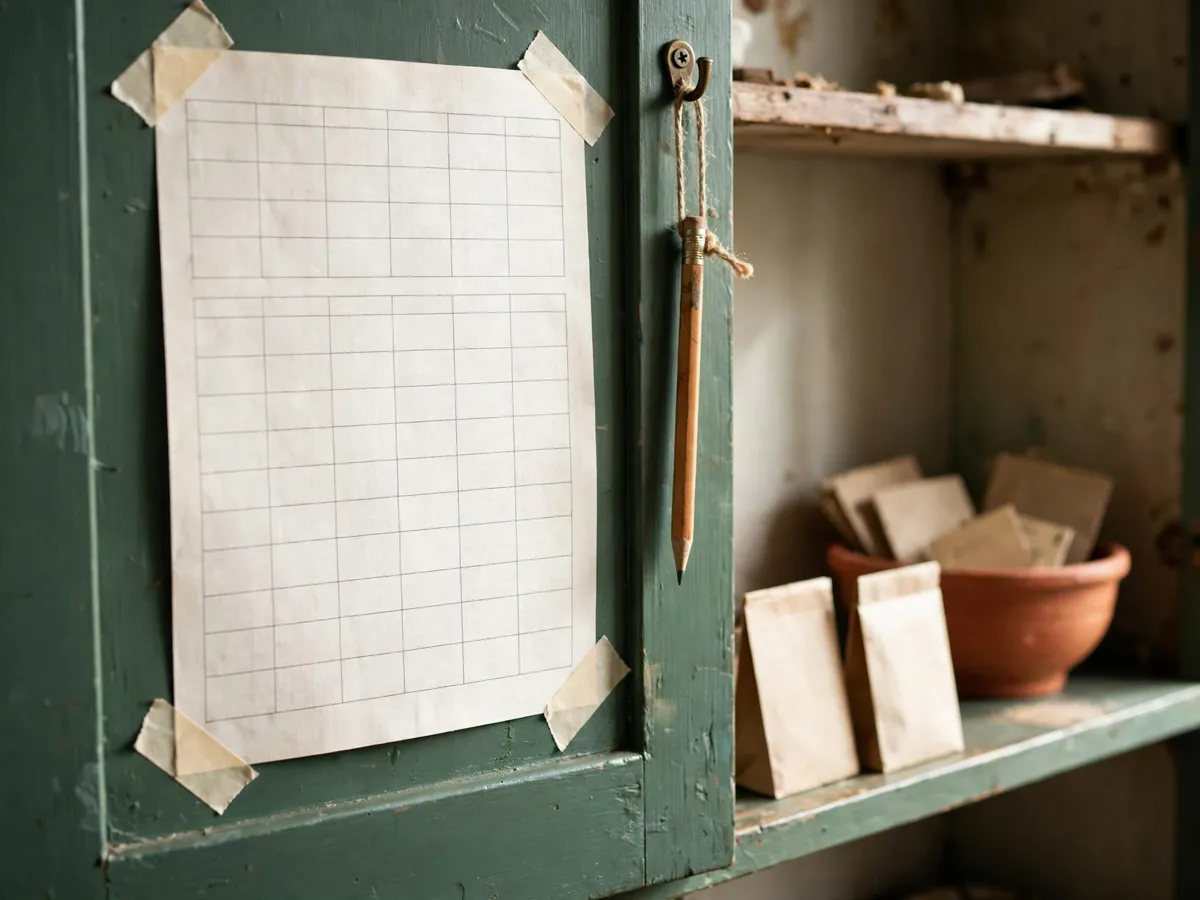
Cost: $0–$15 for printing, a marker and a pencil. Time: 20 minutes to print, tape and mark. Put it where you make tea.
What we would skip
- Planning on the zone number alone. It is a winter map. Write your own frost date on the sheet and use that instead.
- Starting tomatoes in January in zone 4. They will spend ten weeks on a shelf they did not need, get leggy, and run out of pot-up room before the ground is ready.
- Buying a grow tent before a single seed has germinated. One light bar and one shelf is the whole rig for a first season.
- A prettier calendar app with reminders, before you know your own frost date. The date is the content; the delivery system is not.
- Starting a crop the packet says needs twelve weeks when you have a windowsill and no light. The count is honest and so is the windowsill.
- Sowing the entire packet in one go. Three or four plants of a crop feed a small household, and the rest of the packet keeps.
Cost: $0 to skip. Time: 5 minutes to strike them off the list.
The one-hour checklist
- Zone looked up, then set aside as the hint it is
- Frost date taken from two sources: county extension late date plus a local record
- Later date marked for warm-season crops, earlier for cool
- Two weeks added in pencil if this is the first season here
- Three tables printed — frost range, month grid, weeks per crop
- Frost date written in marker at the top, readable from a step away
- Weeks-before-frost counts copied beside the crops actually bought
- Start dates written in pencil, so they can move
- A ruled line at the bottom for sown, sprouted, potted up, planted out
- Sheet taped inside a cupboard door near the kettle
Cost: $0–$15. Time: one hour, once, and then ten minutes each January.
Questions beginners ask
Is a seed starting calendar by zone accurate enough to sow from?
As a first hint, yes; as a final date, no. A hardiness zone maps winter minimum temperatures, and last frost depends on elevation, distance to water and the local record, so two gardens in one zone can sit three weeks apart. Use the zone row to find your month, then replace it with your own frost date from two sources.
Can I start seeds in January in zone 6?
Onions, leeks and celery, yes. Peppers only at the end of January and only under a light. Tomatoes in January are too early — 6–8 weeks before a mid-April frost means the second week of March, and a January tomato is a plant that runs out of pot room before planting day.
What if I do not know my zone or my frost date?
Get the date first — it is the one that does the work here. Your county extension office publishes the thirty-year frost record for your area, and a nearby weather station or a neighbour’s garden log gives you the second opinion. The zone is a convenience for seed packets, not a planning tool.
How early are tomatoes and peppers really?
Tomatoes 6–8 weeks before last frost, peppers and eggplant 8–10. With a May 10 frost date that puts peppers between March 1 and March 15, and tomatoes about a fortnight later. Sow at the later end of the window if your light is a windowsill.
Do I start seeds every month of the year?
No. For most zones July to December is harvest, clearing and planning, not sowing. The second season is the exception: zones 8 to 10 sow their autumn cool crops in August and September, and zones 3 to 5 start fall cabbage and broccoli in June.
Save these on Pinterest
Pin the two tables — the zone-to-last-frost range and the weeks-before-frost counts — because those are the two you will want again in January when the seed packets come out. Add the month grid too if you garden in a small space, since three crops per cell is the part that keeps a first season sane. The Gardening & Planting Tips collection holds the rest of the small-space growing ideas.