 Plant As Deco
Gardening & Planting Tips
Tropical Houseplants for Beginners: Six That Work Indoors
By Plant As Deco · Updated 19 November 2026
Tropical houseplants get a bad reputation with beginners, and most of it comes from one mistake: buying a plant grown in a humid forest, then treating it like a potted cactus. The rainforest understory is bright but never in direct sun, warm but never dry, and damp without ever sitting in a puddle. A US apartment in January is the opposite of all three at once. These six bridge that gap - they ask for more humidity and more light than a snake plant does, and in exchange they give you the large patterned leaves that made the tropical look popular.
Weekend-ready: $10–$60 for a starter plant, one pot, one bag of mix. The cheapest on this list is also the hardest to spoil.
1. What makes a plant tropical
"Tropical" on a nursery tag describes where a plant grew before it reached the store, and it predicts what the plant wants afterwards. Tropical houseplants come from the understory of humid forests - the layer between the shaded floor and the sunlit canopy. They are not desert plants. A desert plant stores water in thick leaves and waits; an understory plant moves water through thin, broad leaves continuously and cannot wait.
Three tells identify an understory tropical, whatever the tag claims:
- Thin, broad leaves. A rainforest floor is dim, so the plant spreads a wide, thin leaf to catch what light falls. Thick fleshy leaves mean a desert plant, which wants the opposite care.
- Aerial roots. Monstera and philodendron push roots into the air, looking for a trunk to climb and for moisture in the humidity.
- New growth wrapped in a sheath. An unfurling leaf rolled inside a papery spathe is a tropical signature, and it is why these plants arrive half-open rather than in bud.
Read the leaf before you buy. Thin and wide means consistent moisture, bright indirect light and humidity above 40 percent. Thick and fleshy means bright sun and dry soil. A store shelves both under the same "easy-care houseplant" sign, and a beginner waters the understory plant like a desert one until the roots rot. If you want the desert list instead, the low-light indoor plants guide covers the tougher, drier picks.
Cost: $0 to look at a leaf. Time: 30 seconds at the shelf, before the plant is in the cart.
2. The humidity rule, which is the whole game
Humidity separates a thriving tropical houseplant from a sad one, and it is the variable beginners ignore. Most tropical species want 40 to 60 percent relative humidity. A heated US home in winter runs 15 to 25 percent. The plant loses water through its leaves faster than its roots replace it, the edges brown and crisp, and that damage is permanent on that leaf - so the fix has to come before the symptom.
The common wrong fix is misting. A spray bottle raises humidity for about five minutes, and the repeated wet-dry cycle on the leaf invites fungal spots while doing nothing for the air. A tropical with brown edges needs the air changed, not the leaf sprayed.
- A pebble tray works a little. A saucer of pebbles with water below the pot base adds maybe five points of humidity within a foot. Better than nothing, and it costs nothing.
- Grouping plants works measurably. Three or four tropical houseplants on one shelf create a pocket of moister air between them, because each leaf transpires. Clustered plants do better than scattered ones.
- A humidifier is the real answer. A small unit aimed at the plant corner holds 45 to 55 percent and costs roughly $10 a month to run. It is the upgrade that changes calathea and maranta from difficult to normal.
- A hygrometer tells you the truth. A $12 meter ends the guessing. Below 35 percent in a heated room is the danger zone; above 45 percent these six are fine.
Five of these six tolerate average home humidity through a heating season with a tray and a clustered shelf. Calathea does not, and it is the one that tells you the air is too dry. If you will not buy a humidifier, skip the calathea and keep the philodendron.
Cost: $0 for a tray, $12 for a hygrometer, $25–$60 for a small humidifier. Time: 10 minutes to set up.
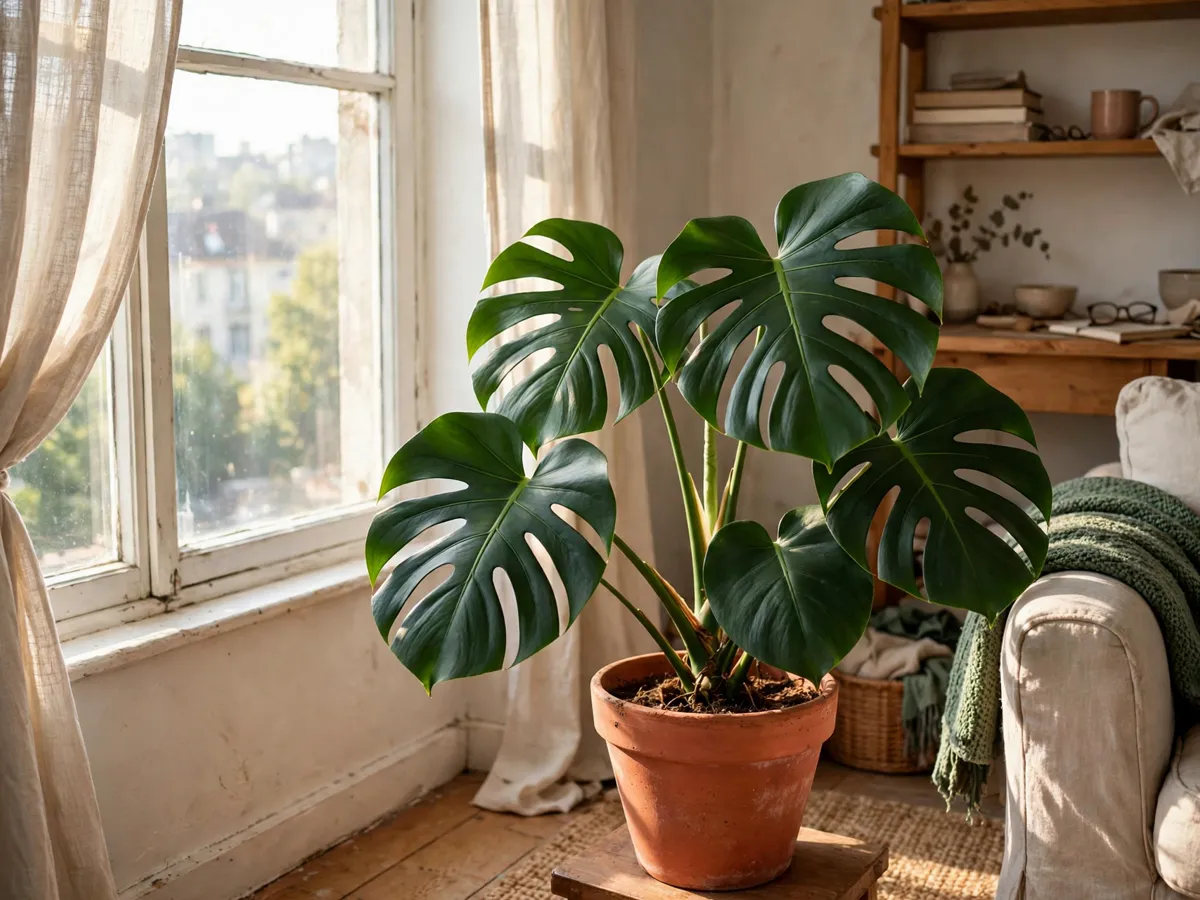
3. Monstera (Monstera deliciosa)
The monstera made tropical houseplants a default decor choice, and it is the second-easiest pick here after the philodendron. Young monsteras have solid, heart-shaped leaves with no splits at all. The famous holes and splits - the fenestration - arrive only as the plant matures and only in enough light. A young monstera in a dim apartment stays solid-leafed for years, and that is the plant being honest about its window, not a defect.
- Light: bright, indirect. An east window, or two to four feet back from a south one. Direct afternoon sun through glass scorches the leaves; a deep corner slows it to a standstill.
- Water: when the top two inches of mix dry out, roughly every 7 to 10 days in summer and every 2 to 3 weeks in winter. Soak until water runs from the drainage hole, then empty the saucer. A monstera left sitting in a saucer rots from the base, the most common way one dies.
- Mix: standard potting mix cut with a third of perlite, or a chunky aroid mix with bark. Dense garden soil holds too much water around these roots.
- Pot: one with a drainage hole, one inch wider than the root ball. Monsteras tolerate being slightly tight, and the one-size-up rule matters here more than most plants.
Growth is slow: one to three new leaves a year in average home conditions, three to six feet over five years. Aerial roots appear along the stem; leave them or train them onto a moss pole to climb. Crispy brown patches mean dry air; a single yellow lower leaf is normal aging.
Cost: $15–$35 for a 4-to-6-inch seedling, $80–$200 for a three-foot plant with splits already showing. Time: 10 minutes of care per week.
4. Bird of paradise (Strelitzia)
The bird of paradise is the statement tropical, and the one here that demands the most from your window. Two kinds are sold indoors: Strelitzia reginae, the smaller one with paddle-shaped leaves on long stalks, and Strelitzia nicolai, the white-flowered giant that reaches six feet in a pot. Reginae is the realistic apartment choice; nicolai is the one people regret. It grows one to two new leaves a month in warm weather, each unfolding from a rolled sheath, and old leaves split along the veins naturally - dry air tears them ragged instead of clean.
- Light: the brightest window you own, a south or west one with a sheer curtain. It wants more light than a monstera, and in a dim room the stalks lean and the leaves stay small.
- Water: when the top two inches dry, every 7 to 10 days in summer and every 2 to 3 weeks in winter. It droops dramatically when thirsty and recovers within hours, which makes it a good teacher for someone learning to read a tropical.
- Mix: a rich potting mix with perlite or bark for drainage. It is a heavier feeder in the growing season than the others here.
- Pot: a heavy pot with drainage. A bird of paradise in a lightweight plastic pot tips over once the leaves reach three feet, and the stiff root ball will not bend back.
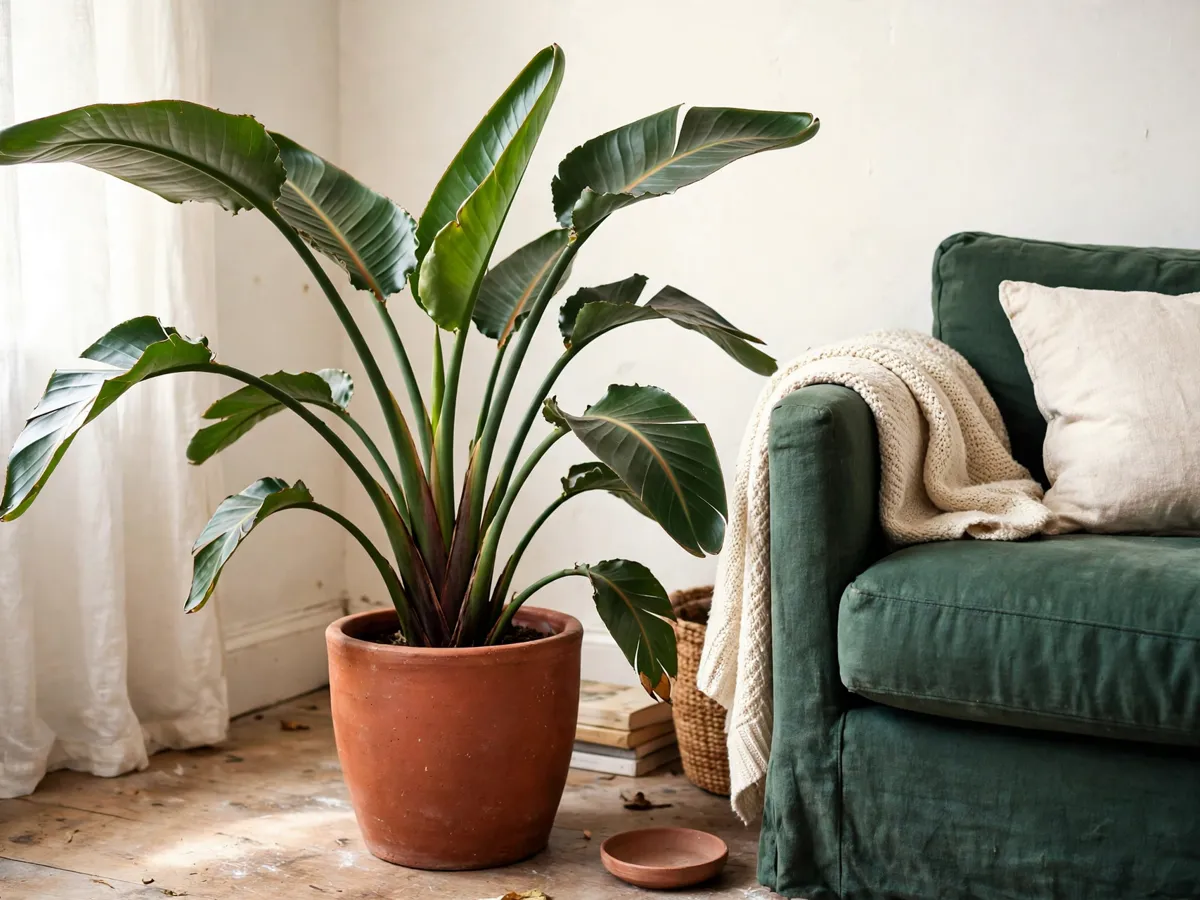
Spider mites are the recurring problem, and dry air is why. Check leaf undersides monthly: fine webbing and pale stippling mean mites, and the answer is a sink shower plus higher humidity, not a pesticide. A bird of paradise in a humid corner rarely gets them.
Cost: $20–$40 for a 6-inch starter, $90–$180 for a three-foot plant. Time: 10 minutes a week, plus a monthly leaf check.
5. Philodendron
If you want one tropical houseplant as a first purchase, make it a philodendron. It shares the monstera's understory background, forgives a wider range of conditions, grows faster and costs less. The trailing heart-leaf form and the larger-leaved climbers behave nearly the same in care.
It is also the easiest tropical to multiply. A stem cutting with one node - the bump where a leaf meets the stem - rooted in a jar of water gives a second plant in three to four weeks, and the propagation guide walks through water versus soil. Leggy plants with bare stems at the base are the best candidates, because the energy has already moved to the tip.
Variegated and pink-stem varieties carry the usual caveat: more white in the leaf means more light needed, and a higher price at the till. A green heart-leaf at $15 is a better first tropical than a $60 rare cultivar.
Cost: $10–$25 for a 4-to-6-inch pot, $30–$60 for a large climbing specimen. Time: 10 minutes a week.
6. Calathea
Calathea is the most demanding plant here, and the most beautiful. The leaves are painted - stripes, dots and feathered edges in purple, pink and silver on green - and they fold up at dusk and unfold in the morning, which is why they are called prayer plants. That movement is the tell: a calathea that stops moving is warning you before the leaves show it.
The demands are specific, and worth knowing before you spend:
- Humidity above 50 percent, consistently. A tray helps; a humidifier is what holds it. This is the plant that justifies the purchase.
- Water with few minerals. Hard tap water leaves brown edges. Filtered or distilled fixes it, and this is the one tropical where the water itself matters, not just the amount.
- Even moisture, never soggy. The mix stays barely damp, never dry to the bottom and never waterlogged. One full dry costs a season of crispy edges.
- Medium light. Bright but indirect, lower than a monstera or a bird of paradise wants. Direct sun bleaches the pattern, and the leaf does not recover its color.
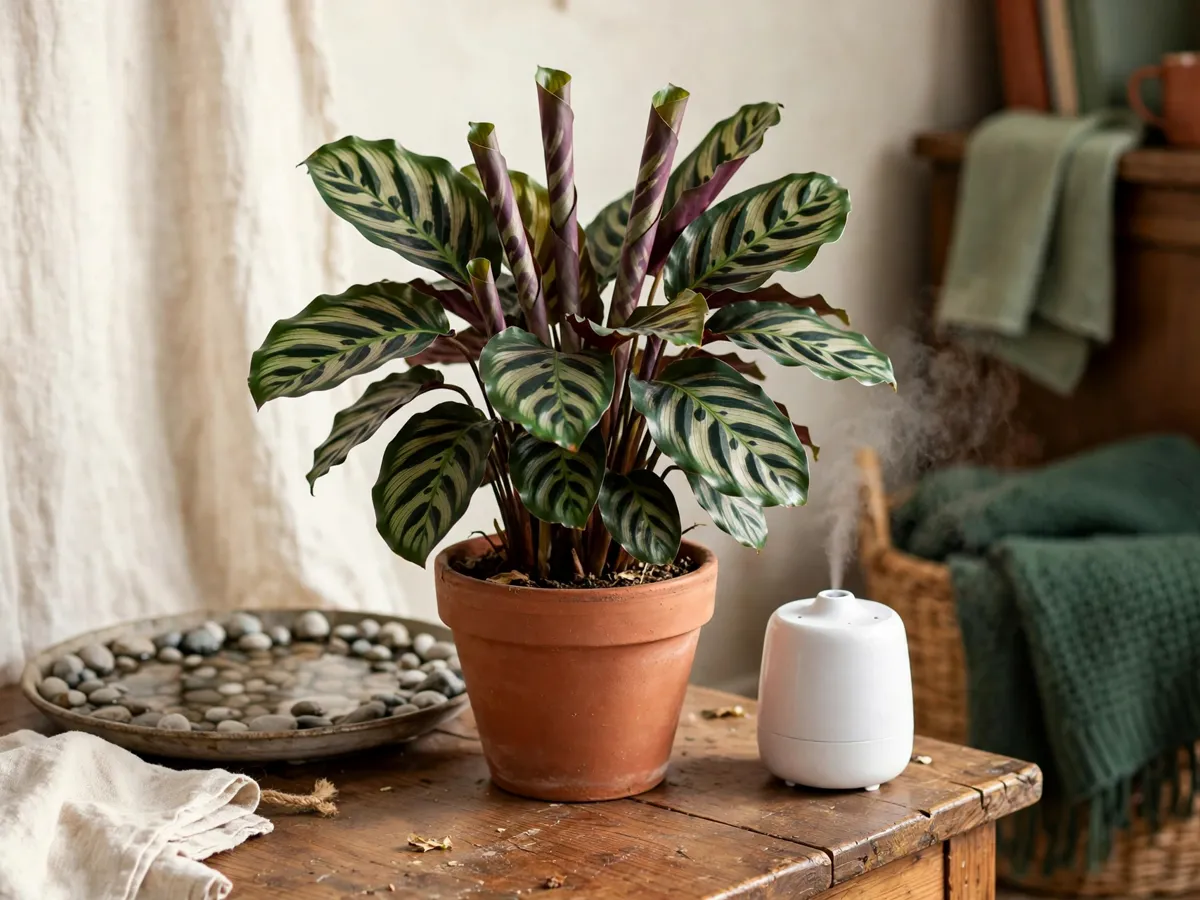
Brown, crispy edges are the near-universal calathea complaint, and the cause is dry air or minerals in the water rather than watering. Trim the worst edges with clean scissors, move the plant to moister air, change the water source, and new leaves come in clean. Yellow leaves mean too little light or a wet mix; curled leaves are a cold-draft response.
Calathea stays compact, 12 to 24 inches over a couple of years, which suits a shelf or a tabletop. It prefers to be slightly root-bound, so a 4-to-6-inch pot holds it for years and repotting is rare.
Cost: $15–$35 for a 4-to-6-inch pot. Time: 10 minutes a week, plus the humidifier if your winter air is below 40 percent.
7. Ficus
Ficus is the family behind the weeping fig, the fiddle-leaf fig and the rubber plant, and it shares one personality across all three: it hates being moved. Relocated to a new room, a new window, or even a new spot in the same room, a ficus drops a third of its leaves within two weeks. That is not death. Put it back, keep it steady, and it regrows in four to six weeks.
The three indoor ficus types differ in how much they ask:
- Weeping fig (Ficus benjamina). Small, glossy, dense leaves on fine branches. The most sensitive of the three to drafts and moves, and the cheapest.
- Fiddle-leaf fig (Ficus lyrata). Large, violin-shaped leaves. The most expensive and the most fragile: it wants the brightest window, drops leaves when neglected and catches pests easily.
- Rubber plant (Ficus elastica). Thick, leathery, deep-green or burgundy leaves on a sturdy stem. The toughest of the three, and the one to buy for ficus character with less drama. Burgundy needs more light to hold its color.
The care that keeps any ficus happy: bright indirect light, water when the top inch or two dries, and a spot you commit to. Choose the corner once and do not rotate the furniture around it. Yellow leaf drop usually means a wet mix; sparse drop with dry mix means thirst; sudden mass drop after a move means exactly what it sounds like. Dust the leaves monthly with a damp cloth, because a dusty plant photosynthesizes slower and works harder for less.
Cost: $15–$30 for a small weeping fig, $40–$90 for a rubber plant, $60–$150 for a fiddle-leaf. Time: 10 minutes a week.
8. The light and water basics that cover all six
Five rules carry every tropical houseplant here, worth writing down before the first nursery trip:
- Bright, indirect light is the default. An east window, a north one in a bright room, or two to four feet back from a south or west one. Direct sun through glass cooks understory leaves; a sheer curtain fixes a west window in summer.
- Water deeply, then let the mix dry partway. A full soak until water runs from the drainage hole, then a pause until the top inch or two is dry. Frequent sips keep roots shallow and the plant weak.
- Never let a tropical sit in a saucer of water. Empty it 20 minutes after watering. Root rot kills more tropical houseplants than drought does, and the saucer causes it.
- Keep it warm, and off the draft. These plants want 65 to 80 degrees and suffer below 55. A window that leaks in January or a vent that blasts in December does more damage than a missed watering.
- Feed only in the growing season. A diluted balanced houseplant feed once a month from March through September, nothing in winter. Growth stops, the roots cannot use it, and salts burn the tips.
Drainage is the rule underneath all five. Every plant here needs a pot with a hole and a mix that does not hold water around the roots. A decorative pot without one is a cover, not a container: keep the plant in its nursery pot, set that inside, and lift it out to water.
These six grow faster than the desert-tough picks, so they need a larger pot sooner - every 12 to 18 months.
Cost: $0 to learn, $5 for perlite, $10 for a bag of mix. Time: 15 minutes at the shelf, once.
9. What not to buy as your first tropical
- Fiddle-leaf fig. The most beautiful and the most returned houseplant in the country. It drops leaves after one move, wants the brightest window you have, and catches pests in a dry room. A rubber plant gives the same leaf shape with a tenth of the drama.
- Orchids. The supermarket phalaenopsis is a tropical epiphyte whose roots grow in bark, not soil, and most beginners water it in a dense mix and drown it within weeks.
- Areca and majesty palms. Sold widely as decor, and they brown at the tips in almost every heated home. Palms want humidity an apartment does not provide, and spider mites love a dry palm.
The pattern is simple: they are tropical, but their demands sit outside what a normal US apartment gives. The six here ask for less, and each one tells you what is wrong in a language a beginner can learn.
Cost: $0 to skip. Time: 2 minutes that save $60 in a plant you will replace twice.
10. What it costs, honestly
Big-box and local nursery prices, mid-size US market, late 2026. The plant is the small part of the spend; the pot and humidity control are the rest.
- Starter plants - $10 to $40. Philodendron $10–$25, calathea $15–$35, young monstera $15–$35, bird of paradise $20–$40, weeping fig $15–$30.
- Mid-size plants - $40 to $90. An 8-to-10-inch pot, a rubber plant or a larger monstera, already looking like decor.
- Floor plants - $90 to $200. A three-foot bird of paradise or fiddle-leaf. The price buys the grower's years, and the risk: a large plant that declines is a larger loss.
- Pot and mix - $15 to $40. Potting mix $10–$18, perlite $5–$8, a pot with a drainage hole $10–$30.
- Humidity control - $12 to $60. A pebble tray is free, a hygrometer $8–$15, a small humidifier $25–$60 and about $10 a month to run. Optional for five of the six, near-mandatory for the calathea.
- Feed - $8 to $14. One bottle of balanced houseplant fertilizer lasts two years at monthly use.
A first tropical, done properly: $25 to $50 for a philodendron or a small monstera, a pot and a bag of mix. A floor plant with a humidifier and a hygrometer: $140 to $290. The tiers differ by size, not difficulty - a $15 philodendron and a $150 fiddle-leaf need the same light and drainage. Only one punishes a beginner for learning slowly.
Realistic all-in for the first plant: $25–$50. Time: one nursery trip, about an hour.
The first-tropical checklist
- Brightest window identified first, and the plant chosen to match the light you have rather than the light in the photo.
- First pick is a philodendron or a small monstera - forgiving, inexpensive, and honest when thirsty.
- Leaf inspected at the shelf: firm, with no webbing underneath and no soft spots at the stem.
- Pot with a drainage hole, one inch wider than the root ball, plus a saucer you empty 20 minutes after every soak.
- Mix is standard potting blend cut with perlite, never garden soil from a bag meant for outdoors.
- Humidity read once with a hygrometer, and the shelf planned accordingly: clustered plants, a tray, or a humidifier if the number came in below 35 percent.
- Spot committed to for at least a season - especially for a ficus, which reads a move as an attack.
- Watering rhythm set on the finger test, not a fixed weekday, and slowed in winter when the plant is not growing.
- Feed schedule noted: March through September only, diluted, once a month.
- A place in the gardening tips collection saved for the day the first tropical is settled and a second one makes sense.
Cost: $0 to check. Time: an hour at the nursery, or 20 minutes ordering with the window in mind.
Common questions
Why are my tropical houseplant's leaves turning yellow?
One lower yellow leaf on an otherwise green plant is normal aging - the plant sheds its oldest leaf to push new growth. Multiple yellow leaves, or yellow between the veins, is a water problem. A mix that stays wet at the bottom rots roots and shows up as widespread yellowing, sometimes with a soft stem base. A mix that dries to the bottom too often yellows leaves that are also dry and crisp. Check two inches down with a finger and fix the rhythm, not the leaf. Cold drafts cause yellow drop too, especially on a ficus.
Should I mist a tropical houseplant?
No. Misting raises humidity for a few minutes and leaves the leaf wet in still air, which invites fungal spotting. Brown crispy edges are a humidity problem, and the fixes that hold are grouping tropicals together, a pebble tray, or a humidifier aimed at the corner. A hygrometer tells you whether you are below 35 percent.
Do tropical houseplants need grow lights?
Not usually, if the room has one bright window. A south or west window with a sheer curtain carries a monstera, a philodendron and a bird of paradise through the year. Two exceptions: a room whose only window faces north in a cold climate, and a calathea you want to keep through December. A simple LED bulb in a desk lamp aimed at the plant for eight to ten hours a day covers both.
Are tropical houseplants safe around cats and dogs?
Several are not. Monstera, philodendron and bird of paradise carry calcium oxalate crystals that irritate a chewing animal's mouth and throat. Calathea and most ficus are listed as mild or non-toxic, though a cat that chews leaves will still vomit. For a pet that chews, the honest answer is a high shelf the animal cannot reach rather than a species gamble.
How often should I fertilize tropical houseplants?
Once a month during active growth, March through September, at half strength. A balanced liquid houseplant feed works for all six here. Stop in winter: growth slows, the roots cannot use the nutrients, and leftover salts burn the root tips and brown the leaf edges.
Which tropical should a beginner buy first?
A philodendron. It is $10 to $25, it grows fast enough to feel rewarding, it takes a wider range of light than the others, and it droops clearly when thirsty so you read the signal before making a mistake. It multiplies from a cutting in a jar of water, so the second and third plants cost nothing. Add a monstera once it is settled, and a calathea only once you own a hygrometer.
Save these on Pinterest
Pin the six-plant comparison and the first-tropical checklist - the two pages that decide whether your first tropical is still alive in six months. This guide and the rest of the gardening tips live together there.