 Plant As Deco
Gardening & Planting Tips
Winter Houseplant Care Indoors: A Simple Cold-Season Routine
By Plant As Deco · Updated 18 November 2026
Most houseplants do not die in the cold. They die in the dry heat next to the cold, or they drown in a pot that is still being watered on a summer schedule. Winter indoors is a different room from the room your plants lived in all summer, even when the furniture has not moved: shorter days, cooler glass, and radiators that pull the moisture out of the air and the leaves at the same time. The fix is a small set of changes you can run in one afternoon, and then a weekly ten-minute check that keeps the routine honest through the dark months.
Weekend-ready: $0–$40, one afternoon of setup plus 10 minutes a week to carry the plants through winter.
At a glance
- Who it is for
- Anyone whose houseplants live indoors through a cold season, whether that is a full northern winter or just a few months of heating and shorter days.
- What you need
- A finger, a saucer for every pot, and one afternoon to move the plants off the glass and away from the heat. Sticky traps and a small humidifier are optional and cheap.
- What it costs and takes
- $0 to $40, one afternoon to set up, ten minutes a week to keep going. Most of the work is moving plants and checking soil, both of which are free.
- What it is not
- A feeding plan, a grow-light guide, or a promise that every plant makes it. Some winter damage is real and the honest move is to prune it in March, not to hide it.
Dormancy indoors: slower growth is normal, not a problem
The first thing to know about winter houseplants is that most of them are supposed to slow down. A plant that pushed out a new leaf every week in July and now sits still for a month is not dying — it is dormant, which is a resting state driven by the shorter days and the cooler nights, not by anything you did wrong. Growth pauses so the plant stops asking for water and food it cannot use, and the leaves it already has carry it through to spring.
Three signals tell you a plant has gone dormant for the season. The first is no new leaves: the top growth stops and the growing tips sit tight instead of reaching. The second is a slower soil dry-down, because a plant that is not growing is not drinking, so the pot that dried in five days in summer now takes two weeks. The third is a little leaf drop on a few species — ficus and some succulents shed a handful of older leaves as the light drops, and a few yellow leaves at the base are part of the season rather than a crisis.
The honest exception list is shorter than people think. Tropical foliage plants kept warm and under a lamp keep growing, slowly, all winter, and the grow lights for indoor plants guide walks through the lamp, distance and timer that keeps them going. A plant under lights is not dormant in the same way, so it still wants a little water and a little feed, just less than summer. Everything else on a normal windowsill — pothos, snake plant, philodendron, ZZ plant, the common foliage group — treats winter as a rest during the cold months it overwinters indoors. If you want a deeper read on which plants sit tight in a dim corner and which keep moving, the guide to houseplants that hold up in a dim corner covers the picks and how dim light changes their winter habits.
Cost: $0. Time: five minutes to read the room and stop expecting summer growth.
Water less: the finger test and the winter interval
The number one winter killer is overwatering, and it happens because a plant that went dormant is still being watered on the old schedule. The pot that needed a drink every five days in summer now sits wet for two weeks, the roots sit in the wet mix the whole time, and rot sets in before the plant ever looks thirsty. The fix is not a calendar — it is a check before every pour.
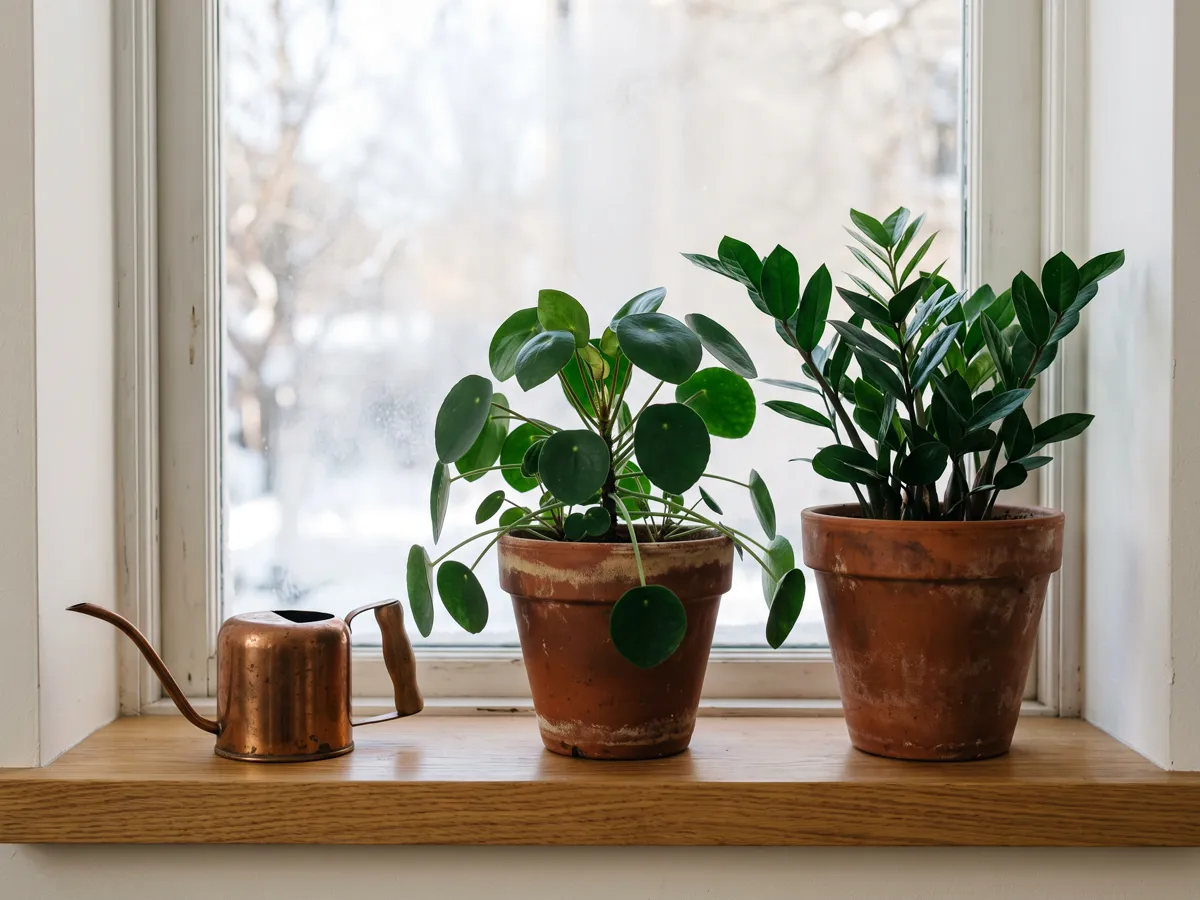
Push a finger two inches into the mix. If it comes out cool and damp, wait. If it comes out dry and the surface is light colored, water. Weight is the second cue: lift the pot right after a thorough watering so you learn what a wet pot feels like, and lift it again before the next watering — a light pot is a dry pot. The saucer rule is the third part and it is the one most people skip: water until it runs through, let the pot drain for ten minutes, then empty the saucer. A plant that sits in a saucer of runoff water is standing in a puddle, and in winter that puddle never dries on its own.
A simple interval table, as a starting point rather than a rule: most foliage plants land around 10 to 14 days between winter waterings, succulents and cacti stretch to three to four weeks, and a plant in a cool, dim room runs at the long end of its range. The point of the table is the check, not the number — a pothos in a warm, bright room may still dry in eight days, and the same pothos in a cool corner may take three weeks. Check before you pour, and let the soil tell you.
Cost: $0. Time: two minutes per plant, once a week. The check is the whole job; the pour only happens when the check says yes.
Heating season: radiators dry the air and cook the leaves
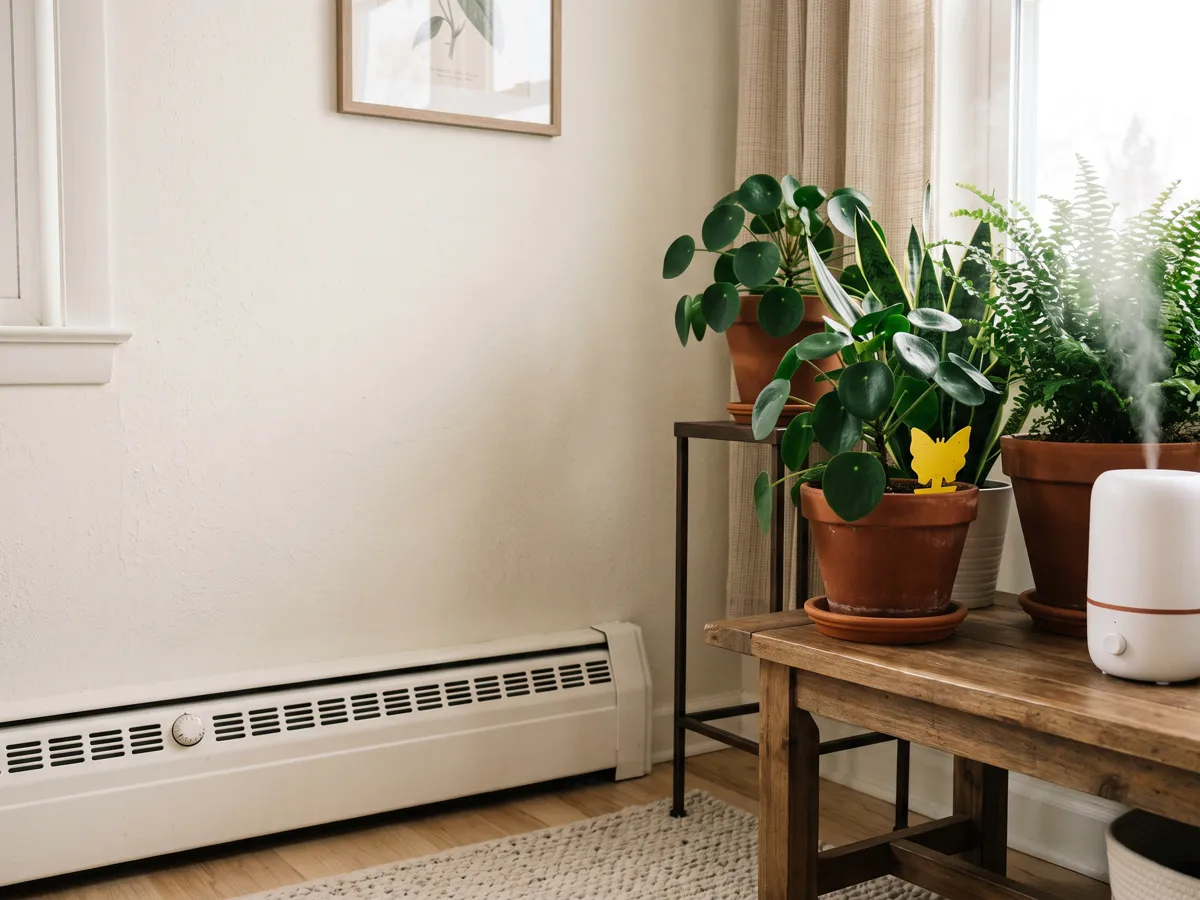
When the heat comes on, the air inside drops fast. Radiators and vents pull moisture out of the room and out of the leaves at the same time, and a plant that was happy at summer humidity starts showing crisp brown edges within a week of the first cold night. The two fixes that matter are placement and grouping: keep plants two to three feet clear of any working radiator or heat vent, and cluster the ones that like moisture so they sit in a small pocket of their own breath. Grouping raises the local humidity a few points for free, and it costs nothing.
The pebble tray is the honest cheap option: a shallow tray of gravel with water below the top of the stones, the pot sitting on the stones and never in the water. It adds a little moisture to the air right around the plant. A small humidifier is the real fix for a room that runs dry all season, and it costs about $30 to $40. Misting is a five-minute fix, not a humidity strategy: the leaves are dry again within minutes, and on a plant with fuzzy leaves it can invite fungus. Skip the mist, keep the humidifier or the tray.
Two rooms in the house already run more humid than the living room in winter: the bathroom and the kitchen. A humidity lover — ferns, calathea, prayer plant — does well on a bathroom shelf that gets some daylight, and a shelf near the kitchen sink holds a little more moisture than a hallway. The trade is light: both rooms often have small windows, so the plant has to tolerate the dimmer spot to get the wetter air. A fern in a bright bathroom usually beats a fern next to a radiator in a sunny living room, even though the living room has more light.
Cost: $0 for grouping and pebble trays, $30–$40 for a small humidifier. Time: ten minutes to move the plants, a weekly top-up for the tray or the humidifier.
Cold glass and drafts: the move-it-six-inches rule
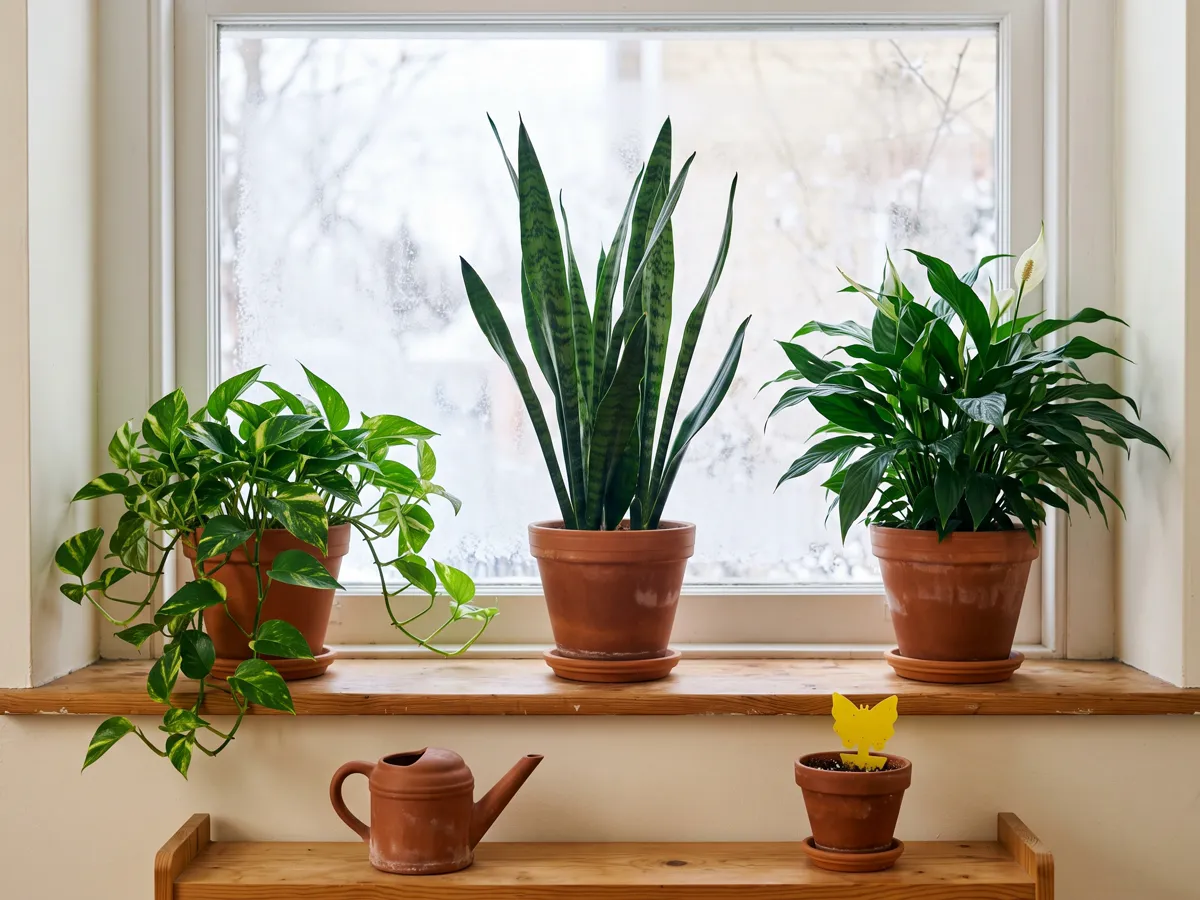
A leaf touching the glass in a 20-degree night takes real damage, even in a heated room. The cold radiates straight through the pane, the leaf sits against it, and by morning the edge is translucent and soft — cold scald, the same way a hot pan burns skin. The fix is a gap. Six inches of air between the foliage and the glass is enough to keep the leaves at room temperature instead of window temperature, and six inches is usually the depth of a windowsill plus a little more.
Curtains make a trap, not a shelter. A plant tucked behind a closed curtain at night sits in a cold pocket between the glass and the fabric, colder than the room and often colder than outside on a clear night. The nightly move is to pull the plant forward of the curtain, onto the room side, and let the curtain close behind it. A shelf set back from the window a foot or two sidesteps the whole question and is the better winter home for anything tender.
One spot that sounds warm and is not: directly above a working radiator. The hot, dry air rises straight into the pot, the soil dries fast at the surface while the roots stay cool, and the leaves cook from below. The same plant on a table three feet from the window and three feet from the radiator usually does better than the one wedged between the two. Drafts from doors and old windows matter too: a plant in the line of a cold draft drops leaves faster than one out of the path, and a strip of draft foam along a leaky frame costs a dollar and helps the plant as much as the heating bill.
Cost: $0 to move a plant six inches. Time: five minutes a night during the coldest stretch, or none if the plant lives on a set-back shelf.
Feed less, rotate more: the winter feeding rule
A dormant plant is not building new tissue, so feeding it pushes weak, soft growth the plant cannot support and then has to be pruned back. The winter rule for most plants is no feed at all, or a quarter-strength dose once a month for the few that are still growing under a lamp. A plant in fresh potting mix that was repotted this year does not need a single feeding through the cold months — the mix already carries the food, and the plant is not asking for more.
The one move that is always worth it in winter is rotation. Light comes from one direction for months, and a pot that never turns grows one-sided, reaching toward the glass. A quarter turn each week keeps the whole plant in the light, and it takes ten seconds. If a plant is in a genuinely dark corner and the rotation is not enough to keep it compact, that is the moment for a lamp — the grow-light guide linked above owns the lamp, distance and timer detail, so this page does not re-teach it.
Cost: $0 to skip feed and rotate. Time: ten seconds a week per plant. The saving on fertilizer pays for the sticky traps in the next section.
Winter pests: fungus gnats from wet soil, spider mites from dry heat
Two pests show up every winter, and both are a side effect of the season rather than bad luck. The first is the fungus gnat, a small dark fly that comes from wet soil. The larvae live in the top inch of the mix, and they thrive in a pot that stays damp — exactly the pot you get when a dormant plant is watered on a summer schedule. The fix is to let the top inch dry between waterings, which also starves the larvae, and to set yellow sticky traps at soil level to catch the adults. A pack of traps runs about $8 to $12 and lasts the season.
The second is the spider mite, and it loves the opposite condition. Dry, heated air is spider mite weather, and the first sign is a fine stippling on the leaf surface and faint webbing under the leaves where they meet the stem. A weekly check of the leaf undersides catches them early, and a thorough rinse in the sink or the shower — lukewarm water, both sides of the leaves — knocks most of them off. A plant that has a real infestation goes into quarantine away from the rest, and a horticultural oil or insecticidal soap at the label rate handles the survivors. Scale shows up the same way — small brown bumps on stems and leaf undersides — and the treatment is the same: isolate, then wipe and spray.
When to isolate a plant: the moment you see pests on more than one leaf. A single infested plant in a cluster spreads to the cluster within a week, and winter is the worst time to fight a room-wide problem because every plant is already a little stressed. Move the affected plant to a separate room or a far corner, treat it there, and keep it apart until two weekly checks come back clean. That is cheaper and faster than treating every plant in the house.
Cost: $8–$12 for sticky traps, $0 for the shower rinse. Time: five minutes a week to check leaf undersides.
The March ramp: feeding, repotting and pruning the winter damage
The spring wake-up does not happen on a date — it happens when the days lengthen and a plant starts to grow again, which in most of the US falls somewhere in March. The first sign is a new leaf, and that new leaf is the signal to start feeding again at half the label rate, then move to the full rate a few weeks later. Feeding before the plant is growing wastes the food and salts the soil, so wait for the growth, then feed.
Repotting follows the same cue. A plant that overwintered in the same pot is ready to move up when roots come out of the drainage hole or water runs straight through the mix in seconds, which means the root ball has filled the pot and there is no soil left to hold water. The next pot is one size up — an inch or two wider, no more — because a pot too big stays wet too long and undoes the careful winter watering in a single pour. The repotting one size up guide walks the pot sizing and the first two weeks of watering in order. Spring is also the time to prune the winter damage: cut back the leggy, stretched stems to a node, remove the dead or yellow leaves, and let the plant push fresh growth from the cuts. Where a stem has gone bare and woody, the cuttings guide shows how to root the healthy top as a fresh start. A good spring prune is the fastest way to turn a ragged winter plant into a full one.
If any plants are moving outside for the summer, they need a hardening-off period of about two weeks. A plant that has lived in still, indoor air all winter sunburns and wilts if it goes straight out to wind and full sun, so set it outside for an hour the first day, two hours the next, and build up over a fortnight to a full day and night. Start in shade and move into more sun gradually. Skipping the hardening is the usual way a winter survivor dies in spring, which is a frustrating end to a plant you kept alive through the cold.
Cost: $0 to prune and ramp feed, $8–$15 for fresh potting mix if a plant is rootbound. Time: one afternoon for the spring reset.
What we would skip
- A winter fertilizer “boost.” A dormant plant cannot use it, and the extra salt builds up in the pot. Save the feed for March, when the plant is growing again.
- Ice cubes as a watering method. The idea is that slow melt waters gently, but a cube is cold water on warm roots in a season when the roots are already cool, and the amount is a guess. Use the finger test and a watering can instead.
- Plant-food myths. Coffee grounds, tea, pasta water and the rest are not fertilizer, and dumping them in a winter pot invites fungus gnats and mold. A balanced liquid feed at the label rate, when the plant is growing, is the real thing.
- Diagnosis promises. A brown leaf can be cold damage, dry air, overwatering, or a pest, and a single photo rarely settles which. This page gives the routine that prevents most of them; it does not promise to diagnose yours.
- “All plants need the same.” A succulent wants dry and bright, a fern wants damp and dim, and a snake plant sits out both. Read the plant before you read the routine.
Cost: $0 to skip. Time: the two minutes of thinking that keeps each of these off the winter list.
Weekend checklist: one afternoon setup, then ten minutes a week
One afternoon setup
- Every plant moved six inches off the cold glass
- Every plant two to three feet clear of any working radiator or vent
- Tender, humidity-loving plants grouped together or moved to the bathroom or kitchen
- Pebble trays set under the plants that need more moisture, or a humidifier placed and filled
- Sticky traps dropped into the pots that tend to run wet
- Each pot checked for a drainage hole and a saucer that gets emptied
- Feeding stopped for the dormant group, noted on the calendar
Ten-minute weekly routine
- Finger test two inches into the mix on every pot before any watering
- Water only the pots that read dry, soak and drain, empty every saucer
- Quarter-turn rotation on every plant toward the window
- Leaf undersides checked for spider mites and scale
- Sticky traps glanced at and replaced when full
- Humidifier or pebble tray topped up if the room runs dry
- Any plant with pests moved to quarantine the same day
Cost: $0 to $40 total. Time: one afternoon to set up, ten minutes a week to maintain, one afternoon in March to ramp back up.
Questions beginners ask
How often do I water houseplants in winter?
Less than summer, and only when the soil says so. Most foliage plants land around 10 to 14 days between winter waterings, succulents stretch to three to four weeks, and a plant in a cool, dim room runs at the long end. Push a finger two inches into the mix before every pour, and water only when it comes out dry. The calendar is a starting point, not the rule.
Should I fertilize in winter?
For most plants, no. A dormant plant is not growing, so the food builds up as salt in the pot and can push weak, soft growth. The exception is a plant under a grow light that is still actively growing, which can take a quarter-strength dose once a month. Resume full feeding in March, when the first new leaf says the plant is awake.
Why are my plant leaves falling off in winter?
A few older leaves going yellow and dropping is normal dormancy on species like ficus, and a handful at the base is part of the season. A lot of leaves dropping at once is a signal: cold draft from a door or window, a plant touching the cold glass, or a radiator cooking the leaves from below. Check the placement first — most winter leaf drop is a location problem, not a water problem.
Can I put houseplants outside in winter?
Not through a real cold season. Tropical foliage plants damage below 50 degrees and die at a frost, so winter outside is not an option for most houseplants in most of the US. If you want plants outside for the summer, the move happens in spring, after the last frost, and it needs a two-week hardening-off period so the plant does not sunburn or wilt in wind it has never felt.
When do I start watering more again?
When the plant starts growing, which usually falls in March. The first new leaf is the signal to move from the stretched winter interval back toward the summer one, and to start feeding at half the label rate. Increase the water a little at a time over a few weeks rather than all at once, and keep the finger test as the check — a plant that is just waking up still drinks less than one in full summer growth.
Save these on Pinterest
Pin the move-it-six-inches rule and the watering interval table, because both are the parts you come back to in January when a plant looks tired. The rest of the winter and year-round planting guides live in the Gardening & Planting Tips collection, and if you are building a windowsill setup for the season, the indoor herb garden guide covers the kitchen side of a winter sill.