 Plant As Deco
Home Organization & Storage
Color Organized Closet: The Rainbow Rail
By Plant As Deco · Updated 23 November 2026
A color organized closet hangs everything by shade instead of by garment type, so the rail reads as one gradient and the eye finds a shirt by its color. It is the closet that photographs beautifully and the closet that asks something of you every single week. This page gives you the sequence that actually works, the one-family-per-rail rule, the two buckets that break every system (prints and neutrals), and an honest verdict on which sort you will still be keeping in three months.
Weekend-ready: $0–$40, one evening for the first rail and a full afternoon for the whole closet. Renter-safe: hangers, liners and baskets only, nothing drilled, nothing that has to move out in pieces.
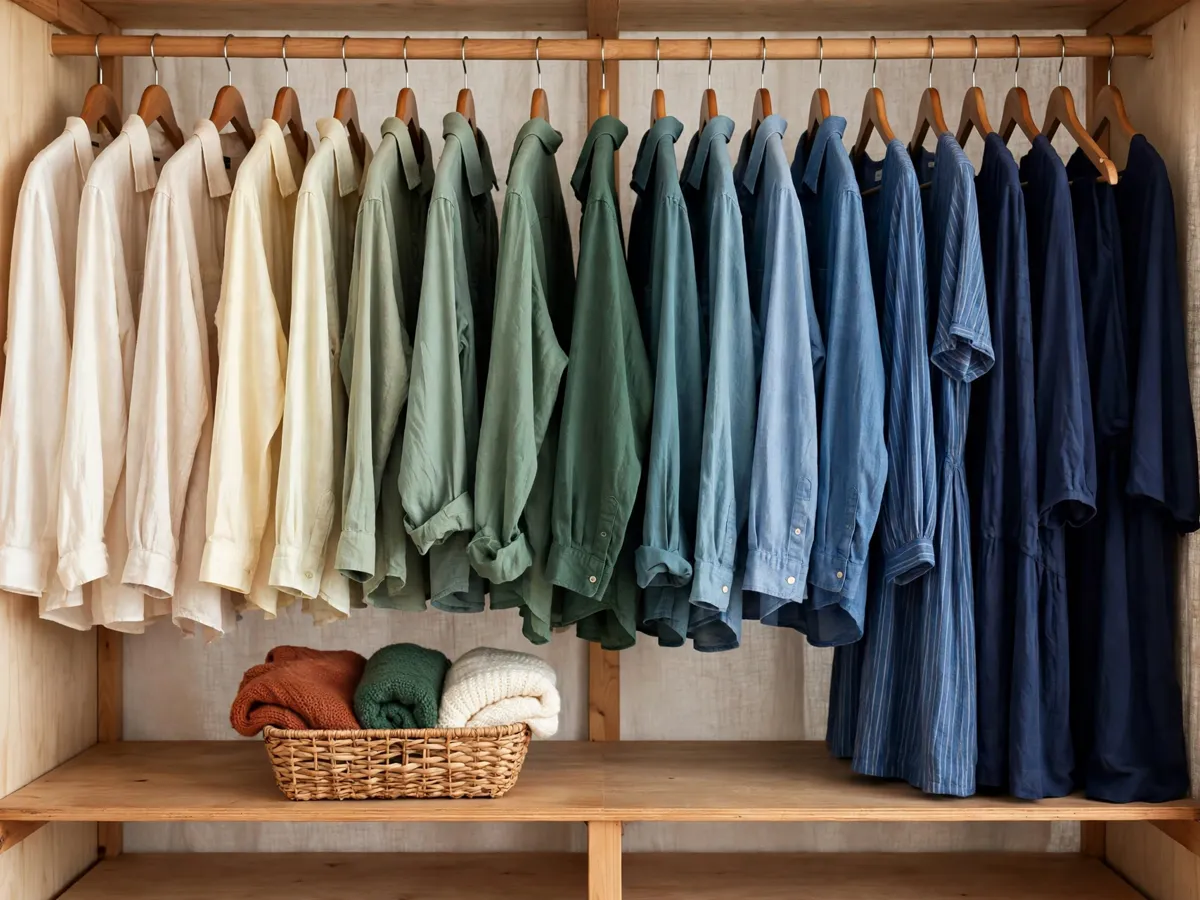
1. The Two Sorting Philosophies: Color Rail vs Category Rail
Almost every closet you were taught to build sorts by category: shirts together, trousers together, jackets at the end. A color rail throws that away and sorts by hue instead, so a navy shirt can sit between two pairs of trousers. Category answers what do I own. Color answers what do I want to wear right now.
Neither is an upgrade over the other, and the mistake is assuming the pretty one is the practical one. Category sorting is an inventory: you can scan it and see gaps. Color sorting is a menu, faster to pick from and harder to audit. If you have ever stood in front of a category closet saying you own nothing to wear, color is the answer. If you have ever bought a third grey sweater because the two you own were buried, category is.
Cost: $0. Time: 15 minutes. Decide which question your closet is answering before you move one hanger.
2. The Honest Verdict: Color Wins for Getting Dressed, Category for Shopping
Say it plainly, because most closet advice will not: color sorting costs more maintenance than category sorting. Every clean shirt that comes back to the rail has to find its shade, and shade is a judgement call, not a label. Category has it easy, a shirt is a shirt, and the hang decision takes one second. Color asks two seconds and a small opinion every time, and those seconds multiply across a week of laundry.
What color buys you with that tax is speed in the morning. You stop digging and start scanning, and the outfit assembles by eye. The verdict that holds up over months of use: color wins for getting dressed, category wins for shopping your own closet. If your problem is reaching for the same three things, sort by color. If your problem is buying duplicates you forgot about, keep the categories.
Cost: $0. Time: 5 minutes. Budget roughly double the weekly upkeep of a category closet, then decide if the trade is worth it.
3. The Rainbow Order: Which Sequence Actually Reads Fast
The full spectrum, red through violet in wheel order, looks spectacular in a photograph and reads slowly in a real bedroom, because most wardrobes hold almost no orange, no yellow and no violet. The sequence that reads fast is the short one: whites and creams, then pale neutrals, then pinks and reds, then the greens, then the blues, then purples, then browns, then greys, then blacks. That is the rainbow with the empty bands removed.
Two rules make the order behave. Keep warm and cool families apart rather than interleaved, because a red next to a teal reads as a mistake while a red next to a pink reads as a gradient. And anchor the ends: lightest at the reachable end, darkest at the far end, so the rail has a beginning you recognize from the doorway. For the smaller version of that rail: The small-closet version: small closet organization ideas.
Cost: $0. Time: 30 minutes for the first pass. Write the order on tape inside the door so every later reload follows it.
4. Dark-to-Light: The Gentler Gradient for Muted Wardrobes
If most of what you own is beige, denim, charcoal and black, the rainbow has nothing to work with, and forcing it produces a long grey gap with two lonely red shirts in the middle. The gentler system for a muted wardrobe is a single value gradient: lightest at one end, darkest at the other, ignoring hue entirely. Cream, stone, oatmeal, sand, mid-grey, slate, indigo, charcoal, black. It reads as calm instead of costume.
The practical advantage is that the sort is objective. Two shades of beige are ambiguous by hue and obvious by brightness, so the reload argument lasts one second instead of one minute. The disadvantage is that a value gradient hides color: your only green can end up stranded between two greys and stop getting worn. Keep a short accent run at the dark end, three or four pieces, and the colored things stay visible.
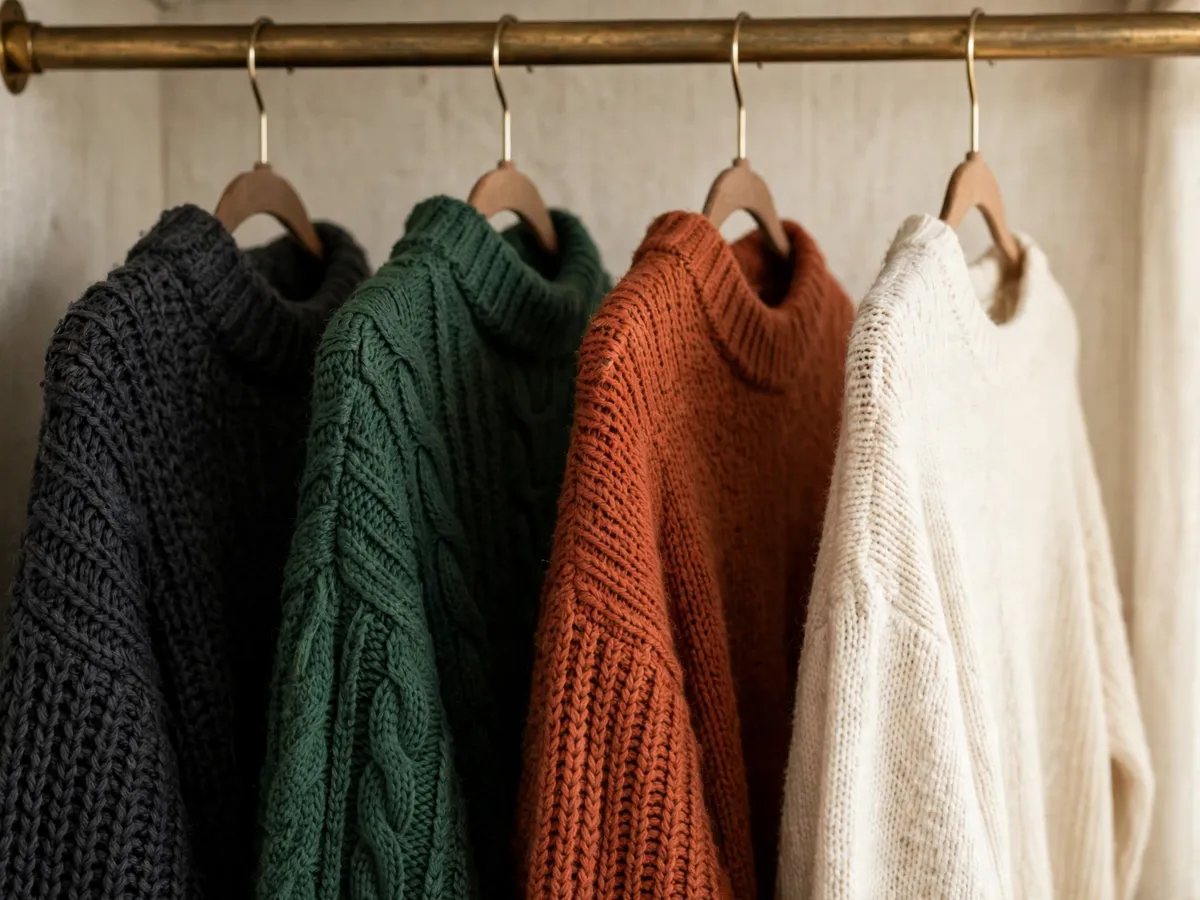
Cost: $0. Time: 20 minutes. Choose value gradient for muted wardrobes, hue order for colorful ones, and never both on one rail.
5. The Per-Rail Rule: One Color Family per Rail, Not One Rail per Color
The rule that keeps a color closet from turning into a museum of single garments: one color family per rail, not one rail per color. A rail is the length of rod your closet gives you, usually forty to sixty hangers. A blue rail and a red rail of twenty hangers each leave most of the rod empty and split the wardrobe into fragments you cannot scan. Treat each rail as one sweep of the gradient and let the family change happen at the rail boundary.
In a two-rail closet, run pale through green on the left rail and blue through black on the other. In a longer walk-in, let the transition sit where the rod turns a corner, because a corner hides a seam better than mid-span does. The bigger plan lives here: The bigger closet plan: walk-in closet organization. One thing this rule prevents: a garment that fits no band gets appended to the nearest rail rather than starting a new one.
Cost: $0. Time: 10 minutes to measure the rods. Count hangers per rail first; the rail length decides the bands, not the other way round.
6. Prints and Patterns: The Bucket That Breaks the System
A floral blouse is pink, green and cream at once, and that single fact is why prints break more color closets than anything else. There is no correct position, so two people hang it in two places, and after a month the rail has a hole where the pattern used to be. Give prints one designated run and stop pretending they belong inside the gradient.
The run works best at the end of a rail, sorted by dominant color rather than by the pattern itself: a multicolor scarf-print joins whichever hue covers the most surface. Small all-over prints that read as one color from arm length, a chambray check, a fine pinstripe, can stay inside the gradient. Anything with a border, a big graphic or a logo goes to the print run without discussion. Stripes and checks that could live either way start in the print run.
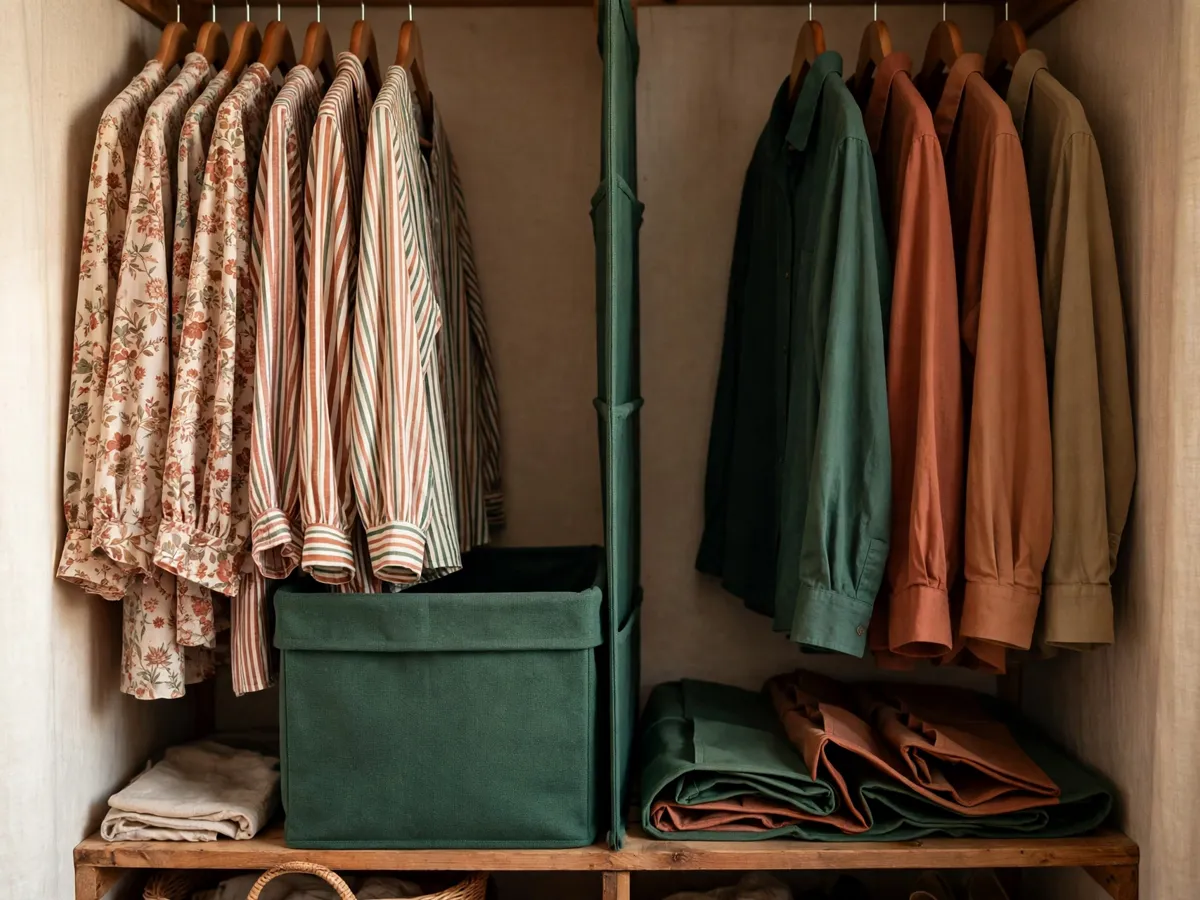
Cost: $0. Time: 15 minutes. One print run per closet, not one per rail, or the gradient never finishes.
7. Neutrals: The Black-White-Denim Pile and Where It Goes
The second bucket that breaks the system is the neutral pile, and it fails for the opposite reason: there is too much of it. In most wardrobes, black, white and denim together occupy half the rod, so a strict rainbow buries the colorful half under six inches of identical greys.
Three placements work, and you pick one and stay with it. The anchor method puts white and cream at the near end and black at the far end, so neutrals frame the color instead of interrupting it, and it reads best in a small closet. The denim drawer method moves jeans off the rail entirely and folds them onto a shelf or into a bin, which alone frees up eight to twelve hangers. The separate-band method keeps one full rail of neutrals, ordered light to dark. Whatever you choose, never scatter black through the middle of a rainbow run: it reads as a gap in the rail, not as a design.
Cost: $0. Time: 20 minutes. Fold the denim first and re-measure the rod before deciding where neutrals live.
8. Hanger Uniformity: The Thing That Makes a Color Rail Read
Here is the unglamorous truth behind every color closet that looks effortless online: the gradient is not doing the work, the hangers are. Mixed hardware, wire ones from the dry cleaner plus plastic ones from a charity shop plus three wooden leftovers, puts a different silhouette between every garment, and the eye stops seeing color and starts seeing clutter. Uniform hangers are the single highest-impact purchase on this page, and the only real spend in the whole article.
Slim velvet-covered hangers are the cheap way to a clean rail: they grip knits, they hold their shape, and they pack roughly a third more clothing into the same rod length, which matters more in a shallow closet than any other variable. Wooden hangers look warmer and cost several times as much per garment. Pick one, buy a single lot so the batch matches, and replace the dry-cleaner wire ones the day the new set arrives. The hats that share the rail have their own rule: The rail neighbors: hat organizer for closet.
Cost: $18–$40 for a 20-pack. Time: 40 minutes to rehang everything. Buy one lot, one style, one color of hanger.
9. Seasonal Color: The Front-of-Rail Swap
A color closet makes seasonal rotation unusually easy, and almost nobody uses it. Because the rail is already ordered by eye, you can move a whole season to the reachable end without re-sorting anything: light layers and linens slide toward the near end in spring, heavier dark knits slide toward the far end in autumn, and the gradient stays intact the whole way.
The swap takes thirty minutes and it is the habit that keeps the system alive, because a rail that holds summer shorts in December makes the color order irrelevant: you cannot find the coat whether it sits in the black band or not. Off-season clothing goes into labeled bags under the bed or on the top shelf, and it does not count against rail space. Keep the print run and the neutral band at fixed positions through the swap.
Cost: $0–$12 for a couple of garment bags. Time: 30 minutes twice a year. Move the season to the near end, not the whole closet around it.
10. The Closet That Is Not Deep Enough: The Two-Row Workaround
A shallow closet with one rod has a hidden flaw that a color rail makes worse: garments hang front to back in two rows, and the back row is invisible from the doorway. In a category closet you learn the back row by memory. In a color closet the front row reads as a gradient and the back row reads as nothing, so the system looks like it works while half the wardrobe goes unworn.
The workaround is a second rod set in front of and below the first, a two-row hanging bar that turns the hidden row into a visible one. It costs fifteen to thirty dollars, and it drops the top rod far enough that long coats no longer fit: coats and dresses go to the single-rod section or the back of the door, and the two-row bar carries shirts, trousers and skirts only. Order each row as its own short gradient, because a rainbow that continues behind itself reads as a duplicate. If a second rod is out of reach, the answer is fewer hangers, and the honest place to start is Sort less, see more: declutter checklist room by room.
Cost: $15–$30 for the double rod. Time: 60 minutes, or a landlord conversation. Two short gradients beat one split one.
11. Maintenance: The 5-Minute Weekly Reset That Keeps It
This is the section that decides whether you still have a color closet in three months. Laundry returns to the rail in whatever order it was carried in, and a color system degrades visibly within a fortnight, long before it looks messy enough to justify a re-sort. The fix is a five-minute weekly reset, and it works because it is weekly.
One fixed slot in the week, Sunday evening or a Monday morning, three motions. Slide every freshly hung garment to its band, using the taped order card inside the door as the reference. Pull anything worn three times in a row to the near end so it stays in rotation. Drop the day's rejects into a small basket rather than re-shuffling mid-gradient, and empty it at the next reset. Folded colors on the shelves follow the same gradient, and that half pairs with The folded colors below: drawer organization ideas. Five minutes, once a week, and the tax from section 2 stays small.
Cost: $0–$8 for one basket. Time: 5 minutes a week. Skip two resets in a row and the next one costs an hour instead.
12. Kids and Helpers: Why the System Collapses and How to Retrain
A color closet is one shared opinion, and the moment a second person hangs laundry it becomes two opinions. That is why these systems collapse in family households, not from laziness but from a rule nobody else was told. A partner returning a shirt to whichever gap is nearest undoes the gradient in one motion.
Retraining takes one afternoon and three supports. First, make the rule visible instead of remembered: a strip of tape on the rod marks each band boundary, and a card inside the door shows the order left to right. Second, shrink the surface other people touch, so everyday family garments live on their own short run or in their own drawer. Third, accept a permanent exception zone: hooks by the door for the half-clean coat and the bag, because a system with no drop zone borrows its mess from elsewhere. Say the rule out loud once, then let the reset in section 11 absorb the drift.
Cost: $0–$6 for tape and a door card. Time: 30 minutes to retrain, then zero. A rule only in your head is not a rule.
13. The $0 Start: Re-railing One Shelf Before Committing
Do not spend a Saturday re-hanging the entire closet on a theory you have never tested. The cheap test is one shelf. Take the folded stack on a single shelf, the sweaters or the t-shirts, and arrange it pale to dark, no hangers, no purchases. Leave it for two weeks and watch one thing: whether you put laundry back the way you found it.
That is the whole experiment, and it is honest in a way the rail test is not, because a shelf reset takes ten seconds and shows whether your household respects a color rule at all. If the shelf holds for two weeks, the rail will hold, and you can spend the money in section 14 with a straight face. If the shelf turns into a pile by Thursday, the problem was never the sorting method, and a category closet with better bins is the answer instead.
Cost: $0–$14. Time: 10 minutes plus two weeks of observation. Shelf risers are the only optional buy in this section.
14. Cost Reality: $0–$40 (Hangers Are the Only Real Spend)
The sorting itself is free, and that is the genuinely good news about this system. Everything on this page splits into three bands.
- $0, the sorting band: the order card, the one-family-per-rail rule, the print run, the neutral placement, the seasonal swap, the weekly reset and the shelf test. Nine of the fourteen sections here cost nothing but attention.
- $8–$20, the visible band: a 20-pack of slim hangers, a small basket for the reset, tape and shelf risers. This is where the rail starts reading as a gradient instead of a pile with colors in it.
- $20–$40, the full band: a proper hanger lot for the whole closet, plus the double rod from section 10 if your closet is shallow. Worth it only after the shelf test passes.
The honest line: the real cost of a color closet is not money, it is the five minutes a week and the double reload tax from section 2. Forty dollars is a one-time bill; the attention is the recurring one, and most people should budget both.
Cost: $0–$40 all-in. Time: 90 minutes for the first rail. Hangers are the only spend worth defending.
Common questions
Is a color organized closet actually worth the upkeep?
It is worth it if your problem is picking outfits, and not worth it if your problem is knowing what you own. The maintenance is real: every reload asks a shade decision, and the weekly reset is five minutes you owe the rail. Run the shelf test in section 13 for two weeks before committing.
Should the rainbow go light to dark or dark to light?
Either, as long as the lightest end sits where your hand reaches first, usually the side nearest the doorway. Direction is a comfort preference; consistency is the actual rule. The mistake is a rail that starts dark, goes light in the middle and darkens again.
What do I do with printed and patterned clothes?
Give them one designated run at the end of a rail and sort that run by dominant color, the hue covering the most surface. Fine all-over prints that read as a solid from arm length can stay inside the gradient. Anything with a border, a large graphic or a logo belongs in the print run permanently, and arguing it out garment by garment is what stalls the system.
How do I keep a color closet when other people use it?
Make the rule visible rather than remembered: tape the band boundaries on the rod and card the order inside the door. Then shrink the surface other people reload, so family essentials live on their own short run or in a drawer, and add hooks by the door. Absorb the drift with the weekly reset instead of a conversation.
Do I need matching hangers for this to work?
You need uniform hangers, which is a cheaper requirement than matching ones. Slim velvet-covered hangers from a single lot give the rail one silhouette and recover about a third of the rod length. Mixed wire, plastic and wood hardware breaks the gradient even if the clothing is sorted perfectly, so spend here first.
Save these on Pinterest
Pin the short rainbow order, the one-family-per-rail rule, the print run, the neutral placement and the five-minute weekly reset, plus the shelf test you can run for nothing tonight. This guide and the rest of the organization and storage collection live together there.