 Plant As Deco
Home Organization & Storage
Nursery Closet Organization: Sizes, Bins, and the Growth Spurt
By Plant As Deco · Updated 23 November 2026
A nursery closet holds the smallest clothes in the house and, somehow, the most stuff. Every other closet guide here sorts by season or by category. This one sorts by size, because a baby leaves a size bucket in eight to twelve weeks and no seasonal system survives that. Sizes, not seasons, are the axis: get the sorting wrong and the closet becomes a pile that grows instead of a system that turns over.
Three moving parts carry the job. The size-bucket rail keeps today's clothes findable in ten seconds. The rotation moves clothes between buckets on a schedule rather than on a frustration. The flow out the door turns outgrown outfits into one bag that leaves the house.
Weekend-ready: $0–$120, one afternoon for the rail and the bins, then fifteen minutes a week. Renter-safe: nothing drilled into a wall you do not own, hooks on the door or into a stud, freestanding shelves where the walls are off limits.
1. Why a Nursery Closet Is a Different Problem (Sizes, Not Seasons)
In the first year a child passes through roughly five or six sizes, and the outfit worn last Tuesday is unwearable by the end of the month. An adult wardrobe shifts four times a year, a kid one once. The nursery closet is the only one where the inventory is designed to expire, and that changes what organizing means here. You are not arranging a collection. You are managing a conveyor.
The second difference is what shares the room. Clothes sit next to diapers, wipes, a changing pad, a stack of burp cloths and a bin of toys, all in the smallest closet in the home. A category system fails on that mix, because the categories are not the unit of use. The unit of use is the size, and the test is simple: can you pull a clean, fitting outfit with one arm free, in ten seconds, without opening a lid.
Cost: $0–$2. Time: 15 minutes. List the sizes physically in the closet before buying any storage.
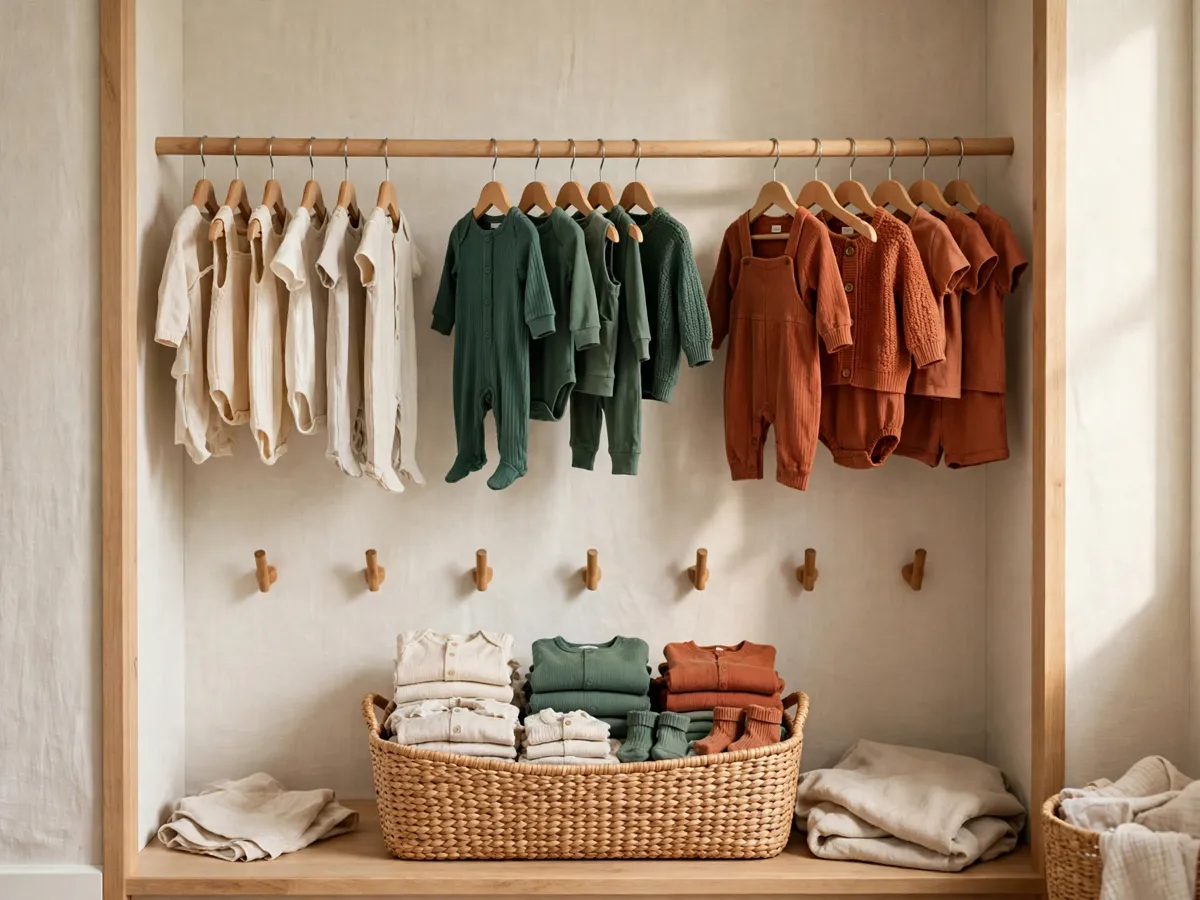
2. The Size-Bucket Rail: Current, Next, Too Big
One rod, three sections, and the sections are sizes rather than garment types. The current bucket takes the front half of the rod: ten to twelve outfits in the size that fits today, on hangers sized for the shoulders, nothing folded. The next bucket takes the back half: the size above, hung and counted but not reached for daily. Too big is not a section of the rod at all; it is a bin waiting to leave, and the moment it climbs back onto the rail the system has slipped.
Keeping the count honest matters more than the look. Ten outfits covers a week with one laundry run in the middle; twenty does nothing but hide the boundary. Buy newborn-size hangers separately, because a standard 13-inch hanger swallows a three-month shirt and the sleeves stick out past the ends.
Cost: $8–$22. Time: 30 minutes. Ten to twelve outfits on the rail, not twenty.
3. The Growth-Spurt Rule: Rotate Before the Drawer Wins
Here is the failure every nursery closet runs into. Clothes stop fitting, nobody rotates the rail, so the too-big stack stays hung out of habit and the current size gets shoved into a drawer, where it turns into a jumble within four days. The drawer wins because it is faster than re-hanging a rod at two in the morning. The answer is to make the rotation a scheduled event rather than a reaction.
Check the fit every four weeks in the first six months, then every eight to twelve weeks through year two. The trigger is a fitting check, not a birthday, because size labels disagree between makers. Weigh and measure on a card taped inside the door and write the date beside it. A rotation itself takes twenty minutes: next moves to the front half, current moves to the too-big bin, and the empty back half gets refilled with the size above.
Cost: $0–$3 for a card and a marker. Time: 20 minutes. Rotate on the calendar, not on the day a zipper stops.
4. Low Hooks and the Kid-Reach Line
Set a short row of hooks at roughly 18 to 24 inches off the floor and something changes in the morning routine: a toddler can hang a coat, a small tote or a lovey without being lifted to the rod and without an adult carrying it to a hook at chest height. That is the entire argument, a reach fact rather than a rulebook one. Children at that age work at arm height, and storage above the arms is adult furniture to them. Three or four small pegs, spaced about six inches apart, is enough for a coat and one bag.
Renters put the row on the inside of the closet door with over-the-door hooks; homeowners drive the pegs into a stud. Check the weight rating of whatever you mount against a soaked winter coat rather than a dry one, since a wet coat is the heaviest version of the same item. A short rod segment above the hooks holds the current coat on a small hanger, so the reach line covers hanging as well as hooking.
Cost: $6–$18. Time: 20 minutes. Rate the anchor against a wet coat, not a dry one.
5. The Diaper-Toy Split: Two Zones, One Closet
The closet carries two non-clothing zones, and mixing them is the quiet mistake. Diapers and wipes are consumables you grab one-handed in the middle of a change, so they live in one open bin at working height on the changing side, top layer always visible so you see the stock running low before the pack is empty. Toys are a different animal: a bin that gets emptied onto the floor and refilled by hand. Give them their own bin, lower down, and never share a container with the diaper stock.
Two rules keep both zones tidy. The diaper bin holds unopened packs plus one day of loose ones, and a full bin means the ordering habit broke rather than that you need a bigger bin. The toy bin holds five to eight items, not the whole collection, because a bin stuffed to the rim gets dumped rather than searched. Creams, ointments and anything you would rather a small child not open belong in the bathroom.
Cost: $10–$26 for two open bins. Time: 15 minutes. One bin each, and neither gets a lid.
6. Bins That Grow With the Kid (Labeled by Size, Not Type)
Label the bins by size and not by contents. A bin marked 6M holds six-month folded clothes today, nine-month folded clothes in six weeks, and socks or washcloths after that, and the label never needs changing, because it describes the shelf slot rather than the item inside. Compare a bin marked sleepers: the moment the sleepers outgrow, the label is a lie and the bin becomes a catch-all. This one choice is what lets a rotation move through the closet without relabeling everything.
Use three to five open-top bins, clear or pale plastic, the same footprint so they line up, and tape a paper label on the front and a second one inside the lid, because the front one peels off within a month of handling. Skip the nursery-branded organizer sets: they are shaped for a specific garment and a specific shelf, and both change faster than the bin does. The logic is the same one the toy room runs on: toy storage for small apartments.
Cost: $12–$30. Time: 30 minutes. Two labels per bin, front and inside the lid.
7. The Hanging-Divider Habit (The $8 Part That Runs the Rail)
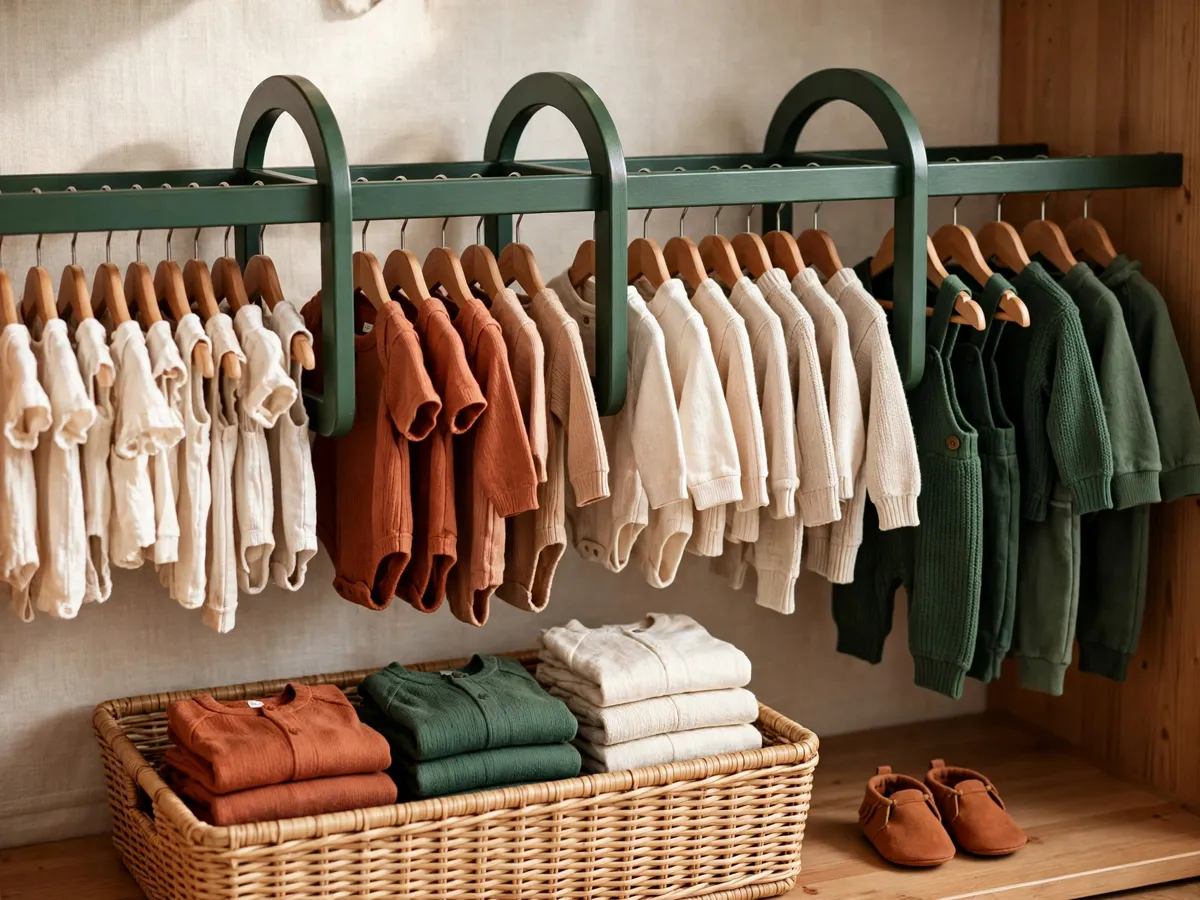
The size-bucket rail survives or dies on its boundaries, and a boundary you remember is a boundary you lose. Hanging rod dividers, the small clips that slide onto the rod and stop at a set point, mark the line between current and next in hardware instead of memory. One tired retrieval at two in the morning, where a shirt goes back on the nearest hook, is enough to blur an unmarked boundary, and after a week the rail reads as one long section again.
Two dividers cover three sections. The free version works too: a thick colored rubber band around the rod at the boundary, or a tag clipped to the last hanger in each bucket. What matters is that the marker is visible from the doorway without moving anything. Pair the dividers with matching hangers, because mixed widths and shapes eat rod length and hide the count.
Cost: $6–$14 for dividers and a hanger pack. Time: 10 minutes. The cheapest part on this page and the one that keeps the rest running.
8. Hand-Me-Down Flow: In, Labeled, and Out the Door
Hand-me-downs arrive in a bag and, untreated, they arrive on the floor. The rule is one sorting session on the bed or a clear table, never on a shelf: check the printed size on each piece rather than the label of the bag, drop anything stained, missing a snap or with a stretched neckline, wash the rest, then place each item straight into its size bucket. Nothing sits in a to-deal-with state longer than a week.
The out flow is the half people skip. Too-big clothes go into one bag by the door, marked with the date it filled up, and the bag has thirty days before it moves to a donation drop or to the next family. Write the date, because a bag without one stays in a corner until the next pile buries it. The same sweep runs the rest of the home: declutter checklist room by room.
Cost: $0–$8 for a couple of bags and a marker. Time: 45 minutes. Sort an incoming pile on a table, never on the shelf.
9. The Deep-Shelf Problem: Fold Stacks Low, Bin High
Nursery closets usually ship with a shelf 12 to 16 inches deep, which is the wrong depth for tiny folded clothes. A stack at the front gets pulled from, and whatever sits behind it collapses or disappears into the back, so within two weeks the shelf holds a neat row in front of an archaeological dig. The fix is to treat depth as the enemy: fold stacks only on the front half of a deep shelf and let the back half carry an open bin instead.
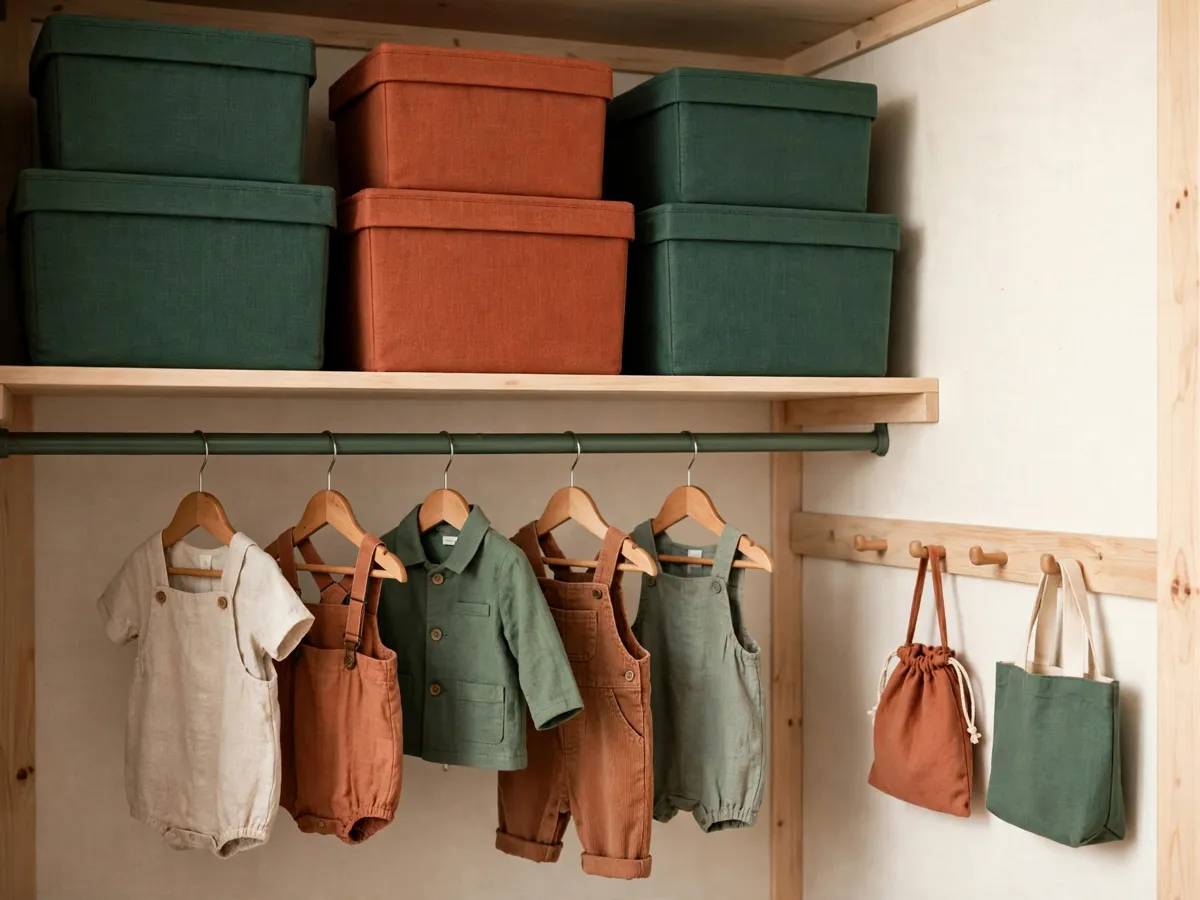
Height decides the container. At or below the shoulders, open bins and shallow fold stacks, because a pulled item must not take the neighbors with it. Above head height, lidded boxes are fine, since nobody reaches them weekly. Keep any single fold stack to eight or ten items; a fifteen-item stack of three-month shirts topples on the second pull.
Cost: $8–$20. Time: 25 minutes. Bins low, boxes high, no stack over ten items.
10. Small-Space Version: Dorm-Closet Mechanics in a Nursery
Plenty of first apartments and converted rooms hand you the dorm-style closet: one rod set high, a single wire shelf, no built-in shelving, and a wall you cannot drill. Nothing about the size-bucket rail changes; only the hardware does. A rod at 60 inches or higher is useless for a three-month onesie, so the first purchase is a hanging double-rod splitter, the frame that hooks over the existing rod and drops a second bar 12 to 16 inches below it. Two bars, two buckets, no tools.
The wire shelf needs a liner, a sheet of paper or a plastic mat, or a labeled bin slides off and a paper label falls through the grid. The low hook row moves entirely to the door, where over-the-door hooks carry the coat, the diaper caddy and the empty bag from section 8. Whatever the shelf cannot hold goes on a freestanding cube unit or a slim wire rack beside the closet, the same no-drill answer the smallest closets here use: small closet organization ideas.
Cost: $20–$60 for a splitter, a liner and door hooks. Time: 40 minutes. Same three buckets, different hardware.
11. Season on Top of Size: The Two-Layer Sort
Season is the second layer, never the first. Inside the current bucket, group the heavier pieces together and the light ones together, so a cold morning is one grab rather than a search, and keep two full outfits of each weight on the rail. What you do not do is box the winter clothes of the current size on the top shelf because the calendar says spring; the size expires faster than the season turns, and a boxed winter set may never be worn.
Split by season only after a size is out of rotation. The too-big batch divides into a winter box and a summer box, each marked with the size as well as the season, and that is the only place a size-plus-season label earns its keep. Anything in a seasonal box must have been outgrown first; a box of clothes the child still fits is a rotation you skipped.
Cost: $10–$24 for two flat boxes. Time: 30 minutes. Size first, season only after the size is out.
12. The 15-Minute Weekly Reset
The rotation is a monthly event; the reset is weekly, and it is three five-minute moves done on the same day each week. First five: walk the rail and pull anything that no longer fits into the too-big bin, which keeps the current bucket honest between rotations. Second five: refill the diaper bin from the stash, return stray toys to their bin and drop used burp cloths in the laundry. Third five: run a hand along the rod and re-hang anything backwards or across a divider.
Write the three moves on the card inside the door, one line each, and tick them rather than trusting memory. Once a month, add the rotation check from section 3 to the end of the reset, which makes it a 35-minute session instead of a fourth surprise job. The reset is the difference between a system that holds and a closet that looked right for eleven days.
Cost: $0–$2. Time: 15 minutes. Three five-minute moves, same day each week.
13. Common Mistakes: The Stuffed Top Shelf, the Unlabeled Bin
The stuffed top shelf is mistake one and the most universal. Every too-big item goes up there because it is the only free space, the shelf fills within two months, and the rotation stops, because pulling a bag down from a packed shelf costs more effort than leaving a small shirt on the rod. The fix is a limit rather than a bigger box: the top shelf holds only dated, out-of-rotation sizes, and when it is full the oldest bag leaves the house before another arrives.
Mistake two is the unlabeled bin, three identical opaque containers where every grab means opening all three. Mistake three is buying the next size in bulk before the current one is outgrown. Mistake four is mixed hangers, the reason a rod looks full while holding half the outfits it could. All four are fixed by parts already named here: dividers, size labels, one dated bag, and a hanger pack. The rail also hosts the hats and small bags: hat organizer for closet.
Cost: $0–$14 in labels, dividers and hangers. Time: 40 minutes. Mark the top-shelf limit and the bin labels first, the rest follows.
14. Cost Reality: $0–$120 All-In
Three bands, and none of them is a renovation.
- $0–$25, the starter band: two hanging dividers or rubber bands, a pack of small hangers, a marker and paper labels, and the door card. The size-bucket rail working, plus the rotation record.
- $25–$60, the working band: three to five open-top bins, the low hook row on the door, one lidded box for the too-big batch and a shelf liner. The closet stops borrowing containers from other rooms.
- $60–$120, the settle band: the double-rod splitter for a high dorm-style rod, a freestanding cube unit or slim wire rack, a full matching hanger set and two flat seasonal boxes. Worth it when the lease runs long enough to carry the unit to the next room.
The honest line: the free habits decide everything. The rotation schedule, the weekly reset and the size labels cost nothing, and a $120 closet with none of them is a well-equipped pile. Buy the starter band, run the system for a month, then spend only on the part that actually broke.
Cost: $0–$120 all-in. Time: 120 minutes. Rail first, bins second.
Common questions
How many sizes should be in a nursery closet at once?
Three, and only two of them on the rail. Current and next hang in marked sections; the third is the too-big batch waiting in one bin to leave. Anything older belongs out of the closet, because a fourth size on the rod is the point where the boundary stops meaning anything.
What should I hang and what should I fold?
Hang anything layered or put on daily: sleepers, jackets, the pants you reach for twice a day. Fold the small multiples, socks, washcloths, bibs and spare shirts, into a size-labeled bin, because hanging six pairs of socks wastes rod you need for outerwear. Ten to twelve hanging outfits plus two fold bins covers a week between laundries.
Do I need a double rod in a nursery closet?
Only when the existing rod sits too high to use, which is common in a dorm-style closet at 60 inches or more. A hanging splitter drops a second bar 12 to 16 inches below the first for about $15 to $25, needs no tools and leaves with you. If the rod is already at adult chest height, one bar and two marked sections is enough.
When should outgrown clothes leave the closet?
At the rotation check, the same day you pull the next size forward. Waiting for a big donate session is how the too-big bin becomes the stuffed top shelf in section 13. Mark the outgoing bag with the date it filled, give it thirty days to move, and pass it to a drop point or the next family rather than holding it in case.
How do I organize a nursery closet in a rental with no drilling?
Everything moves to the door and the floor: over-the-door hooks for the low reach line and the caddy, a hanging splitter on the existing rod, a shelf liner over the wire grid, and a freestanding cube unit beside the closet for the bins. Nothing is anchored, nothing is holed, and the system leaves in one trip. The older-kid version: kids closet organization ideas.
Save these on Pinterest
Pin the three-section rail, the size-label rule, the low hook row and the three budget bands, plus the 15-minute reset card. This guide and the rest of the organization and storage collection live together there, and the school-age handoff has its own page: kids closet organization ideas.