 Plant As Deco
Organization & Storage
Kids Closet Organization: A Reset Your Child Can Do Alone
By Plant As Deco · Updated 22 November 2026
A kid's closet fails in one specific way: the rod is too high, the bins are too closed, and by the end of the week every shirt lives on the floor. This guide builds the opposite - a closet a small person can reset without a stool, without your help, and without a lecture. The whole plan hangs on one number (reach height), four zones, and an exit for the clothes your child has already outgrown.
Weekend-ready: $0–$180, one weekend. The low end buys nothing - it is moving and labeling what you already own. Renter-safe: tension rods, over-door organizers and freestanding racks need no drilling.
1. What a kid's closet has to do that an adult closet does not
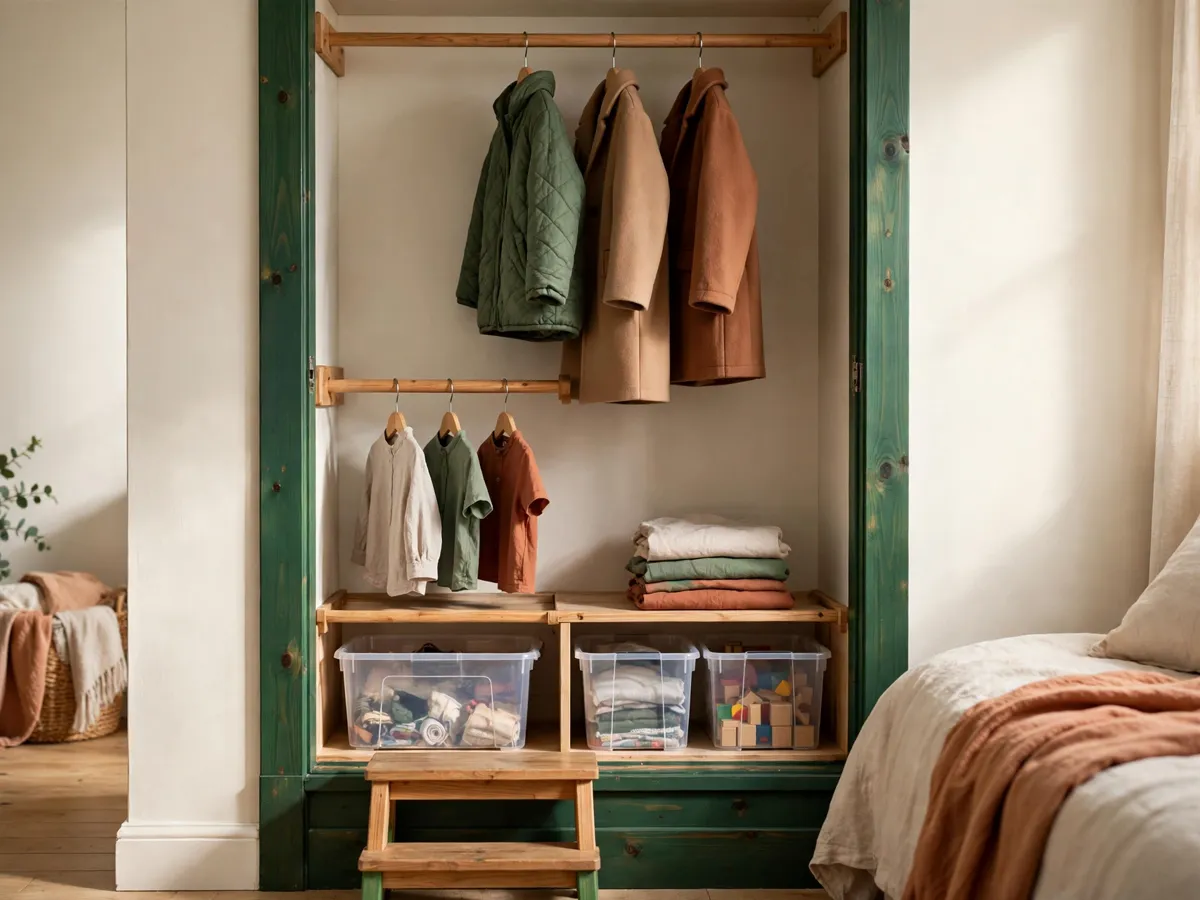
An adult closet is organized for storage. A kid's closet has to be organized for return. You put a shirt back because the hanger is at your shoulder height and you have decades of habit behind you. A four-year-old puts a shirt back only when the spot is at their height, open, and obvious. Every decision in this guide follows from that difference.
Start with the reset test. Ask your child to put away their coat and their pajamas, then watch without helping. If they need a stool, need you, or give up halfway and drop everything on the bed, the closet is arranged for you, not for them. That is not a discipline problem. It is a design problem, and it has a fix you can finish in a weekend.
A kid's closet carries three jobs at once, which is why copy-pasting an adult closet system onto it rarely works: daily wear at the child's reach, staged sizes waiting their turn, and a clear exit for whatever has been outgrown. The child owns the low zone. You own everything above it. The sections below build those zones in the order that actually works - inventory first, hardware second, habits last.
Cost: $0. Time: 10 minutes to run the reset test and see the problem clearly.
2. Start with the clothes you actually have, not the storage you want
The expensive mistake in a kid's closet happens in a store aisle before anything changes at home. You buy the cute organizer set, haul it home, and discover your child owns forty t-shirts and no dresses. The inventory has to come first, and it is honest work: pull everything out of the closet, the dresser, the bin under the bed, and the bag of hand-me-downs you never unpacked.
Sort the mountain into five piles and count as you go: wears now, nearly outgrown, too big (the next size up), wrong season, and gone - the stained, torn, and never-gonna-happen pieces. The counts decide everything downstream: how many bins at child height, how many lidded bins up high, whether the next-size pile even fits in this closet. Write the counts on your phone before you put anything back.
Be honest with the gone pile. Keep one or two sentimental pieces in a single keepsake box, and move the rest out the same day: donation bag by the front door, consignment for the good pieces, trash for the stained ones. A good working rule: if you would not dress your child in it tomorrow morning, it does not come back inside the closet. If you want the full apartment version of this triage, the room by room declutter checklist walks the same keep-or-let-go decision across five rooms.
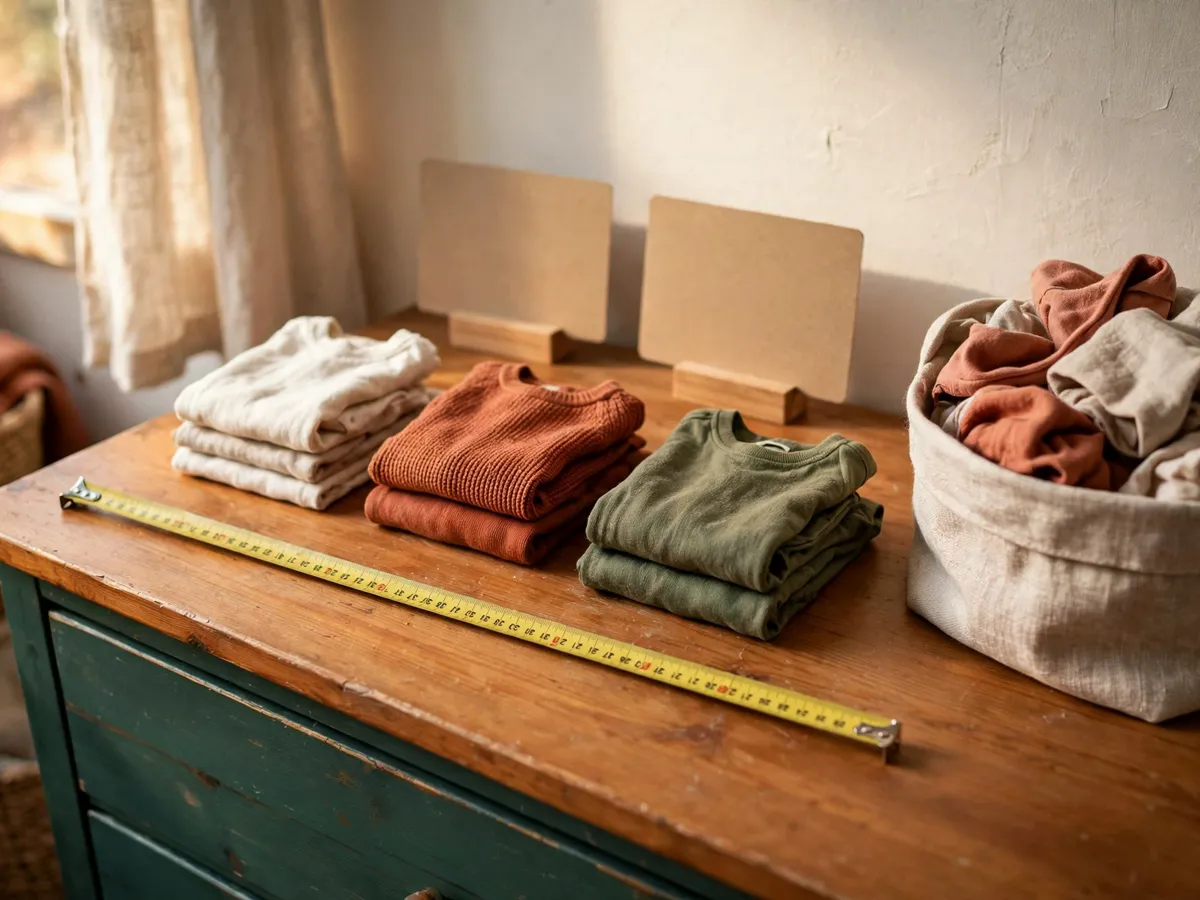
Then measure the closet itself before you shop for anything: the rod height, the shelf height, the width and depth, and the door swing. Write those numbers next to the counts. Ten minutes with a tape measure prevents every "it does not fit" return trip, and it tells you exactly how much low zone you have to build.
Cost: $0. Time: 60–90 minutes for the full pull-out, plus one trip to the donation drop-off.
3. Reach height: the number that decides everything
The rod that came with your apartment sits at adult shoulder height, somewhere around five and a half feet off the floor. A young child works comfortably at roughly their own chest to shoulder height, which lands between about 34 and 42 inches off the floor for most three-to-six-year-olds. That gap is the entire reason the floor becomes the closet. No bin or label fixes it; only a lower bar does.
The cheap fix is a second, lower rod. A tension rod wedged inside the closet frame works on a standard reach-in and needs no drilling. A rod doubler, two S-hooks and a length of rod or even a sturdy cord slung below the existing one, does the same job. The original high rod becomes yours: next-size bins, off-season storage, the things an adult manages. Two owners, two heights, one closet.
Watch how a child actually hangs a coat before you commit. Hanging on a hanger is a three-step skill: line up the collar, hook it, push it along the bar. Any step at eye level or above ends with a crooked hanger on the floor. For outerwear, two low hooks on the closet side wall or the door edge beat the rod entirely, because a coat on a hook is one motion. Keep hangers for shirts and dresses on the low rod, and put hooks at the same height for the coat and the backpack.
When do you add the low rod? As soon as your child starts picking their own outfits. Before that stage, one reachable bin set plus your help at the high rod is plenty, and you can skip the hardware entirely. If your own side of the project is the standard one-rod reach-in shared with a partner, the small closet reset for beginners covers the adult half - the three-pile edit, the rod zones and the nightly two-minute hang.
Cost: $0 using the existing rod for hooks only; $10–$30 for a tension rod or a doubler set. Time: 30 minutes, including watching your child use it once.
4. Bins, labels and the picture-label trick for pre-readers
For daily wear, open bins beat drawers, and open bins beat lidded bins. A bin is one motion: drop it in. A lid is two motions plus a latch small fingers fight with, and a drawer is a track that jams when overfilled. Anything a child has to open before they can put away will collect laundry on top instead. Soft fabric bins or light plastic ones work best, and the child should be able to carry the bin to the hamper and back.
Keep it to four or five bins at reach height, one category each: shirts, pants, pajamas, and one combined bin for socks and underwear. The hamper sits outside this stack, because dirty clothes have their own home. Beyond five categories, young children stop matching and start dumping - the extra sorting belongs to you, so it lives up high, not at their height.
The picture-label trick: a pre-reader cannot read "shirts", but they can match a picture of one. Tape a printed photo, a hand drawing, or a cut-out from a clothing catalog to the front of each bin at the child's eye level. Label the bin, not the shelf. Better still, have your child draw the symbol themselves or pick the photo - a label they made is a bin they own, and owned bins get used. Re-do the labels whenever the categories change, which in a growing kid's closet is about once a year.
The same system runs the rest of the room. If the toy corner is the other half of the nightly floor mess, the toy storage for small apartments guide applies the same picture-label logic to bins at kid height, with a rotation box for the overflow.
Cost: $10–$45 for four to five open bins, tape and printing. Time: 45 minutes, including the label-drawing session.
5. Zones: every-day, current size, next size, out of season
A kid's closet is a warehouse with a turnover problem, so it runs on four zones, each with exactly one home. Every-day: the low rod plus the open bins, everything your child wears this week, fully in their control. Current-size overflow: the surplus of the size they wear now - the twelfth t-shirt, the backup jeans - on the high shelf or in the dresser, where you rotate it down as the low bins empty.
Next-size: one lidded bin per upcoming size, labeled by size and not by season, stored up high. "3T" on the lid tells you what is inside in one glance; "fall clothes" tells you nothing in March. Keep at most one or two sizes ahead in the closet. A bin of too-big clothes at child height stops being storage within a day and becomes the dress-up box, with its contents mixed into everything else.
Out-of-season: the current size but the wrong weather - snow pants in June. Flat, squishable bins under the bed or on the top shelf hold these, and they swap with the every-day zone twice a year. Give each zone one place and hold that line. When a zone starts overflowing, the problem is never storage: it is that the exit loop in the next section has stalled.
Cost: $0–$25 if you need lidded bins and a marker. Time: 45 minutes to map the zones once the inventory is done.
6. The size-sort: how hand-me-downs move through the closet
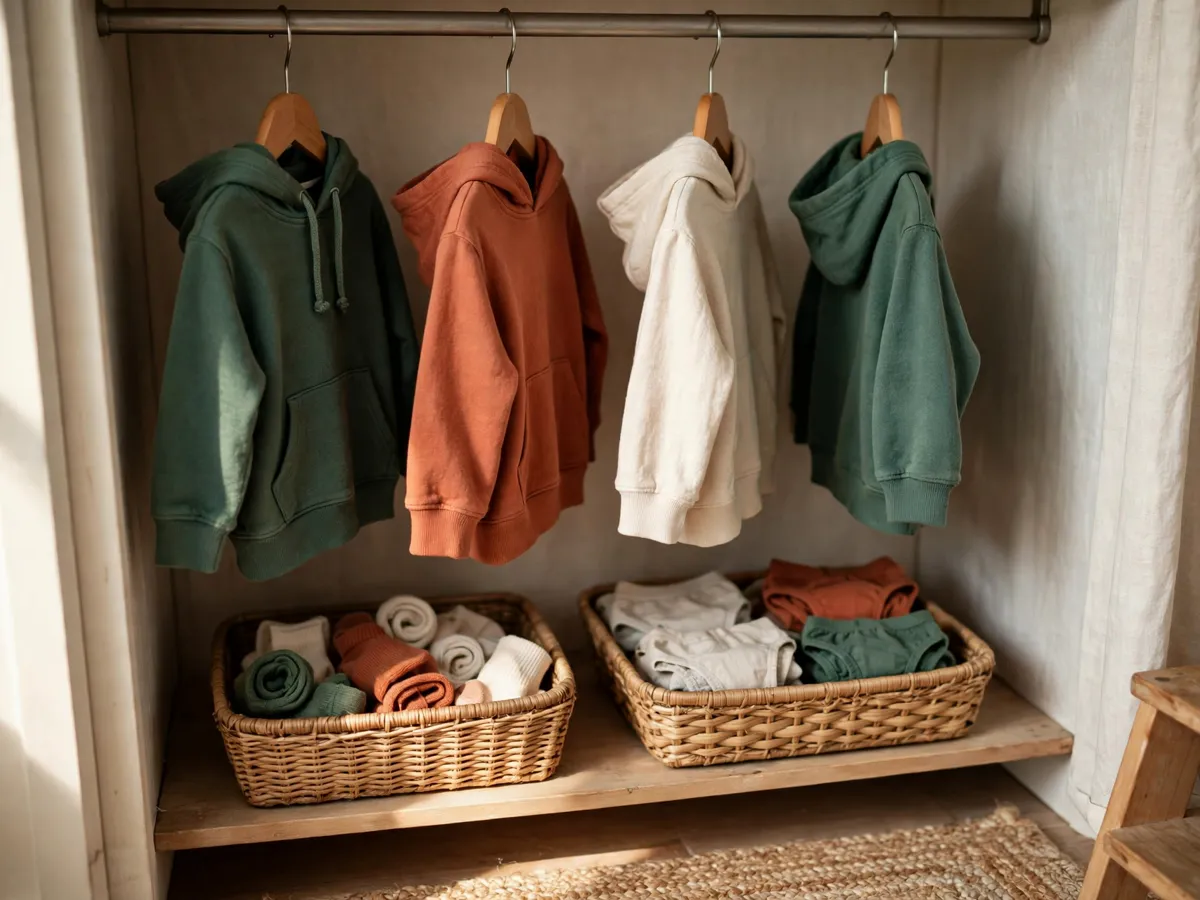
Hand-me-downs are the hidden inventory of a kid's closet. They arrive in trash bags from cousins and buy-nothing neighbors, and the family that sorts the bag the day it arrives ends up with a working closet, while the family that shoves the whole bag onto the top shelf ends up with a mystery pile. Sort on arrival: fits now goes straight into the current-size overflow, the next size into the labeled next-size bin, and anything more than two sizes ahead into deep storage - under the bed or the back of the top shelf.
Then the closet runs a promotion day. When the pants start looking short, pull the next-size bin down: its contents become the new current-size overflow, and the too-small clothes leave the closet the same day. Promotion and exit happen together, or the old size quietly reclaims the rod space the new size needs.
The exit needs a route, not an intention. Keep a donation bag hooked by the front door and take it to the drop-off when it is full. Consign the good pieces; box the true keepsakes into the one keepsake box, and cap it. One "maybe" box is allowed per child - if it sits closed for a month, it leaves with the next donation run. A younger sibling changes only the destination: too-small goes to a labeled bin under the bed instead of the donation bag, still max one bin per size.
For the seasonal half of the rotation, the off-season clothing storage guide covers the swap-day loop in full - where the off-season bins live in a small apartment, and the honest choice between squishable bags and lidded bins.
Cost: $0. Time: 45–60 minutes for the first full size-sort, then 20 minutes on each promotion day.
7. The daily flow: a two-minute reset a child can do
The daily reset happens where the clothes come off, so put the bins there. If pajamas come off beside the bed, the pajama bin lives beside the bed, even if that technically moves it out of the closet. The hamper stands at the same spot. The coat hook waits by the door on the exit path. A reset that requires walking anything across the room has already failed, because the trip is where the clothes get dropped.
The flow itself is three moves, every night: pajamas into the pajama bin, yesterday's outfit into the hamper, coat onto the hook. Two minutes, done by the child, with no folding anywhere in it. Children sort by category long before they can fold by crease, and a bin is the right goal. Folding is a skill that arrives around school age with the drawer, not the bin.
The hard part for the adult is staying out of it. If you refold the pajama bin every night, you have taken the reset back, and your child knows the bin is your job now. Your jobs are the weekly scan and the seasonal swap, both in the next section. The nightly two minutes belong to the person wearing the clothes.
Cost: $0. Time: 2 minutes a day, and they are not your minutes.
8. The weekly and seasonal reset, for the adult
Once a week, spend fifteen minutes inside the kid zone. Scan the low bins for mixed sizes - a 2T shirt hiding in the 4T pile moves back up. Move strays off the floor and the bed. Check that the hamper is actually making it to the laundry and back, because a stuck hamper loop is what usually kills the nightly flow. Refill the every-day zone from the current-size overflow so the low rod never looks empty enough to fill with something else.
Four times a year, run the seasonal swap in about an hour: off-season bins out from under the bed, the next-size bin promoted down if the season came with a growth spurt, the outgrown bag out the door. Shoes are the early warning - toes hit the front of the shoe before cuffs ride up the ankle, so check shoes first and let them trigger the promotion day.
Re-label while you are in there. The picture labels survive a size change (a shirt is still a shirt), but the size labels on the lidded bins do not. Every bin that changes jobs gets a new label the same day it changes contents, or the whole map silently rots. This is also the moment to retire the keepsake overflow: one box per child, then the rest goes.
Cost: $0. Time: 15 minutes weekly, about an hour each seasonal swap.
9. Small-space and renter reality: no closet at all
Plenty of kids' rooms in rentals have no closet, or a closet so shallow the hangers clip the door. The renter-safe replacements all avoid drilling. The strongest one is a freestanding low wardrobe or an open bookshelf turned closet: two shelf levels at kid height for labeled bins, a rod bracket on the side for hanging, and a couple of hooks. Secondhand ones run $60–$180 and move with you to the next apartment, which no bolted-in system ever does.
A tension rod works in an alcove, a nook between two walls, or across the short wall beside the door, hung at the 34-to-42-inch height. Over-the-door organizers are the other quiet win: a hanging shoe organizer carries a couple dozen pockets, which is enough room for socks, underwear, hats and the small pieces that otherwise own the dresser. It uses dead space behind a door that closes over it.
Under the bed is the kid's closet attic. Measure the clearance first - about six inches fits most flat bins - and give that space to the next-size bins and the off-season, never to daily wear. Flat, zippered, squishable bins beat rigid ones here because they survive whatever else gets shoved under there. The rule from section 5 holds everywhere: the child's things live at child height, and the staged inventory lives in the low-rent spaces.
Cost: $20–$180 depending on the route - free if you inherit a shelf, about $180 at the freestanding wardrobe end. Time: one afternoon.
10. Cost and time, honestly
The $0 version is real: the rod you already have, hooks on its end, bins you own relabeled with tape and drawings, and one afternoon of inventory. It is also the version most families should start with, because it tests the layout before any money confirms it.
- $0. The full reset with what you own: picture labels, five piles, zones mapped onto the existing shelf and rod.
- $10–$45. The stage that matters most: a tension rod or doubler for the low bar, four to five open bins, tape and printing for the labels.
- $20–$60. Over-door organizer plus flat under-bed bins, the no-closet and small-closet add-ons.
- Up to $180. A freestanding low wardrobe when the room has no closet at all - the ceiling, not the default.
What you do not need: custom closet kits sold by the foot, drawer towers for daily wear, or anything that bolts to a rental wall. Time side: the first full reset runs two to four hours with a helper underfoot, the nightly flow is two child minutes, the weekly scan is fifteen, and each seasonal swap about an hour.
Cost: $0–$180 all-in. Time: one weekend to build, then minutes a week to run. Prices are big-box and secondhand estimates, not quotes.
11. What usually goes wrong
The failures repeat across almost every kid's closet, and none of them are about the child. Run your setup against this list before you blame the routine.
- Buying organizers first. The bins arrive before the inventory, nothing fits the counts, and the organizers become the clutter. The pull-out in section 2 always comes first.
- One rod at adult height. The chair becomes the closet, then the floor. If nothing hangs below 42 inches, the child owns nothing.
- Bins a child cannot open. Lids, latches, heavy wooden boxes, stackable drawers - each one converts a put-away into a decision to drop the shirt on top.
- Too many categories. Seven labeled bins is a filing system. Four or five is a kids closet; past that, the bins are mixed within a couple of weeks.
- Next-size storage at child height. The too-big bin gets raided for dress-up and mixed into daily wear. Staged sizes live up high, always.
- Text labels for a pre-reader. A label the child cannot match is decoration. Pictures until they read, then words.
- No exit. Outgrown clothes with nowhere to go refill the closet in a season. The donation bag by the front door is part of the closet, not a separate errand.
Cost: $0. Time: 10 minutes to audit your setup against this list.
Common questions
What height should a kids closet rod be?
Between about 34 and 42 inches off the floor for most three-to-six-year-olds, roughly their own chest to shoulder height. Keep the original rod above for the adult zones, and put coat hooks at the same low height for outerwear, since a coat on a hook is one motion where a hanger takes three.
How do you organize a closet for a child who cannot read yet?
Picture labels. Tape a photo, a drawing, or a cut-out to the front of each bin at the child's eye level, one category per bin, four or five bins at reach. A pre-reader matches pictures instead of reading words, and a label the child drew themselves works even better than one you printed.
What do you do with clothes that are too big right now?
One lidded bin per upcoming size, labeled by size and not by season, stored up high where the child cannot reach it. Sort hand-me-down bags the day they arrive, keep at most one or two sizes ahead in the closet, and promote the bin down when the current size runs short - sending the too-small clothes out the same day.
How many bins does a kid's closet need?
Four or five open bins at reach height: shirts, pants, pajamas, and one combined bin for socks and underwear. The hamper sits separately, because dirty clothes have their own home. More categories than that and the sorting stops being something a young child can do at bedtime.
How do I keep it tidy without redoing it myself every night?
Put the bins where the clothes come off, keep the flow to three moves (pajama bin, hamper, coat hook), and drop the folding - a bin is the goal, not a crease. If the reset test from section 1 passes, the nightly two minutes belong to your child, and refolding their bins hands the job back to you.
Save these on Pinterest
Pin the reach-height numbers and the size-sort map - the two pages that keep a kid's closet working after the weekend is over. This guide and the rest of the organization and storage guides live together there.