 Plant As Deco
Home Organization & Storage
Closet Jewelry Organizer: Stored So Nothing Tangles
By Plant As Deco · Updated 23 November 2026
Jewelry does not get messy because there is too much of it. It gets messy because it catches on itself: two chains sharing one hook swing into each other every time the door opens, and a week later they are a single knot you pick apart with a fingernail over the sink. A closet jewelry organizer, then, is not a box. It is a set of spacing rules, and the hardware follows from them. One piece per hook, one pouch per chain, one compartment per ring, and the tangle never forms in the first place.
Weekend-ready: $9–$60, one afternoon for the whole system. Renter-safe: door racks, pegboard on adhesive or a freestanding panel, and drawer inserts, so nothing is drilled into a closet you do not own.
1. Why Jewelry Messes Up Differently (It Catches on Itself)
Every other closet item stays where you put it. Jewelry is the one thing in the closet made of connectors, clasps and loops, and those catch on each other the moment there is slack. Motion is the second ingredient: a hanging panel swings when the door opens, a drawer rattles when it shuts, and each jolt is a chance for one clasp to hook through another chain link.
That is why a bigger box makes it worse. Piling more necklaces into one compartment adds more catching points, not more room. The fix is always separation, and separation comes in three physical forms: distance (its own hook), enclosure (its own pouch or compartment), or stiffness (a chain held straight so it cannot coil).
Cost: $0. Time: 15 minutes. Empty the current pile onto a bed and count the knots; that number is your real problem, not the amount of jewelry.
2. The Wear-Frequency Sort: Daily, Weekly, Never
Sort by how often you reach for a piece, not by what it is. Type is a bad organizer because it splits things you grab together, the pendant necklace lives far from the studs you pair with it. Three piles, twenty minutes, on the bed with the closet door open.
Daily is everything you wore in the last week without thinking: usually two or three rings, one chain, one pair of studs. It gets the closest home, within arm reach of the spot where you get dressed, and it never goes into a pouch you have to open. Weekly is the rotation, maybe fifteen to thirty pieces, and it gets separated storage but not prime real estate. Never is the box behind the seasonal bin, and it is usually the part nobody has opened in a year: broken clasps, single earrings, pieces from a life you no longer live.
The rule that keeps the system alive: the daily pile must fit in one hand. Past five or six pieces, some of it is really weekly and is pretending otherwise.
Cost: $0. Time: 30 minutes. Do this before buying anything, or the money goes to a rack sized for the wrong pile.
3. Daily Pieces Live at the Door (or the Vanity Edge)
The door is the shortest distance between getting dressed and being finished. Four hooks on the inside of the closet door, at eye height, hold the whole daily pile: one chain, one pair of hoops, one watch, one ring on a small dish hooked over the same rail. No lid, one motion per piece.
Two practical checks. The door must still close: hooks sit about an inch off the panel, so a door that clears the frame by half an inch will jam. And a smooth painted door is the only surface an adhesive rack trusts; a textured or veneered panel lets go under weight, so on those, use the over-the-door style that hooks on top of the panel and needs no sticking at all.
If your closet is across the room from where you get ready, the daily pile belongs nearer the mirror instead, and that drawer has its own rules. The vanity-drawer version: vanity drawer organization.
Cost: $4–$14 for door hooks or a small over-door rack. Time: 20 minutes. Test the door swing before you stick anything down.
4. Chains: Hook Spacing and the Straw Trick
Almost every knot starts at spacing. Cheap door racks hang hooks two to three inches apart, which is fine for clasps and fatal for chains, because an eighteen-inch necklace hangs in a loop roughly four inches wide and a neighbor loop simply runs through it. The working number is four to six inches of clear rail per necklace, and on a twenty-four-inch rail that means four necklaces, not nine. When the rack offers more hooks than that, use every other one and leave the spares empty.
Length is the second variable. Hang short chains where long ones cannot swing through them, shortest at one end and longest at the other, so the loops nest outside each other instead of inside. For the fine chains that knot anyway, the straw trick works: slip the chain through a drinking straw, then clasp it. The straw holds the chain straight, so there is no loop to catch.
Spacing decides what else shares the rail with you. Rail neighbors that share hooks: hat organizer for closet.
Cost: $0–$8. Time: 20 minutes to re-space a rail. Count hooks against necklaces before you buy the rack, not after.
5. Hanging Organizers: The Velvet-Strap Verdict
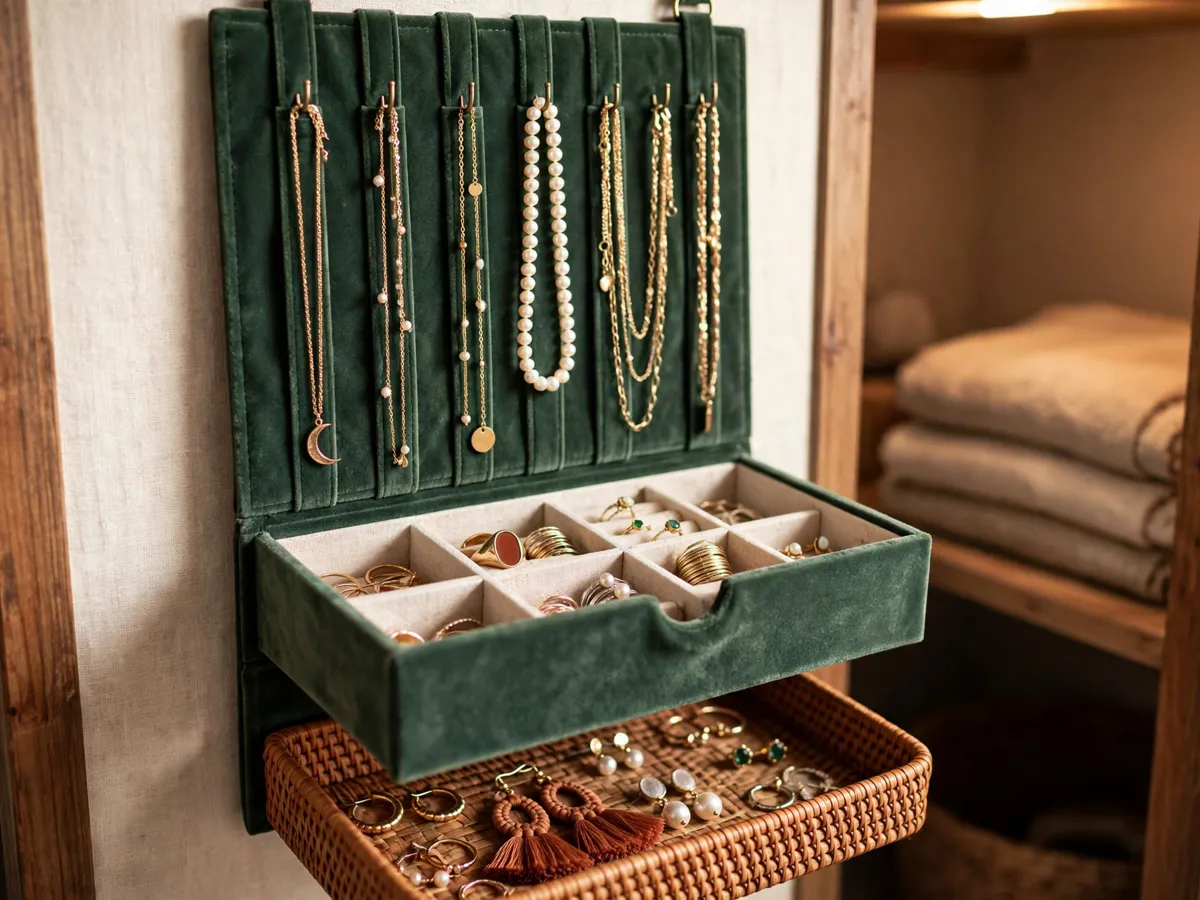
The velvet-strap panel is the most photographed jewelry organizer and the one most likely to disappoint, so here is the honest verdict. It looks good, it hangs on a rod in a minute, and it is genuinely the right choice for chunkier pieces: pendants, beaded necklaces, scarves, belts, watches.
The problem is fine chain. Each strap is sewn at the top and free at the bottom, so under real weight the loops stretch and sag over a few weeks, and a stretched strap hangs lower than its neighbors, which puts a fine chain right into the swing path of the ones beside it. Thin rope chains and cable chains still knot on a velvet panel. If most of your collection is delicate, buy hooks instead of straps. If it is mixed, use the panel for the chunky half and move the fine chains to spacing of their own.
Cost: $14–$30. Time: 15 minutes. Choose strap count by piece count, and expect to re-hang the fine chains somewhere else.
6. Pegboard Inside the Closet: The Visible-Storage Route
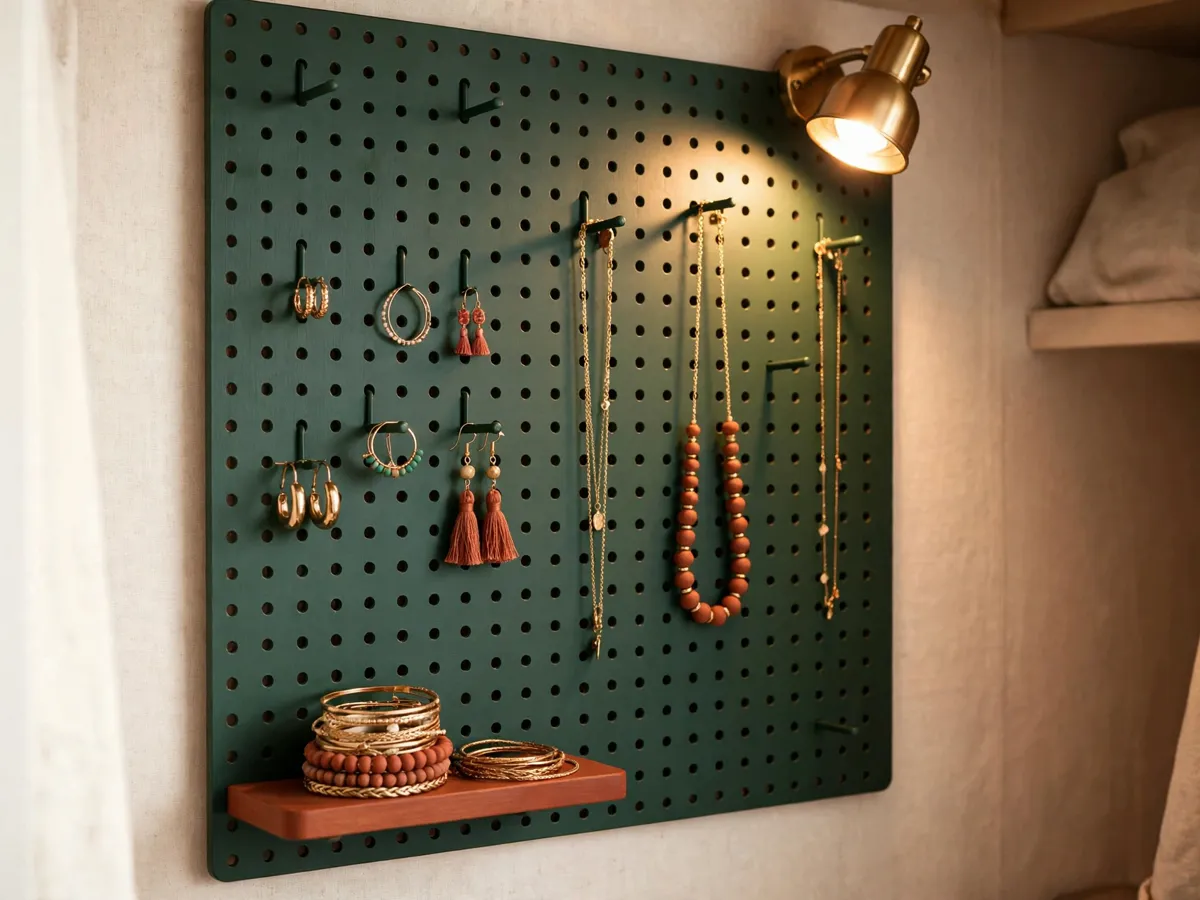
Pegboard is the route that solves spacing outright, because you place every hook yourself. A two by four foot panel on a closet side wall, with small cup hooks screwed into the grid, gives you forty or fifty independent hanging points at any spacing you want, and the layout reads at a glance: earrings on the top rows, necklaces below, watches on a hook at the bottom. Nothing shares space and nothing swings into a neighbor.
The caveats are honest ones. Visibility cuts both ways: a pegboard in a closet that guests open shows every piece you own, and dust settles on the metal, so plan a quick wipe every month or two. And mounting is the actual decision. Screws through the board into two studs is the permanent version and costs a landlord conversation. Adhesive strips hold a light board with light jewelry on a smooth wall, but a loaded pegboard pulls hard at the top edge and textured drywall defeats the bond; test one corner under load for a week before committing. The renter compromise is a freestanding panel, a framed board leaning on closet shelves and fixed with two tension rods, which carries the same hooks and moves out with you.
Cost: $20–$45 for the board, hooks and a frame or tension rods. Time: 45 minutes. Spacing is the whole point, so do not fill every hole.
7. Drawer Inserts: The Real Size Math for a 24-Inch Closet
Closet drawers are the most mis-bought organizer, because people measure the closet and not the box. A closet built 24 inches deep gives you an interior drawer about 23 inches front to back and 21 to 22 inches side to side, since the cabinet eats an inch on each wall. Standard insert trays ship at 15 by 10 inches, so two trays side by side cover 20 of the 21.5 inches of width, and laid front to back they cover 20 of 23 inches of depth. That leaves a half-inch seam at the side and a three-inch strip at the back.
The back strip is where a ring goes to disappear, so do not fill it with a second deep insert. Put one shallow full-width tray, roughly two inches tall, along the back for the weekly pieces, and keep the grid trays in front. Height matters as much as footprint: a compartment must sit lower than the drawer interior height or the drawer will not close on it. Closet drawer packs run four and 6.5 inches, so rings and studs go in the four and watches, stacked beads and cuff bracelets go in the 6.5. Measure the open box, not the closing one.
The same math works in a kitchen or a dresser drawer. Divider logic for any drawer: drawer organization ideas.
Cost: $12–$28 for two or three trays and a shallow back tray. Time: 25 minutes. Tape the box measurements on the inside of the closet before ordering.
8. Individual Pouches: The Cheap Anti-Tangle Fix
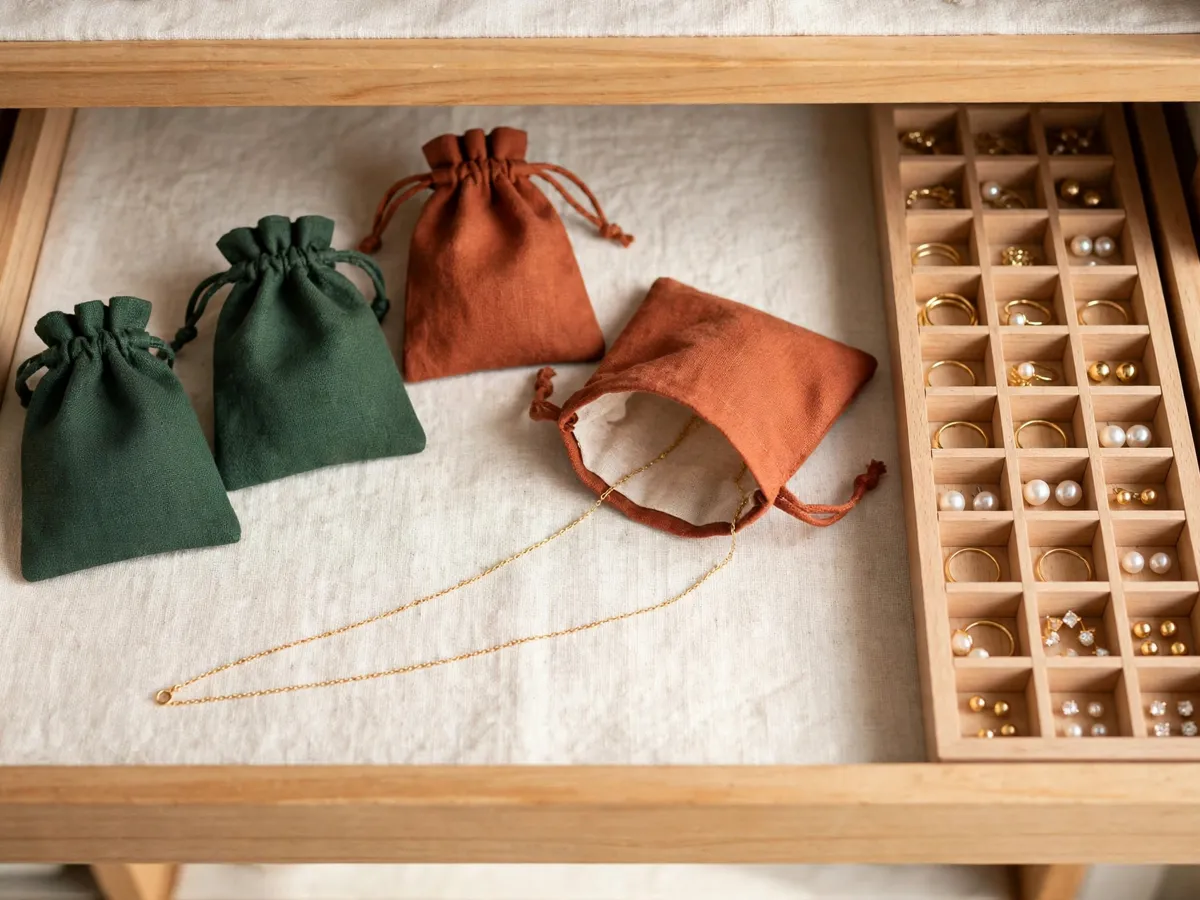
If hooks, spacing and pegboard are out of reach, enclosure wins, and it is the cheapest real fix on this page. One chain per small zip pouch, air pressed out before the seal, and the chain has nothing to catch on. A fifty-pack of clear pouches runs six to fourteen dollars, and it works in a drawer, on a shelf, or in a suitcase.
Two habits make pouches a system instead of a junk drawer. Keep one size for daily-weight pieces and a smaller one for studs and singles, so the pile reads by shape. And write on the pouch, not beside it: a strip of masking tape and a pencil name the piece, because three identical silver chains in a box are indistinguishable through plastic. Pouched storage is also the correct home for the never pile and for silver.
Cost: $6–$14 for a fifty-pack. Time: 20 minutes for a whole collection. Press the air out before sealing or the pouches swell and will not stack.
9. Rings and Earrings: Dividers, Not Piles
Rings and earrings fail differently from chains. They do not knot, they migrate: a loose ring rolls under a tray, an earring back detaches in a pile and its partner waits months for a match. Both need walls rather than space, and both are happy in a compartmentalized tray under two inches deep.
For rings, one slot per ring, and thin bands stand rather than lie so they cannot rub each other. For earrings, pair the two halves together before storage, always: a post pushed through a small square of felt, a hoop clipped onto the rim of a compartment, a stud back left on the post instead of loose in the tray. The egg-carton habit works and costs nothing, and a shallow dish holds studs that are truly daily. Keep pairs physically joined and the single-earring problem stops being a problem.
Bags and hats share this shelf and each has its own spacing rules. The other accessories: purse and handbag closet organization.
Cost: $5–$12 for a compartmented tray, or nothing for cartons and felt. Time: 20 minutes to pair everything once.
10. Silver and Tarnish: The Airtight-and-Cloth Rule
Tarnish is a material fact about silver, not a jewelry-quality complaint. It is what air does to the metal: sulfur compounds and moisture in the surrounding air react with the silver surface and build a dull layer over weeks. You cannot stop the chemistry, but you control the two inputs, and that is the whole rule. Keep the metal away from air, and keep the air dry.
In practice: an airtight pouch or a gasketed box with the air pressed out, plus one anti-tarnish cloth strip laid inside the container, not wrapped around the piece. Strips come in packs of four to eight for eight to fourteen dollars and last a couple of months, so write the start date on the pouch. A polished and fully dry piece goes in.
This is also why the bathroom drawer is the worst spot in the apartment for silver. Showers push humidity into a small room, the temperature swings, and moisture condenses inside the container every time it opens, so the metal sits in damp air rather than dry. A bedroom closet shelf, away from the tub and away from a steam-facing wall, is the same box in a different climate, and the difference shows up within a season.
Cost: $9–$20 for pouches and strips. Time: 15 minutes. Dry before sealing, every time, or the pouch holds the moisture in with the air.
11. The Walk-In Version: A Wall Section, Not a Box
A bigger closet does not need a bigger jewelry box; it needs one wall section claimed. The useful move is to give jewelry a deliberate strip, roughly two feet wide and from eye height to waist height, and treat it as its own zone rather than an afterthought inside a shared shelf. Inside that strip, the same three routes scale up comfortably: a pegboard or slat panel for spacing, a row of cup hooks for the daily pile, and one drawer at elbow height for rings and earrings.
Two things change at walk-in scale. Lighting, because a jewelry wall in a dim room reads as a dark jumble, so a small battery puck under the shelf above it turns the zone from storage into display. And distance, because a walk-in is often far from the mirror, which is exactly when the daily pile should split: keep daily at the getting-ready spot and let the wall carry weekly. Everything else about planning the room is a different guide. The bigger closet: walk-in closet organization.
Cost: $0–$35 on top of the panel and drawer already listed. Time: 40 minutes. Claim a strip, not a shelf.
12. Common Mistakes: The Mixed Bowl, the Bathroom Drawer
The mixed bowl is the default everyone inherits, a dish on a dresser or a single compartment where everything lands. It is the one home that puts every piece in contact with every other, and contact is the mechanism, so the knots return no matter how often you pick them out. The fix is not a nicer bowl; it is that the bowl stops holding chains. A daily ring in a dish is fine; long chains in a dish are a weekly undoing.
The bathroom drawer is the second, chosen for convenience next to the mirror and paid for in damp air, per section 10. The third is buying hardware before sorting, which produces a twenty-four-hook rack for nine necklaces or a shallow tray that will not close over a watch. Fourth: hanging a heavy pendant on a single adhesive hook, which fails on a textured door panel within days. Fifth, the small one nobody names: storing clasps open. A chain hung with its clasp undone is a hook waiting to catch a neighbor, so close every clasp before it goes up.
Cost: $0–$18 to correct all five. Time: 25 minutes. Remove the bowl first; it is the mistake that causes the rest.
13. Cost Reality: $9–$60 All-In
The system lands in three bands, and the sorting work in section 2 is free in all of them.
- $9–$20, the pouch band: a fifty-pack of small zip pouches, a pack of anti-tarnish strips and four door hooks. Nothing drilled, nothing bought in the wrong size, and every chain separated.
- $20–$40, the door-and-drawer band: adds an over-door rack or a twelve-hook panel for the daily pile, plus two or three insert trays sized to the actual drawer from section 7. This is where the closet starts reading as intentional instead of merely tidy.
- $40–$60, the wall band: a pegboard or slat panel with cup hooks, a shallow compartmented tray for rings and earrings, and a battery light puck.
The honest line: the free decisions decide the outcome. Wear frequency, hook spacing and closed clasps do more than any rack, and a sixty-dollar panel with three-inch hook spacing tangles just like the bowl did.
Cost: $9–$60 all-in. Time: 90 minutes for the full system. Spend after the sort, never before.
Common questions
How do I keep necklaces from tangling in a closet?
Give each chain its own hanging point with four to six inches of clear rail, and hang them shortest to longest so the loops nest outside each other. Close every clasp before it goes up. For fine chains, slip the chain through a drinking straw and clasp it, or seal one chain per small pouch with the air pressed out.
Are velvet-strap hanging organizers good for fine chains?
Not reliably. The straps are sewn at the top and free at the bottom, so they stretch and sag under weight, and a sagging strap puts a delicate chain into the swing path of its neighbors. Velvet panels are a good buy for pendants, beads, watches, scarves and belts; move the thin rope and cable chains to spaced hooks or pouches.
Where should I store silver so it stays bright?
In an airtight pouch or gasketed box on a dry bedroom closet shelf, with one anti-tarnish strip laid inside and the start date written on the pouch. Let a worn piece dry and cool before it goes in. Keep it out of the bathroom drawer, where shower humidity and temperature swings put damp air inside the container.
What size drawer insert fits a standard closet drawer?
Measure the open box, not the closet. A 24-inch-deep closet cabinet gives roughly 23 inches of interior depth and 21 to 22 inches of width, so two 15 by 10 inch trays cover the width and most of the depth. Fill the leftover three-inch strip at the back with one shallow full-width tray, and keep compartment height under the drawer interior height so it closes.
Can I organize closet jewelry without drilling?
Yes, and the top band of this guide is entirely no-drill: pouches, over-the-door racks that hook on top of the panel, drawer inserts and a freestanding pegboard braced with tension rods. Adhesive strips are only for smooth surfaces and light loads, so test one corner under weight for a week before committing a whole board to them.
Save these on Pinterest
Pin the wear-frequency sort, the four-to-six-inch hook spacing, the velvet-strap verdict and the three budget bands, plus the drawer math for a 24-inch closet. This guide and the rest of the organization and storage collection live together there. The door route pairs with the rail it shares: hat organizer for closet, and the shallow-drawer version with the tray it fills: vanity drawer organization.