 Plant As Deco
Home Organization & Storage
Hall Closet Organization: The One Everybody Opens
By Plant As Deco · Updated 23 November 2026
One closet in nearly every apartment gets opened without anyone deciding to open it. It sits within six feet of the front door, it holds the coats, and it takes a beating twice a day from everyone in the house plus every guest. Open the door and a sleeve swings out, or the whole row shifts forward like a deck of cards. Hall closet organization is a different job from every other closet here, because this closet is not archive. It is a traffic point, and it is shallower than it looks: 12 to 14 inches of real depth, not the 20 to 24 a reach-in bedroom closet gives you.
Weekend-ready: $0–$85, one afternoon for the whole system. Renter-safe: the door and the rods you already have do the work.
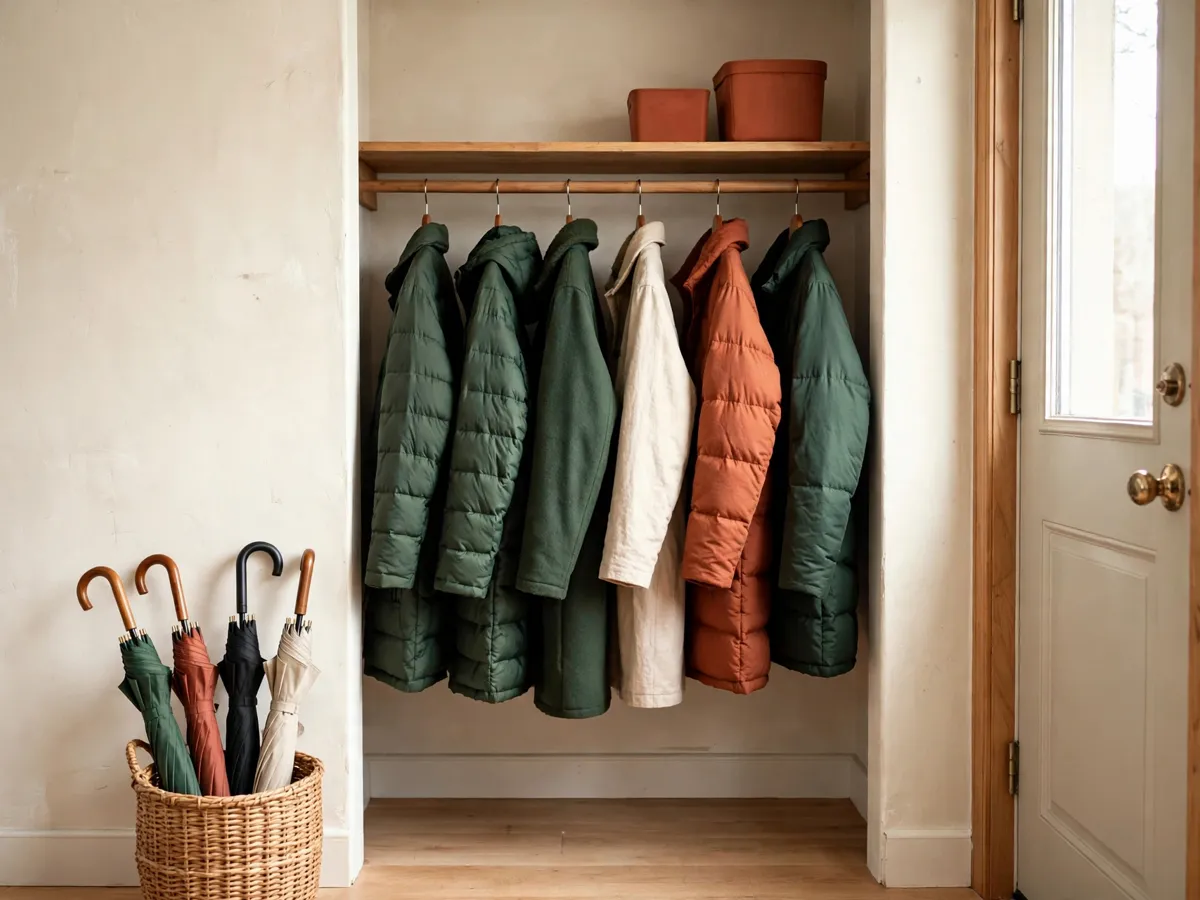
1. Why the Hall Closet Is a Different Problem (Traffic, Not Storage)
A bedroom closet is visited: you walk in, you choose an outfit, you close the door behind you. A hall closet is passed through. The door goes open while a coat comes off, a bag gets dropped and a leash gets grabbed, and somebody else arrives in the middle of it.
So the closet fails in motion rather than in clutter. It looks terrible at 7:50 in the morning with a coffee in one hand, which is why the goal is not a pretty interior. The goal is that a coat goes up and comes down in one motion, with the door still able to close. The outerwear system itself, hanger count and seasonal swap included, has its own guide: coat closet organization.
Cost: $0. Time: 15 minutes. Watch how the door gets used for a day before you move anything.
2. Measure First: Rod Height, True Depth, Door Swing
Three numbers explain why the closet will not behave. The first is true depth. Do not trust the width of the door opening. Run the tape from the back wall to the inner face of the closed door, then subtract the door stop, the raised bead the door seals against, which eats another half to three quarters of an inch. Hall closets commonly land at 12 to 14 inches after that subtraction, and that number is why bedroom-closet advice fails here.
The second is rod height, floor to the underside of the rod: 66 to 72 inches is normal. The third is the door swing. Open the door a full 90 degrees and see where the inner face lands, because that panel is the only unused square footage in the closet, and it tells you whether a hook strip will hit the opposite wall. Write all three on masking tape inside the door.
Cost: $5–$9 for a tape measure. Time: 10 minutes. The depth number is the one that changes your plan.
3. The One-Hand Zone: What Lives at Arm Height
The one-hand zone is the band you can service while holding the door open, without stepping in and without setting anything down: roughly 36 to 60 inches off the floor, and only the 12 to 18 inches nearest the door. In a traffic closet, zone by reach rather than by category.
Fill it with what moves daily. One rod slot per person for the coat in rotation, the bag you actually carry, the leash, the umbrella, the key hook. Anything worn once a month does not belong there, and neither does anything you lean past to reach. The test settles arguments: if you open the door and cannot take the item with the same hand that holds the door, it is in the wrong place. Everything outside the zone is archive, and archive gets one rule: it stays visible, label out.
Cost: $0. Time: 20 minutes. Rehang what is in the zone and move the rest out of it. Do not buy an organizer yet.
4. The Coat-Only Rule (Evict the Linens and Suitcases)
This rule fixes more hall closets than any product sold for them: the closet holds things that get put on or taken off at the door, and nothing else. The squatters are predictable. Bath towels and spare sheets, because the linen closet is full or does not exist. Suitcases and weekender bags, because they are big and the door hides them.
Every squatter takes depth the coats need, and every one gets opened less often, so the coat row gets shoved forward past the door stop each time somebody wants a bath towel. Evict in one pass. Linens go where folded cloth is stored properly, at shelf heights that suit a towel stack: linen closet organization. Suitcases flatten under a bed or climb to the highest shelf, empty. The one exception is a guest blanket, and only if it lies flat in a lidded bin without propping the door.
Cost: $0–$12 if the evicted linens need a bin. Time: 30 minutes. The eviction is what makes the depth math in section 5 possible.
5. Shallow Closet Math: 12 to 14 Inches and the Slim-Hanger Answer
Depth is spent in three places at once: the hanger hook, the garment body, and the air the door needs to close. Work the budget on a 13-inch closet with the rod centered 6 inches off the back wall. That leaves 7 inches forward, minus the half inch of door stop, so 6 and a half inches for the coat. A bulky winter coat on a wide wooden hanger measures 9 to 10 inches from the shoulders to the front of the sleeve, so it will not fit that budget. The door gets propped, and the prop is the reason the row collapses.
The same coat on a slim hanger lies flatter, closer to 6 or 7 inches, because the shoulder slope follows the garment instead of holding it open. The width bonus is plain arithmetic on top of that: a 24-inch rod divided by 1 and three quarter inch wooden hangers fits 13 coats, and 24 at 1 inch. Face every coat the same way, sleeves back to the wall.
Cost: $10–$18 for a 24-pack of slim hangers. Time: 25 minutes to rehang the row. Close the door when you are done: it should not touch a sleeve.
6. The Door Is Storage: Over-Door Rails and Hooks (Renter-Safe)
In a 13-inch closet the door is the only surface with room on it, and using it is the cheapest depth you will ever buy. An interior door is 1 and three eighths inches thick, and over-door hooks and rails are made for the 1 and a quarter to 1 and a half inch range, so they slip over the top with no hardware, no holes and no landlord conversation.
Build it in two rows. A hook strip across the upper door, roughly 60 inches off the floor, takes what is grabbed on the way out: tote bags, the reusable grocery sacks, a hat, the scarf in rotation. Below it, an over-door valet rod at about 30 inches holds tomorrow's jacket or the school backpack, hanging instead of draped over a banister. Keep the hardware three to six inches deep and check the swing from section 2, because a 6-inch rail on a door that opens into a wall stops short of 90 degrees.
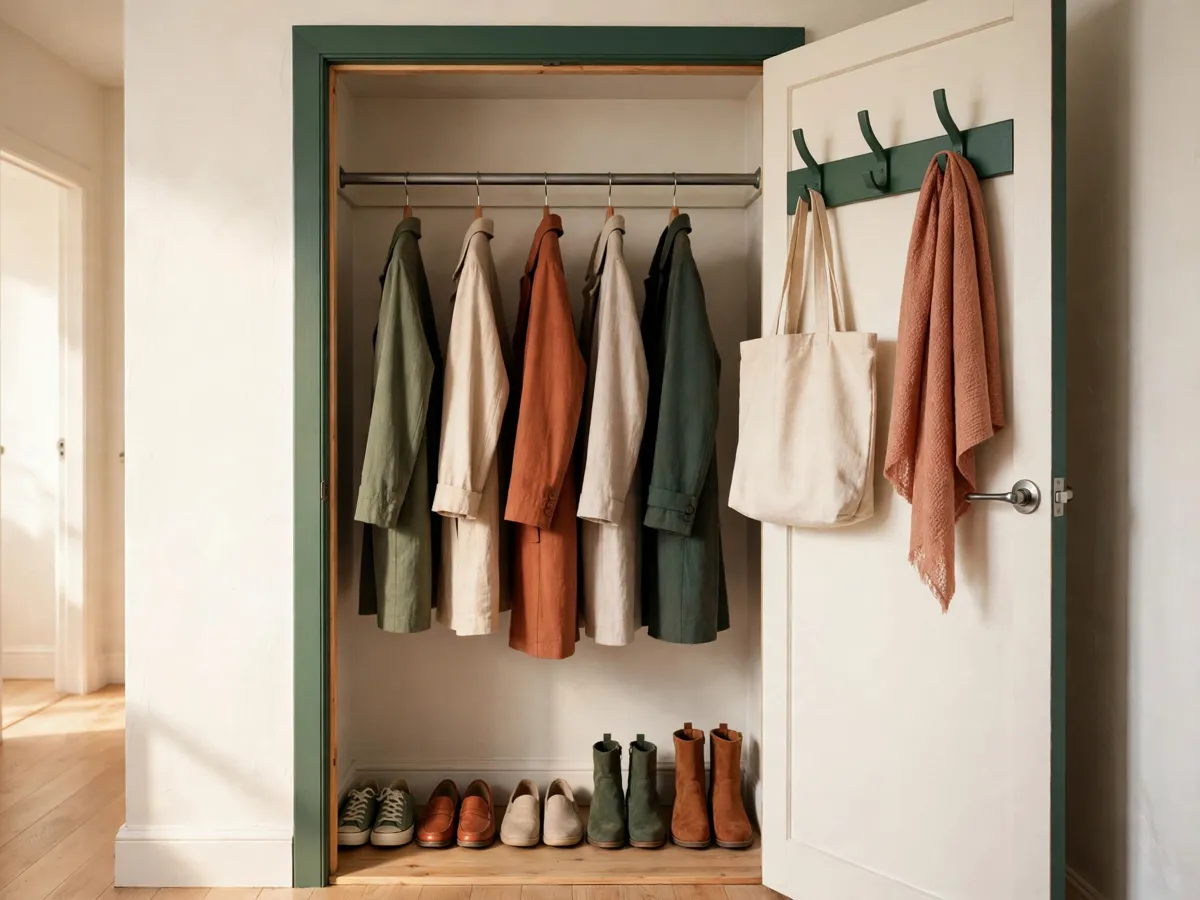
Cost: $6–$18 for a hook strip and a valet rod. Time: 15 minutes. Fit them before the coats go back.
7. Seasonal Overflow: Where the Winter Coats Go in July
The hall closet has one job per season, and in July the winter coats are squatting on the one-hand zone. The rule is one coat per person, plus the rain layer, plus nothing. Everything else moves out on the day the weather turns, not on a weekend you never schedule. Two flat lidded bins about 6 inches tall solve most of it: one labeled winter for knit hats, gloves and the scarf surplus, one labeled rain. The top shelf stops being a dig.
Suitcases and the second winter coat go under the bed on rollers, or up to the highest shelf in another closet, empty and zipped. Compression bags are the third option, with a caveat worth taking seriously. They suit cotton and synthetic layers. A down-filled coat compressed for two seasons does not bounce back to the same loft, so hang the down coat in a breathable cotton bag in the furthest closet instead of flattening it.
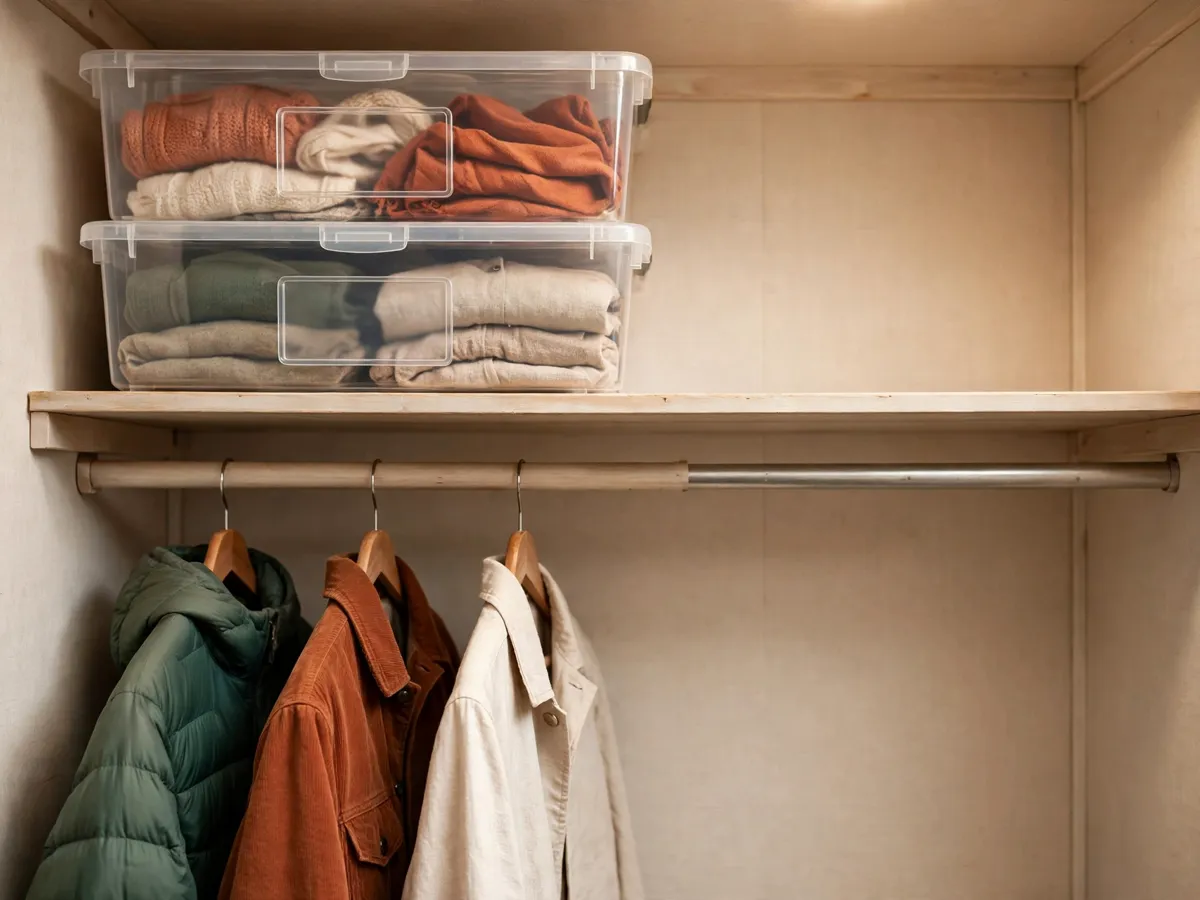
Cost: $12–$24 for a pair of flat lidded bins. Time: 30 minutes. Write the season on the lid as well as the contents.
8. Shoes and Bags: The Floor Strip
The floor of a hall closet is 13 inches deep and about 24 to 36 inches wide, which is not enough room for a rack and a coat hem. Coats hang down to roughly 22 inches off the floor, so anything stacked higher than 12 inches becomes furniture the door has to fight. Keep the strip flat: one row of everyday pairs, toes the same way, on a low mat or a 10-inch slim rack set against the back wall.
Bags do not go on the floor at all, because a bag there is the thing the vacuum chews and the reason the coat row tilts forward. They take the door hooks from section 6. The one floor item worth keeping is a basket for umbrellas, in the corner where the rod does not reach, so a wet umbrella is contained instead of leaning on the coats. If the household runs more than four pairs through this door daily, the entry needs its own shoe plan: shoe storage for a small entryway.
Cost: $0–$14 for a mat and an umbrella basket. Time: 15 minutes. Nothing on that floor rises above 12 inches.
9. Umbrellas, Keys, Leash: The Five-Item Landing Zone
Count what actually disappears at this door and the number is small: keys, the leash, the wallet, an umbrella, the sunglasses. Each is a two-second search at the moment you are already late. Give them one fixed zone inside the one-hand band, reachable with the door held open. The build is a hook strip and a tray. Three to five hooks carry keys on a carabiner clip, the leash, and the foldable tote. A shallow tray on the shelf below takes the wallet and the sunglasses, the two things with no hook-shaped end. Umbrellas go in the floor basket when wet and on a door hook when dry.
The habit is one motion on the way in: the item leaves the hand and lands on its hook, not on the kitchen counter.
Cost: $5–$16 for a hook strip and a tray. Time: 10 minutes. Five items, five homes, all inside 18 inches of closet.
10. Kids and Guests: The Low Hook Row
This section is about reach and nothing else. A four-year-old stands about 40 inches tall and puts a hand up to roughly 48, which is why a coat at 66 inches ends up on the floor and then on the sofa. Set two hooks at 40 to 44 inches on whichever wall or door panel is nearest the entrance, spaced about 12 inches apart so two small jackets do not tangle their hoods. One child, one hook, labeled with a name the child recognizes.
The row does double duty for guests. A visitor coat at 44 inches is a visitor coat that never migrates onto the back of the dining chair. Keep the low row for the layers a small person and a guest handle themselves: light jackets, hoodies, rain shells, a small backpack. The heavy winter coats stay on the main rod at adult height, where the one-hand zone already holds a slot.
Cost: $8–$16 for a two or three hook strip. Time: 20 minutes. Height is the whole trick: 40 to 44 inches, not 66.
11. The Two-Rail Trick for Tall Shallow Closets
A standard double rod buys hang space by spending depth, roughly 12 inches fore-to-aft, which is why it wants a 24-inch closet and is a nonstarter in a 13-inch hall. The version that works here spends height instead. Many hall closets are 8 feet tall with a rod at 66 inches and 20 to 30 inches of open wall above the coat shoulders. Mount a second, shorter rail on the same back wall at 86 to 90 inches, carrying only items shorter than the gap: the off-season rain layer, a scarf, a hat, a foldable tote.
Both rails sit on one plane, so the depth budget from section 5 never changes and the door still closes. Two 24-inch rods with brackets land at $14 to $32 and the job is an hour with a level. Homeowners drill into a stud; in a rental, ask, and if the answer is no, use the door panel from section 6 instead.
Cost: $14–$32 for the rod set and brackets. Time: 60 minutes with a level. Height, not depth, is the currency in a shallow closet.
12. The 10-Minute Reset Before Company Comes
Guests do not need a curated closet. They need the door to close and the coat row to stop spilling, and that is a ten-minute sequence you can run with the doorbell already answered. One, open the door and catch whatever is about to fall, two minutes, and put it back deliberately rather than pushing it in. Two, walk every non-coat out to its real home, three minutes; that is the coat-only rule from section 4.
Three, rehang the coats facing the same way, two minutes, and slide the row toward the hinge end so the door side is clear. Four, the floor: shoes toe-forward, bags onto the door hooks, umbrella into the basket, one minute. Five, keys and leash onto the strip, one minute. Six, close the door. If it does not close, one more item leaves, and that is the whole test. Run it weekly whether or not anyone is coming. The full small-closet habit list lives here: small closet organization ideas.
Cost: $0. Time: 10 minutes. The door closing is the pass or fail grade, not how it looks from the hallway.
13. Common Mistakes: The Deep-Shelf Black Hole, the Hanger Mismatch
The deep-shelf black hole is the top shelf in a 14-inch closet used as a dump. Items go in from the front and settle at the back, and the front row becomes packaging nobody wants to unpack. The fix is a depth limit rather than a fourth bin: two bins deep, labels facing out.
The hanger mismatch is the second, and it is the one that props the door. Mixed hangers make a ragged front edge, and the coats at the seam stick out two or three inches further than the rest. The door stops sealing, and once it stands open the whole row collapses forward within a week. Three smaller ones: a single hook for the household, so the first coat on it wins and everyone else drapes. A bedroom-closet organizer, usually 20 inches deep, bought for a 13-inch closet. And the holiday box living in the one-hand zone in October.
Cost: $0–$18. Time: 45 minutes for the full rescue. Fix the hangers and the shelf depth before adding any product.
14. Cost Reality: $0–$85
Three bands, and you pick from them rather than stacking all three. Most hall closets finish in the middle one.
- $0–$18, the rules band: the coat-only eviction, the one-hand zone, uniform slim hangers and the 10-minute reset. This is the band that fixes the door.
- $18–$45, the door band: adds the over-door hook strip, the valet rod, an umbrella basket and a key tray. Where most hall closets should stop, because it converts the one surface nobody uses.
- $45–$85, the build band: the flat lidded bins for the top shelf, the low hook row and the second rail at 86 to 90 inches for a tall closet. Worth it when the lease runs long enough to keep the system.
The honest line: the free decisions decide the closet and the paid ones only make it faster. Depth math, the coat-only rule and one-hand reach cost nothing, and no organizer on the market buys back the six inches a wide hanger spends.
Cost: $0–$85 all-in. Time: 120 minutes for the whole system. Measure first, evict second, buy last.
Common questions
How deep is a standard hall closet?
Most land between 12 and 16 inches, and a surprising number are closer to 12 once you subtract the door stop. A reach-in bedroom closet is 20 to 24 inches, which is why advice written for that closet fails here. Measure from the back wall to the inner face of the closed door, and take that number shopping with you.
My hall closet door will not close. What do I do first?
Treat the gap as a depth problem, not a tidiness problem. Pull the row to the hinge end, face every coat the same way with the sleeves back, and check the hanger widths. One wide wooden hanger in a row of slim ones is often the whole reason. If the door still stands open, something that is not a coat is in there, and it leaves before anything else moves.
Can I organize a hall closet without drilling?
Yes, and the door does most of it. Over-door hooks and an over-door valet rod slip onto a standard 1 and three eighths inch door with no hardware at all, and they carry the bag layer, the keys and tomorrow's jacket. Add slim hangers, a floor basket and labeled bins on the shelf you already have, and the system moves out in one piece when the lease ends.
Where do winter coats go in the summer?
Out of the traffic closet. Knits, gloves and the scarf surplus flatten into a 6 inch lidded bin on the top shelf. The second winter coat and any down-filled layer go on a hanger in a breathable cotton bag in another closet, because compression costs a down coat its loft over two seasons.
Should the hall closet hold towels and linens too?
Only if there is genuinely no other closet, and then only on the top shelf in a lidded bin that sits flat without propping the door. The reason to resist is mechanical: linens open monthly and coats daily, so a towel stack in the depth zone forces the coats forward every time somebody needs a bath towel.
Save these on Pinterest
Pin the one-hand zone, the coat-only eviction, the 13-inch depth math and the over-door build, plus the three budget bands. This guide and the rest of the organization and storage collection live together there. Outside the closet, the entry itself has its own guide: entryway ideas for small spaces, and the coats themselves, hanger count and swap included, are covered here: coat closet organization.