 Plant As Deco
Home Organization & Storage
Mudroom Ideas for Small Homes: Drop, Sort, Hang, Sit
By Plant As Deco · Updated 20 November 2026
A mudroom is four jobs living in one place by the door: a spot to drop whatever is in your hands, a way to sort what stays, a rail to hang what you will wear again tomorrow, and a seat that makes boots easy. In a small home those four jobs are usually scattered across the whole apartment — keys on the counter, coats over chair backs, shoes drifting down the hall. Pulling them back onto one wall is the entire project, and it costs less than a month of small annoyances.
Rentals get the mudroom look without building anything. Every fitting in this guide is adhesive, over-door or freestanding: a rail that peels away without a mark, a seat with zero fixings, bins that pack into a box on moving day. The system holds because each zone has one job and one owner, and because the whole wall resets in about a minute. That minute is the real product — the bench and the baskets are just the parts you can photograph.
Weekend-ready: $80–$300 total, one weekend. Renter-safe: adhesive and over-door fittings, a freestanding seat, and bins that leave with you when the lease ends.
1. What a mudroom is, and why small homes need one
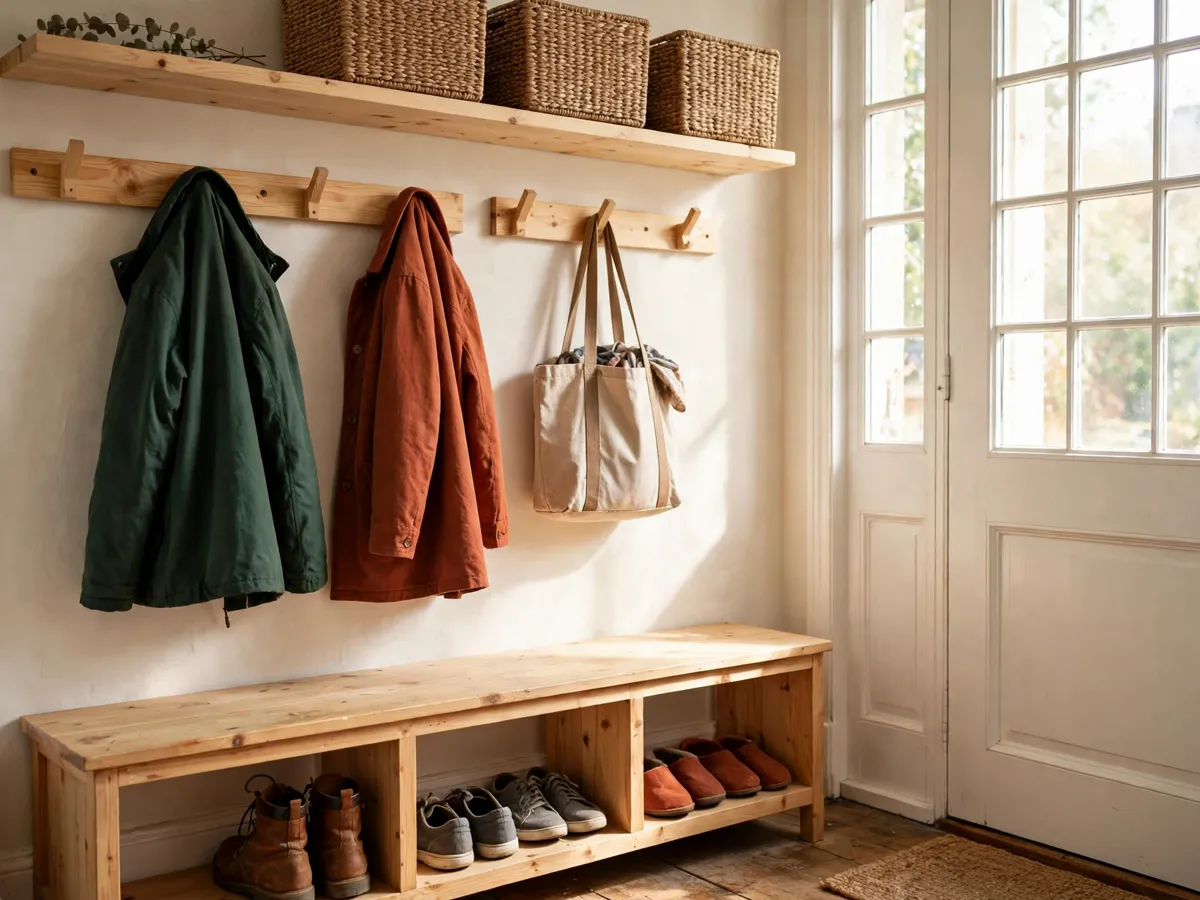
Ask three people what a mudroom is and you will get three answers: a room behind the garage, a row of tall lockers, a magazine photo with shiplap and a labrador. For a small home, forget all of that. A mudroom is a stretch of wall near the door organized into four jobs — drop, sort, hang, seat. Keys and sunglasses land in one dish. Wet gloves go into one bin to dry. Coats and everyday bags live on hooks instead of furniture. And somebody can sit down to pull boots off without balancing on one leg in a doorway.
Small homes need this more than big ones do, and the reason is arithmetic. A house with a true mudroom hides the incoming mess behind a door; an apartment entryway usually is the living room's front row, so every backpack set down "for now" stays on display until somebody deals with it. Named spots break that loop. When the dish, the bin, the hook and the seat each have one job, the ten-minute morning search for the other shoe stops, and the flat surface beside your sofa stops being the family's unofficial storage shelf. The wall by the door is the last free space a small home has, and giving that space the four jobs is what keeps every other room clear.
Cost: $0 for this step. Time: ten minutes to stand at your own doorway and say the four jobs out loud — drop, sort, hang, seat — then look at what actually happens there today. The gap between the two lists is your shopping list.
2. Read the entryway before you buy anything
Before a single hook goes up, spend fifteen minutes reading the entryway like a surveyor. Measure the clear wall in inches — the run the open door does not cover. Swing the door through its full arc and mark where it stops, because a rail mounted inside that arc becomes a scratch toy within a week. Write down three numbers: wall length, walkway depth, and the height of the nearest outlet or switch. Anything under 36 inches of clear walkway is a slim-wall plan, and the shopping list changes with that number.
Then count the users and their honest gear. How many people drop things here on a school or work day? How many coats are genuinely in this season's rotation — count them on hangers and be strict about it? How many pairs of shoes actually end their day at the door? One renter with a gym bag needs a rail and a dish; a family of four with two school-age kids needs a second rail at kid height and a bin per child. The most expensive mistake in mudroom planning is fitting a system to the household you wish you had instead of the one that walks in every evening.
If the wall is bare and the budget is tight, start with the lighter version: the entryway drop-zone guide builds a working door in one afternoon for under $80. This page upgrades that setup into the full four-zone system once the basic habit holds. Run the small version for two weeks, then spend.
3. The four zones: drop, sort, hang, seat
Give every foot of the wall a job before you give it a product. The drop zone sits closest to the handle: a shallow tray or dish at hip height where keys, wallet and sunglasses land without a decision. The sort layer sits just above the seat: bins with one owner each, so nothing has to be dug through to work out whose glove is whose. The hang row takes the middle: the rail at adult shoulder height, one hook per person plus one spare. The seat anchors the end of the run: a place to sit, with shoe storage underneath.
On a 6-foot wall the split looks like this. The first 12 inches beside the door carry the drop tray; the next 48 take the rail with a hook every 8 inches — six hooks, enough for four people with two spares. The seat runs under the right-hand end of the rail, 12 to 14 inches deep, and the bins go on a shelf across the top at 12 to 15 inches deep. A 4-foot wall cuts the hook count to four, swaps the seat for a fold-flat stool and keeps everything else. The layout survives because the jobs stay in the same order: what you carry in lands first, what you wear again hangs in the middle, what you sort waits at the end.
Build in this order: hang first, seat second, sort third, drop last. The rail is the zone everything else leans on, and the drop tray only works once there is a reason to pause at the wall — a coat to hang — instead of walking straight past it.
4. Hooks and rails that survive rental walls
There are three honest ways to put a rail on a wall you do not own. Adhesive hooks and adhesive-backed rails hold the light daily load — a rain jacket, a tote, a scarf — typically 4 to 7 pounds per fixing, so read the pack, count the fixings and add the loads up before you trust one. Over-door hooks take heavier coats with zero wall contact, which makes them the safest home for a soaked winter parka. If the lease allows small holes, two screws into studs turn a basic rail into furniture-grade hardware, and a dime-sized dab of spackle at move-out is a five-minute eraser.
Height is the setting most people never adjust, and it decides whether the rail still gets used by March. Start at 60 to 65 inches to the top of the rail so long coats clear the floor with an inch to spare. In a household with children, run a second rail at 36 to 40 inches — a kid who can reach their own hook hangs their own jacket, and that single design choice quietly deletes a nightly argument. Space hooks 8 inches apart so a puffy coat has air, and keep one hook lower than the rest for the daily bag, because a tote with a laptop inside will out-pull any adhesive strip ever made.
Cost: $12–$45 for the rail and fixings. Time: 30–45 minutes with a level and a pencil. A rail hung level on the first try is the difference between a wall that reads as deliberate and a row of crooked pegs that reads as an afterthought. Renter-safe storage at the door starts here, because a rail that holds is what keeps the space in front of it clear.
5. Benches and seats that double as storage
A seat earns its footprint by storing as much as it serves. The numbers that matter: 12 to 14 inches deep, 17 to 19 inches high, rated for at least 250 pounds so an adult can sit and wrangle boots without checking the label twice. Under the top, choose a shape that matches the household. Individual cubbies give each person a shoe bay and end the whose-side-is-this debate. A two-tier open shelf holds pairs in plain sight and wipes clean in seconds. A flip-top lid hides one deep cavity for the once-a-week gear — helmets, the good umbrella, the picnic blanket that lives by the door in June.
In a hall under 3 feet wide, a fixed bench is a corridor obstacle wearing a cushion. Use a fold-flat stool that lives against the wall and comes out only when someone actually sits, or a sturdy low basket with a cushioned top — seat and shoe overflow in one piece. The seat is the last zone to buy, never the first: run the drop-sort-hang system alone for a week and watch whether anybody sits at the door. If they do, buy the bench. If they do not, you just saved a hundred dollars and a walkway.
Cost: $60–$140 new, roughly half that second-hand. Time: 20 minutes to place, level and pad — a felt pad under each foot keeps a wooden floor from learning about the mudroom the loud way. A bench that stores shoes and gear is the most-used furniture in a small space, so size the storage space to the shoe count, not to the look.
6. Bins, baskets and the sorting system
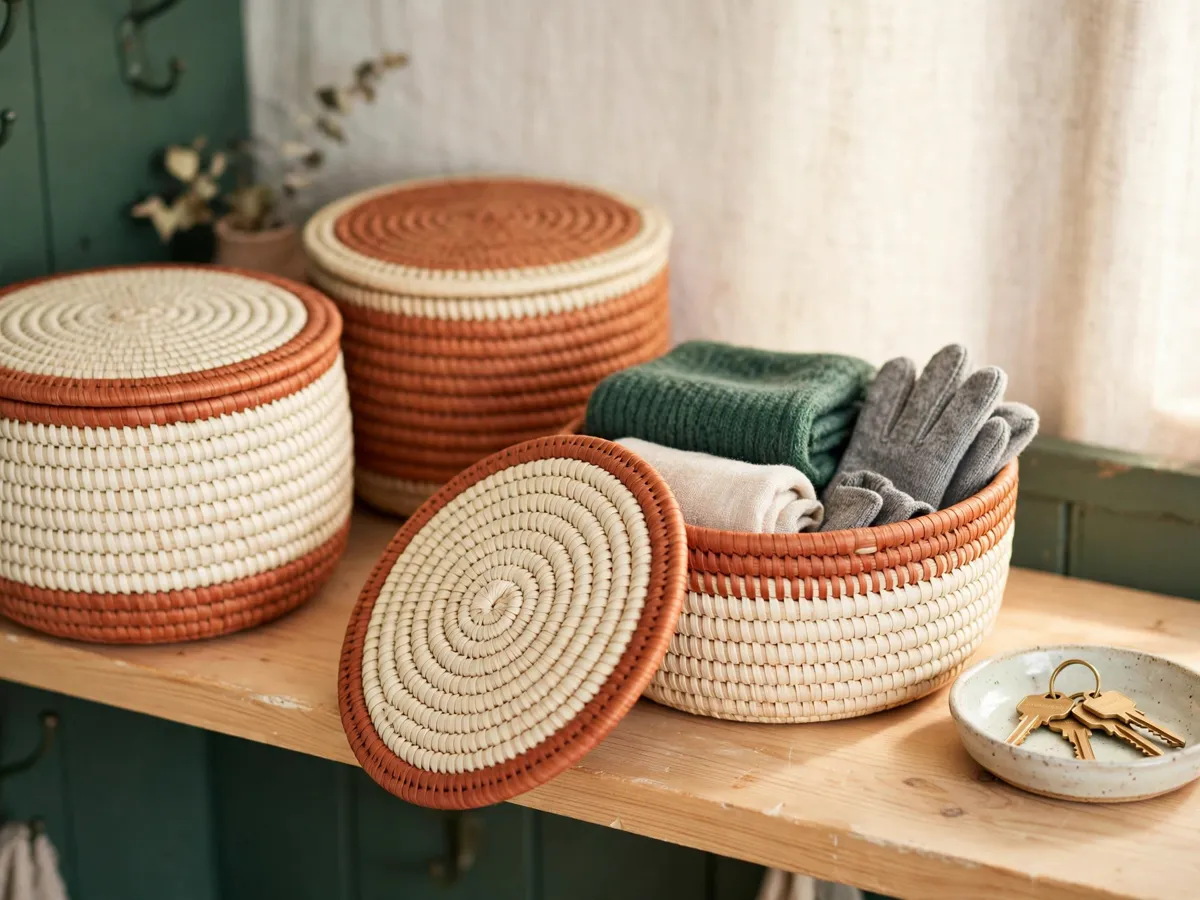
Bins are where a mudroom stops being furniture and starts being a system. Give every person one bin and the household one shared bin, then name each one on a label: hats and gloves, dog gear, returns and donations. Named bins get emptied; unnamed bins get buried. Open baskets on a shelf handle the daily grab — the glove pair, the dog leash, the library book going back — while lidded ones cover anything stored on a wall a guest sees first, because an open basket at eye level reads as a pile with good posture.
The sorting layer runs on one rule: the mudroom holds this season and nothing else. Once a week, take ten minutes: everything that belongs elsewhere leaves, damp items dry out fully before they are stored away, and the seasonal overflow — the heavy scarves, the beach hats — waits in a wardrobe or under-bed boxes instead of crowding the shelf. When a bin overflows twice in one week, the fix is one item out, never a bigger bin. Capacity that grows to meet the pile is how an organized wall quietly stops being organized.
Cost: $30–$60 for a matched set of four to six. Time: 15 minutes to label on a Sunday. Matched woven baskets keep the wall calm; mismatched ones keep it honest — pick a lane and stay in it. Bins that fit the shelf store the daily grab without wasting the space above the seat.
7. Shoe storage that works at the door
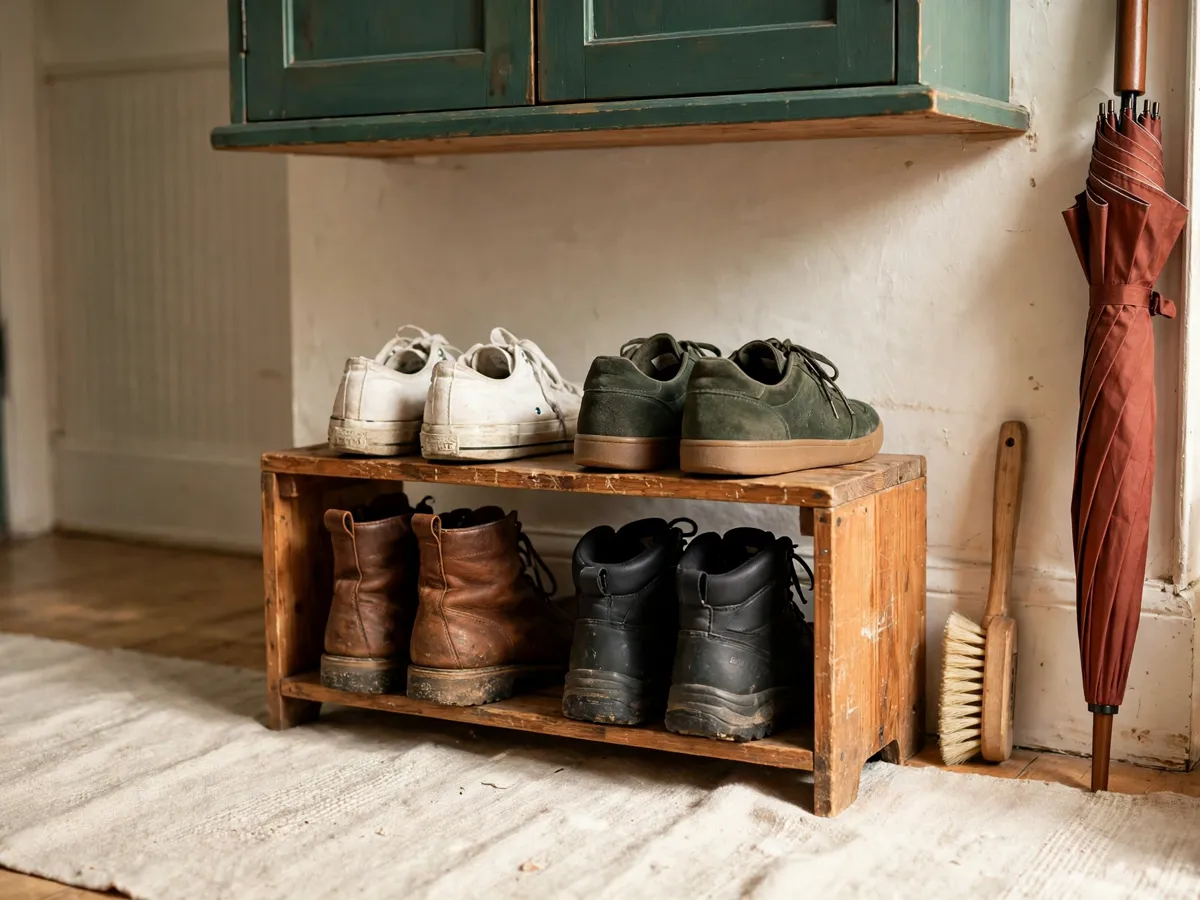
Shoes decide whether the whole system holds, because they are the only zone that walks back in twice a day. Set the limit first: two pairs per person live at the door, and everything else goes to its real home. A low two-tier rack covers eight to ten pairs in a 24-inch run — enough for a family of four living at the two-pair line. Slim vertical slots earn their keep in narrow halls by holding one pair per slot at a fraction of the depth, and they force the kind of honesty a wide shelf never asks for.
Wet weather rewrites the rules. Boots and soaked sneakers go on a boot tray beside the rack, never on it, and they stay there for 24 hours to dry before rejoining the row. A tray with raised edges and a layer of river pebbles lifts each pair out of its own puddle, which is the cheapest smell-prevention upgrade in this whole guide. Salt stains wipe off a pebble tray in seconds; off carpet, never.
For the sizing math — rack depths, tier counts, the narrow-hall versions and the two-pair rule in full — the shoe storage guide for small entryways covers it end to end.
Cost: $20–$45 for rack and tray. Time: 20 minutes to set the limit and place the rack where the current pile already forms. Shoe storage sized to the two-pair rule keeps the doorway space free for the mat, which is the space shoes are actually meant to occupy.
8. Coats, bags and the hanging row
The hang row runs on a seasonal limit: three coats per person on the rail at any time, and the rest live in the closet until the season turns — the beginner closet reset is the fast way to run that swap. Count honestly. If four people keep five coats each on six hooks, the rail has already failed, and no amount of tidying fixes a math problem. Heavy winter parkas overwhelm adhesive strips, so give them the screwed section of the rail or an over-door hook of their own.
Bags are the quiet clutter of an entryway, and they need named hooks like everything else. The daily bag gets one hook at the end of the row, at whatever height its owner reaches without thinking. Work totes empty into the drop tray before they hang, or they are just pockets with a handle. Umbrellas take the lowest hook where drips can do no harm, and the dog leash takes the one nearest the door at exactly the height your hand drops to on the way out.
Cost: $0 once the rail is up. Time: five minutes on Sunday for the seasonal check — count the coats, count the hooks, move one back to the closet if the math has drifted.
9. Kid heights and the family plan
A mudroom only adults can reach is a system with half the family locked out. Run the second rail at 36 to 40 inches so a five-year-old hangs a backpack without a stool, and give each child a matched set: one hook at their height, one labeled bin on the low shelf, one marked spot on the shoe rack. Picture labels beat word labels for pre-readers — a shoe taped inside the cubby, a jacket drawn on the hook. The goal is that "put your things away" becomes a place, because places can be checked and instructions can be argued with.
The family plan is a 60-second reset, and it works best right after the school run while everyone is still standing at the door. Bags to hooks, lunch gear out of backpacks, shoes to the rack, gloves to the bin — four moves, timed against the kettle. Give the youngest the first job; small children take an assigned task seriously in a way they never take a repeated reminder. After a week or two the reset runs itself, and the doorway stops being the place where the day's chaos is parked.
Cost: $10–$20 for the second rail, labels and a low bin. Time: one Saturday afternoon to set up, then one week of kettle-timed practice before it stops needing a parent to conduct it.
10. Light, air and smell
Light comes first because a dark doorway reads as messy even on a clean day. Swap the bulb for warm white — 2700 kelvin — then add one task light: a plug-in sconce with a cord cover, or a rechargeable puck light stuck above the drop tray. Aim light at the wall, never at eye level on the way out. Two small points of light beat one bright ceiling bulb in a narrow hall, the same trick that works for galleries and restaurant menus.
Air and smell are one problem with one cause: damp. Wet coats need half an hour on a hook to stop dripping before they join the dry load; boots rest on the pebble tray rather than steaming inside a closed cubby. Keep a window cracked or a vent running when the weather allows, tuck a cedar block into the glove bin, drop a sachet of baking soda into the shoe rack, and wash the doormat on a monthly cycle. Your own nose adjusts within minutes of arriving home, so test the room the honest way: ask the first guest.
Cost: $15–$30 for the bulb, one puck light and two sachets. Time: 20 minutes, most of it waiting on the kettle. This is the least photogenic zone on the wall and the one every visitor quietly remembers.
11. The weekend mudroom plan
Clear the wall before you fit it. Every system built on top of existing overflow re-creates that overflow within a month, so run the room-by-room declutter checklist first — the entryway pass alone takes an hour and decides what actually deserves a place in the new layout. What survives the sort is what the wall gets sized to.
Saturday morning is the shopping run, and the honest budget is: rail and fixings $25–$60; seat $60–$140; bin set $30–$60; low shoe rack $20–$40; light $15–$25. That lands at $150–$325 all-in. Two honest ways to trim it: the fold-flat seat swaps the $60–$140 line for about $25, and second-hand baskets run a third of retail — together they pull the floor of the budget down to $80. Buy once, in one trip, with the wall measurements from the survey in your pocket.
Saturday afternoon: hang the rail level, add the kid rail, place the seat and re-check the 36-inch walkway with a tape measure. Sunday morning: load and label the bins, set the rack and the boot tray where the current pile already forms, fit the light. Sunday evening: run the first 60-second reset with everyone who lives here, including the shortest ones. Then give the system one undisturbed week before any judgment — a mudroom is a habit wearing hardware, and habits need their week.
Total cost: $80–$300. Total time: one weekend, roughly four hours of work spread across two days. The recurring cost is ten minutes a week, and that is the entire maintenance contract. Storage that fits this wall is what keeps the space by the door working after the weekend ends.
Common questions
Do I need a spare room to have a mudroom?
Yes, you need a wall — the room is optional. A 4-foot stretch beside the door runs all four zones on the slim plan: adhesive rail, fold-flat seat, one shelf of bins, a drop dish. Households with a real mudroom room simply spread the same four jobs over more furniture; the jobs themselves never change.
What can I install in a rental without drilling?
Adhesive hooks and rails for light daily loads within their pound ratings, over-door fittings for heavy coats and bags, and freestanding everything else. Total the weight before trusting any adhesive: jacket plus bag plus scarf, seldom jacket alone. Where the lease allows small holes, two screws into studs carry a full winter's load, and a dab of spackle erases them at move-out.
Where should the drop zone actually go?
Within arm's reach of the door handle, at hip or chest height — where your hands already empty themselves. A tray on a high shelf looks tidy in a photo and stays empty in real life, while the keys keep landing wherever the evening leaves them. Put the dish where the keys already fall, and the habit is free.
How do I stop shoes from piling up at the door?
Set the two-pairs-per-person limit, size the rack to that math, and put wet pairs on the boot tray instead of the shelf. Once a week, walk the pairs that lost their place back to their real home. A visible border does more than any reminder — the edge of the rack is a rule everyone in the house can see.
How many bins does a family need?
One per person, one shared bin for household gear like the dog leash and reusable bags, and one wash-bound bin for damp gloves and hats at the end of a wet day. That is five for a family of four, all labeled, all under 13 inches deep so they fit a standard 12-inch shelf without overhang.
What actually fixes the smell by the door?
Dry before you store: coats drip for 30 minutes before they hang with the dry load, boots rest on the pebble tray, gloves dry flat. Add a cedar block and a baking-soda sachet, wash the doormat monthly, and keep air moving through the space. Scent products cover the cause for a day; airflow removes it.
Save these on Pinterest
Pin your mudroom wall, then browse the Organization & Storage collection for the entryway drop-zone guide and more small-space organization projects.