 Plant As Deco
Home Organization & Storage
Sweater Closet Organization: Fold, Stack, Rotate
By Plant As Deco · Updated 24 November 2026
Sweaters rarely disappear because you own too many. They disappear because knitwear is the only fabric in your closet that gets hurt twice: hung up, the shoulders stretch into points you cannot fold back; folded too high, the pile crushes the bottom sweater until it looks like a cushion cover. Then the whole stack loses its shape and the one you actually wanted stays at the bottom. This guide is about the two physical facts behind that mess, and the small habits that keep a knit closet calm through a full year.
Weekend-ready: $5–$70, one afternoon for the whole reset. Renter-safe: shelves, baskets and hanging organizers only, nothing drilled into a wall you do not own.
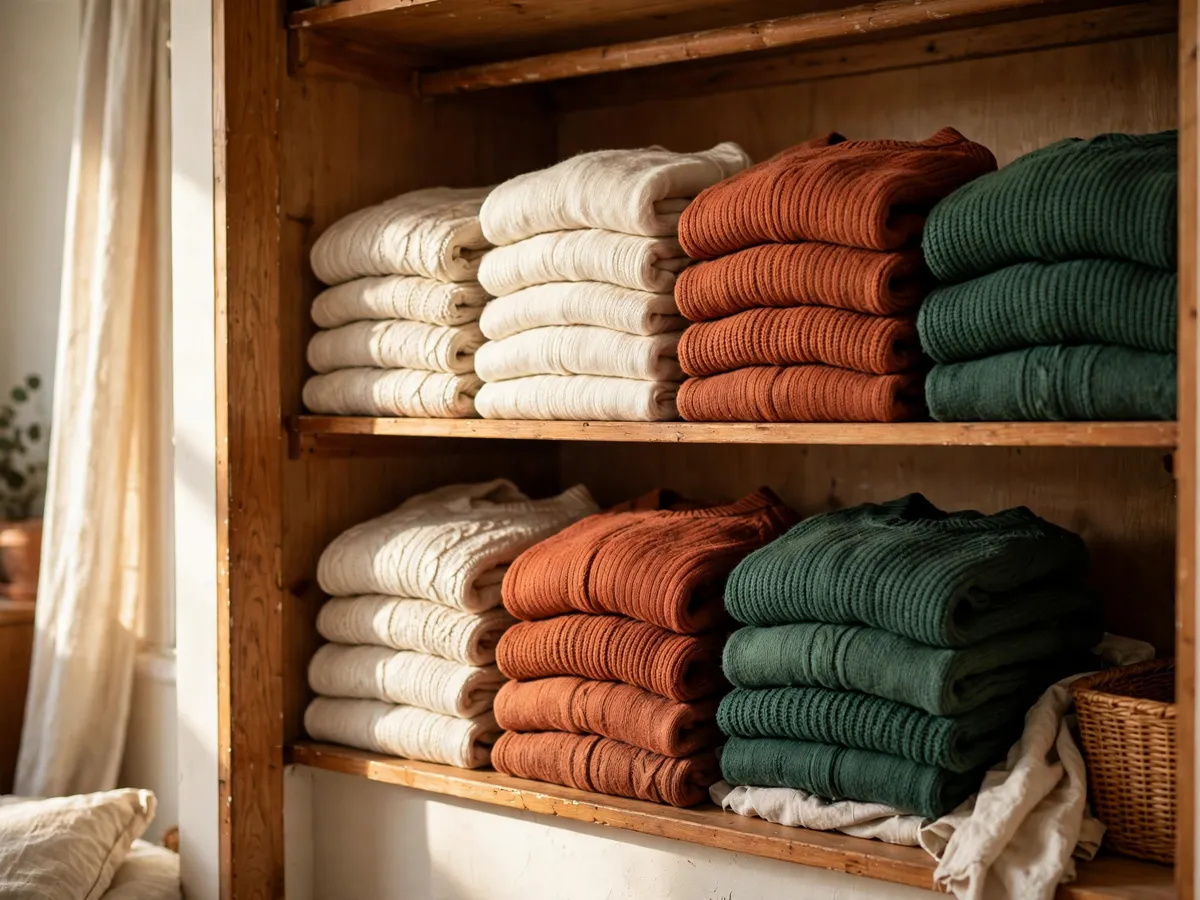
1. Why Sweaters Need Different Rules
A knit is a grid of loops, and a grid behaves in ways cotton never does. It stretches when you pull it, springs back slowly, and it keeps the shape of whatever pressed it last. That is why a sweater on a hanger grows pointed shoulders while a shirt on the same hanger stays flat, and why the bottom of a tall pile comes out looking compressed even when you never sat on it.
None of this is a style rule you have to follow. It is a material fact, and once you know it, the closet decisions get easy. Give knits surfaces that do not pull, keep piles short, and give each sweater a fold that lets you find it again without unstacking the whole shelf.
Cost: $0–$3. Time: 10 minutes. Check one sweater after a day on a hanger and one from the bottom of an old pile; the difference is the whole page.
2. Sort by Wear Frequency: The Weekly Three on Top
Before you fold anything, pull every sweater out and sort it into three groups: worn in the last two weeks, worn a few times a season, and not worn since last winter. Do it on the bed, not in the closet, because the pile this makes needs the floor. Then you get the number that runs the rest of the page: your weekly three, the sweaters you actually reach for on a repeat Tuesday.
Put those three, plus one backup, on the front of the top shelf where your hand lands first. Everything else moves back or down. Color can be the tie breaker once wear frequency is done: color-organized closet shows how that second pass looks calm.
Cost: $0–$5 for small labels or sticky notes. Time: 30 minutes. Three groups on the bed, weekly three on the top shelf, everything else off the daily path.
3. Fold Geometry: The Third-Fold Rule and the Shoulder-Crease Problem
The third-fold rule: fold a sweater in thirds, not in quarters. Lay it flat, sleeves folded in along the body, then bring one side over the other so the finished bundle is roughly one third as wide as the sweater. A third fold leaves the body just wide enough that you can see the neck line from above, and the neck line tells you which sweater it is without picking anything up.
The shoulder crease comes from the opposite mistake. If you fold the body in half with the shoulders facing outward and press hard, the shoulder seam takes a hard line that stays visible when you wear it. A softer press, folding the body in half with the shoulders tucked inside, and a stack you do not press down, all three keep that line from setting.
Cost: $0–$2. Time: 10 minutes per sweater. Thirds, neck line up, shoulders tucked, no hard press.
4. Stack Height Math: Why Six Is the Limit
Six sweaters per stack is the ceiling for most closets, and the reason is easy to check. Measure the usable shelf height, then measure one folded sweater, then count how many fit with a finger of air between them. In a standard closet that number is usually four, five or six. Anything past that and the bottom items are carrying the weight of everything above, which is how a knit loses its loft and comes out looking flat and tired.
The cost of a collapsed pile is not just the flattened sweater. It is the one you never see again. When a stack grows past the limit, the bottom layer stops being visible, so the sweater you wanted this morning is the one you skip and replace with whatever is on top. Six keeps every sweater one glance away.
Cost: $0–$2. Time: 5 minutes. Measure shelf and sweater, count with a finger of air, and set the limit on the shelf itself.
5. Shelf Depth: The 24-Inch Problem and the Front-Row Solution
A typical bedroom closet runs about 24 inches deep, and most shelves in it are 16 to 18 inches deep. That leaves a back gap of several inches where sweaters get pushed and forgotten. The front-row solution keeps two depths on the same shelf: the front row holds the weekly sweaters, set at the front edge where you can see and pull them straight out, and the back row holds the occasional ones, pushed all the way back, so the gap becomes useful depth instead of dead space.
If your closet is deeper than that, the same logic doubles into three rows, front to back, and you keep the heaviest knits in the row closest to you so lifting them does not drag three sweaters off the pile. If you have a walk-in space instead, the same logic applies at a larger scale: walk-in closet organization covers the wider layout.
Cost: $0–$6 for a shelf lip if you want one. Time: 20 minutes. Weekly knits at the front edge, occasional knits at the back, heavy pieces closest.
6. The Hanger Question: When a Sweater CAN Hang (and the One Fold That Saves It)
Plenty of sweaters hang perfectly well, and forcing them onto a shelf is not always the answer. A chunky cardigan, a heavy ribbed crew, or a sweater with a structured shoulder can live on a wide padded hanger as long as the shoulder seam reaches the edge of the hanger and the weight hangs straight down. The hanger matters more than the fold here, because a thin wire hanger is what creates the pointed shoulders: the weight concentrates on two narrow points.
The one fold that saves it applies to the sweaters that do not belong on a rod: hooded styles, anything with heavy embellishment at the neck, and fine knits that go soft and slack on a hanger. Fold those and they keep their shape for a whole season. The wider question of what to hang and what to stack lives in the basics: small closet organization ideas.
Cost: $5–$15 for one or two wide padded hangers. Time: 15 minutes. Wide hangers for heavy knits, folded for hoods and fine knits.
7. Drawer vs Shelf: The Verdict for a Deep Closet
For a closet that is 24 inches deep, the honest verdict is that drawers win for knits and shelves win for bulk. A drawer gives you a flat surface with a front edge, so the top row of folded sweaters stays visible the whole way down to the bottom of the drawer, and every sweater sits one finger apart instead of pressed under a pile. A shelf in that same closet asks a stack of six to carry itself, and stacks collapse.
The catch is drawer depth. Most drawers are 12 to 16 inches deep, which is narrower than a full sweater folded in quarters. This is where the third-fold rule pays off twice: fold in thirds, and the bundle fits the drawer with the neck line showing. Add a small divider so the back row does not slide into the front. The rest of your drawer system has its own guide: drawer organization ideas.
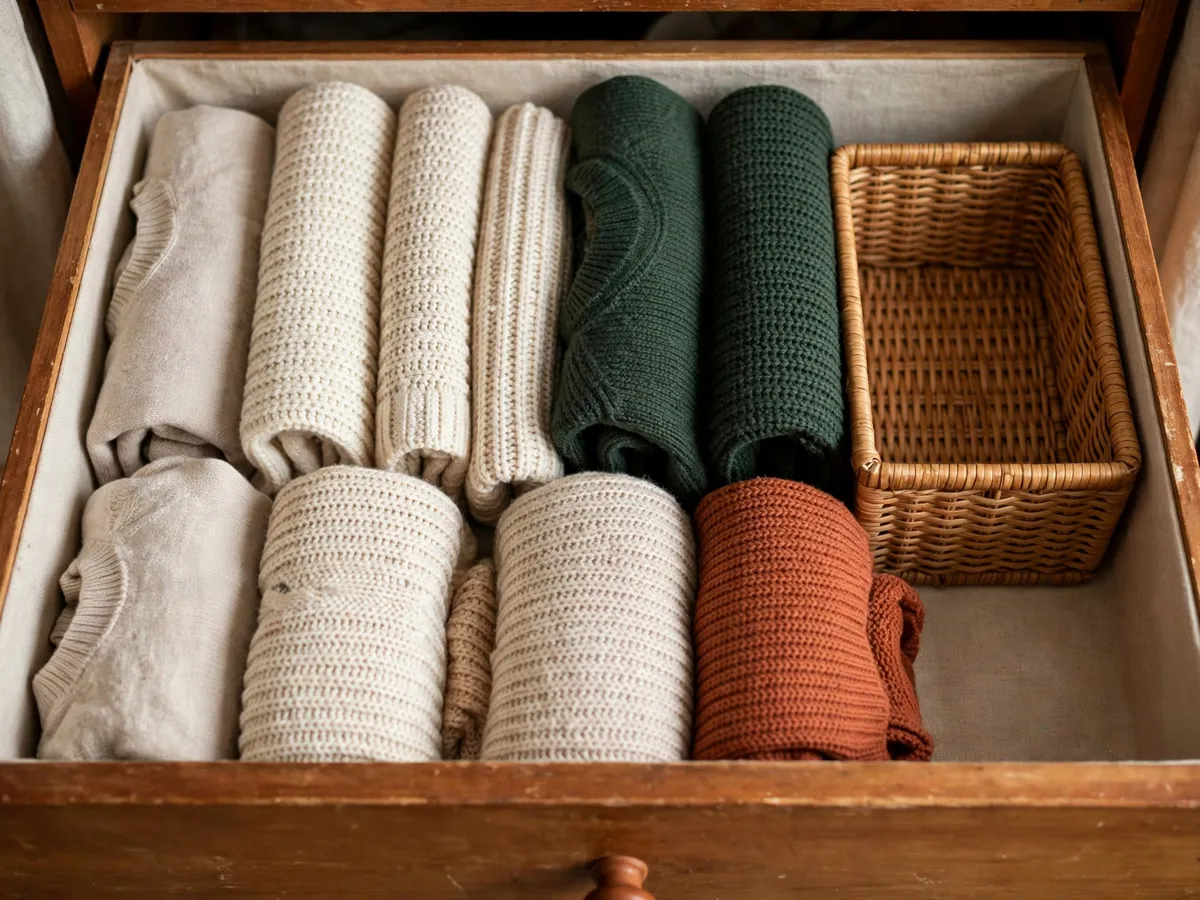
Cost: $0–$25 for a divider and a small set of drawer organizers. Time: 30 minutes. Thirds not quarters, neck line up, divider so the back row stays put.
8. The Off-Season Rotation: Vacuum Bags and the July Closet
Pick two swap days a year and keep them. A late-May swap empties the closet down to what you wear now, and an early-August swap does the same in the other direction. On those days the closet should feel quiet, because anything not in season leaves the room entirely. A closet that only holds current sweaters does not need clever storage, it needs less stuff in it.
Vacuum bags are the right tool for some of what leaves, and the wrong tool for knits. A sealed bag pulls out the air and the loft of a sweater does not always come back, so sweaters travel in breathable bins or cotton pillowcases instead, folded loosely, with a cedar block for scent if you like one. The deeper seasonal system is covered here: off-season clothing storage.
Cost: $10–$30 for bins, pillowcases and a few bags. Time: 60 minutes per swap. Two dates a year, knits breathable, everything else packed.
9. Moths and Storage: The Sealed-Bag Fact
One physical fact handles most of this: a sealed bag is a barrier. If the opening is closed and the seal holds, what moves through the closet cannot get to the wool inside. A zipper bag, a lidded bin with the lid pressed down, or a vacuum bag with the seal pressed flat all work the same way, because they all remove the open path. That is a physical barrier, and it needs no chemical to do the job.
Two habits make that barrier work. Fold sweaters clean, because the oils and crumbs a worn sweater carries are what draw small pests in the first place, and shake them out before they go into storage. Then look in once a month while things are packed, in the same way you check a pantry shelf. Cedar blocks and dried lavender are a scent layer many people add to a bin; the barrier is the sealed lid.
Cost: $8–$20 for sealed bags or lidded bins. Time: 30 minutes. Clean, folded, sealed, and a monthly look while everything is packed.
10. Hanging Shelf Organizers: The Renter-Safe Stack
If you have no shelf and no permission to drill, a hanging organizer that drops over the closet rod is the honest answer. It gives you cubbies that hang in mid-air, which turns unused vertical space into usable shelf space without touching the wall. One organizer hung low, near shoulder height, keeps its cubbies in reach and stops the whole thing from swinging.
Weight is the part people get wrong. Fabric organizers are built for light things: folded sweaters, scarves, hats and gloves fit well, and a stack of heavy winter coats in the bottom cubby pulls the whole thing down. Load the lower cubbies with the lightest items and keep the heavies on a real shelf or the floor.
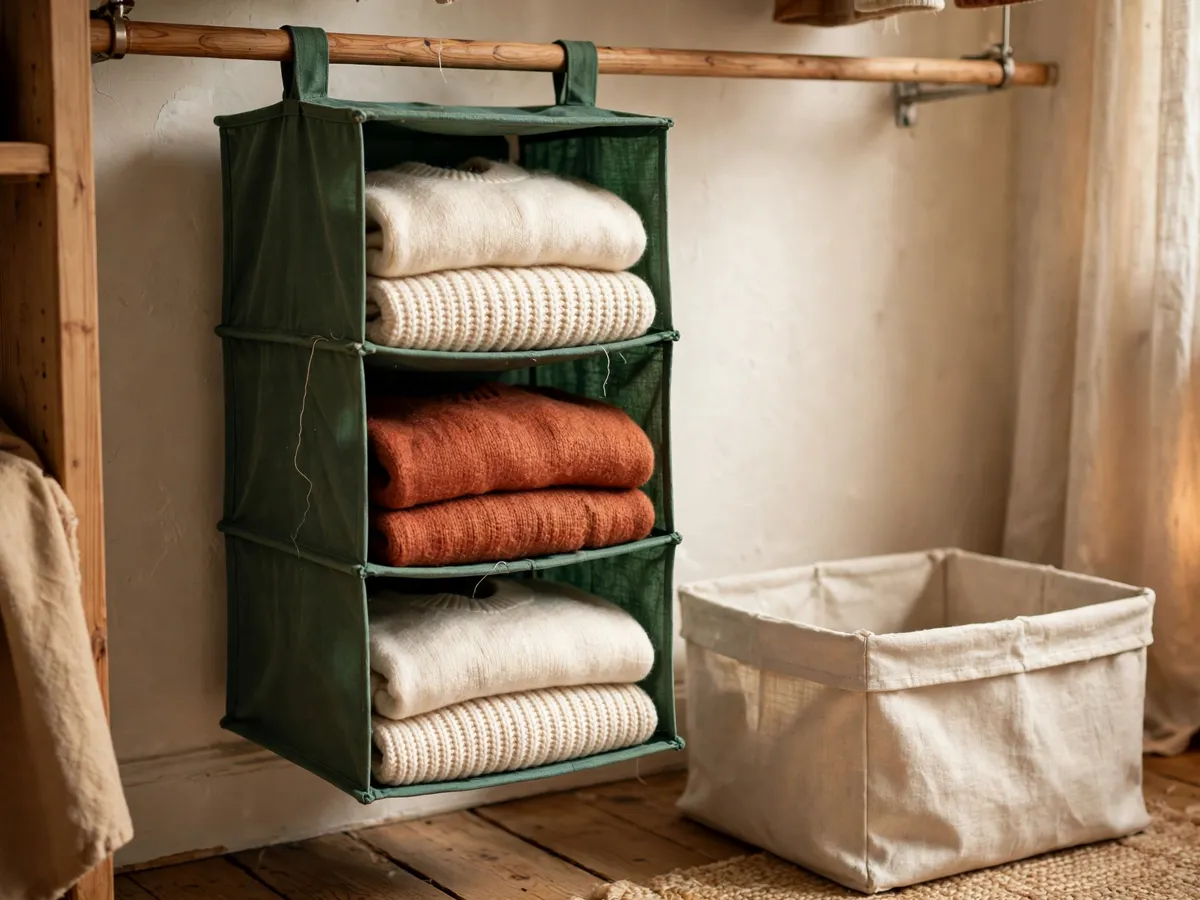
Cost: $15–$35 for one organizer and two baskets. Time: 30 minutes. Hung low, loaded light, nothing drilled.
11. Bins and Labels: What Belongs Behind the Fold Wall
Bins are for the small knit-adjacent things, not for the sweaters themselves. Gloves, scarves, hats, socks and the odd cardigan with no shelf space go into a bin or a basket on the floor, because those items are small and seasonal, and they are the ones you will not miss when they are behind a fold. Sweaters stay in the open, where you can see the neck line.
Labels make a bin worth opening. A small label on the front face of each bin, reading winter gloves, scarves and hats, or linen and seasonal, saves you from pulling out three bins to find one thing. Write the label facing the room, not facing up, because you read them from a step away and not from above. Woven baskets look warmer than plastic ones and hide the small mess inside.
Cost: $10–$30 for two baskets and a label set. Time: 45 minutes. Small items behind the fold wall, sweaters in the open, labels facing the room.
12. Delicates: The Wool and Cashmere Shelf Rules
The finest knits get their own rules because they react faster than everything else. Cashmere and merino should never hang, because the weight of the garment pulls the shoulders of a fine knit downward over a season. They should not go in a vacuum bag either, since compressed fine fibres can come out flat. Fold them, store them loosely, and put them where you touch them least, which is the back of the top shelf rather than the bottom of a drawer.
Between wears, air them out for a few hours before they go back in the fold, because a knit that folds while damp picks up a smell that is hard to shift later. If a delicate sweater is the one you wear every week, keep it on the top shelf at the front, folded in thirds, where it takes one second to reach.
Cost: $0–$12 for acid-free tissue or a cedar block. Time: 20 minutes. No hanger, no vacuum bag, back of the top shelf, aired out before folding.
13. The 10-Minute Weekly Reset: Keeping the Top Pile Honest
The reset is short enough that you will actually do it. Put a basket or a hook by the closet door and every worn sweater goes there, not back on the pile. On Sunday, or Monday morning, you take the basket, fold each sweater in thirds, and return it to the front of the top shelf. Most weeks that is three or four sweaters, and it takes ten minutes with a stacker.
Add three checks to the same ten minutes. Make sure the front row is still in front, since a heavy sweater at the back can slide forward over a week. Make sure no stack has crept past six. And make sure the neck lines are still visible, because a sweater folded the wrong way disappears into the pile even at a good stack height.
Cost: $0–$5 for a laundry basket by the door. Time: 10 minutes a week. Worn to a basket, folded in thirds, back to the front row.
14. Common Mistakes: The Wire Hanger, the Overfull Stack, the Plastic Bin Left in Sun
Three mistakes cause most of the sweater closet damage. The wire hanger is the first, and it is the easiest to fix: swap it for a wide hanger that supports the full shoulder line, and the pointed shoulders slow down or stop. The overfull stack is the second, and section 4 already covers it, six items maximum, because a stack of ten hides its bottom layer and crushes it at the same time.
The plastic bin left in the sun is the third, and it is the one people do not expect. A clear bin on a sunny windowsill or an unshaded top shelf fades the color of the knit over one summer, and the heat inside the closed bin is far warmer than the shelf. Move seasonal bins away from glass and out of direct afternoon light. If the closet has no shaded shelf, an opaque basket or a lidded bin on the floor is a better home than a sunny shelf.
Cost: $0–$20 for a few wide hangers. Time: 45 minutes for the full rescue. Wide hangers, six per stack, bins away from the sun.
15. Cost Reality: $5–$70 All-In
The whole system lands in three bands, and none of them is a renovation.
- $5–$15, the starter band: two or three wide padded hangers for the heavy knits, a roll of labels or sticky notes for the bins, and a tape measure for the shelf height. Most of the improvement comes from the sorting and the fold geometry, so this band already changes how the closet feels.
- $15–$35, the working band: adds a hanging organizer for a closet with no shelf, two woven baskets for gloves and scarves, a drawer divider, and a small set of sealed bags for the seasonal swap. This is where the closet starts looking intentional instead of merely tidy.
- $35–$70, the settle band: a set of drawer organizers, more sealed bins and pillowcases, extra hangers in two sizes, a stacker for the folding table, and a cedar block set for the off-season bins. Worth it when you keep sweaters for years.
The honest line: the free parts matter most. Sorting by wear frequency, folding in thirds, and keeping six per stack cost nothing, and they decide whether you can find the green sweater on a cold Tuesday.
Cost: $5–$70 all-in. Time: 120 minutes. Sort first, buy second.
Common questions
Should sweaters be folded or hung in a closet?
It depends on the knit, not on a rule. Heavy chunky cardigans and ribbed crews hang well on a wide padded hanger, where the shoulder line is supported. Fine knits, hooded styles and anything with a delicate neck should be folded, because a hanger slowly pulls the shoulders down. Most closets need both.
How do I stop sweaters from stretching out?
Take them off the hanger first. Thin wire hangers are the usual reason, because the weight of the sweater pulls on two narrow points instead of the whole shoulder line. Swap to a wide hanger for anything heavy, fold the fine knits, and give the folded ones a rest in a drawer or on a shelf rather than on a rod.
How tall should a stack of folded sweaters be?
Six is the practical limit, and your shelf may hold fewer. Measure the usable shelf height and one folded sweater, count with a finger of air between them, and stay at that number. The reason is visibility as much as weight: past six, the bottom sweater cannot be seen, so it stops being part of your rotation.
Can I store sweaters in vacuum bags?
For most knits, no. A vacuum bag pulls the air out and the loft of a sweater does not always return, so the garment comes out flatter than you want. Store sweaters folded in a breathable bin or a cotton pillowcase, and use sealed bags for cotton and synthetic layers instead. Where a sealed bag is used, the seal is what matters, for the simple reason that a closed bag is a physical barrier.
Where do I put sweaters if my closet has no shelves?
A hanging organizer that drops over the closet rod gives you cubbies without drilling anything. Hang it low so it stays in reach, load the lower cubbies with the lightest knits, and use two baskets on the floor for the heavier pieces and for the gloves and scarves that belong behind the fold wall.
Save these on Pinterest
Pin the third-fold rule, the six-per-stack math, the front-row shelf trick, the July closet swap and the three-piece renter route. This guide and the rest of the organization and storage collection live together there, from the front row of the top shelf to the July swap that empties the closet down to what you wear now.