 Plant As Deco
Small Room Decor
Hallway Wall Decor Ideas for Long, Narrow Walls
By Plant As Deco · Updated 16 November 2026
A hallway wall decor plan stands on five numbers: hang the centre of every frame 57 to 60 inches off the floor, choose one of three ways to run frames down a long wall, keep anything that pokes out under two inches when the hall is narrow, give the end wall the mirror-or-art job before anything else, and light it all without wiring. This page holds those numbers for renters with a long blank corridor, a short dark one, or a dead-end wall staring back at them. The floor and the drop zone are a separate job — linked once below.
Weekend-ready: $40–$220, one afternoon. Renter-safe, no studs needed, nothing wider than two inches off the wall.
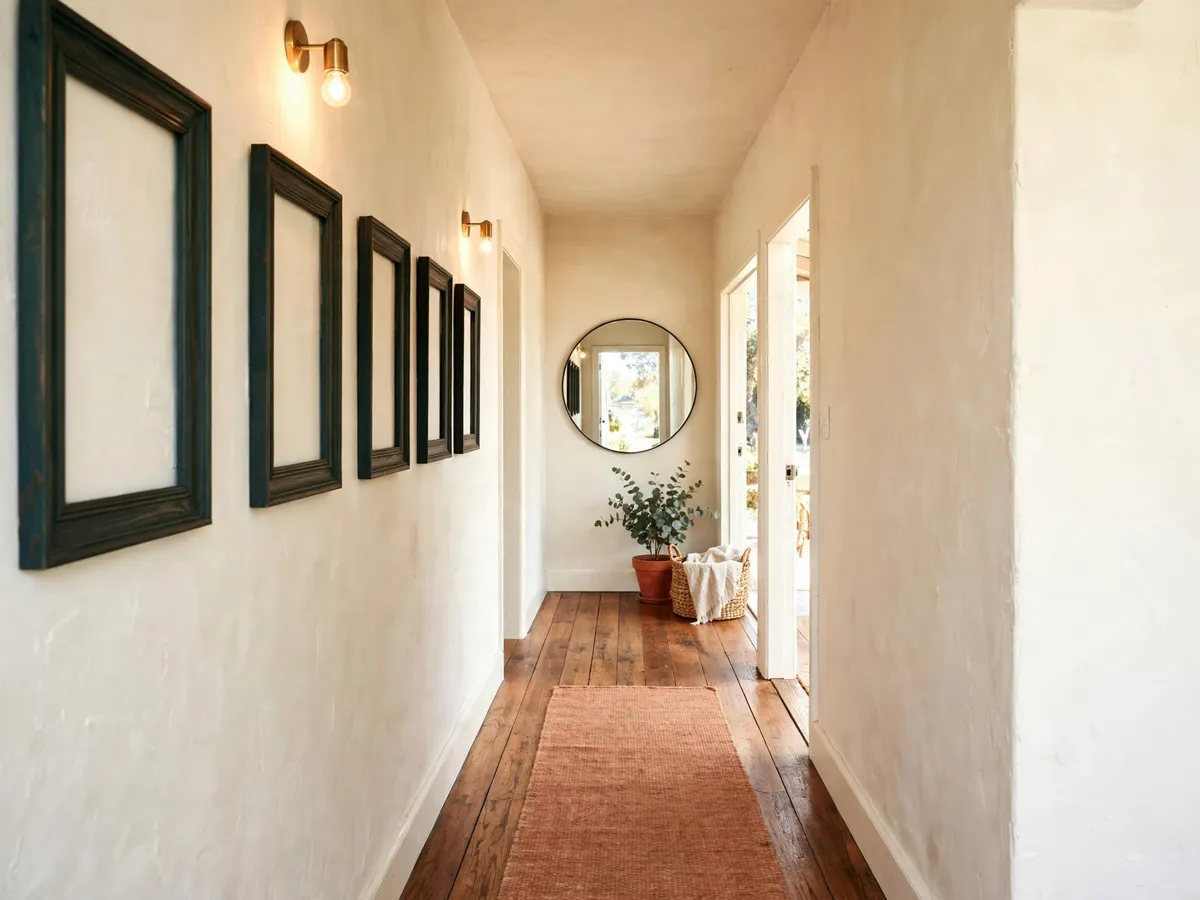
1. Hang at eye level, even in a hallway
The rule gallery staff use works in a corridor: the centre of the picture — not the nail, not the top of the frame — sits 57 to 60 inches off the floor. That band is where the average eye rests standing, and hall art gets read standing, in motion, from farther away than lounge art. Pick one number in that band and hold it for every frame in the hall. Measure to the centre, mark, then measure from the mark up to the hanging hardware, and pull the nail down by that distance. Most frames then land with their wire stretched by a thumb-width — that is the sign the centre is right.
Ceiling height changes the frame shape you choose, not the height you hang it. A hallway with a low ceiling reads taller with vertical frames — a 2:3 shape like a 12x18 or 16x24, hung on the same 57 to 60 inch centre line, pulls the eye up and down the wall. A hallway with a high ceiling can take horizontal frames or a wide pair, because the wall has room and the eye is not being pushed anywhere. The one placement that hurts both: hugging the ceiling to "fill the wall" — a row of frames near the ceiling line reads as storage, not decor, and nobody looks up while walking.
Two situations bend the line, and only these. Frames going up a staircase rise with the steps — keep the same 57 to 60 inch centre, stepped up in line with the pitch, so the line moves at roughly six inches of rise per step of travel. And frames hung above a slim console or picture ledge can sit 3 to 4 inches over its top; the piece and the surface below read as one unit. The bare-line numbers, plus how furniture and stairs bend them, are worked through in the picture-hanging heights guide.
Cost: $0–$25 for a tape measure, a pencil and a hanging kit. Time: 15 minutes to mark the first line before anything goes up. The one thing to skip is the old "57 inches is a gallery-only rule" doubt — a hallway is the room that reads it best.
2. Three ways to run frames down a long wall
A long hallway wall does not want art sprinkled down its whole length — it wants one clear line for the eye to travel. There are three layouts that work, and the honest way to pick between them is how much maintenance you want and how many holes your lease can carry.
- The single run. One row of identical frames spaced 2 to 3 inches apart, centred on the 57 to 60 inch line, running as far as your frames reach — five to eight frames is the usual count for a standard corridor stretch. Matching frames and matching mat widths are what make it read as one gesture; one odd frame breaks the line and the eye stops there every time. This is the calmest layout and the fastest to hang: measure the total run on the floor, find the centre of the wall, work outward.
- The dense gallery. Five to seven frames — two sizes, one frame color — grouped onto one stretch of wall roughly three to four feet wide, everything else left bare. The contrast between the busy block and the empty wall does the work a full-length scatter never does. Layout is planned flat on the floor first, photographed, then taped to the wall in outline before the first nail; the floor-plan step is the one people skip and the one that saves the wall. The small-space gallery wall guide walks that sequence frame by frame.
- One mirror, one art piece. A mirror near the bright end or the doorway, one large frame near the far end, and the middle of the wall left plain. This is the layout for a hall you pass through dozens of times a day — two objects, zero clutter, and the mirror keeps the corridor feeling open. It also survives a move to the next apartment with nothing to re-plan.
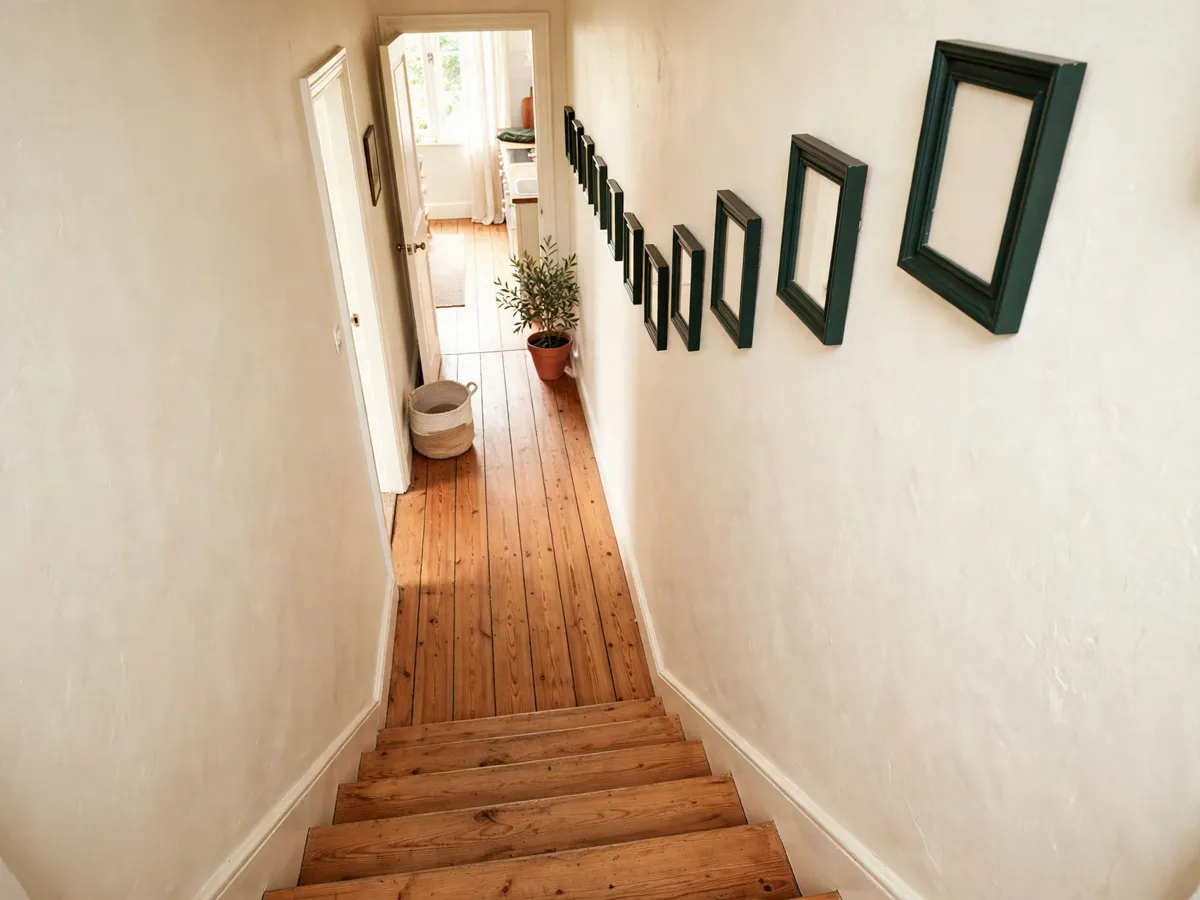
The maintenance angle decides it when you like both looks. Single runs and galleries both need dusting, straightening and eventual re-taping; a renter who wants none of that takes the mirror-plus-art route. And if the lease forbids a gallery's worth of holes, the same dense layout compresses onto one wall-anchored board: a peel-and-stick picture rail or a wall-anchored wood board carries five to seven frames with two anchor points instead of seven holes, and the whole board comes off at move-out. The strip ratings and the board route are detailed in the no-drill wall decor guide.
Cost: $60–$180 for the frames themselves, whatever layout you pick. Time: 45 to 90 minutes including the floor layout. A run of mismatched frames read at walking speed as a fence, not a gallery.
3. Keep depth under two inches
Measure the hallway at its narrowest point, not at the doorways, because that pinch is the width you actually live with. Under 36 inches changes what belongs on the wall: nothing in the walking zone should stick out more than 2 inches from the wall surface. Every inch a frame protrudes is an inch the hallway loses, and a row of 2-inch-deep box frames down a 33-inch hall reads as a corridor that has grown furniture. Slim profiles — flat gallery-style frames, typically 0.75 to 1 inch deep — and a flat mirror face keep the wall plane quiet. Nothing to catch a shoulder, a bag strap or a laundry basket on the way past.
At 42 inches of clear width and up, the hall has room and the rule relaxes: deeper frames, a small floating shelf with a pair of objects, or a thin sconce with a shade all fit without making the space read pinched. Between 36 and 42 inches, stay slim but do not panic about it — the 2-inch guide still holds, but one deeper piece on the end wall is fine, because the end wall is approached head-on, not side-swiped.
Two corollaries finish the depth check. Canvas boards and fabric hangings run under an inch and are the natural narrow-hall art. And whatever you hang, set the bottom edge at least 8 inches above the floor — a frame that hangs low enough to catch a vacuum or a passing boot ends up crooked within a week no matter how well it was hung. The whole scope of this page is the walls: runner rugs, the drop-zone table and where the hall lamp sits belong to the hallway overview guide, which treats the floor and the furniture half of the same corridor.
Cost: $0 to measure; slim 0.75–1 inch frames run $10–$18 each. Time: 5 minutes with a tape measure at the narrowest point. Depth is the mistake nobody photographs — it just reads as a hallway you brace your elbow in.
4. Dress the end wall first
Every hallway terminates somewhere, and that end wall is the sightline the whole corridor aims at — from the front door, from the living room, from the bedroom. It is the highest-value square feet of wall in the home, so decide it before the side walls, not after. Two options work, and one decision rules them: does the hall need more light, or a destination?
The mirror. Choose it when the hallway is dark or short. A mirror at least 24 inches wide, centred on the 57 to 60 inch line, set flat to the wall, bounces whatever light enters the corridor and reads as depth — the hall appears to continue past the wall. Place it to catch something worth reflecting: the doorway to a bright room, a window at an angle. A mirror that reflects the water heater closet is a mirror wasted. Keep it flat or framed flat — a thick bevelled frame on the end wall of a 34-inch hall breaks the depth rule from the last section.
The bold art piece. Choose it when the hall has light and needs a reason to walk down it. One frame at least 30 inches wide — a single large print, not a small frame the corridor shrinks — centred on the same line. Bold here means a clear composition that reads from fifteen feet away: one strong shape or one strong contrast, not a detail piece. The end wall is the one place in a hallway a large piece is safe to hang head-on even in a narrow corridor, because nothing passes it side-on.
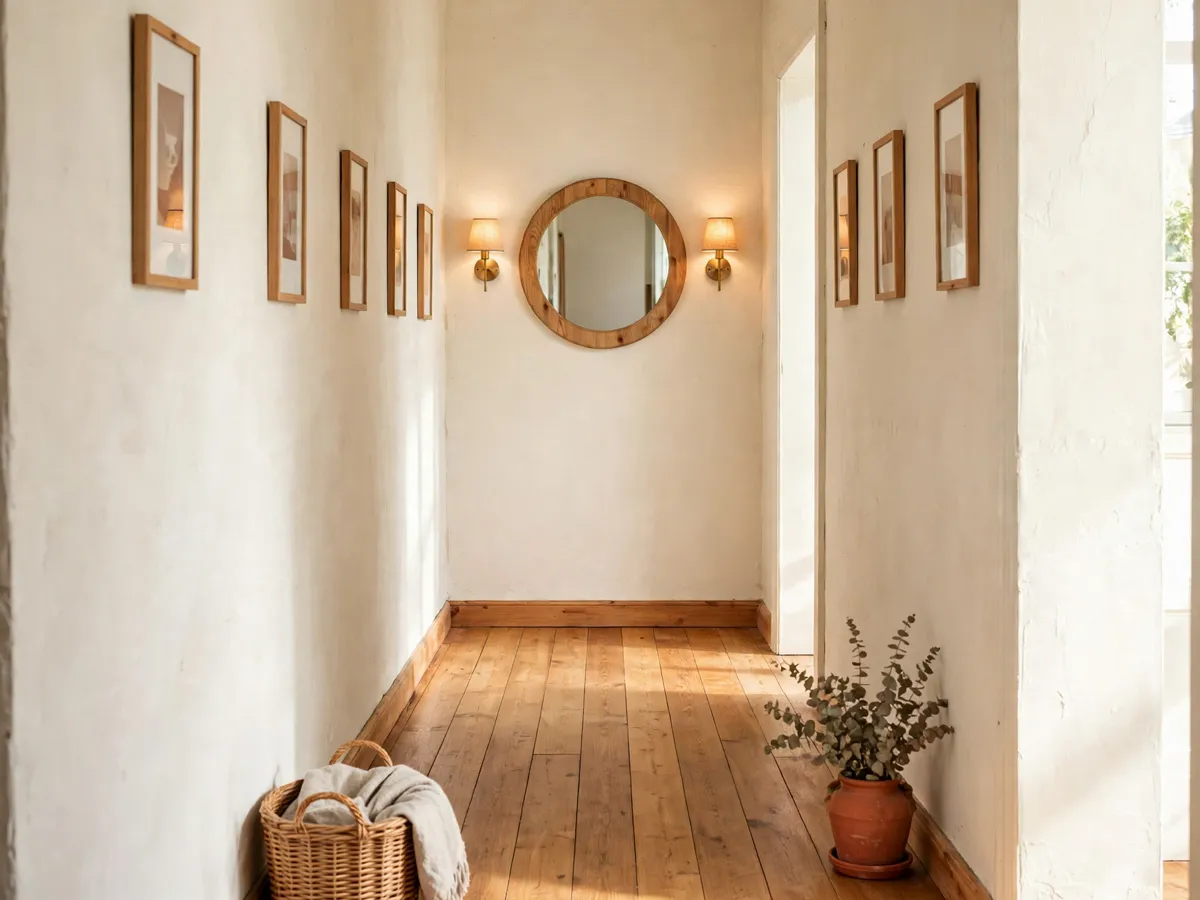
What does not belong on an end wall: a television (it turns a corridor into a waiting room and blocks the sightline), and anything hung directly facing an interior door at eye height — swinging doors and frames at 57 inches meet exactly where the hinge stops. If the hallway ends at a bedroom or bathroom door rather than a wall, pull the focal piece to the last side wall before the door and let the door itself terminate the corridor.
Cost: $40–$140 for a 24–30 inch round mirror or a large framed print. Time: 30 minutes to centre, level and hang. A small frame on a big end wall is the single most common hallway mistake — the corridor eats it.
5. Light the wall without wiring
A hallway with no ceiling fixture — or one sad bulb over the middle — makes every wall decision above look flat at night. Two lights fix that with no drilling, no electrician and no holes:
- Rechargeable picture lights clip onto the top edge of a frame or mount with a small adhesive plate behind it, and wash the art downward — a run of five frames with two picture lights over the second and fourth is enough to make the whole run glow. Recharge on an every-few-week rhythm; keep two in rotation so one is always charged.
- Battery sconces mount with a strong adhesive plate or a screw into one anchor point, and hold 60 to 64 inches off the floor — a touch above the art centre line, so the cone falls on frames, not above them. In a hall with no ceiling light at all, a pair at the one-third and two-thirds marks does the corridor's whole night job.
Placement follows a three-beat rhythm, not even spacing. For a long hall, place the first light a few feet in from the doorway, the second roughly the middle third, the third just before the end wall — three pools of warm light, with dim crossings between, read far cosier than a strip of glare running the ceiling. The bulb tone carries the mood: 2700K warm white is the one to buy; anything cooler reads institutional in a corridor at night. Timers or dusk sensors on the battery lights save the ritual of tapping each one on.
All of this stays plug-and-stick — the rechargeable lights exist precisely so a renter never wires a corridor. If the hall does have a ceiling fixture, one warm bulb swap there is still the cheapest single change on this page, and the layering on top of it is what makes the walls look intentional after dark.
Cost: $25–$75 per battery sconce, $20–$45 per rechargeable picture light. Time: 20 minutes to place three lights and level them. Cheap cells dim in weeks — spend the extra few dollars on lights with a dusk sensor.
What we would skip
Skip sprinkling frames the full length of both walls — a corridor with art on every foot reads as a fence, not a gallery, and doubles the holes for no gain. Skip deep box frames and chunky ledges in any hall under 36 inches; the depth reads before the art does. Skip the television on the end wall, and anything at eye height directly in a door swing. Skip symmetrically-spaced ceiling-adjacent rows hung high to "fill" the wall — nobody walks a corridor looking up. And skip mirrors opposite each other on facing side walls: the infinite bounce is disorienting in a narrow space, where one mirror, placed to catch real light, does all the same work with none of the funhouse.
Cost: $0 to skip. Time: two minutes of reading that saves a hallway from the seven-hole mistake and the TV-in-a-corridor regret.
The before-you-hang checklist
- Hallway measured at its narrowest point — under 36 inches means nothing deeper than 2 inches off the wall
- One number picked in the 57–60 inch centre band, written on the tape measure case, used for every frame
- Layout chosen by maintenance: single run, dense gallery, or mirror-plus-art
- Renters: dense gallery planned on a wall-anchored board or peel-and-stick rail instead of seven separate holes
- Frame shape matched to ceiling — vertical 2:3 under a low ceiling, horizontal allowed where the wall is tall
- End wall decided before the side walls: mirror at least 24 inches wide, or one bold piece at least 30 inches wide
- No frame bottom lower than 8 inches off the floor; nothing at eye height in a door swing
- Three warm lights placed on the three-beat rhythm — doorway, middle third, end wall — all battery or rechargeable
Cost: $0 to check. Time: 10 minutes with this list and a tape measure before a single frame comes out of the closet.
Common questions
How high should hallway wall decor hang?
Centre every frame 57 to 60 inches off the floor — the same band the eye rests at standing — and hold that one number for the whole hall. Frames going up a staircase keep the same centre and step up with the stairs, and pieces above a console sit 3 to 4 inches over its top.
How do you decorate a very long hallway wall?
Pick one of three runs: a single row of matching frames spaced 2 to 3 inches apart on the centre line, a dense gallery of five to seven frames on one three-to-four-foot stretch with the rest of the wall bare, or one mirror near the light and one large frame near the far end. Spreading frames the full length of both walls is the one layout to avoid.
What should go on the wall at the end of a hallway?
A mirror at least 24 inches wide if the hall is dark or short — it bounces light and reads as depth — or one bold art piece at least 30 inches wide if the hall has light and needs a destination. Centre either on the 57–60 inch line, and keep a television off that wall.
Can you hang wall decor in a hallway under 36 inches wide?
Yes, with flat pieces only: keep everything under 2 inches of depth off the wall, use slim 0.75 to 1 inch frames and a flat mirror, and set the bottom edge at least 8 inches above the floor. Halls of 42 inches or more can take deeper frames and a thin sconce or shelf.
Save these on Pinterest
Pin the numbers that hold a hallway wall together — the 57–60 inch centre line, the three frame runs, the two-inch depth rule, the end wall decision — so the next free afternoon starts with a tape measure instead of a scroll. The walls-only plan here pairs with the floor-and-furniture half in the hallway overview guide, and both live in the small room decor collection.