 Plant As Deco
Small Room Decor
Holiday Decor Without a Fireplace: Five Focal Points That Work
By Plant As Deco · Updated 16 November 2026
Almost every holiday photo is built around a mantel — the garland, the candles, the stockings, all hanging off one shelf. If your living room has no fireplace, that photo is useless to you, and copying it piece by piece leaves the room looking scattered. This page replaces the mantel with a focal point you already own: a window, a console, the TV wall, a bookshelf or the entry table. Pick one, size the garland with real measurements, hang everything with removable hooks and hold the season to three colors — no drill, no fake mantel, no new furniture unless you want it.
Weekend-ready: $25–$150, one afternoon. One focal point, a garland and battery lights — renter-safe, nothing drilled, nothing built.
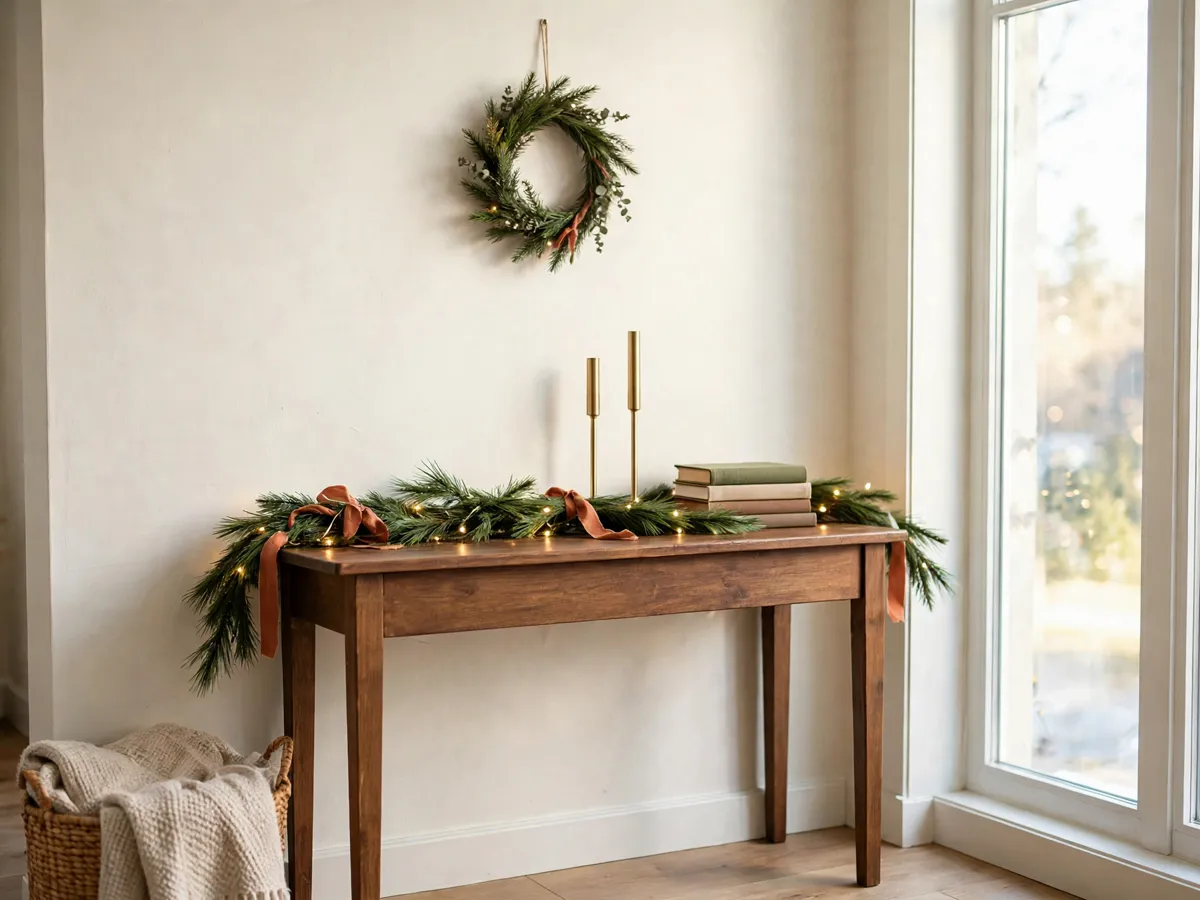
1. Pick your focal point first
The mistake most no-fireplace rooms make is scattering. A wreath here, a strand of lights there, a few figurines on the coffee table — each piece is fine, and together the room reads as decorated everywhere and centered nowhere. A mantel works because it is one stage the whole room faces. Without one, you have to choose the stage on purpose, and everything you buy flows from that single choice: the garland length, the number of hooks, the one run of lights. Choose before you shop, not after.
One of these five spots will carry your whole season, and each has its own section below:
- The window — the room's existing focal point; the garland frames daylight instead of firelight (section two)
- A console or buffet — a 30–32 inch table dressed like a mantel (section three)
- The TV wall — greenery hanging down from above the screen, never wrapped around it (section four)
- The bookshelf — a garland running along its shelf edges in one continuous curve (section five)
- The entry table — the same mantel treatment in the hallway, plus a wreath
The entry table is the quiet winner when your front door opens straight into the living space: it is the first surface anyone meets, so it does mantel duty without competing with the TV or the window. A 30-inch table against the entry wall takes the three layers from section three, a wreath hangs above it, and the drop zone keeps working — the bowl for keys and mail stays at one end, because a holiday table that pushes the keys onto the floor is a nuisance for five weeks.
Two rules carry over from the small-space holiday plan: if the main sightline runs past a door frame, a garland draped over that frame is the cheapest focal point of all — and the season holds to three colors, a cream base, pine green and one warm accent, so the room reads composed instead of busy.
And if the wall you already love is a wall of frames, use it: run one garland along the top edge of the frames and let the art carry the rest of the season — the spacing and layout rules live in the gallery wall guide.
Cost: $0. Time: 15 minutes. Pick the spot you actually see from the couch — a wreath on a door nobody faces decorates a door nobody sees.
2. The window garland, sized right
Measure before anything else, and measure the frame, not the glass — the garland hangs from the frame's top corners, so the frame's outside width is the number that matters. The working rule is one and a half times: a garland needs 1.5× the width of the frame to drape with any presence at all. A 6-foot window frame takes a 9-foot garland. A garland cut to the exact frame width pulls taut like a clothesline; one and a half times is what lets it swag, and the swag is the whole look.
Hang it from the top corners on two removable adhesive hooks and let the garland drop to one third of the frame's height, measured from the top edge down. A third is the sweet spot: enough drop that the window reads framed for the season, not so much that the greenery sits over the glass where the daylight comes through. Below the bottom of the swag, the window stays exactly as it was. Weight the two tails with a short ribbon tie or a single ornament each, so the ends keep their hang instead of sliding along the cord.
The hooks are the renter-safe part of the plan. Two adhesive hooks rated around 3 lb each carry a real 9-foot pine garland — press each onto clean, dry paint for the full thirty seconds the package specifies and wait an hour before loading it; lights and ribbon ask almost nothing of a hook. Removal is the stretch-release tab pulled straight down, slowly, never snapped.
Real pine against faux is the one honest trade-off here, and heat decides it. Warm air rises, so a garland hung at the top of a window sits in the warmest air in the room — and a heating vent under or beside the window doubles it. Real garland near that much heat dries out, drops needles and wants a mist every few days. Faux garland holds its color all season, packs flat into one box in January and asks nothing in between. If the window runs cold, real pine is worth it for the smell; if a vent sits below, buy faux.
Cost: $25–$55 — a 9-foot garland at $20–$45 plus an $8–$12 pack of rated hooks. Time: 30–40 minutes with a step stool. A garland cannot be stretched: a frame measured wrong means a garland bought wrong.
3. A console that reads like a mantel
A console table is the cheapest real mantel substitute there is, and the size is not negotiable: 30–32 inches tall, 12–16 inches deep. That height puts the decorated surface at the level the eye lands on when standing; that depth holds a layered display without eating the walking lane behind it. Anything taller competes with art, anything deeper is a desk, and anything shallower cannot carry three layers. If you do not own one, a secondhand console in that range runs $25–$60 and works all year, which is more than a fake fireplace can say.
Place it against the wall the sofa faces, or the wall you see first from the doorway — the same wall a mantel would occupy. Above it, lean one mirror or framed print instead of hanging anything: leaning is renter-safe by definition, and a leaning frame gives the console the vertical headroom a mantel gets from its chimney breast.
The display itself is three height tiers, back to front. Tier one, the garland lying loose along the back edge of the tabletop — not wrapped around anything; its job is the green line the eye follows. Tier two, a strand of battery micro-lights woven through that garland, warm white, on a timer. Tier three, two or three tall objects standing at the back: candlesticks, a vase of dried branches, a stack of two books with one small object on top. Then the part everyone skips — leave 8 inches of bare table at each end. That clear space is what lets the eye rest, and it is the difference between a console that reads styled and one that reads covered.
Stockings need a ledge, and the console has one. Loop a ribbon from each stocking's hanging loop over the front edge of the tabletop, or set two small removable hooks on the wall just below the top — one per stocking, so the weight sits on the table edge and the hooks only keep them from swinging. A 4-foot console holds about four; the overflow goes on the bookshelf in section five.
An entry table takes the identical treatment: same three tiers, same 8 inches of clear space at the ends, a wreath above instead of the leaning mirror. Which table shape suits which hallway — depth for the walking lane, length for the wall — the console table guide walks through with measurements.
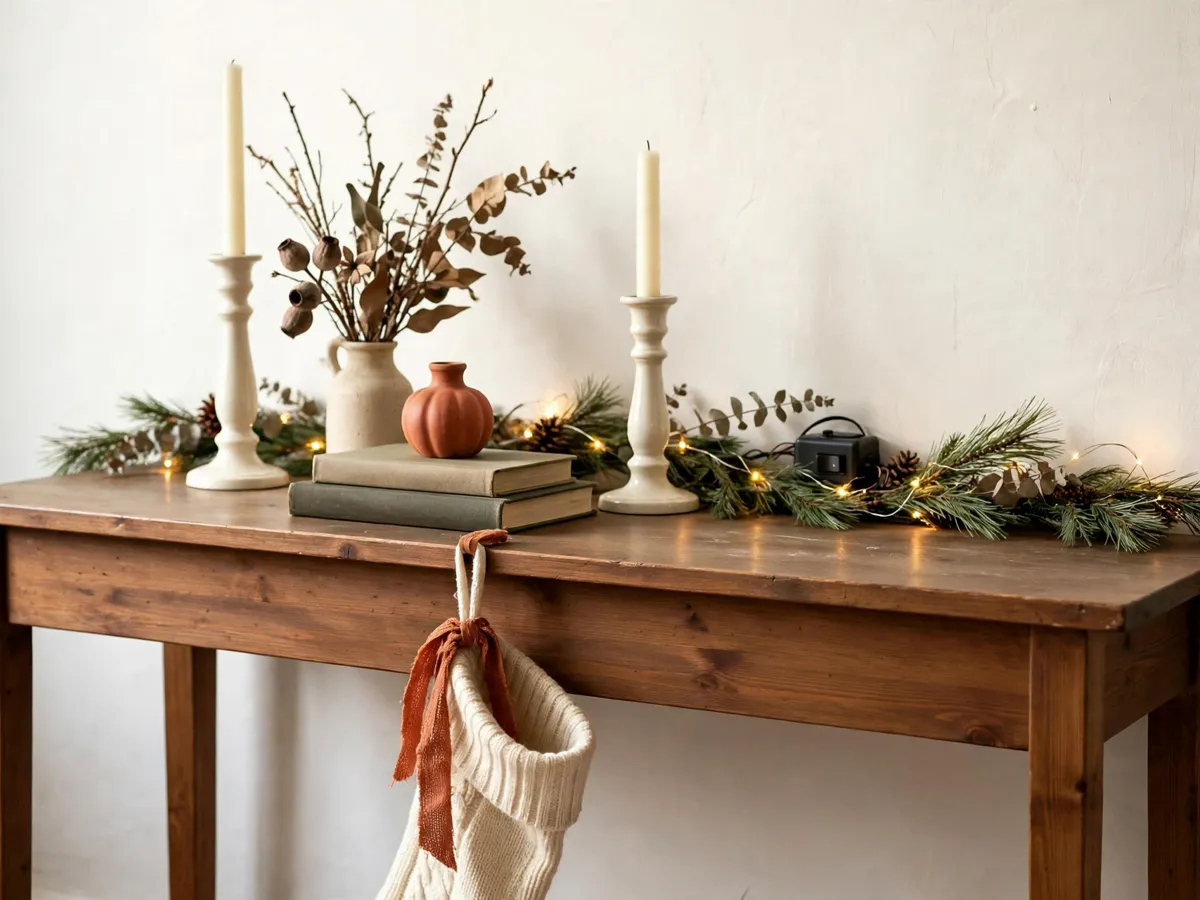
Cost: $30–$90 with a thrifted console at the top end; $25–$45 if the table is already yours. Time: 45 minutes. Fill the table end to end and the room reads cluttered, not festive — the empty 8 inches are doing work.
4. The TV wall that doesn't fight the screen
The internet's favorite version of this — garland wrapped around the TV like a wreath around a picture — is the one to refuse. Wrapped greenery frames a big black rectangle, crowds the screen's edge, sits over vents and cables, and turns the room's most changeable object into a fixed decoration. The trick runs the opposite direction: the greenery hangs down from above the TV, along its top edge, falling a little way down each side.
Set two removable hooks on the wall 6 inches above the TV's top corners and drape the garland between them, tails hanging down the sides of the screen — the screen stays completely clear, and the wall above it, usually empty anyway, becomes the decorated band. If a full garland is too much for the room, eucalyptus stems tied in twos hang the same way with a softer line. Nothing, ever, attaches to the TV itself — the wall carries every ounce.
Here is the part that makes this a focal point instead of decor built around one: a switched-off TV is a large quiet dark field, and a dark field does for twinkle lights what a night sky does for stars. At night, with the garland lights on and the lamps low, the dark screen is the backdrop your lights sit against — it does the job a mantel gives its row of candles. When the TV is on, the screen supplies all the brightness itself, and the garland above is genuinely all the room needs — movie night decorates itself.
Lights in this garland should be battery micro-lights on a timer, like every other strand in the plan: the TV wall rarely has a spare outlet at garland height, and a wire running down the wall to a power strip is the one thing that makes the treatment look installed rather than decorated.
Cost: $25–$50 for garland or eucalyptus plus hooks. Time: 20 minutes. If the TV lives on a media console with shelf space, dress that console with section three instead and leave the wall simple — one green band per room.
5. The bookshelf you already own
A bookcase is a ready-made holiday scaffold: horizontal ledges at hand height, a frame to wrap, and a footprint you have already paid for. The move is running one garland along the front edge of the shelves in a continuous S-curve — it follows the front lip of the top shelf, drops down the side panel, runs the front lip of the next shelf and so on toward the floor. The math is the same one and a half times thinking from section two, run vertically: a 3-shelf case takes one 9-foot garland, a full 5-shelf case takes two.
Attachment needs no wall at all, which makes this the most deposit-proof treatment on the page: loop the garland around the case's side panels at each shelf, or set small removable hooks on the underside front edge of a shelf where nothing touches them. The bookshelf is furniture — nothing in this section ever touches drywall.
The styling rule that separates a good bookcase from a store display: no two adjacent shelves get the same treatment. Decorate the top shelf with the garland and lights, leave the next shelf books only, give the third a couple of objects and a short pine pick, let the fourth be plain again. The alternation lets the eye travel down the case and read rhythm; decorate every shelf the same way and the whole thing turns into a wall of green that hides the books — the reason the bookcase existed in the first place.
Run one strand of battery micro-lights straight down a side panel, looped around each shelf end, rather than weaving through every shelf — the lights draw the case's outline instead of filling it. For how to style what sits on the shelves the rest of the year, the bookshelf guide covers spacing, leaning and what to leave empty.
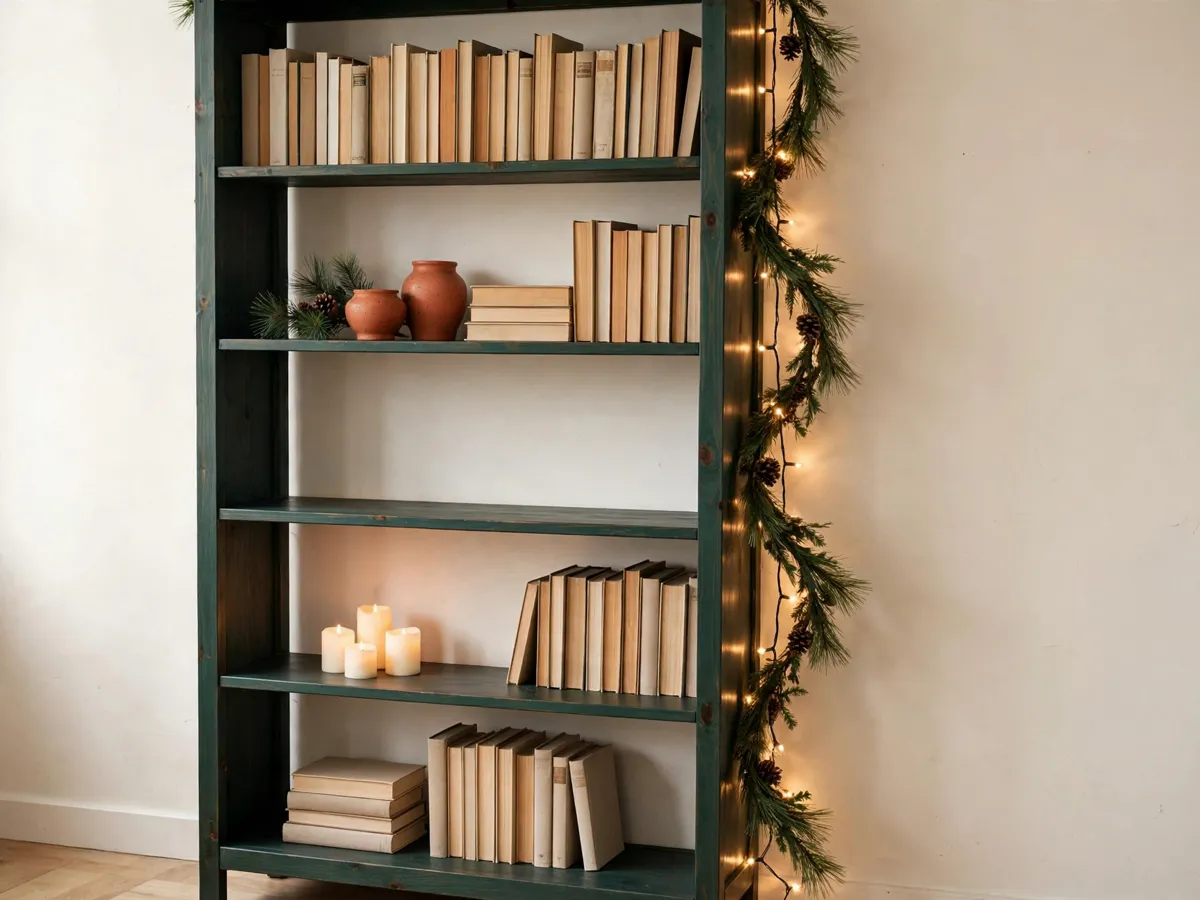
Cost: $20–$45 for one or two garlands and a strand of battery lights. Time: 40 minutes. If a shelf holds daily-use things — a speaker, a work laptop — that shelf stays plain and undraped.
What we would skip
Skip the fake fireplace. Freestanding mantel kits and faux-fireplace cabinets eat a wall of floor for five weeks, cost more than every option on this page combined, and read as stage props once the novelty wears off — a console from section three does the same job all year. Skip wrapping anything around the TV itself; the wall above it is the surface, not the screen. Skip hanging stockings from window glass — suction hooks hold wreaths, not weight. Skip real garland anywhere near a heating vent, where it dries out in days. And skip the scatter: five small placements with no center is the problem you started with, not a solution to it.
Cost: $0 to skip. Time: two minutes of reading that saves a wall, a screen and a deposit.
The before-you-buy checklist
- One focal point chosen from the five, and visible from the seat you use most
- Window frame measured at its outside width — garland length 1.5× that number, so 9 feet for a 6-foot frame
- Console measured: 30–32 inches tall, 12–16 inches deep, with 8 inches of clear tabletop kept at each end
- Hooks rated for the garland's weight — about 3 lb per hook — pressed 30 seconds, loaded after an hour
- Vents checked above and behind the chosen spot before buying real greenery
- Every light strand warm white, battery, on a timer
- Three colors named before shopping — cream base, pine green, one warm accent
- One storage box planned now, so the season packs away in January
Cost: $0 to check. Time: 10 minutes with a tape measure, before anything is ordered.
Common questions
How do you decorate for the holidays without a fireplace?
Pick one stand-in focal point and build the season on it: the window, a console, the TV wall, the bookshelf or the entry table. One garland, one run of lights and three colors centered on a single spot read more decorated than decor scattered across every surface — and nothing on the list needs a drill.
What size garland do I need for a window?
Measure the outside width of the window frame and multiply by one and a half — a 6-foot frame takes a 9-foot garland. Hang it from two removable hooks at the frame's top corners and let it drop a third of the frame's height, so the greenery frames the window without sitting over the glass.
Where do stockings hang if there is no mantel?
Off the console. A ribbon looped over the front edge of the tabletop carries each stocking, or two small removable hooks set on the wall just below the top keep them from swinging — a 4-foot console holds about four. The bookshelf front edge works the same way for the overflow.
Can I put holiday decor on the TV wall without drilling?
Yes — and nothing touches the TV. Two removable adhesive hooks on the wall above the screen's top corners carry a garland or eucalyptus that hangs down the sides; the screen stays clear and the wall carries the weight. The bookshelf route needs no wall at all.
Save these on Pinterest
Pin the one rule that carries the whole page — one focal point, sized and hung with the math behind it — so next season starts with a decision instead of a scattered room. The window math, the console layers and the bookshelf curve all survive a move to a new apartment, and the rest of our renter-friendly room ideas live in the small room decor collection.