 Plant As Deco
Gardening & Planting Tips
Indoor Plant Pests: How to Get Rid of Aphids, Gnats and Mites
By Plant As Deco · Updated 20 November 2026
You found the bugs on a Friday evening and the plant is still on the shelf. The order that works is short: identify the pest, knock the population down with physical steps, treat with something that handles that species, then give the plant weeks to recover. This guide covers the five pests behind most indoor infestations - aphids, gnats, mites, mealybugs and scale - what each one looks like, what handles it inside an apartment, and the point where replacing the plant costs less than saving it.
Weekend-ready: $5–$20, one afternoon plus two follow-ups over three weeks. Apartment-safe: every fix here runs indoors.
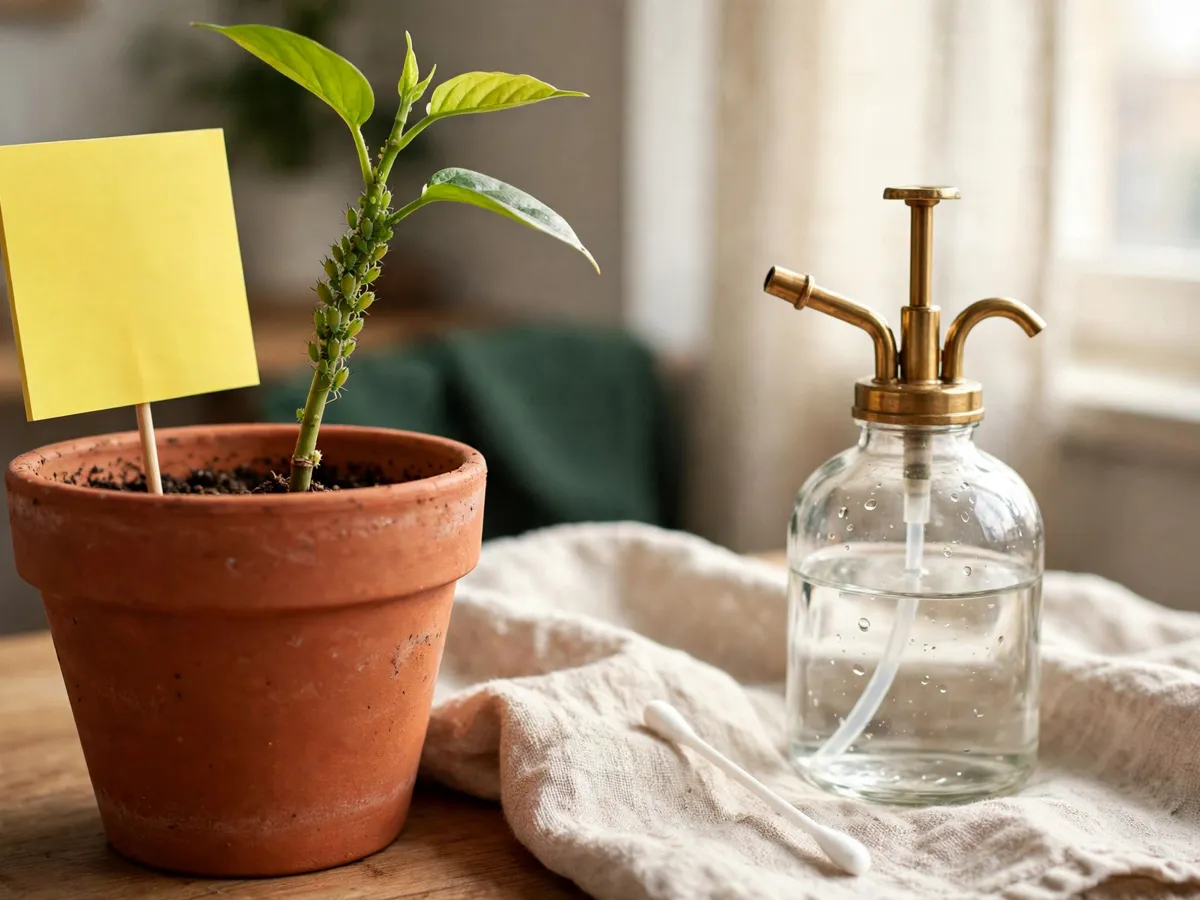
1. Identify the pest before you treat anything
The reflex is to grab the first bottle labelled for bugs and spray. That wastes a week and sometimes damages the plant, because each of the five responds to something different, and two of them live in the soil where nothing sprayed on leaves reaches them. Five minutes of identification decides which approach you pay for.
Inspecting properly takes a bright window and your phone camera. Zoom in and look at three places in order: the newest growth at the tips, the undersides of the middle leaves, and the surface of the soil. The spot is half the identification.
- Where are they? Clustered on soft new growth: aphids. Swarming over the soil when you walk past: gnats. Speckled across leaf undersides with fine webbing at the joints: mites. White fluff tucked into leaf joints: mealybugs. Fixed brown bumps along the stems: scale.
- Do they move? Tap the pot. Aphids and mites shift slowly, gnats fly, and adult mealybugs and scale barely move once they settle - which is why the stationary ones need a different attack.
- What damage is there? Sticky, glossy residue on leaves means sap-suckers above it. Pale pinprick speckling means mites. Curling, yellowed new growth means aphids. A plant dropping healthy leaves with nothing visible is usually a soil problem.
Sap-sucking insects excrete honeydew, and it coats the leaves below the colony until they look varnished. Wipe a leaf with a damp cloth and then inspect its underside, because the pest sits above the mess it drops. The weekly houseplant routine already includes a two-minute pest sweep; this article is what to do the week that sweep finds something.
2. The five pests that show up most indoors
Apartment infestations are not evenly distributed. These five account for nearly everything a grower meets indoors, and each has a signature that separates it from the others in seconds.
- Aphids. Soft, pear-shaped insects 1–3 mm, green, brown or black, packed along new growth and flower stems. They reproduce live young through the winter, so a colony on a warm sill climbs fast.
- Gnats (Bradysia spp.). Delicate black flies under 5 mm that hover over the soil and swarm when the mix is watered. The adults annoy; the pale larvae in the mix are the pest, eating fine roots in the top two inches.
- Mites. Tiny 1 mm arachnids that colonise leaf undersides in dry, warm air. Their tell is the leaf: hundreds of pale dots, then bronzing, then dropping.
- Mealybugs. Slow-moving insects covered in white, cottony wax, collecting in leaf joints, under foliage and along the soil line. They leave the same sticky honeydew aphids do, but in clumps instead of crowds.
- Scale. Brown or tan bumps 2–4 mm across, welded to stems and leaf veins. Soft scale excrete honeydew; armored scale do not. Neither walks away, so both are handled by hand before anything else.
Thrips turn up occasionally and behave like the five above, so the fixes overlap. Photograph anything else and compare before buying a treatment sized for the wrong pest.
3. Aphids on the new growth
Aphids are the easiest pest to confirm and the fastest to grow. They cluster where the plant is pushing soft new leaves, because that tissue is easy to pierce and the sap is thin. Look for tips curling inward, a shiny film on the youngest leaves, and a ring of pale shed skins at the growing point.
The damage pattern matters more than the count. Ten aphids on a tough mature leaf is a nuisance; ten on a new shoot is a season of stunted growth, because that shoot will never un-curl. Prune the worst-affected tips into the trash rather than the compost, and take no more than a third of the new growth at one sitting.
Aphids respond to physical force first. Carry the pot to the sink or shower and rinse with lukewarm water, turning it so the spray hits the undersides. A strong jet knocks down most of the colony and every nymph too small to see. Repeat every third day for two weeks: eggs and hidden nymphs hatch between rinses, so one wash is one generation, not the population.
If rinsing alone does not hold them, insecticidal soap at the label rate covers the undersides and works on contact rather than lingering in the plant. Neem at the label rate follows a week later. Both are cheap - a bottle runs $8–$15 and lasts a year across several plants. Damaged leaves do not recover their shape, but clean new growth after two weeks is the sign the colony broke.
4. Fungus gnats live in the soil
Gnats are the pest people mistake for a sick plant. The flies orbit the pot and dive when you water, and the assumption is that the foliage is failing. It is not. The adults live above the mix and the real damage is under it: larvae chew fine roots in the damp top layer, and on a small plant that shows up as wilting with the soil still wet.
The cause is almost always a soil surface that never dries. A peat-based mix kept damp, a saucer that stays full, or a pot with no drainage hole all create the same condition, and the algae and mould in that layer is what the larvae eat. Fix the moisture and the colony runs out of what it lives on, which makes gnats the one pest here where prevention is a watering habit rather than a product.
Start with the dry-down. Let the top two inches of soil go dry to the touch between waterings, and water from the bottom for a few cycles so the surface stays crumbly. Yellow sticky traps at soil level catch the adults and, more usefully, tell you the trend: ten flies on Monday and two on Friday is a collapsing population. Traps monitor the problem; they do not solve it.
For the larvae, two options are proven. A top dressing of coarse sand or horticultural grit blocks females from laying. A product based on Bacillus thuringiensis israelensis, applied as a drench at the label rate, reaches the larvae in the mix. A diluted hydrogen peroxide drench works too, but the dry-down plus grit costs less and takes four days. Expect firm new growth three to six weeks after the flies stop.
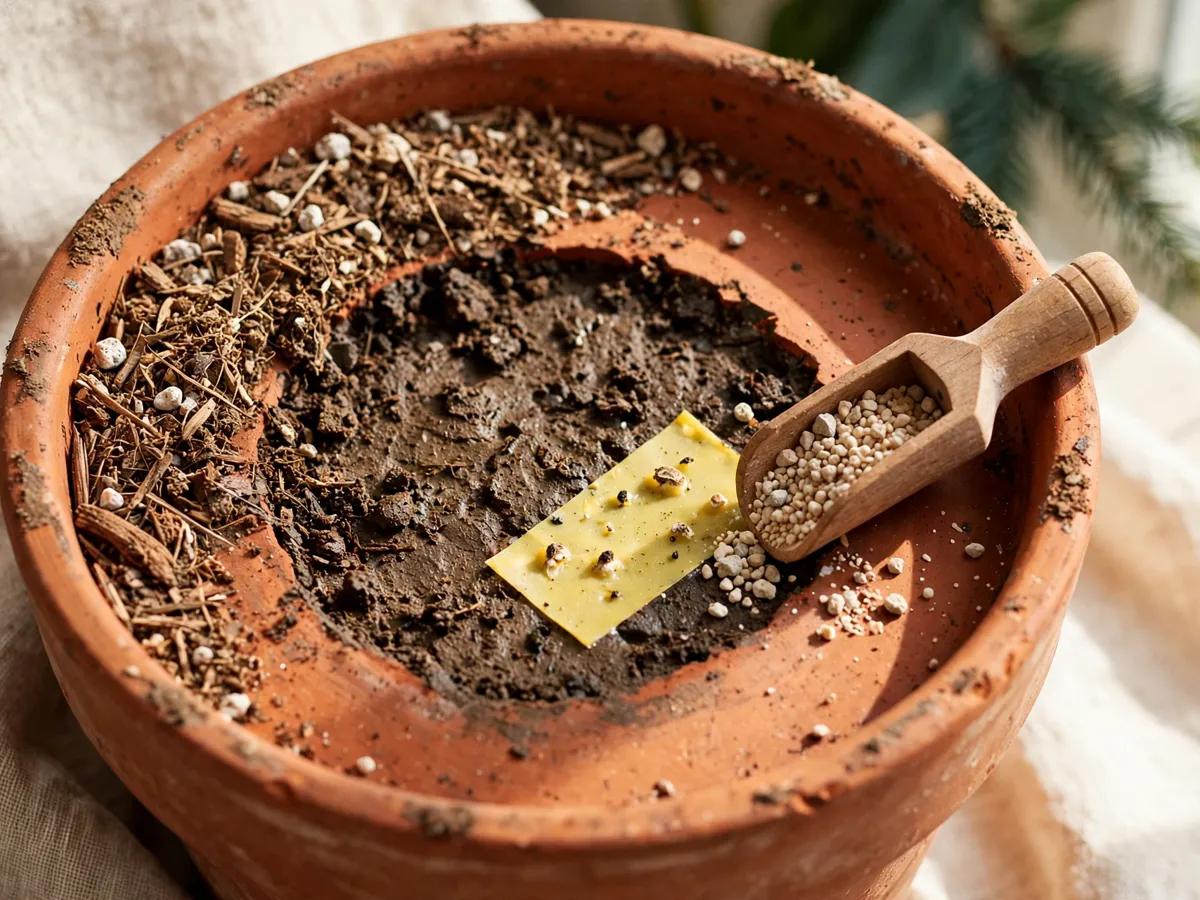
Cost: $0 for the dry-down, $6–$10 for traps. Time: ten minutes to set up, two weeks to watch the count fall.
5. Spider mites need dry air
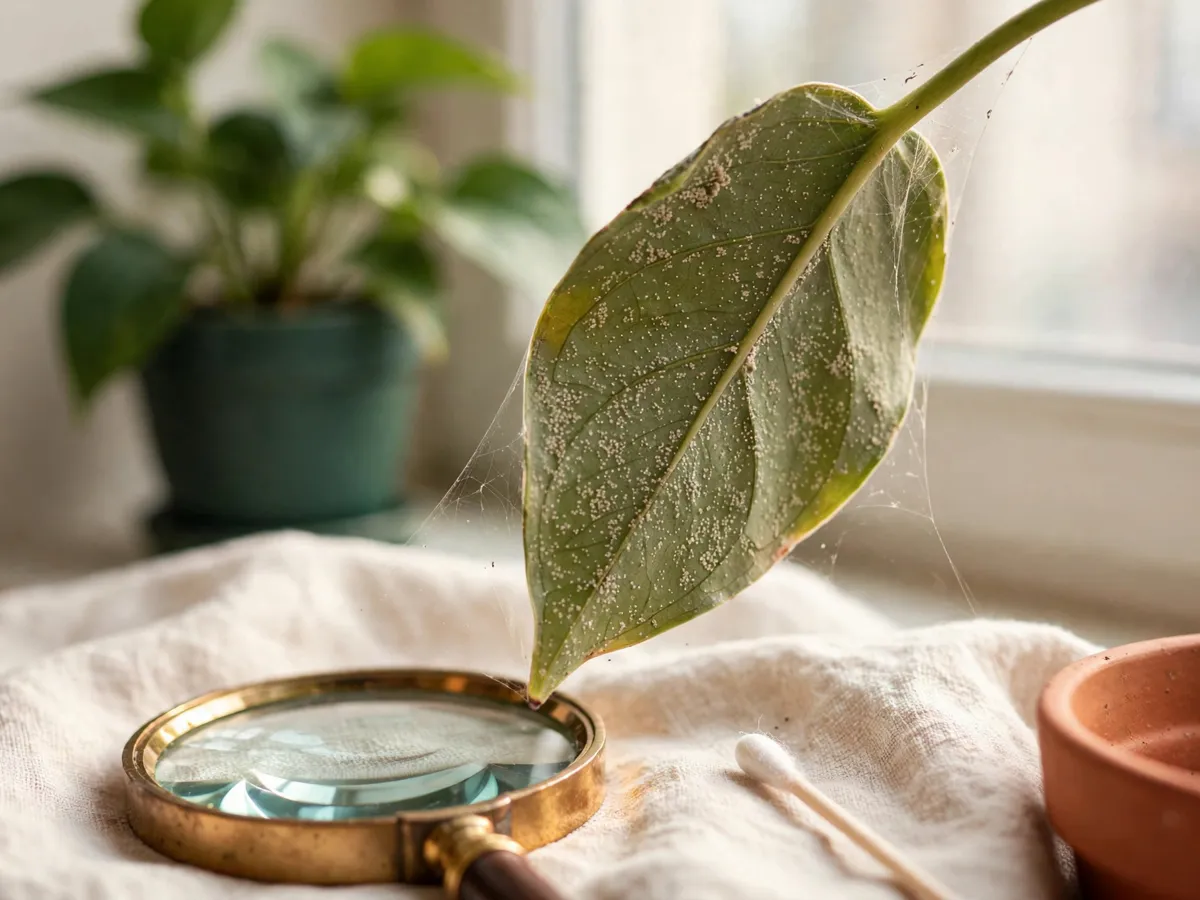
The spider mite (Tetranychus urticae) is an arachnid, not an insect, and it thrives where heated apartment air is driest - along radiators, behind curtains, on the shelf that never gets a humidifier in winter. Mites pierce individual leaf cells and drink their contents, so the first tell is the leaf: a scatter of pale pinpricks that later bronze over, starting at the bottom and climbing.
Confirm them with the paper test. Hold a sheet of white printer paper under a leaf and tap the stem sharply. Specks that fall, then crawl across the paper under a magnifier, are mites. By the time webbing shows at the leaf joints the colony is large; webbing is a late signal.
Treatment runs on a clock, because a spray reaches hatched mites and not the eggs. Rinse the whole plant in the shower, then treat with insecticidal soap at the label rate every five to seven days for a minimum of three passes. That interval is the point: eggs hatch inside the gap, so one spray does nothing lasting. Horticultural oil at the label rate is the second pass for heavier colonies, applied in the morning so leaves dry before the light gets strong.
Then change the air, because mites return to the driest plant first. Raise the humidity around the shelf and pull the pot back from the radiator; the winter houseplant care guide covers the dry-air side. A heavily damaged plant can shed most of its lower foliage and still recover from the crown, provided the mites are gone. New leaves that come in solid green are the proof.
6. Mealybugs and scale: the stationary ones
Mealybugs and scale are the two pests you deal with by hand, because both wear armour that water and sprays slide off. Mealybugs secrete a white, fluffy wax that sheds liquid, and they hide where a leaf meets the stem and along the soil line. Scale cement themselves to stems and veins and grow a hard shell over the body. Neither runs.
Start with a cotton swab dipped in rubbing alcohol and dab each visible insect directly. The alcohol breaks the wax on a mealybug and softens a scale shell on contact, and the swab lifts it off. For scale, loosen the bump with a fingernail after dabbing, then wipe the area clean. Do this over the sink and bin what comes off.
One pass never clears them, because the ones you cannot see are the ones that matter. Mealybugs hide in crevices a swab never reaches, and scale lay eggs under their own shell while the young are mobile. Repeat the dabbing every week for three or four weeks, and follow each round with insecticidal soap at the label rate on the joints and stems. Neem at the label rate is the third layer: it does not reach adults, but it disrupts the nymphs and slows the next generation.
Honeydew is the running score. While leaves stay glossy and sticky, the colony is still at work. When the wipe comes up clean for two consecutive weeks, it is broken. Scale damage to a stem heals slowly and mealybug damage to soft growth often does not, but a plant with a woody stem can carry scarred leaves for a year and still push clean shoots.
7. The order to try things in
Every pest in this guide gets the same ladder, bottom rung first. Physical steps cost almost nothing and remove most of the population; products handle what is left; the strongest chemistry is a last resort.
- Isolate the plant. Move it away from the rest of the shelf before you do anything else. Every one of these pests travels on hands, towels and air.
- Identify it. Section one, five minutes. The species decides which rung below is the real treatment.
- Physical removal. Shower rinse, pruned tips, swab and dab. That is most of the population gone before you spend a dollar.
- Traps and monitoring. Sticky traps for flying adults and for counting. You cannot tell if treatment worked without a number to watch.
- Contact treatment. Insecticidal soap or horticultural oil at the label rate, three passes five to seven days apart. Never one pass.
- Neem as the follow-up. A growth-disrupting layer for stubborn colonies, after the soap rounds.
- Fix the soil and the watering. For gnats this is rung one. For everything else it removes the stress that let the colony start.
- Systemic product, last. A systemic insecticide at the label rate is the final option for scale and mealybugs on a plant worth the spend, and only after the rungs above failed twice.
The mistake that burns money is starting at rung five. A bottle buys you one generation; the ladder buys you the cycle. Treat on a schedule, inspect weekly, and stop when the count holds at zero for two consecutive weeks rather than when the bottle is empty. The cheapest step in this guide is prevention: a weekly two-minute check catches a colony before it needs any rung above three.
8. Sticky traps, a shower rinse and isolation
These three physical steps do most of the work in a mild infestation.
Sticky traps. Yellow cards catch gnats, whiteflies and the mobile young of scale; the stake version stands above the canopy and the short version lies on the soil. A trap is a counter first and a control second. Replace it when the surface is covered, roughly every one to two weeks, and log the count so you see the trend rather than the day. A pack of twenty-five costs $6–$10.
The shower rinse. Lukewarm water, low pressure, the pot held so the mix does not flood. Support the stem with one hand and let the spray run over the undersides for thirty to sixty seconds per section. Rinse three days apart for three rounds on aphids and mites, then dry the plant with airflow rather than leaving water sitting on foliage.
Isolation. A treated plant stays off the shared shelf until it is clear. The spare bedroom, the laundry room, or a bathroom with the door shut all work - anywhere you can keep it for two to three weeks after the last live pest, where the light still suits it. If it sits on a plant stand with neighbours, the whole stand moves with it. Do not set it on the floor beside the others "just for now".
Wash your hands and wipe the sink after handling a pest plant, and never dry a plant with a towel you reuse on the others. Isolation is the cheapest step in this guide and the one that protects the rest of the shelf while the treatment runs its weeks.
9. Changing the soil and the watering
Soil is where infestations restart. Old mix holds water longer than it did when fresh, the surface stays damp, and the next colony starts in the same conditions as the last. For gnats, changing the soil surface is the treatment; for everything else, it is the prevention that keeps a pest from coming back.
The light version: scrape off the top inch of mix, replace it with fresh dry mix, and add a half-inch dressing of coarse sand or grit so the surface stays dry between waterings. Ten minutes, under five dollars for a bag. The heavy version: unpot the plant, rinse the roots under the tap, and repot into fresh mix in a pot you have scrubbed with hot soapy water. That is the move for a soil colony that survived two rounds. The repotting one size up guide covers the mechanics; do it in the growing season so the plant recovers fast.
Watering is the half people skip. Saturate thoroughly, then let the top layer dry before adding more, empty the saucer ten minutes after every watering, and check with a finger rather than a calendar. A mix that dries on a cycle starves the larvae and strengthens the roots. A mix that stays wet invites root rot on top of whatever pest brought you here.
Perlite in the top layer keeps the surface loose and dry-looking, which discourages laying. And pause plant food while you treat: a stressed plant does not need extra salts, and the nutrient guide covers when to restart once the plant is clear.
10. When a plant is not worth saving
Some plants are cheaper to replace, and pretending otherwise costs you six weeks and the shelf beside it. Do the arithmetic honestly: a $12 pothos versus a $15 replacement plus four rounds of treatment and the isolation space. A $60 specimen with five years on it is worth the fight. A rooted cutting that keeps losing ground after two ladder cycles is not.
Walk away when three things are true at once. Most of the foliage is already damaged - bronzed, curled or dropped. The colony is at the crown or through the roots, where nothing reaches it. And the pest spreads fast to neighbours, like mites on a crowded shelf.
Dispose of it cleanly. Tip the whole rootball and mix into a bag, tie it, and put it in the trash, not the garden bed, where the pests finish their cycle. Inspect every plant that shared the spot, since the ones that looked fine may carry eggs. Wash the pot in hot soapy water and let it dry in the sun before reuse.
There is no failure in this. A plant that cost twelve dollars and gave you a season is a fair trade, and the budget you did not spend on it buys the next one a cleaner start. What matters is that the pest left with the plant, not with the shelf.
11. What it costs and how long it takes
The honest bill for one plant, one infestation, start to clear.
- Rubbing alcohol and cotton swabs: $1–$3, and a bottle lasts every future mealybug and scale fight you have.
- Yellow sticky traps: $6–$10 per pack of 25, enough for a full cycle on three or four plants.
- Insecticidal soap: $8–$15 per bottle at the label rate, roughly a year of supply.
- Neem oil: $10–$18, the follow-up layer, and one bottle covers a season of preventive sprays.
- Horticultural oil: $9–$14, only worth buying for a heavy mite or scale colony.
- Fresh mix and a grit dressing: $5–$12 if the soil needs changing.
A first attempt - physical steps, traps, alcohol, one soap bottle - costs most readers under $20, and the bulk of it is reusable equipment rather than a one-off. Time is the bigger spend: twenty to thirty minutes per session, four to six sessions, spread over three to five weeks. The cycle does not compress; the five-to-seven day gap between passes is the life cycle of the pest, not a suggestion.
Recovery runs behind the treatment. A plant that is clear of pests still carries damaged leaves for months, so expect four to eight weeks between the last live insect and a plant that looks fine. Judge recovery by the newest leaves rather than the ones you started with.
Cost: $5–$20 for a first cycle, under $35 for the full kit. Time: one afternoon, then twenty minutes every week for a month.
Common questions
How do I know the treatment actually worked?
Count, do not feel. A sticky trap that drops from a dozen flies to two, a wipe that comes up clean of honeydew, and new growth with no speckling are the three signals. Judge the trend across two consecutive weeks, because one good day inside a life cycle means nothing.
Do these pests spread from one plant to another?
Yes, and quickly. Aphids and mites move on hands, cloths and air; gnats fly the few feet between pots; scale young crawl on contact when leaves touch. Inspect every plant that shared the shelf on the day you find the first colony, then weekly for three weeks.
Are these pests harmful to cats and dogs?
None of the five is commonly listed as toxic to pets, and they are a nuisance rather than a threat to animals. The products are the caution: keep cats and dogs away from foliage that is wet with soap, neem or oil until it has dried, and store every bottle out of reach. If a dog chews a treated plant, ask a veterinarian before assuming it is harmless.
Can I use dish soap instead of insecticidal soap?
A drop of detergent in water is a weaker version of the same idea, and it is easy to overshoot the concentration and strip the leaf's coating. A product labelled as insecticidal soap is priced so that guessing is unnecessary: use it at the label rate. The difference in cost is a few dollars, and the difference in damage risk is a whole plant.
Why do the gnats come back every time I water?
Because the surface never dried. Eggs and larvae live in the top two inches of mix, and a watering habit that keeps that layer damp sustains them through generation after generation. The dry-down plus a grit dressing solves it in about ten days; if it does not, replace the top layer of soil and check the saucer.
Should I cut off leaves that have bugs on them?
On soft new growth, yes - prune the worst-affected tips into the trash and take no more than a third of the plant at one sitting. On a mature leaf, dab the pest off and keep the leaf, since it is still doing work. For a succulent, wipe rather than cut, because wounds on those take a long time to close.
How long before the plant looks healthy again?
The pests go in three to five weeks; the leaves take longer. Bronzed and curled foliage does not repair, so recovery means new growth arriving clean, which shows in four to eight weeks in the growing season. Photograph the plant the day you finish treating and compare a month later.
Save these on Pinterest
Pin the identification list and the eight-rung ladder - those are the two pages you will want open on a Friday night with a sick plant in your hands. They sit with the rest of the gardening tips collection.