 Plant As Deco
Gardening & Planting Tips
Large Indoor Plants: Floor Space, Light Reach and Weight
By Plant As Deco · Updated 20 November 2026
A large indoor plant is the only home upgrade that takes space back. It fills a bare corner, it reaches the ceiling, and it changes how the room reads - but it also claims a footprint you were saving for a chair. This guide is about the arithmetic of that trade: how many feet of floor a tall plant really needs, how far light travels from a window before a big plant stops growing, what a 30-inch pot weighs when it is full, and how one person moves it without wrecking the floor. Every number here is a dimension you can measure this afternoon with a tape.
Weekend-ready: $40–$250 per plant, one afternoon to place and pot it. Rent-friendly: nothing here needs a drill, and every setup lifts out the door when you move.
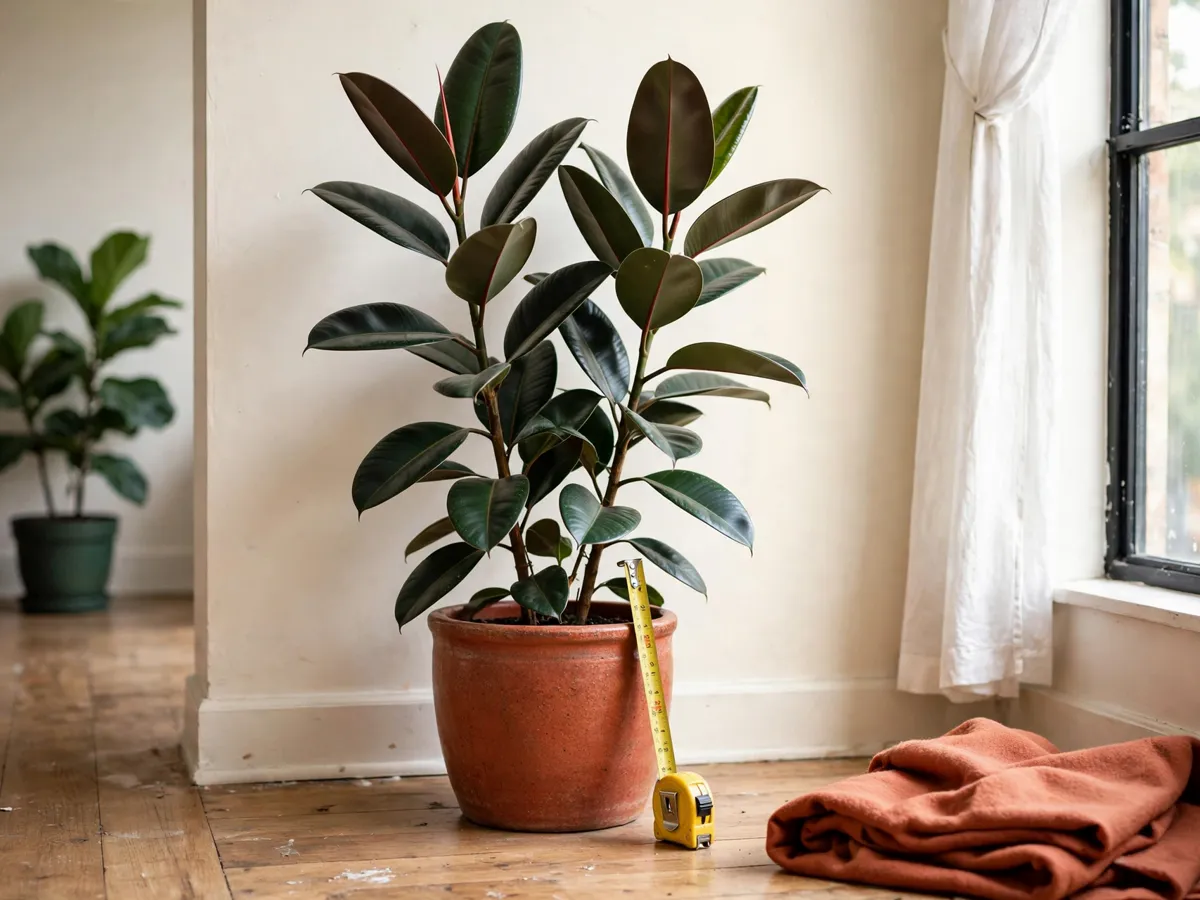
1. What counts as a large plant
Nurseries call anything in a 10-inch pot a "floor plant," which is how people end up with something small standing where a tall one was promised. The honest line is height measured from the floor, not the pot label. A plant that finishes under 30 inches is a tabletop plant. From 30 to 48 inches it is a medium plant that sits on a stand. Anything that tops out above 4 feet is large.
Height is only half the size. Spread - the diameter of the canopy seen from above - is what eats the floor. A 5-foot plant with a 20-inch spread occupies a circle you can walk around. A 5-foot plant with a 36-inch spread blocks the path to the window and knocks the chair back two feet. Measure both before you buy, and measure the mature number, not the one on the tag.
- Small: under 30 inches tall, 12-inch spread, 6-to-8-inch pot. Weighs 5 to 10 pounds soaked.
- Medium: 30 to 48 inches tall, 18-to-24-inch spread, 10-to-14-inch pot. Weighs 15 to 30 pounds soaked.
- Large: 4 to 6 feet tall, 24-to-32-inch spread, 14-to-18-inch pot. Weighs 35 to 70 pounds soaked.
- Extra-large: 6 feet and up, 32-inch spread or more, 18-to-24-inch pot. Weighs 70 to 150 pounds soaked - a two-person lift when you vacuum under it.
The category you pick decides the pot, the caddy, the light requirement and the cost. A medium plant in a bright bedroom is a $60 decision; an extra-large one is a $250 decision plus a floor plan.
Cost: $0 to sort your target. Time: five minutes with a tape and a pencil.
2. Measure the floor footprint first
Work out the footprint before you look at a single species. The footprint is the pot diameter plus the overhang of the lowest leaves plus a service gap. A 20-inch pot under a plant whose lowest leaves reach out 8 inches claims a 36-inch circle, and you cannot squeeze a 30-inch basket into the remaining 6 inches. Tape that circle on the floor with painter's tape and live with it for a day before you buy.
Three clearances matter more than the pot size itself:
- Walkway: leave 30 to 36 inches between the footprint and any path you cross daily. Under 24 inches, you will start routing around the plant and it becomes the problem it came to solve.
- Swing: add the arc of every door that opens near it - 30 inches for an interior door, 36 for an entry. A plant standing in that arc takes a bump every time the door opens, and it sheds where it gets knocked.
- Radiator and vent: keep the pot at least 12 inches from a heating unit. A tall plant beside a radiator dries out at the leaf edges within one season.
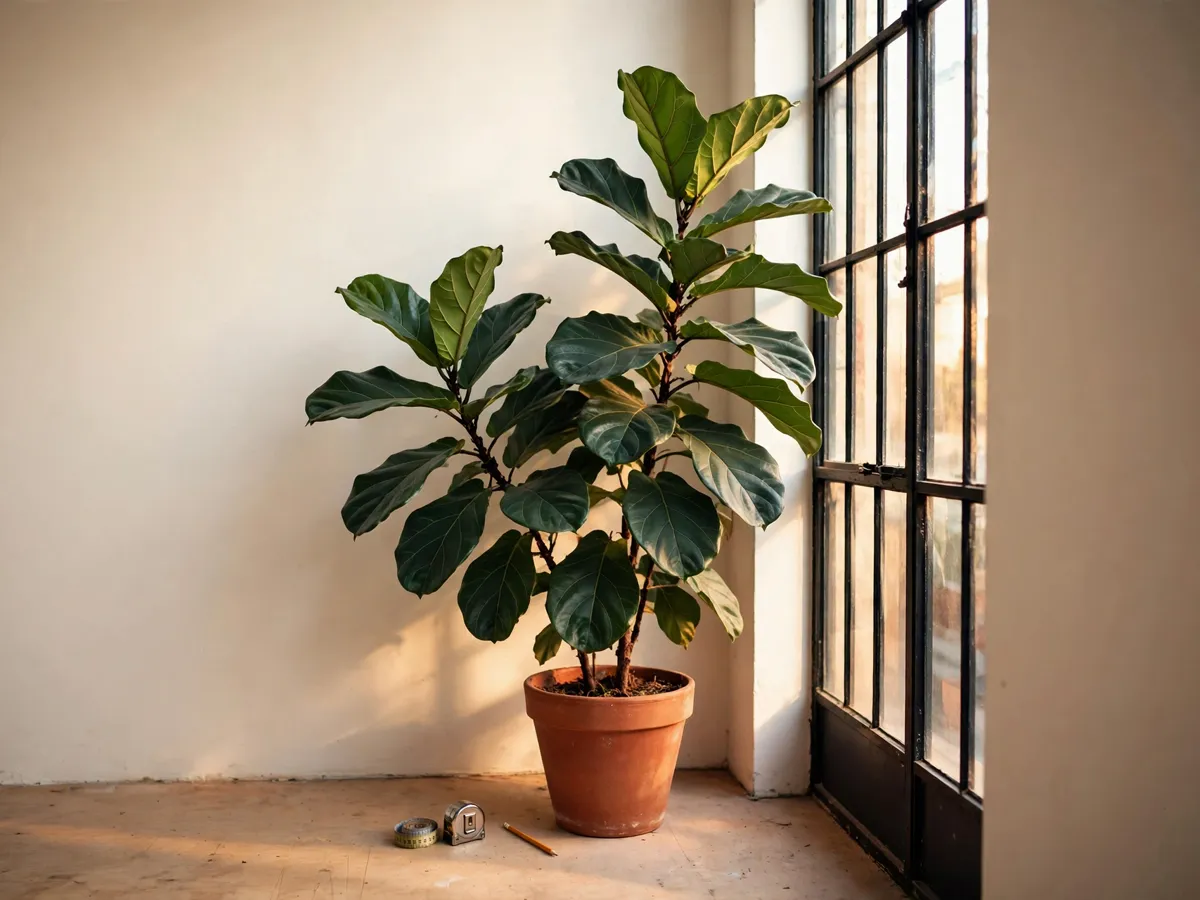
Then look up. A 6-foot plant in a room with an 8-foot ceiling leaves 2 feet of gap, which is enough for air movement and enough for you to prune without a step stool. In a 7-foot apartment with a sprinkler head or a light fixture over the corner, the same plant presses against the hardware and grows lopsided around it. Ceiling height is a real limit, and it is the one nobody measures.
Cost: $4 for painter's tape. Time: 20 minutes to tape the circle and one day of walking around it.
3. Light reach at windows and ceilings
Light fades with distance from the glass, and the fade is steeper than most rooms expect. A south window delivers bright light across roughly a 10-foot band in summer and 6 to 7 feet in winter. An east or west window holds it for about 5 feet. A north window gives steady but modest light that reaches 3 feet and then drops below what even forgiving species can use.
Height cuts the budget further. Every foot a plant grows, its lowest leaves sit deeper in shadow because the canopy above them blocks the window line. A 6-foot plant beside a window gets usable light on its top third and dim light at the base, which is why big plants drop their lowest leaves first. The fix is rotation: a quarter turn whenever the stem leans toward the glass.
- Under 4 feet from a south or west window: nearly any large species grows well - rubber plant, fiddle leaf fig, bird of paradise.
- 4 to 6 feet back from an east window: the tough generalists still grow - rubber plant, dracaena, parlor palm.
- Beyond 6 feet from any window: the corner needs supplemental lighting or a smaller plant. Do not spend $180 on a specimen for a spot the sun never reaches.
If the corner fails the distance test, the grow light guide prices out a supplemental setup, and the shade-tolerant list covers the species that shrug at a dim room. Everything on this page assumes the light is already there. No pot size fixes a dark corner.
Cost: $0 to measure the distance. Time: ten minutes at noon with a tape and the window open.
4. The plants that actually get big indoors
Five species reliably deliver height inside a normal apartment. Each entry gives the mature dimensions, the footprint it claims, and the light it needs to hold that size.
- Rubber plant (Ficus elastica). The most forgiving tall plant indoors. Reaches 6 to 8 feet with a 24-to-30-inch spread; in a 14-inch pot it weighs 40 to 50 pounds soaked. Takes bright light down to medium, and the glossy leaves wipe clean with a damp cloth.
- Fiddle leaf fig. The one everybody photographs. Grows to 6 to 10 feet indoors with a 30-inch spread, and a 17-inch pot, soaked, runs 60 to 80 pounds. It wants its bright light steady; one move across the room costs a month of adjustment and dropped leaves.
- Dracaena (marginata or fragrans). The budget workhorse. 5 to 7 feet with a narrow 20-inch spread, about 40 pounds soaked in a 14-inch pot. Tolerates medium light and forgives a missed week; the cane trunk keeps the footprint slim.
- Bird of paradise (Strelitzia nicolai). The largest on the list. 7 to 8 feet indoors with paddle leaves a full 2 feet wide, so the footprint runs 36 inches across. An 18-inch pot, soaked, weighs 70 to 90 pounds. It wants a south or west window within 6 feet.
- Parlor palm (Chamaedorea elegans). The safe pick for a dimmer corner. Tops out at 4 to 6 feet with a 24-to-30-inch feathered spread. A 12-inch pot weighs 20 to 25 pounds soaked - the lightest large option, and the easiest for one person to reposition.
For a plant that stands where you set it, the five above are the honest short list. The tropical houseplants guide adds the smaller varieties that suit a desk or a shelf instead, and the forgiving list covers the tough ones for dimmer corners. Care lives on those pages; this one is only about size.
Cost: $40–$250 per plant depending on size. Time: one hour to compare the five against your corner.
5. Pot size and the root ball
The pot you buy the plant in is rarely the pot it lives in. A 6-foot specimen from the nursery arrives in a 12-inch plastic grower, and the instinct is to drop it straight into a 22-inch decorative planter. That is the mistake that kills big plants: the root ball occupies the middle third of the larger pot, and the rest holds more moisture than the roots can drink. Go one size up from the grower, then up again a year later. The one-size-up repotting guide walks the timing; here is the sizing arithmetic.
- 10-inch grower (30-to-40-inch plant) → 12-inch pot. Root ball roughly 8 inches deep, 9 inches wide.
- 12-inch grower (4-to-5-foot plant) → 14-inch pot. Root ball 10 to 11 inches deep.
- 14-inch grower (5-to-6-foot plant) → 16-to-18-inch pot. Root ball 12 inches deep, and it weighs a fraction of the finished pot.
- 17-inch grower (6-to-7-foot plant) → 20-inch pot. Root ball 14 inches deep; the planter alone adds 25 pounds before anything goes in it.
Two rules outrank the chart. First, a pot with no drainage hole is a slow drowning - buy the decorative planter, keep the plastic nursery pot inside it, and lift it out to drain. Second, diameter beats depth for stability. A 6-foot plant in a 14-inch pot tips; the same plant in an 18-inch pot stays put, because the base is wider than the canopy is top-heavy.
Cost: $20–$70 for a 14-to-18-inch planter with a drainage hole. Time: half an hour to pot up, on the same afternoon you bring it home.
6. Weight, and the floor you are standing on
Nobody quotes the weight, so nobody plans for it. A soaked large pot is heavy in a way that surprises strong people.
- 12-inch terra-cotta, soaked: 25 to 30 pounds. One person, no problem.
- 16-inch ceramic, soaked: 50 to 65 pounds. A two-hand lift off the ground, and the point where backs start complaining.
- 20-inch stone or fiberclay, soaked: 90 to 150 pounds. Not a lift - a move that needs a dolly and a second person, or a wheeled caddy and slow patience.
Spread that weight over the floor and the problem changes shape. A residential floor carries distributed load easily; the risk is point load and moisture. Terra-cotta and stone sweat water through the bottom, and a wood floor held damp at one spot for a season swells and darkens. Put a saucer under every pot, and a felt pad under the saucer. Both cost under $10, and both protect the floor you are about to stand a heavy plant on.
Upstairs apartments add one more check: the beam line. A plant over 100 pounds belongs near a wall, where the framing carries it, rather than mid-span in the middle of an empty room.
Cost: $10 for a saucer and felt pads. Time: ten minutes, before the pot is filled.
7. Moving a heavy plant alone
You will move it. To vacuum, to rotate it toward the light, to repaint the wall, to carry a box in from the hall. A plant you cannot move becomes a plant you stop cleaning around, and the leaves collect dust that blocks the light they need.
The wheeled plant caddy is the whole answer for anything over 40 pounds. It is a low platform on four locking casters, rated by weight, and it turns a 90-pound lift into a one-handed push. Pick it by the numbers, not by the look:
- Size the caddy under the pot. A 16-inch pot wants an 18-inch caddy. Wider and it shows at the corner; narrower and the pot overhangs the wheels and tips on a rug edge.
- Read the weight rating. Cheap caddies are rated 60 pounds and fail at 80. Buy one rated at least double the soaked weight of the finished pot.
- Buy locking casters. Two wheels with brakes hold the plant against a wall in a draft; four free-rolling ones send it creeping across the floor all season.
- Lift, do not drag. Set the pot on the caddy before you fill it. Dragging a full 70-pound pot across a wood floor scores the finish through the saucer.
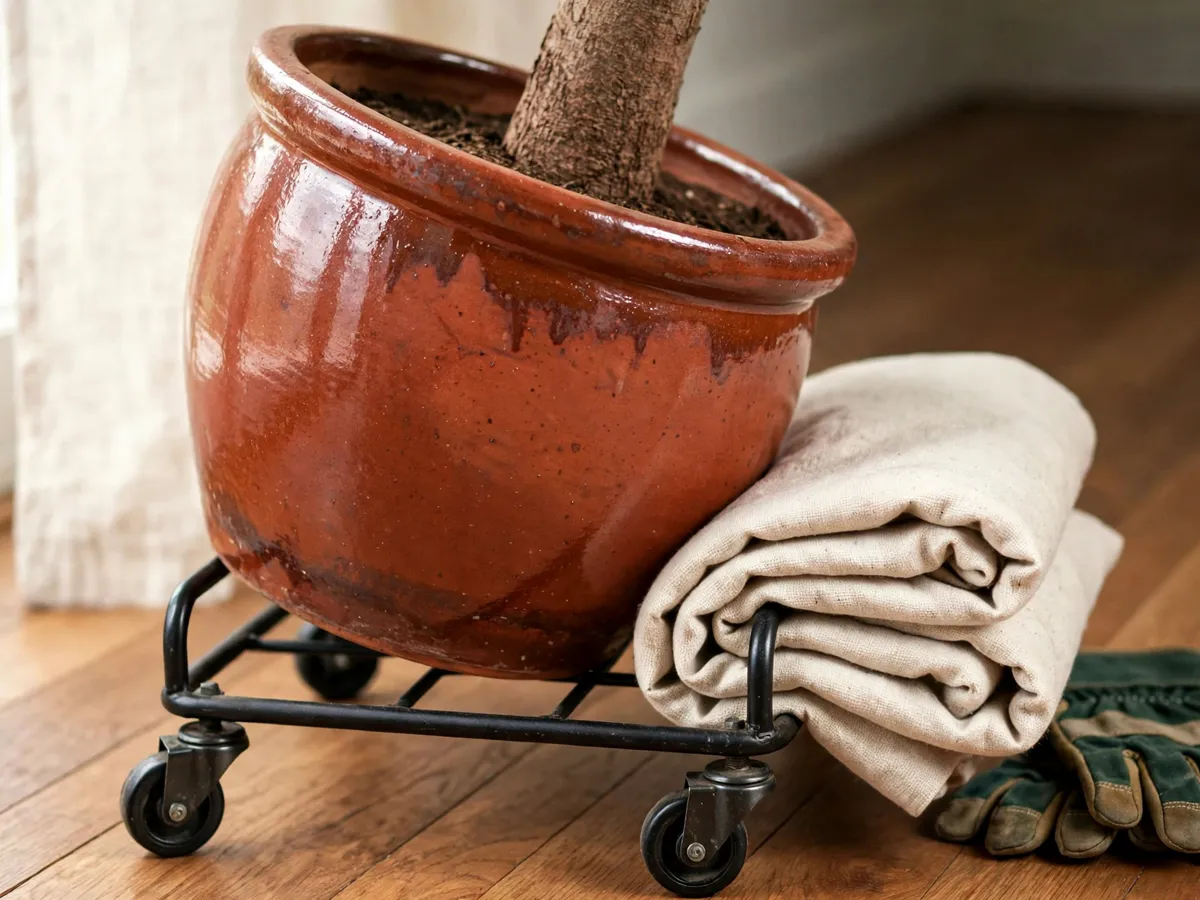
Without a caddy, use the moving blanket. Tip the pot onto its side on a folded blanket, drag it on the blanket to the new spot, then stand it up. One person handles 60 pounds this way in about five minutes. Past 80 pounds, the honest method is to lift the root ball out by its stems, move the empty pot, and refill it in place - which costs fifteen minutes and saves the back.
Cost: $25–$55 for a rated caddy. Time: 20 minutes to set it up, then seconds every time after.
8. Pruning for height and spread
A large plant that outgrows its corner does not have to leave the house. Height is controllable by pruning, and the two cuts do different jobs. Topping - cutting the main stem just above a leaf node - stops upward growth and forces the plant to branch out wider below the cut. Thinning - removing a whole stem or branch back to the trunk or the crown - reduces spread while keeping the height.
The numbers that matter: a rubber plant topped at 5 feet fills out to a 30-inch spread within two seasons instead of reaching 8 feet. A dracaena cane cut 6 inches above the pot rim will push new growth from the stub.
Prune in spring, when the plant is pushing new growth and the cut heals fast. Use clean, sharp scissors, and cut at a slight angle so water runs off the wound. The one rule that protects the shape: never take more than a third of the live canopy at once, because every leaf is also the plant's way of catching the light it needs to regrow.
Legginess is the signal to act. When the bare stem below the canopy runs past 12 inches, the plant is reaching for light it is not getting, and pruning alone will not fix it - move it closer to the window first, then cut. If the room cannot give it more light, a plant stand that raises it 12 to 18 inches buys real distance toward the glass; the plant stand plans cover building one that holds the weight.
Cost: $12 for a pair of sharp scissors. Time: 15 minutes a season, plus an hour if you rebuild the stand.
9. Where a big plant fails in a small room
A tall plant is not automatically right. Four room shapes fight it, and the fight shows up as dropped leaves and a slow decline rather than a clean failure, which is why people blame the plant instead of the corner.
- The 8-foot ceiling with a light fixture over the corner. A 6-foot plant plus a 20-inch pot puts the canopy at 8 feet, and it presses the fixture. The plant grows around the obstruction and tips toward the nearest light, so the trunk curves within a season.
- The narrow galley living room. A 36-inch footprint in a 30-inch walkway removes the path.
- The corner 8 feet from the only window. Big plants need more light than small ones because they have more leaf to feed. Set a fiddle leaf fig that far back and it drops the lowest leaves first, then the ones above them.
- The room with a rug and no hard floor under the pot. A caddy's casters sink into a plush pile, a freshly soaked pot sweats through the weave, and moving the plant tears the rug. Set it on tile, wood or vinyl, then lay a rug beside it instead of under it.
The honest test: if the corner fails two of the four checks above, buy the medium size instead and put it on a stand. A 4-foot rubber plant on an 18-inch stand reads as tall as a 6-foot plant on the floor, costs half as much, weighs a third as much, and leaves the room its walkway back.
Cost: $0 to run the test. Time: ten minutes with the tape before a $200 mistake.
10. A placement checklist before you buy
Take this list to the garden center, not home afterward. Every line is a number you can measure in the room before you spend money on a plant that will not fit it.
- Distance from the corner to the nearest window, in feet.
- Ceiling height, minus the depth of any fixture over the corner.
- Footprint in inches: pot diameter plus twice the leaf overhang you expect at maturity.
- Clear walkway left after the footprint: 30 inches minimum.
- Door swing checked against the taped circle.
- Soaked weight of the pot you intend to buy, and whether one person can lift it over the threshold.
- Caddy sized one step larger than the planter, rated at double the soaked weight.
- Saucer and felt pad under the pot, before the soil goes in.
- Renter check: every piece lifts out the door on moving day, and nothing is bolted to the wall or the floor.
The styling side - how the plant sits against the wall, what goes beside it, how to layer a corner so it reads designed instead of dumped - is a separate job. The plant styling guide covers that, and the rest of the gardening library holds the care pages this one deliberately leaves out.
Cost: $0 to check. Time: 30 minutes, one weekend morning before the trip.
11. What it costs and how long it takes
The plant is the middle line of the budget, not the first. A 5-foot dracaena costs $40 to $70 at a garden center, and the same height in a nursery-raised fiddle leaf fig costs $120 to $250. Around it sit the parts people forget at the register: a 16-inch planter with a drainage hole runs $20 to $70, a rated caddy runs $25 to $55, and a saucer with felt pads stays under $10.
- Tight: $75 all in - a 4-foot rubber plant, a 12-inch pot, no caddy. One afternoon from the trip to the finished corner.
- Middle: $160 - a 5-to-6-foot dracaena, a 16-inch planter, a caddy rated for the soaked weight. Half a weekend.
- Top: $320 - a 7-foot bird of paradise, a 20-inch fiberclay pot, a caddy, and a second pair of hands for the threshold. A weekend morning plus the drive home.
Time is the other cost, and it is the one nobody budgets. Measuring the corner takes twenty minutes; the trip, the lift into the car, the walk through the door and the re-pot run two to three hours for one plant. If the corner needs a stand before the pot will sit level, add another hour and the price of the lumber.
Renters should budget the exit as well as the entry. A large plant sells secondhand for roughly half what it cost new, the planter and the caddy travel to the next apartment untouched, and nothing on this page leaves a hole in the wall.
Cost: $75–$320 for a finished corner. Time: one afternoon, or a weekend morning for anything over 6 feet.
Common questions
How much floor does a tall plant really take?
Count the pot diameter plus twice the overhang of the lowest leaves. A 16-inch pot under a plant whose leaves reach out 8 inches each way claims a 32-inch circle.
Can one person move a 6-foot plant?
Yes, up to about 60 pounds, and only with a wheeled caddy under the pot. Push it rather than dragging it, and lock the casters once it is in place so it stops creeping toward the door. Past 80 pounds the honest answer is two people and a moving blanket, or an empty pot carried over and filled back up where it stands.
Does a big plant need a much bigger pot than the nursery one?
One size, not three. A root ball that sits in the middle of an oversized planter is surrounded by more moisture than the roots can drink. Move up 2 inches at a time and let the roots fill the gap before the next step.
Will a large plant ruin a wood floor?
Only if it sits wet. Terra-cotta and stone sweat through the bottom, and a spot of hardwood held damp for a season swells and darkens. A saucer catches the runoff and a felt pad under the saucer stops the rim from scoring the finish when you rotate the plant toward the light.
Which tall plant survives the furthest corner?
The parlor palm and the dracaena, in that order. Neither needs the window line the rubber plant or the fiddle leaf fig wants, and both hold their height at 5 to 7 feet with a slim footprint.