 Plant As Deco
Gardening & Planting Tips
Indoor Mint Plant: The Containment Rule
By Plant As Deco · Updated 25 November 2026
Mint is the easiest kitchen plant to keep alive and the hardest one to keep contained. It rarely fails quietly in a corner. It spreads: a single plant sends runners underground, breaks the surface a foot from where you planted it, and turns a shared windowsill planter of five plants into a monoculture of mint.
Weekend-ready: $5–$30 for a nursery pot, its own 6-inch container, a bag of potting mix and a watering can, one afternoon. Ten minutes a week after that.
1. What mint actually is: a running perennial in a pot
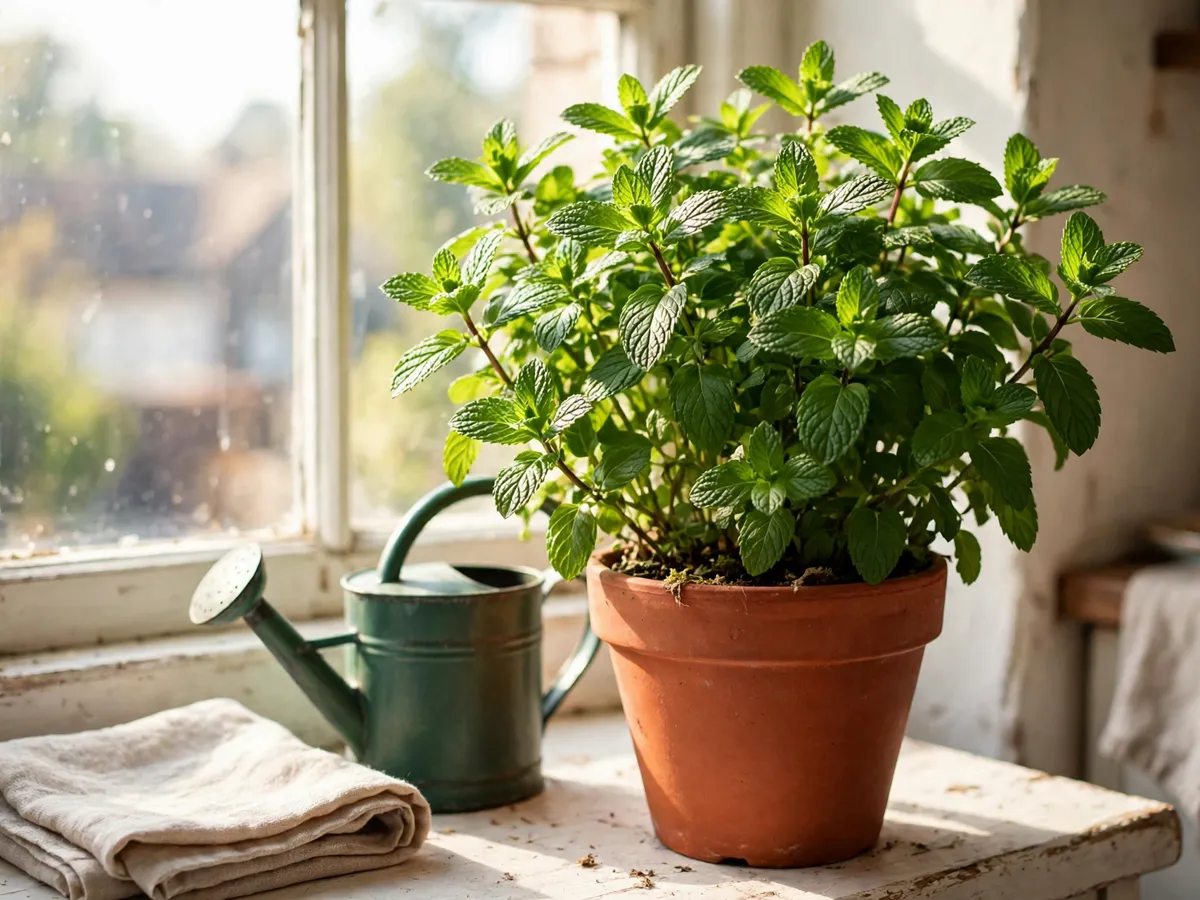
Garden mint is the genus Mentha, and the two you will meet most often are spearmint (Mentha spicata) and peppermint, a spearmint-watermint hybrid written Mentha × piperita. Both are perennial, meaning the plant lives from year to year rather than dying after one season the way basil does. The detail that matters indoors is the growth habit: mint spreads by rhizomes, which are underground stems. Each one pushes sideways through the soil, sends up a shoot where it finds light, and stores food behind it.
Cost: $0. Time: 5 minutes to read the plant tag and check whether the label names a species or just says mint. Caveat: a label that only says mint is usually spearmint, the default garden type, but garden centers sell several Mentha species under the same common name.
2. The one mechanism: it escapes, it does not die
Almost every indoor plant fails slowly in the wrong direction, and mint is the mirror image. It tolerates mediocre light, irregular water, ordinary room air and a pot that is two seasons past its prime. What it does not tolerate is a shared container. In a mixed planter, mint does not compete politely for the same soil. Its runners travel underneath the other plants, occupy the moisture and the nutrients first, and shade out anything that grows more slowly. Within one season the neighbors thin out and you are left with a healthy mint and empty space where the others used to be.
Cost: $0. Time: 10 minutes to lift the suspect plant out of the shared planter and look at the root ball. Caveat: a plant that has already been overtaken rarely recovers its shape, so expect to divide the mint and restart the neighbors rather than rescue them in place.
3. The containment rule: its own pot, always
Give mint a container nothing else lives in, and the whole problem disappears. A pot of its own is a physical wall around the runners, which is why a windowsill pot works so well and a garden bed does not. Any pot from 6 inches across works for a single plant, and a 10-inch pot grows enough for two people. Drainage holes are not optional, because mint drinks steadily in summer and a sealed base holds water the roots cannot use.
Buy a potting mix rather than garden soil, since a heavy soil holds too much water and compacts around the runners. The best potting soil for indoor plants guide covers the label terms and the mixes worth buying. Set the pot on a saucer, not inside a decorative cover, so runoff does not sit against the base. Terracotta is a good choice here: it breathes and dries at the sides as well as the top.
Cost: $4–$15 for the pot and saucer. Time: 20 minutes to pot up a nursery plant. Caveat: a large pot on a narrow windowsill is a tipping risk when the plant is in leaf and full, so keep heaviest pots on a stable shelf instead of a sash edge.
4. Light: the four to six hour sun verdict
The honest number is four to six hours of direct light a day, and a south window is the easiest way to get it in winter. A south-facing sill gives the longest window of sun of any exposure. East and west windows give you roughly half the useful hours, which still supports a leafy plant with thinner stems, and a north window rarely gives enough for mint to stay compact. Plants in a dim window do not die, they stretch: stems get longer, the gaps between leaves widen.
If no window in your home reaches four hours, a grow light closes the gap for less money than most people expect. The details of how long to run one and how close to hang it are in the grow lights for indoor plants guide. Rotate the pot a quarter turn every week, because the side facing the glass fills in and the side facing the room goes thin.
Cost: $0–$40 for a light if the window falls short. Time: 5 minutes a week to turn the pot. Caveat: a hot south window in summer can dry a small pot in a day, so a pot that is comfortable in winter may need a second watering a week in July.
5. Watering by weight: the lift-the-pot habit
Pick the pot up. A dry mint pot feels light for its size and the top of the mix looks pale; a watered one feels noticeably heavier and the surface is dark. Learn the two weights for your own pot, since soil volume, terracotta thickness and humidity all change them, and then water on the weight rather than on a day of the week.
When it is time, pour slowly over the whole surface until water runs from the drainage hole, let the pot drain over the sink, and empty the saucer before it goes back on the sill. A bright summer window means two or three waterings a week; a dark winter window can drop to once every ten days or less.
Cost: $0–$10 for a watering can with a thin spout. Time: 5 minutes per watering. Caveat: a pot with no drainage hole cannot be judged by weight, because the water stays at the bottom and the surface still looks dry.
6. Varieties: spearmint, peppermint, chocolate
Buy for scent and use, not for looks, because all mint needs the same four to six hours and its own pot. Spearmint (Mentha spicata) is the default and the safest pick: a sweet cool scent, broad leaves, vigorous growth, and the flavor that works with lamb, peas, new potatoes and lemonade. Peppermint (Mentha × piperita, a spearmint and watermint hybrid) has narrower leaves, darker stems and a stronger, hotter flavor that carries further, which is why it is the drying and tea type in most kitchens.
Chocolate mint is a selection of spearmint with a warm, cocoa-backed scent when you brush it, and apple or pineapple mint (Mentha suaveolens) adds round, fuzzy leaves and a fruit note. They are one genus and one care sheet, so treat them as rows on this page rather than different plants.
Cost: $4–$8 per pot. Time: 10 minutes to choose the scent at the nursery. Caveat: a large shared pot of mixed mints in a planter is exactly what section 10 warns about, so buy one type unless you have one pot per plant.
7. Starting: seed vs cutting vs nursery pot, ranked by honest speed
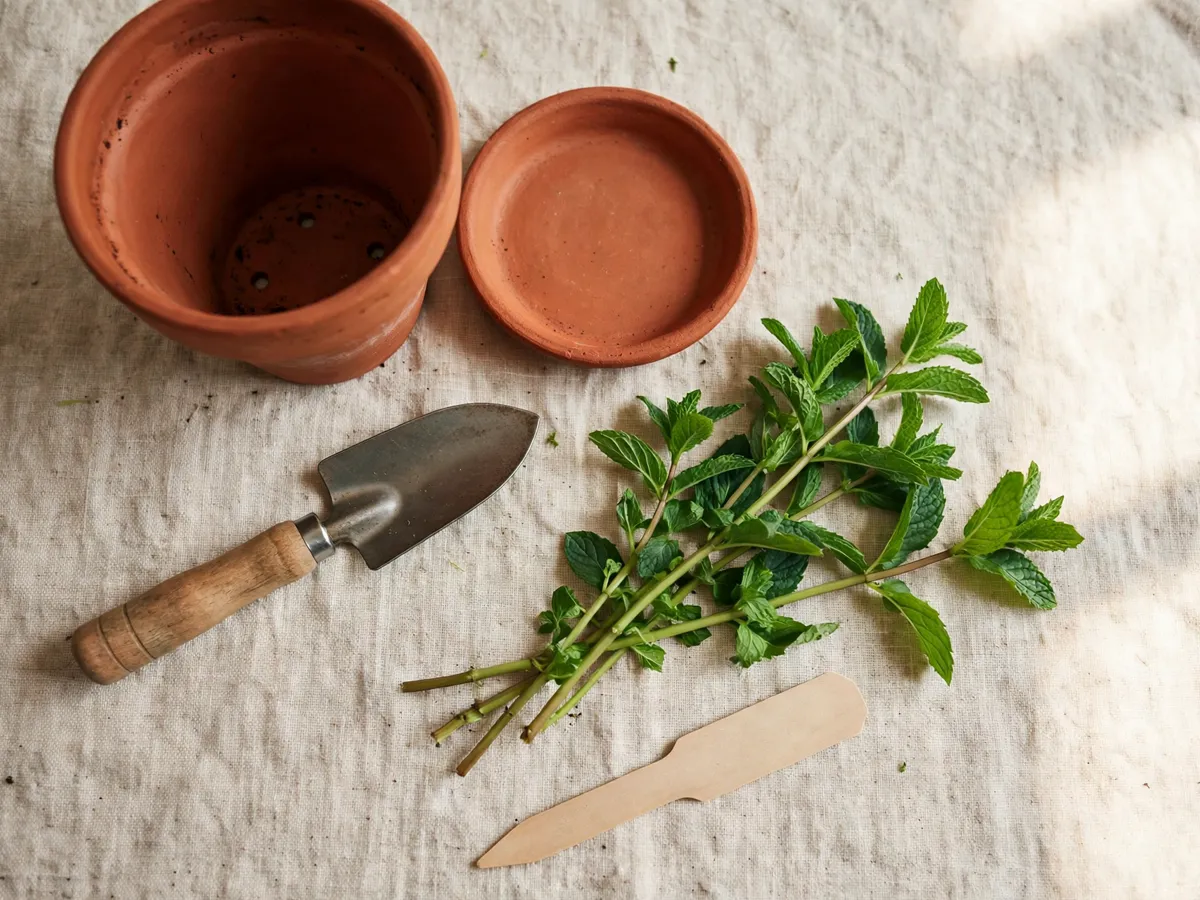
Buy a nursery pot if you want a harvest this year. A small mint plant in a 3-inch pot costs a few dollars, fills a 6-inch pot within a season, and gives you leaves in two to three weeks. It is also the only route with a known variety on the label.
Buy a plant and take cuttings from it, and you get a second plant in three weeks. Snip a length of stem roughly four inches long, strip the lower leaves so no leaf sits under the water line, stand it in a glass of water on a bright windowsill, and change the water when it clouds. Mint roots quickly in water, and once roots are an inch or two long the cutting moves into mix and grows on like any other plant.
Seed is the slow route and the least certain: mint seed germinates unevenly, takes weeks to reach a harvestable size, and the variety choice is limited compared to what a nursery carries.
Cost: $0–$8, and $0 if you are dividing a plant you already own. Time: 15 minutes to take a cutting, then 3 weeks to roots. Caveat: a cutting in water on a dark windowsill rots instead of rooting, and roots are slower in winter light than in spring.
8. Pinching: the weekly two-second job that keeps it bushy
Once a week, take the top two leaf pairs off the end of every stem, between thumbnail and forefinger, and put them in whatever you are cooking. That pinch does two things at once. It removes the growing tip, so the plant sends out two side shoots where there was one taller stem, and it takes a harvest while you do it. A pinched plant fills out from the middle and stays a compact mound.
Cost: $0. Time: 2 minutes a week. Caveat: a large plant in a big pot needs a slightly longer weekly pass, and skip pinching entirely in the two weeks after you repot, because the plant is spending its energy on roots.
9. Feeding: the light-touch schedule
Mint is a leaf crop, so nitrogen in a small, steady supply is what you are buying. A balanced liquid fertilizer at half the label strength, every three weeks from spring through early fall, is plenty for a pot that gets three cuts a month. A fresh plant from the garden center needs nothing for the first six to eight weeks. Overfeeding is the failure worth avoiding, because a mint pot pushed hard grows pale, thin leaves with a weaker scent. Stop feeding in late fall, when the light drops and the plant stops asking for it.
Cost: $0–$12 for one bottle of liquid feed that lasts a season. Time: 5 minutes every three weeks. Caveat: a plant sitting in a dark room with no supplemental light does not need extra feed, it needs the light first, and fertilizer cannot substitute for it.
10. The mixed-planter warning: which neighbors it takes over
Buy a windowsill planter of mixed plants at a garden center and the first thing you will notice in month two is that only one green thing is still alive in it. Mint does not compete politely for light or water. It competes by taking the root run, and a rhizome tip that reaches six inches past its own corner will send up shoots there, so the plant with the slower root system, usually thyme, oregano or parsley, is the one that loses. The same thing happens in a shared pot and in a bed, just slower, and the result is the same monoculture. The rule that follows is short: one mint, one pot.
For the companion side of the question, see the compatibility map: herbs to grow together. For the mixed windowsill that avoids mint, the five-pot plan is laid out in indoor herb garden ideas. For the mixed windowsill that avoids mint, the five-pot plan is laid out in the companion guide above.
Cost: $0–$6 for one extra 6-inch pot and a bag of mix. Time: 10 minutes to move mint into its own container. Caveat: a planter that already has runners through the whole soil volume needs repotting in full, not a scoop-and-divide, because a two-inch rhizome piece left behind regrows.
11. Winter: the windowsill reality
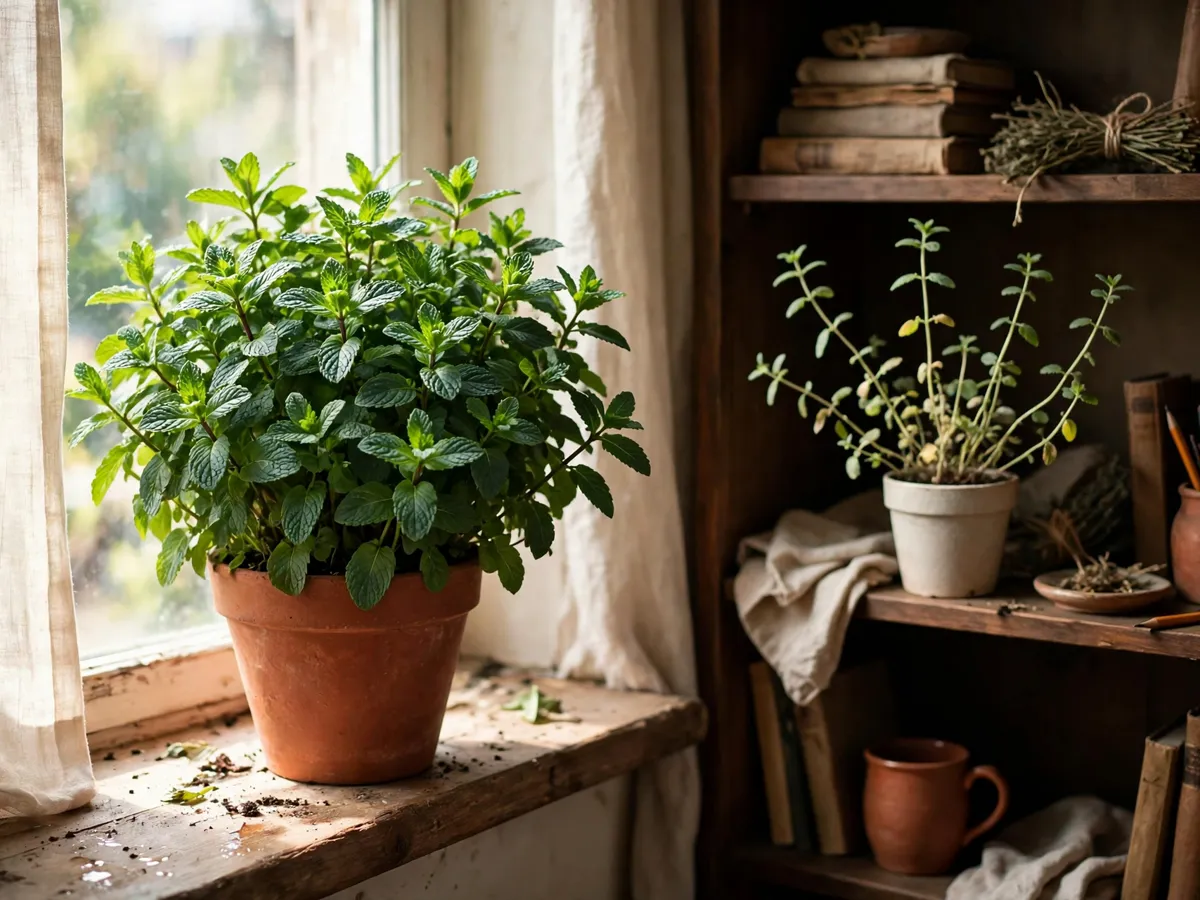
Winter is where people decide their mint has died, and the diagnosis is usually wrong. Mint is a hardy perennial, so it does not need a frost-free life the way basil does, but indoors the change is still real: a south window that gave four to six good hours in June gives a fraction of that in December, the day length falls, and the plant slows its top growth to match. The pot dries more slowly too, so the weight habit now reads as light every two to three weeks instead of every five days. Growth gets smaller leaves, longer gaps between nodes, and less scent. That is a slow-season state, not failure.
The honest winter options, in order of effort: accept the slow season and pinch what little comes, which is what most windowsill growers do; add a supplemental light on a 12-hour timer to keep the plant producing; or cut the top growth back hard to a low, even dome and let it regrow as light returns in spring. What does not work is feeding a dark-room mint through winter, which produces pale soft growth that draws fungus gnats to the damp surface. Rosemary is the other windowsill woody plant, and its winter needs differ, so do not copy this schedule across.
Cost: $0–$35 for a timer-plus-light setup if you choose the winter production route. Time: 5 minutes a month. Caveat: a mint pot moved from a bright window to a dark corner in November is being stored, not grown, so set expectations accordingly.
12. Repotting and dividing: the once-a-year root prune
A contained mint pot fills with rhizomes in a season, and the plant tells you it is root-bound the way any pot plant does: water runs straight out the bottom, the pot dries within a day, and new top growth gets smaller even in good light. The once-a-year job, best done in early spring, is to unpot the whole root ball, cut it in half or thirds with a clean knife, and repot one or two of the pieces into fresh mix in the same pot. Mint tolerates this unusually well because rhizomes are stems with buds on them, so each piece carries growing points and re-establishes quickly. Compost the rest rather than planting it in the garden, because that is how a windowsill mint becomes a yard problem.
Cost: $0–$10 for fresh potting mix. Time: 20 minutes. Caveat: divide when shoots are short in early spring; a plant divided in midsummer heat or midwinter low light re-establishes slowly and sulks for weeks.
13. Harvest: how much one pot actually gives
A 6-inch mint pot in a four-to-six-hour window, pinched weekly and fed lightly, produces a modest but reliable supply: call it a loose cup of leaves every week or two through the growing season, which covers tea, drinks and garnish without ever stripping the plant. Never take more than about a third of the plant at once, because the remaining foliage powers the next flush. Cut stems above a leaf pair, not into bare stem, and a node that keeps its leaves will branch again.
Cost: $0. Time: 2 minutes per harvest. Caveat: yield scales with light, so a pot in a north window or under a weak lamp gives a fraction of these numbers, and no watering schedule changes that.
14. Common problems decoder: what each symptom is telling you
Pale, yellowing lower leaves with soil that stays wet for days is overwatering, and in a mint pot it is almost always the saucer, so empty the saucer and let the pot dry to light weight before the next soak. Long, pale, widely spaced growth in a dim room is a light problem, and moving the pot or adding a lamp is the fix, not water. Tiny flies over damp soil are fungus gnats, which breed in the wet top layer, so let the surface dry between waterings. White powder on the leaves, heaviest on older growth, is powdery mildew, which arrives when air is still and leaves stay wet, so space the pot for airflow and water the soil rather than the foliage.
Cost: $0–$15. Time: 15 minutes to read the plant and the pot. Caveat: two problems at once is common, so fix the light and the weight first, then reassess before treating anything else.
Common questions
Is mint safe for cats and dogs?
The common garden mints, spearmint and peppermint, are listed as non-toxic to cats and dogs, which makes mint one of the safer windowsill choices for a pet household. The oils are strong and a dog that strips a whole plant can get an upset stomach from the sheer volume, so the practical advice is still to place the pot out of reach.
Why is my indoor mint plant leggy?
Two causes, and they usually arrive together. The first is light: a pot getting less than four hours of direct sun stretches, with long gaps between leaf nodes, as the plant hunts for more. The second is pinching, or rather the absence of it: an unpinched stem grows one long shoot with a tuft at the top. Fix the light first, because no amount of pinching compensates for a dark corner, then start the weekly two-pair pinch. The plant fills out from the nodes below each cut within two to three weeks.
Can I grow mint from a grocery store bunch?
Sometimes, and the odds depend on freshness. Supermarket mint is harvested cold and stored wet, so many stems are too stressed to root, but a fresh bunch with firm stems can work. Cut the bottom of a stem cleanly, strip the lower leaves, and stand it in water; roots show in one to two weeks on a willing stem.
Does mint need full sun indoors?
It needs the equivalent of four to six hours of direct sun, and indoors that means a south-facing window, or a south window plus a lamp on a timer through winter. East and west windows keep a mint pot alive but slow, with thinner stems and smaller leaves, which is the stretched look people read as a struggling plant.
How long does an indoor mint plant last?
Indefinitely, if it is contained and divided. Mint is a perennial, so an indoor plant has no built-in end date the way a basil pot does, and the usual failure mode is not age but exhaustion: a pot that was never divided runs out of root room and nutrients in its second season, and the growth thins. A once-a-year root prune into fresh mix, the weekly pinch, and a window with real sun keep the same plant going for years. If a pot collapses anyway, the rhizome pieces you saved from the last division are the fastest restart.
Save these on Pinterest
Pin the containment rule, the four-to-six-hour sun verdict, and the problems decoder, the three sections that decide whether a mint pot stays one plant. This guide and the rest of the gardening tips live together there.