 Plant As Deco
Organization & Storage
Weekly Cleaning Schedule for a Small Apartment
By Plant As Deco · Updated 16 November 2026
A weekly cleaning schedule for a small apartment usually dies in week three, and not from laziness — it dies because the grid quietly grows. This page builds one that survives: one room per weekday in 15 to 25 minutes, three lists split by how often a job actually needs doing, and a written rule for the day you miss. Copy it into your phone notes and run it.
Weekend-ready: $0–$30, 15–25 minutes a day. No shopping list beyond basics.
1. One room a day, not one chore a day
The design decision everything else hangs on: each weekday owns a room, not a list of chores. A chore list has no bottom — wiping the counters suggests sweeping the floor, sweeping suggests the baseboards, and item four quietly becomes item nine. A room does have a bottom. When the bathroom reads clean from the doorway, the slot is finished, whatever the clock says. The room defines done, so the schedule can end.
Room-first also removes the real cost of an evening clean: deciding. Walking in at eight knowing today is the bathroom starts a timer; walking in facing a vague list of chores starts a negotiation, and negotiations lose to the sofa. Five rooms, five labels, nothing to choose.
The order below is deliberate, though you can shift it to fit your week — the sequence is the plan, the names are just labels. The bathroom leads because it is the smallest room and the one where delay shows first: water spots, hair, toothpaste in the sink. The kitchen follows as the busiest room in a small apartment. Floors come midweek, after two wet rooms have settled their dust where it lands. The whole-home tidy sits on Friday, when a week of living has piled the surfaces. Laundry and bedding close the week on Saturday, because the machine does most of the work while the bed airs.
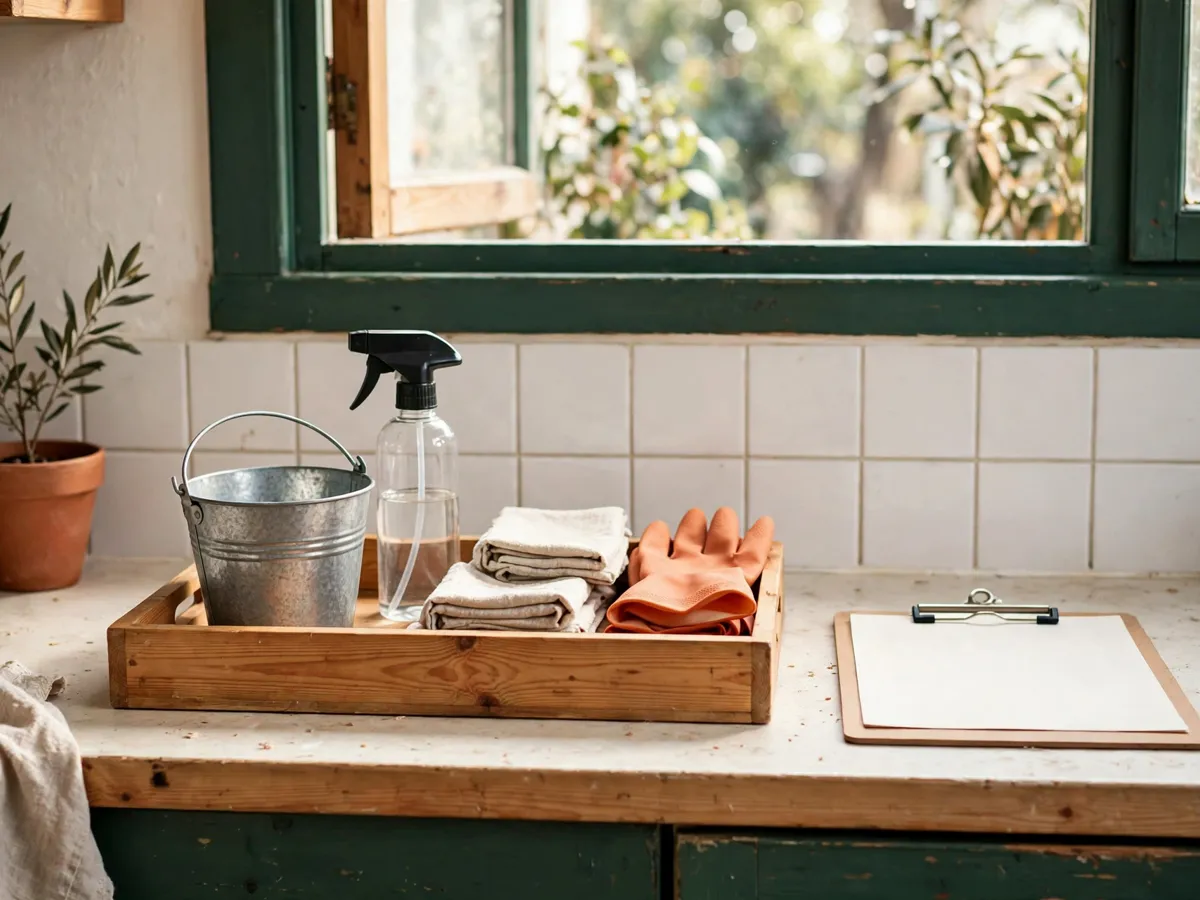
The 15 to 25 minute cap is the second half of the design. A slot that keeps running long is rarely a cleaning problem — it is a stuff problem: a counter that cannot be wiped because it is covered, a floor that cannot be swept because it has become storage. When the same room overruns two weeks running, stop scheduling around it and clear it once — the room-by-room declutter checklist walks that pass one room at a time. None of this needs gear beyond a tray of basics that fits under one sink; nothing drills, mounts or involves the landlord.
Cost: $0. Time: 20 minutes for one slot. The cap is the design — a room that keeps overrunning is telling you it holds too much, not that you clean too slowly.
2. Three frequencies, three lists
A schedule dies when one list holds jobs that belong to three different speeds. Wiping the kitchen counters weekly is right; wiping the fridge interior weekly is wasted effort; wiping the counters monthly is not enough. Before a single day is assigned, the work splits into three lists — and once they are written, the grid stops growing on its own.
The daily anchors, about 10 minutes, four jobs: dishes done or soaking before bed, a one-minute counter wipe after dinner, any floor spill caught while it is still wet, and a 60-second wipe of the bathroom sink and taps. These are not scheduled — they are the floor the schedule stands on, and they run even in a week where everything else slides. They are deliberately the short version. The full 20-minute daily loop — the window, the bin, the traffic-lane sweep — is a separate habit, walked through in the daily cleaning routine guide; the anchors here are the spine that keeps the apartment livable between grid days.
The weekly grid is the five room slots from section one, 15 to 25 minutes each, 100 minutes total. The monthly list is five jobs that each need doing about once a month: the fridge interior with the shelves out and wiped, the window sills and tracks, the floor under the bed with the bed slid aside, the baseboards, and the washing machine door seal and detergent drawer. Each is a 30 to 40 minute job on its own — never a weekly one.
The rule that keeps them apart: nothing moves between lists without evidence. If the fridge interior looked fine at this month's wipe, it stays monthly. The fastest way to kill a weekly grid is promotion — week one the fridge joins Wednesday, week two the baseboards join Thursday, week three the grid is 90 minutes a day, and week four it is abandoned. Monthly jobs ride along as guests, one per week, underlined in the grid. They never move in.

Cost: $0. Time: 15 minutes to write the three lists once. An unwritten monthly list turns into weekly guilt — write it down and the grid stops absorbing it.
3. The catch-up rule that saves the week
Every schedule meets a Tuesday that gets away — work runs late, a friend drops in, the evening disappears. What separates the schedule you keep from the one you quit is not willpower. It is having the missed-day rules written in advance, while you are calm, instead of inventing them at ten at night while tired.
Rule one: never double. The instinct after a missed slot is to run two rooms the next evening, and 45 minutes in one night is exactly the marathon this schedule exists to replace. Doubled evenings get skipped too — and then two days are behind instead of one, which is how a week becomes a lost month.
Rule two: the 2-minute triage. Go to the missed room with a timer and do only the dirtiest thing you can see — usually the toilet, sometimes the stovetop. Two minutes, then stop. Everything else in that room waits for its slot next week, because the room is not behind: it is simply early for next week. That reframe matters more than the cleaning. A missed room that got two minutes is a room you will walk into tomorrow; a missed room that got nothing becomes a room you start avoiding.
Rule three: two missed days means restart, not catch up. If Tuesday and Wednesday both went, effort will not salvage the week — so treat today as Tuesday. Run the grid from slot one, the bathroom, because it is the smallest room in the apartment and one small finished room restarts a streak faster than one large half-done one. The grid is five slots in an order, not five dates on a calendar.
Through all of this the anchors survive. On a collapsed day, run the four 10-minute anchors and let the grid slide — the anchors are what keep a bad week from turning into a restart.
Cost: $0. Time: 2 minutes for a triage. Catch-up that runs longer than the slot it replaces is not catch-up — it is a second schedule, and it fails for the same reason.
4. The 5-day grid to copy
Here is the whole grid, every job named, with honest minutes for a studio or one-bedroom at a normal evening pace.
| Day (slot) | Room | The slot covers | Minutes |
|---|---|---|---|
| Tuesday | Bathroom | Toilet, sink and taps, mirror, one floor pass | 25 |
| Wednesday | Kitchen | Stovetop and backsplash, counters, sink, the fridge front row, floor | 25 |
| Thursday | Living room and bedroom floors | Dust the reachable surfaces, then sweep or vacuum both floors | 20 |
| Friday | Whole-home tidy | A return pass: everything out of place goes home, one basket for what has no home yet | 15 |
| Saturday | Laundry and bedding | Strip the bed, one load on, hang to dry, remake the bed | 15 |
Five slots, 100 minutes of scheduled cleaning a week — at or under the budget this design allows. The daily anchors sit outside that count at roughly 10 minutes a day. For scale: one catch-up Saturday deep clean takes longer than this entire grid, and that is the trade being made — spread over five short evenings instead of one long day nobody wants.
The monthly underline. Each week, one item from the monthly list rides along on the slot it naturally extends, ten minutes extra at most: the fridge interior rides Wednesday, the window sills and the baseboards ride Thursday, and the floor under the bed plus the machine wipe ride Saturday — the bed is already stripped then, so sliding it aside costs three minutes inside the same slot. A month holds four or five grid weeks; when it holds four, the item that missed out goes first next month.
Two rows deserve a note. Tuesday ends at the mirror because a spotted mirror reads dirtier than a spotted counter, and the slot goes faster when the vanity surface is nearly bare — a mirror cabinet keeps the daily bottles behind the glass instead of on it, and the small bathroom mirror guide covers those two-in-one sizes. Wednesday stays at 25 minutes only while the fridge front row stays one container deep; the fridge organization guide sets that up shelf by shelf, dated leftovers tray included.
Friday's 15 minutes is a return, not a clean — hands carry things home, nothing gets wiped. It doubles as the schedule's early-warning system: when the same three items are homeless every Friday, that is a storage decision waiting to be made, not a cleaning one.
The week has seven days and the grid uses five on purpose. The two unused days are shock absorbers — a missed slot lands there without breaking anything, and a good week simply enjoys them. Shift Friday's tidy to Sunday if your clutter peaks on weekends; keep the order, treat the names as labels.
The order also travels. Guests arriving and only one evening free? Run Wednesday — the kitchen is the room visitors stand in. Showing the apartment? Thursday's floors plus the vanity wipe from the anchors cover what a visitor actually sees. The grid is not a fixed schedule to obey; it is five slots you know by heart, so the right one can be pulled out without rebuilding the week.
In a one-bedroom the five rooms map directly — bathroom, kitchen, bedroom and living floors, the tidy pass, laundry. A studio needs the same five slots with different names: the bathroom, the kitchenette strip, the sleeping corner plus the living floor as one slot, the tidy pass across the whole open room, and laundry. Same order, same caps, five labels. The studio version finishes faster than 100 minutes, which is fine — the cap is a ceiling, not a quota to fill, and the minutes saved go to the underlined monthly job, not to more weekly items.
The copy step: put the grid into your phone notes app — one line per day, the monthly item underlined. A phone note is with you at the shelf, edits in two seconds when a room changes, and does not slide behind the fridge like a printed sheet does. Screenshot the table above if that is faster; the point is that the plan lives where your week actually happens.
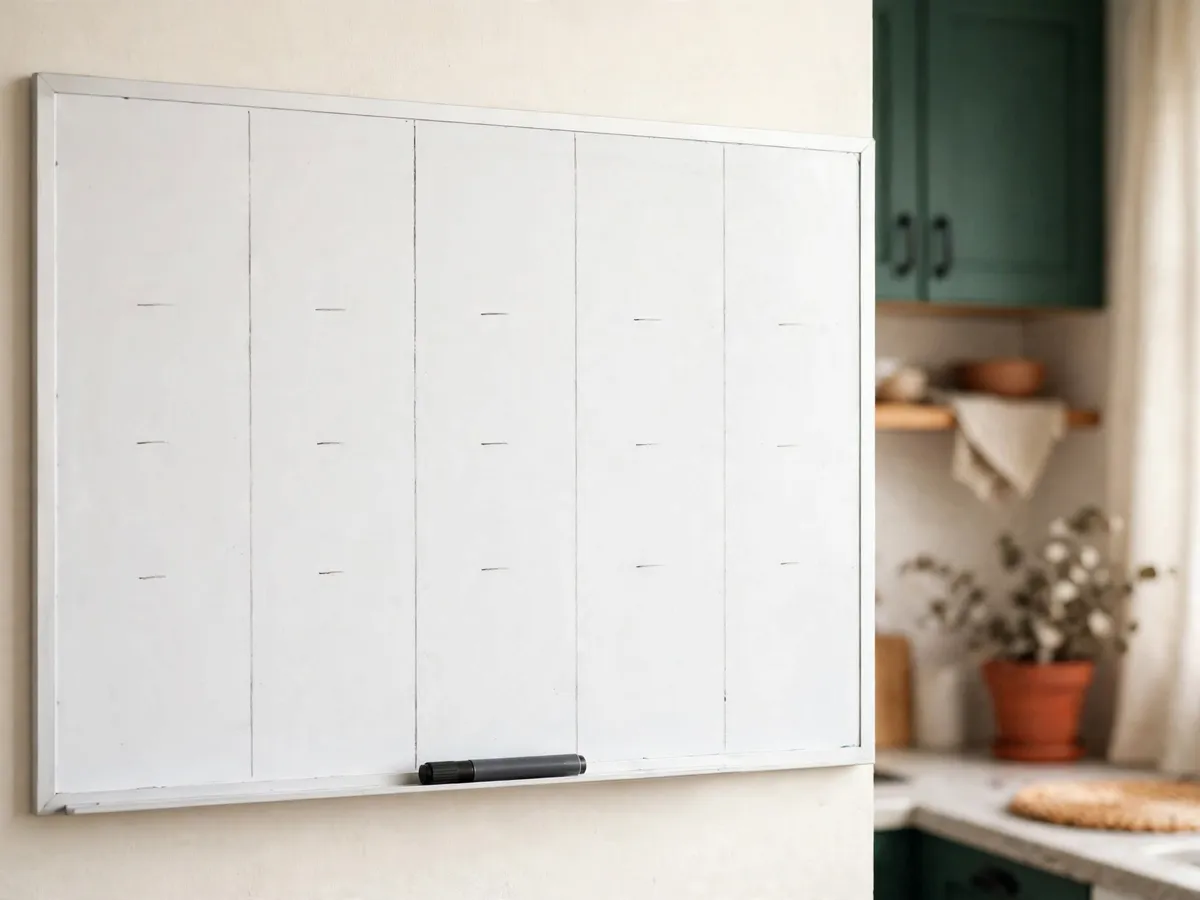
Cost: $0–$30 if the cupboard is starting empty — one all-purpose spray, one glass spray, cloths and a stiff brush cover every slot. Time: 15–25 minutes a day, 100 minutes a week. A Wednesday that keeps running over 25 minutes is a kitchen with a storage problem, not a schedule with too few minutes.
What we would skip
- Doubling up after a missed day — two rooms in one evening is the marathon this schedule replaced; the 2-minute triage exists instead.
- Promoting a monthly job into the weekly grid — the fridge interior on every Wednesday is how week three gets to 90 minutes and week four gets abandoned.
- A cleaning app with streaks and reminders — a five-line phone note does the same job without nagging, and it never pings you at dinner.
- A different product for every surface — one all-purpose spray, one glass spray and clean cloths cover every slot in this grid.
- Turning the two spare days into deep-clean days — they are the shock absorbers a missed slot lands on; spending them brings the marathon back through the side door.
Cost: $0 to skip. Time: 2 minutes to read.
The before-you-start checklist
- The four daily anchors accepted: dishes, counter wipe, floor spills, vanity wipe
- Three lists written — the anchors, the five slots, the monthly five
- The slots matched to your actual week; order kept, names treated as labels
- One monthly item underlined for this week and its slot picked
- The catch-up rules copied word for word at the bottom of the note
- One slot run as a trial before the first full week
- Basics gathered in one tray that fits under the sink
Cost: $0 to check. Time: 15 minutes before week one.
Common questions
How many minutes a week does the whole schedule take?
The five slots add up to 100 minutes — 15 to 25 minutes on each of five days. The daily anchors run roughly 10 minutes a day and sit outside that count.
What do I do when I miss a day?
Never double the next day. Run the 2-minute triage on the missed room — the dirtiest visible thing only — and let the rest wait for its slot next week. Two missed days in a row means restart from Tuesday's room, the smallest one.
Should monthly jobs go on the weekly grid?
No — that is the fastest way to kill it. Monthly items ride along as one underlined job a week, ten minutes extra at most, and stay on the monthly list the moment they look fine.
Does the grid have to run Tuesday to Saturday?
No. The weekday names are labels for five slots in order. Run them on the days that fit your week — the two unused days are the shock absorbers a missed slot lands on.
Save these on Pinterest
Pin the five-slot grid — one room a day, 15 to 25 minutes, one underlined monthly job — so the next sideways week ends with a 2-minute triage instead of a lost Sunday. This guide lives in the organization and storage collection with the rest of the checklists.