 Plant As Deco
Small Room Decor
Indoor Plant Wall Ideas: The Renter-Safe Versions
By Plant As Deco · Updated 23 November 2026
An indoor plant wall is the small-apartment answer to a garden there is no floor for: the plants go up the wall instead of spreading across the room. Most photos online assume you can drill anywhere, and a lease usually says otherwise. This page keeps the idea inside renter rules: three mounts that come down without a fight, the plants that enjoy wall angle, and the two problems nobody posts about, light and watering.
Weekend-ready: $60–$200 for a complete wall, one afternoon to mount plus a planting day. Renter-safe: every system here comes off the wall without a repair bill.
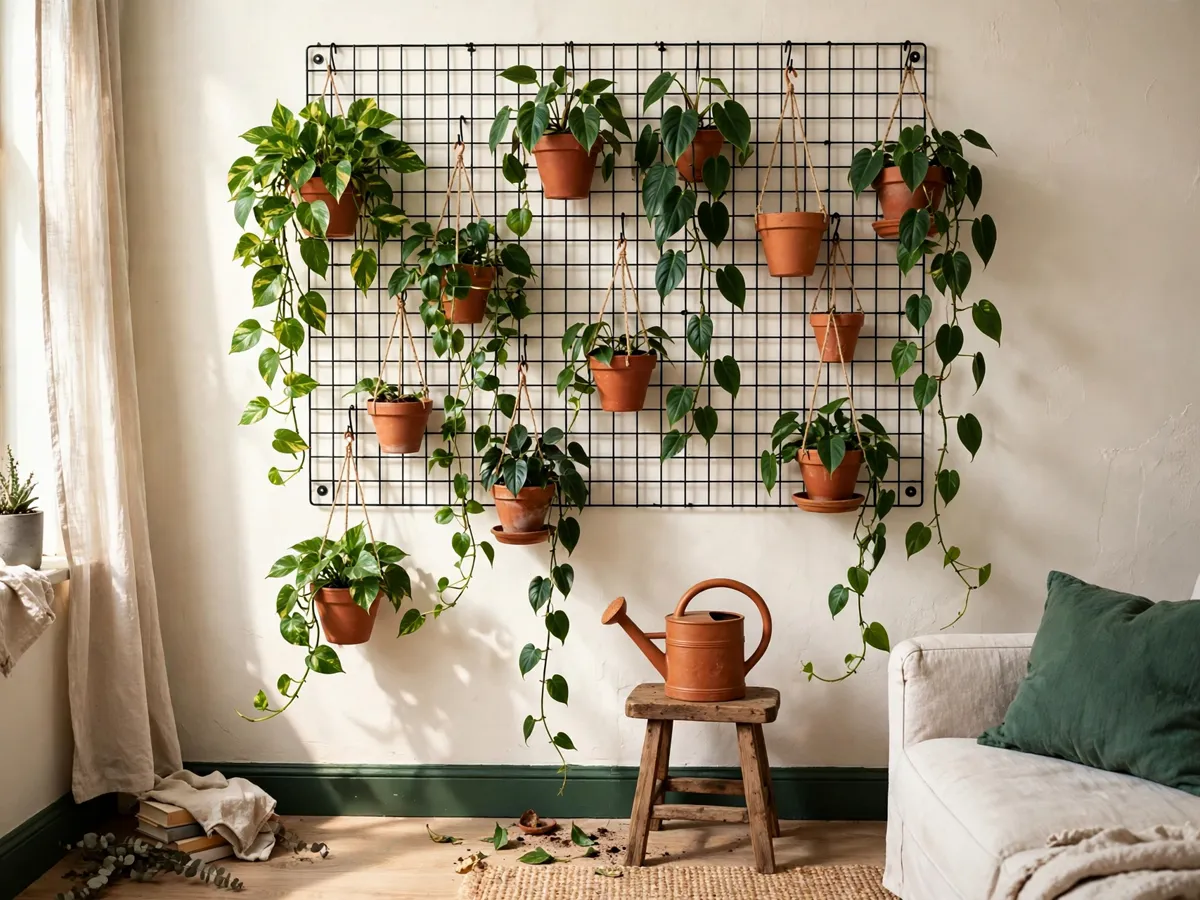
1. What an indoor plant wall actually is (and what it is not)
In plain words, an indoor plant wall is one wall zone carrying living houseplants vertically: hanging planters on a wire grid, small pots on staggered shelf ledges, a leaning rack holding greenery toward the ceiling. The plants stay in their own pots, and the mount either attaches without drills or touches nothing.
It is not three things. Not a plumbed living wall with pumps behind felt, which belongs to buildings, not leases. Not a preserved moss panel, which is real decor but not a living plant. And not an outdoor growing wall: herbs and flowers on a balcony rail are a different project with weather in it, and the vertical garden wall guide covers that outdoor half. This page stays indoors, decor first, at a scale that fits a small room: roughly two by four feet, five to nine plants, one honest light source.
Cost: $0. Time: 10 minutes. Decide indoor decor or outdoor food before buying anything, because neither the mounts nor the plants transfer between the two.
2. The honest limits: light at wall height, the watering reach
The first limit is light at wall height. Windows light a room sideways, not upward, so the top third of any wall is dimmer than the room average, and a plant that thrives on a table three feet from the window can sulk four feet higher beside the same window. Wall plants also cannot be turned every week the way shelf plants can, so they lean toward the glass unless rotated by hand.
The second limit is the watering reach. Everything on the wall sits at the edge of your reach or above it, small pots dry faster than large ones, and a watering slip runs down the paint instead of into a saucer. None of this kills the idea: the wall is planned around two chores, light before mounting and watering before planting.
Cost: $0. Time: 15 minutes. Stand on the step stool you own and check what you can actually reach before choosing a mount height.
3. Mount system 1: the wall grid rack (the renter workhorse)
The grid rack is the renter workhorse: a wire grid panel, the kind sold as wall organization for kitchens and entryways, hung from damage-free adhesive hooks rated for wet weight, or leaned against the wall behind a bench. S-hooks and small hanging planters drop onto the wires at any height, so the layout stays adjustable in a way a drilled system never is, and a 24 by 36 inch panel carries three to five light planters.
The rule that turns a rack into a wall: stagger the heights and put the trailers on top. A pothos at the top corner cascades and softens the wire; a level row of planters reads as a filing system. A climbing plant trained along the wires turns the grid into a trellis, the best of which are listed in the indoor climbing plants guide. Rate the adhesive against wet weight, not dry: a planted pothos roughly doubles its weight after a soak, so four hooks minimum, one per corner, and a week of watching an empty grid before the planters go up.
Cost: $25–$60 for the grid, hooks and first two planters. Time: 45 minutes including the level check. Adhesive ratings are for smooth paint; a textured wall wants the leaning setup.
4. Mount system 2: the floating shelf ledge ladder
The second system is the staggered shelf ledge: two or three narrow shelves climbing one wall zone, pots grouped on each level and a trailer spilling over the top. It reads softer than the grid because wood carries the greenery instead of wire, and it suits rooms that already lean warm. The renter version mounts on adhesive picture ledges rated for shelf plus planted weight.
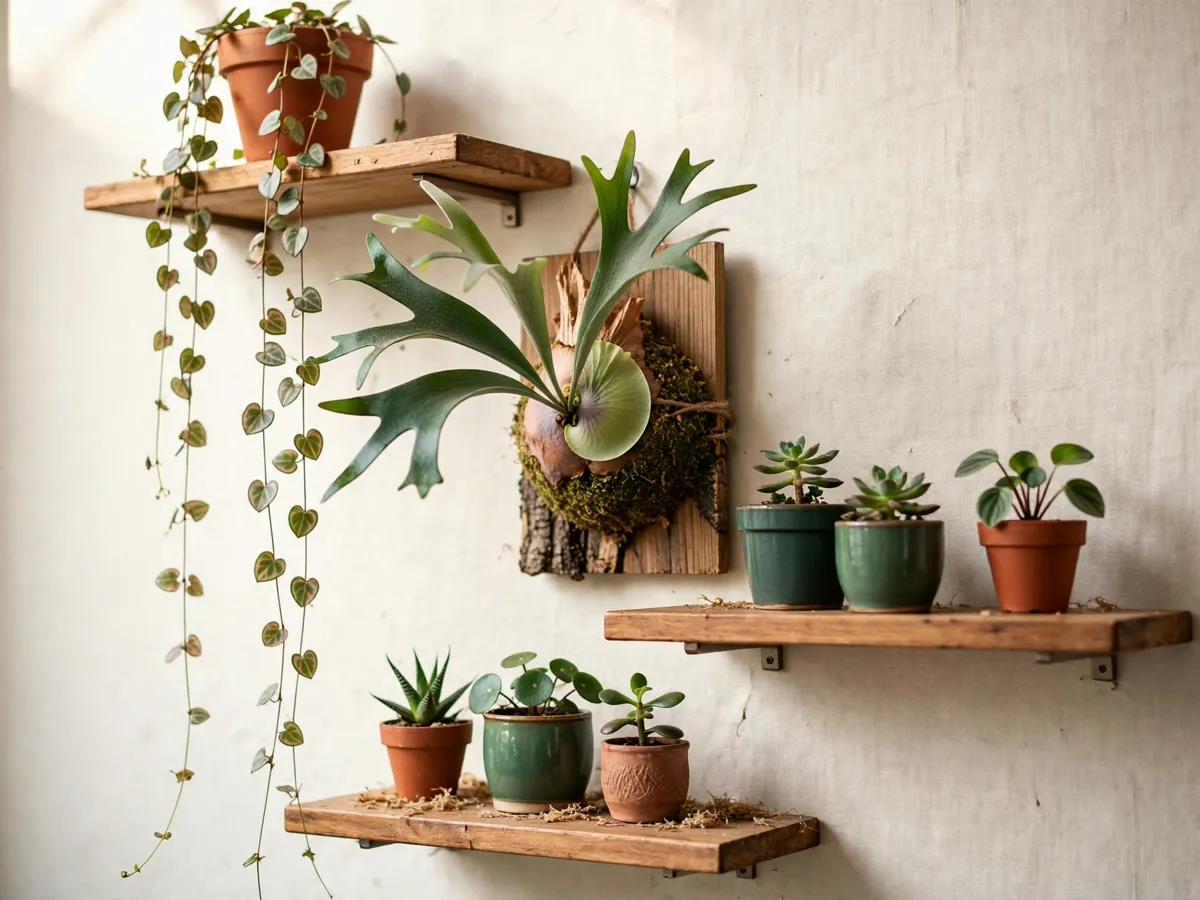
The staggering matters more than the shelves. Three shelves at even spacing with the same pots on each read as a display case; offset like stair steps, with a fern plaque between the first and second, they read as a garden climbing the wall. The weight rule is stricter here because a shelf sticks out from the wall instead of hanging flat: plastic nursery pots inside lightweight covers, nothing wider than a six inch pot up top. A ledge that lets go lands everything at once, so the first week runs with half the pots and a towel below.
Cost: $30–$80 by shelf count and length. Time: 60 minutes with a level and a pencil. Respect the stated weight limit with the planted weight, not the bare shelf weight.
5. Mount system 3: the lean-to ladder (zero wall contact)
The third system touches no wall at all: a ladder-style rack leaning against it, pots on the rungs. Plant ladder racks have deeper rungs or trays across the steps, and a full one carries six to ten pots up five or six feet without a hole, a strip or a hook. It is the system for the strictest lease.
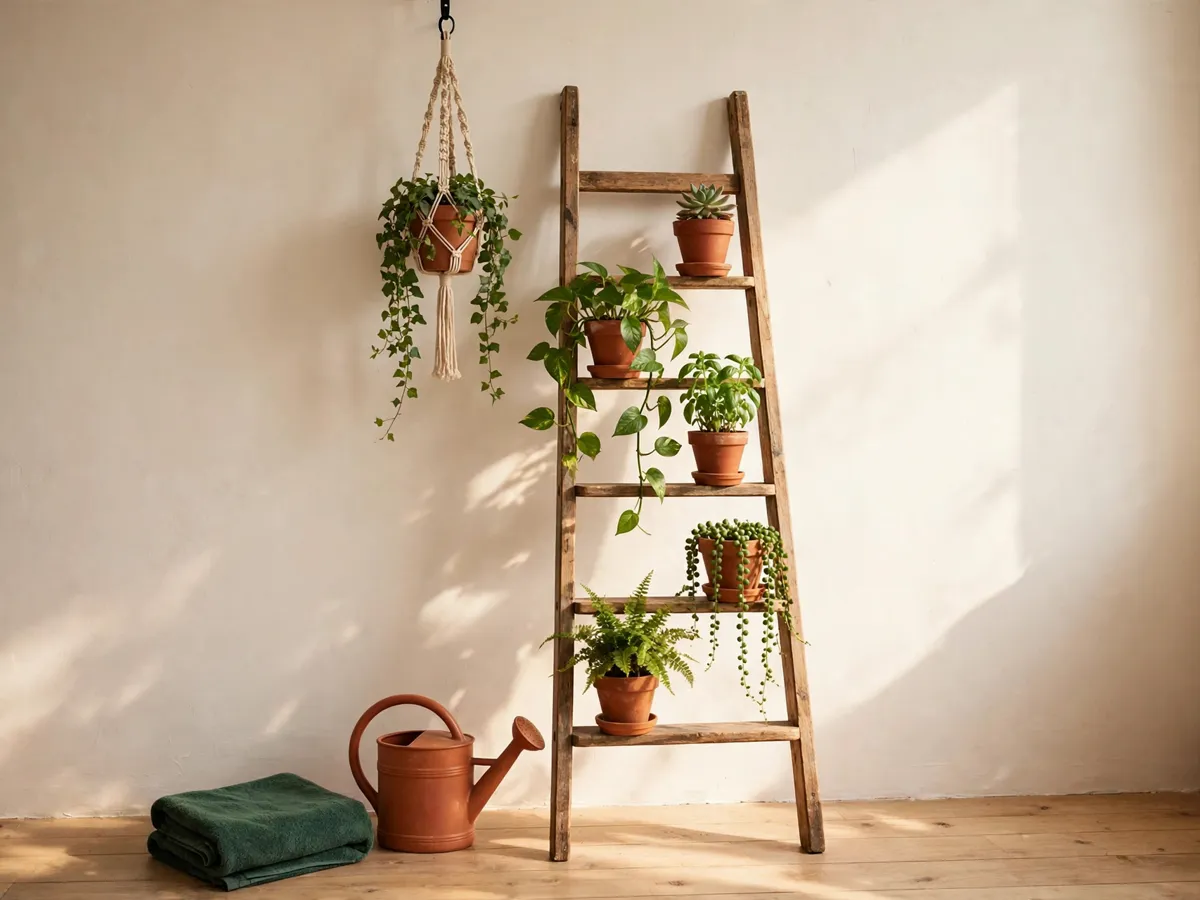
Set the feet about a foot out from the wall so the lean stays stable, and put the heavy pots on the bottom rungs where a fall would be short. The top rung is the trailer spot. A hanging planter from a ceiling hook finishes the picture, but a hook is a small hole; under a strict lease, a tall floor plant beside the ladder stands in instead. The rack also follows the seasonal light in a way no mounted system can.
Cost: $40–$90 for the ladder and the first pots. Time: 20 minutes. The top rung shifts with the lean angle, so trailers take the top and tall pots ride the middle.
6. The mounted plants: staghorn-style plaques and their care
The mounted plaque is the one true wall plant. Staghorn ferns are epiphytes, plants that grow on tree trunks with no soil at all, so living flat against a board is their native situation. A plaque is the fern mounted on wood with a moss backing, hanging from a single damage-free hook rated well above its soaked weight.
The care is the gentlest surprise in wall gardening: once a week the whole plaque comes down, soaks in a sink for ten minutes, drains, and goes back up. No drip, no tray, no spout gymnastics. The soak waters more honestly than a wall planter does: you feel the moss weight and know a dry plaque. Bright indirect light and a monthly feed in the growing season, and the fern slowly grows the antler shape. Plaques ship pre-mounted on cedar boards; start with one above the shelf zone.
Cost: $20–$50 for a pre-mounted plaque. Time: 30 minutes to hang it well, 10 minutes a week for the soak. A soaked plaque can double its weight, so the hook rating matters more here than anywhere else.
7. The plant picks: trailers, shelf plants and the no-drill list
The picks divide into three jobs. Trailers go on top and do the softening: pothos in any form, heartleaf philodendron, string of hearts for a bright wall, inchplant for fast color. What spills from a hanging planter is covered plant by plant in the indoor hanging plants guide. Shelf plants hold the middle: hoya, peperomia, small ferns, and string of pearls only where the light is strong.
The honest exclusions matter as much as the picks. Calatheas and fittonias are drama plants; dry wall air ends them by week six. Large floor plants belong on the floor, and culinary herbs want a kitchen window, not a bedroom wall. Buy small, in four inch pots, and let each plant grow into the spot. A wall is a shelf turned ninety degrees, so the composition habits hold at any angle: odd numbers, varied leaf shapes, one dark leaf against two light ones. The fuller version lives in the indoor plants as decor ideas guide.
Cost: $8–$25 per plant in four to six inch pots. Time: 90 minutes of shopping and potting. Cap the first wave at six plants; a wall fills in faster than a shelf.
8. Light mapping: which wall actually works in a small room
Choose the wall by light, not by emptiness. The emptiest wall is usually empty because the light never reaches it, and plants will not fix that. The best wall is beside or opposite a bright window: a wall perpendicular to a south or west window carries bright indirect light most of the day.
Run the shadow test at midday: hold a hand flat against the wall zone. A crisp shadow with visible fingers means direct sun, a soft-edged shadow means bright indirect light, and a shadow you have to hunt for means a low-light zone. Light fades toward the ceiling, so keep the living plants in the lower five feet and let the mount and vines take the top. A dim wall is not a failed wall; it is a wall for a mirror, a print, or a full-spectrum grow bulb on a clamp arm, which rescues a north-facing wall for $15 to $40 and covers a two by three foot zone.
Cost: $0 for the shadow test, $15–$40 if the wall needs a grow bulb. Time: 10 minutes at midday. Winter light runs a season lower; test in the darker month before committing the wall.
9. Watering a wall: the reach, drip and tray problem solved
Watering decides whether the wall survives month three. The routine: one watering morning a week, the top planters come down and water in the sink, the lower pots water in place from a long-spout can, and everything gets a finger test first. A boot tray catches the odd drip.
Drainage is the quiet decision. Wall planters without holes keep the paint clean but demand careful pours; planters with holes and attached saucers or wicking reservoirs demand less judgment. A self-watering hanging planter cuts the reach problem roughly in half on a grid system. Whatever the choice, water less than instinct says: an overwatered planter announces itself as a paint stain, and a stain is what a deposit inspection remembers. Small pots on a warm wall dry out in four to seven days, and winter heating pulls that shorter, so check twice a week in the heating season and wipe the leaves once a season; they are the light collectors.
Cost: $10–$25 for a long-spout can and a boot tray. Time: 15 minutes a week. The first month reveals the real pace of your wall; write the waterings down for three weeks before trusting a routine.
10. The renter rules: tension rods, damage-free hooks, undo plan
Three tools carry the renter version: tension rods, damage-free hooks, and the undo plan. A tension rod spans a window reveal or a nook, holding a row of small planters with nothing but pressure; the spring-loaded kind inside a window frame carries two to four light planters. Adhesive hooks carry the grid and the ledges, and their ratings are honest on smooth paint but unreliable on texture, so the first hook gets a week of solo testing with a loaded planter before the rest go up.
The undo plan is the part most renters skip and regret. Photograph the wall before anything touches it, keep the hook packaging, and know where the paint patch kit lives. At move-out: plants down, hooks off with a warm hairdryer and a slow pull, residue gone with the method printed on the pack. A wall that took an afternoon to build should take an hour to unbuild and leave no evidence. Everything else that wants the walls, prints, mirrors and textile hangings, follows the same no-drill rules, and the renter wall decor ideas with no drill guide carries that half in full.
Cost: $8–$20 for rods and hooks beyond the mount itself. Time: 20 minutes plus the week of testing the first hook. Steamy bathrooms break adhesive promises; a bathroom wall wants the ladder or the tension rod.
11. Cost planning: the $60–$200 build by system
Three budgets, one band. The grid version lands at $60–$100: the panel, four rated hooks, four to six hanging planters and the first six small plants. The shelf version runs $80–$140, because wood costs more than wire. The ladder version tops the band at $120–$200, and it is the only one that asks no adhesive trust at all.
Where the money should go: the mount, not the plants. A $35 grid rated for wet weight outperforms a $15 one that bows by month two, while a $6 pothos grows exactly as fast as a $16 pothos. Spend once on the load-bearing layer and stay cheap on everything that grows. Spreading the cost is insurance too: mount and first plant wave in month one, the second wave a month later, because a wall planted all at once fails all at once if the light was misjudged.
Cost: $60–$200 total across the three systems. Time: 20 minutes of planning before any purchase. Plants are the line that grows past the plan; set the cap before the second nursery trip.
12. The 3-week setup plan: mount, plant, adjust
Week one is the empty wall: mount the system, hang nothing, and live with the bare grid or ledges for seven days while checking the light at midday and the reach from the step stool. Move the mount now, while moving costs nothing. Week two is the tolerant wave: two trailers and two shelf plants on a fixed watering morning. Week three is adjustment: whatever leaned toward the window gets rotated or dropped a rung, whatever held gets company, and the plaque goes up if the light earned it.
The three-week shape avoids the cascade where everything is planted against the wrong light and fails together; by month end the routine is set and the wall is a ten-minute chore instead of a project.
Cost: $0 beyond the build already done. Time: 20 minutes a week across three weekends. If the first trailer wilts in week one, the light is wrong, not the plant; move the mount before buying the second wave.
13. Common mistakes: too-heavy pots, dark walls, overwatering
Too-heavy pots is the first and most expensive mistake. A soaked terracotta pot on an adhesive hook is a physics problem with a deadline, and the failure mode is the whole planter on the floor. Plastic and composite pots, soil cut with perlite, nothing above a six inch pot on the wall: the weight rule is the difference between a wall that holds and one that does not.
The dark wall is the second: the empty wall gets chosen because it is empty, and it is empty because the light never reaches it; the ten-minute shadow test saves the whole build. Overwatering is the third, hiding behind good intentions: planters without drainage get watered on a schedule instead of a finger test, the roots sit wet, and the first sign is a smell and a stain rather than a wilt. The fourth is the motel row: six identical planters at identical heights. Stagger the heights, alternate the leaf shapes, and let one trailer run loose.
Cost: $0. Time: 10 minutes to audit a wall already built. The fix for most of these is moving one pot, not buying anything new.
Common questions
Can I put a plant wall in a rental without drilling?
Mostly yes. The grid hangs on rated adhesive hooks, the shelf ledges mount the same way, and the ladder touches no wall at all. The limits are texture and steam: adhesive holds on smooth paint and lets go in a bathroom, so a textured or humid wall gets the ladder.
What plants are best for an indoor plant wall?
Trailers on top: pothos, heartleaf philodendron, and string of hearts where the light is strong. Tolerant shelf plants in the middle: hoya, peperomia and small ferns. One mounted staghorn-style plaque if the wall has bright indirect light.
How do I water plants on a wall?
One watering morning a week: the top planters come down to the sink, the lower ones get a long-spout can, and a boot tray catches the drips. Finger-test before pouring, and check twice a week in winter. Self-watering planters cut the work roughly in half on a grid system.
How much light does a plant wall need?
Bright indirect light for most of it: the wall beside or opposite a bright window, tested with the midday shadow test. Keep the living plants in the lower five feet, because light fades toward the ceiling. A dim wall needs a mirror, a print, or a small grow bulb before it can hold plants.
How much does an indoor plant wall cost?
$60–$200 all in for the systems in this guide: the grid at the low end, the ladder at the top, six starter plants included. The mount is where quality matters; the plants can start cheap and small. Anything beyond six plants is a second wave, and the wall will tell you whether it wants one.
Save these on Pinterest
Pin the three mount systems and the two tests that decide between them, the midday shadow test for the wall and the wet-weight check for the hooks, so the next blank wall starts with a plan. The rest of the small-room ideas live in the Small Room Decor collection, and the plant half lives in the Gardening & Planting Tips collection.