 Plant As Deco
Gardening & Planting Tips
Indoor Climbing Plants: Vines, Moss Poles and Trellises
By Plant As Deco · Updated 20 November 2026
A climbing plant uses the part of a small apartment nobody pays for: the wall. Instead of spreading across a dresser, a vine runs up a moss pole, along a trellis, or through a row of clips, and covers four feet of vertical surface from a pot eight inches wide. Given a support it grows larger leaves and reads as built into the room rather than set down in it. This guide covers the six vines that climb indoors, the three supports that hold them, and the training that decides whether either works.
Weekend-ready: $5–$35, one afternoon to set up. Apartment-safe: a moss pole standing in a pot needs no holes in the wall, and a clip run lifts off clean at the end of a lease.
Why climbing plants suit small spaces
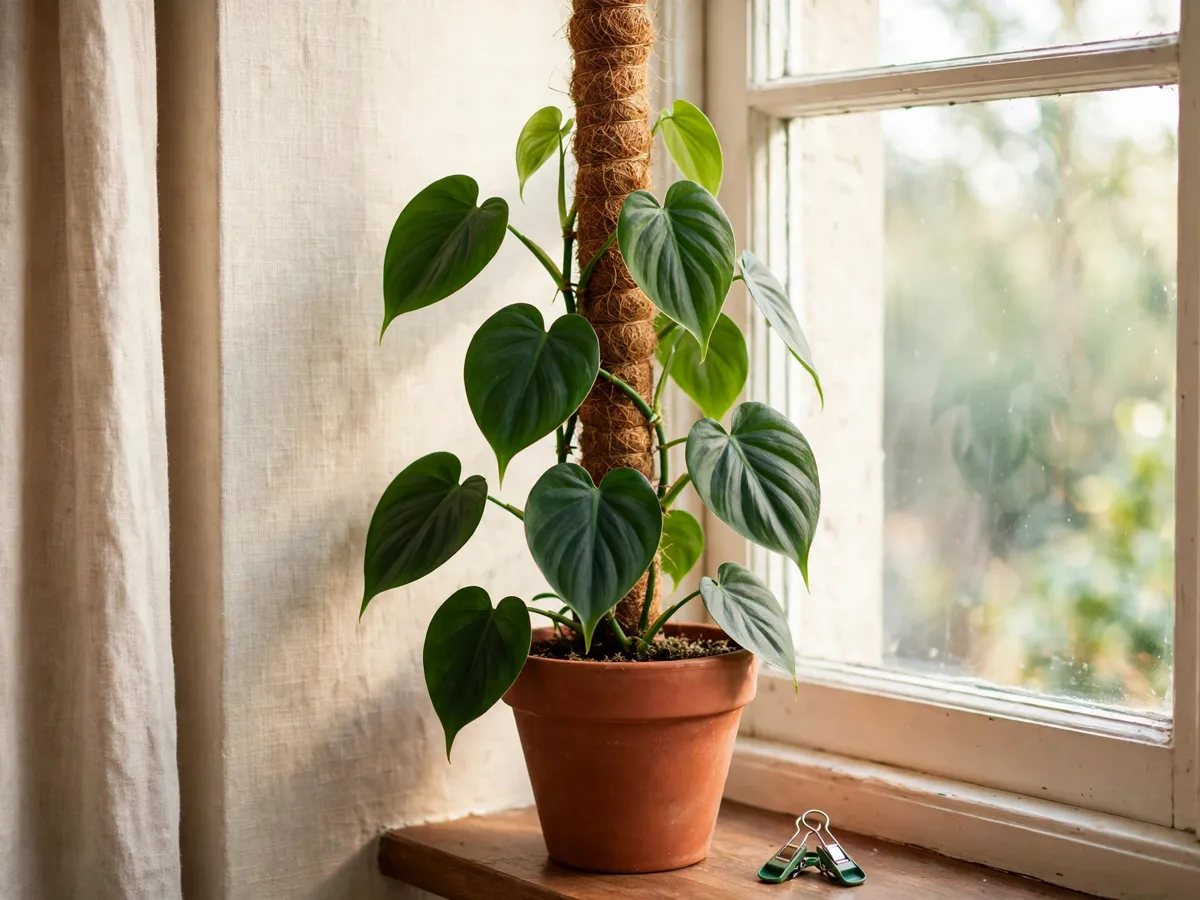
Floor space in a small home is spoken for: the bed, the desk, the path to the window. A pot down there is one more thing to step around. A climber moves the same foliage onto the wall, where the square footage is free. An eight-inch container covers half a square foot; the vine inside it, run up a three-foot pole, presents three or four square feet of leaves.
The second reason is the plant itself. A vine that climbs is in a different phase from one that sprawls. Given something to grip, pothos and monstera push out larger leaves, and monstera adansonii opens the holes that make it worth growing. The aerial roots along each node take moisture from the pole, and the plant stops behaving like a ground creeper.
There is a trade. A pole adds weight above the pot, so a climber tips more easily than a bushy houseplant, and watering has two targets: the mix and the pole itself. Budget ten minutes a week on top of the afternoon you spend setting it up.
One distinction before you buy. This is about green that goes up. If you want foliage falling over the edge of a bookcase, or a basket at window height, that is the downward version, and the indoor hanging plants guide covers the cords and the watering that go with it.
Match the vine to your light first
Light decides whether a vine climbs at all. A support gives a climbing plant somewhere to go; it does not give it the energy to go there. In a dim corner, the pothos that adds a leaf a week beside a window holds what it has and slowly thins, and no pole changes that. Choose for the light before you choose for the look.
Sort the room into three bands. Bright: within two feet of an unblocked east, west or south window.Medium: three to six feet back, or across a north-facing one. Low: eight feet from any window, or an interior wall that gets only spill. Adansonii, string of hearts and ivy want bright. Pothos and heartleaf philodendron climb in medium. In the low band almost nothing climbs well, and the low-light indoor plants list is the honest read on what holds up there.
Then read the plant instead of the calendar. A vine pointed at the glass, with each new leaf the same size as the oldest or bigger, is in enough light. One that swings sideways off the pole, with the gaps stretching and each new leaf smaller, is reaching. Bleached patches on the foliage nearest the glass mean the opposite problem.
Move the container before you blame the support. Light falls off steeply indoors, so a pot two feet closer to a window changes more than a taller pole. Give it four weeks, then look at the newest leaf.
The six that climb well indoors
These are the vines that climb inside an apartment rather than only in a greenhouse. Each grips or winds a support, stays under five feet in a room, and forgives a beginner who misses a watering. All six want a pot with a drainage hole and light in one of the bands above.
Pothos is the vine to learn on. It sends aerial roots from every node, presses them into a coir pole, and enlarges its leaves over a season of doing so. It climbs in medium light, shrugs off a dry week, and roots in a glass of water on a sill.
Heartleaf philodendron (Philodendron hederaceum, often sold as scandens) climbs as willingly as it trails. Its stems are thinner and its leaves smaller than pothos, so it reads well on a trellis panel rather than a fat pole, and it holds colour better in a north-facing room.
Monstera adansonii is the Swiss cheese vine and the one most worth a moss pole. On a support with enough light, each new leaf opens with more holes than the last; sprawled across a desk it stays small and plain. It wants bright indirect light and a pole at least eighteen inches tall. The split-leaf monstera climbs the same way at a larger scale and takes more room.
Hoya, often sold as the wax plant, does not grip. It twines, coiling its stems around anything thin enough to wrap. Offer mesh, netting or a slim trellis rather than a pole, and wind the new growth through by hand. It is slow, stores water in thick leaves, and is one of the gentler plants here for a home with cats or dogs.
String of hearts (Cevophylla woodii) twines the same way, with neat hearts spaced along thread-thin stems and small tubers at the joints. It needs bright light and something fine to wrap, so a twelve-inch pole is too thick; a mesh panel suits it.
English ivy (Hedera helix) grips with holdfasts, the same mechanism it uses on an exterior wall. Train it on a trellis board or a wire panel you can lift away, not on painted drywall. It prefers a cooler room, dries out faster than the tropical vines here, and is toxic to cats and dogs.
Cost: $5–$15 for a young pothos or heartleaf philodendron in a four-inch pot, $12–$28 for adansonii, $10–$25 for a rooted hoya, $8–$18 for ivy. A budget of $35 buys one vine, a twelve-inch coir pole and a pack of clips.
Moss poles, trellises and wall clips
Supports come in three families, and the right one depends on how your vine attaches. Grippers with aerial roots — pothos, philodendron, monstera — want a rough, damp surface to press against. Twiners — hoya and string of hearts — want something thin enough to coil around. Holdfast climbers — ivy — want flat texture and a panel they can lift off later.
A moss pole is the workhorse. Buy a coir one, $8–$22 for twelve to thirty-six inches, or build a DIY version: PVC pipe, a sleeve of mesh, packed with damp sphagnum and tied with twine. The homemade pole costs about ten dollars.
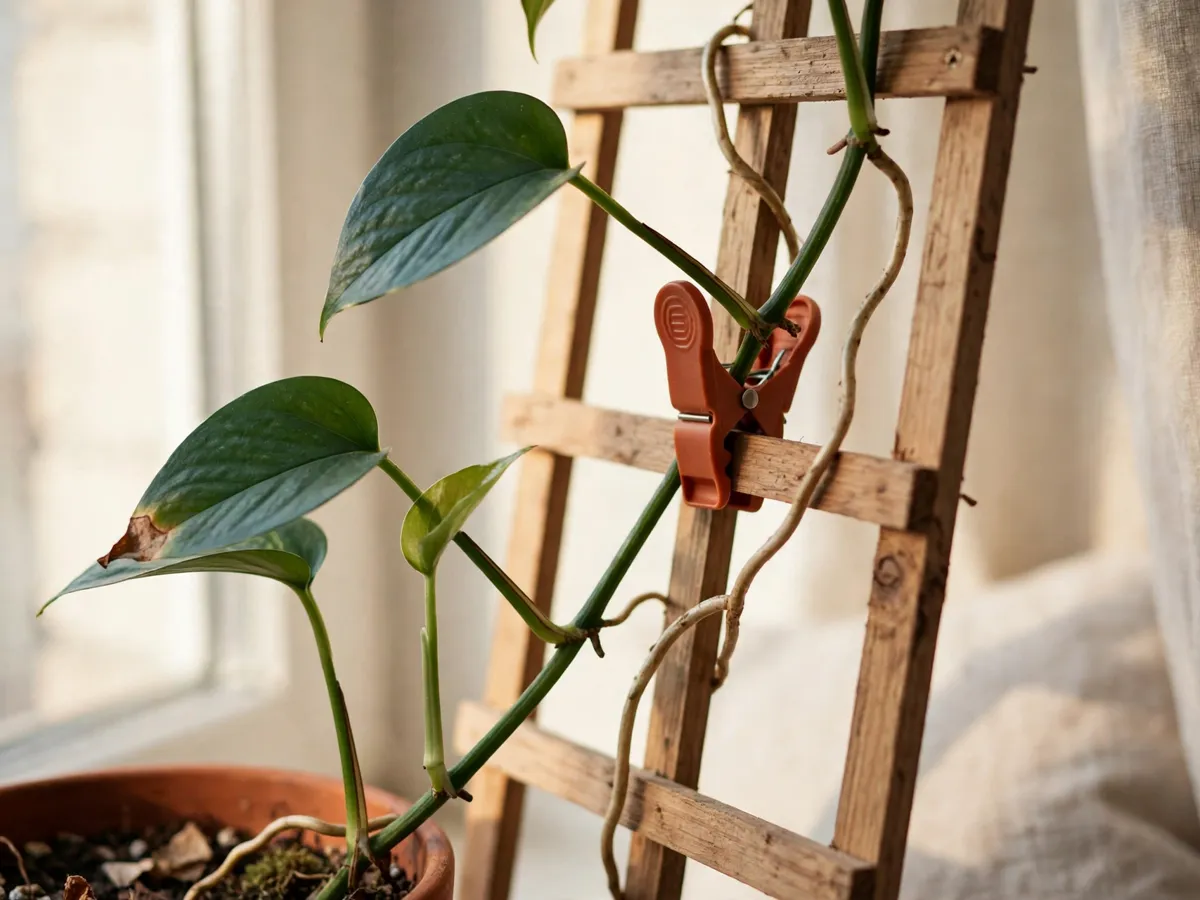
A trellis is a flat panel — a wooden lattice board, a wire grid, a frame of copper pipe — mounted or leaned against a wall. The renter route is to lean it and clip the top, fix it to a picture rail, or use a freestanding stand. Adhesive hooks rated for twice the loaded weight hold a light panel on smooth paint; give them a day before anything hangs on them.
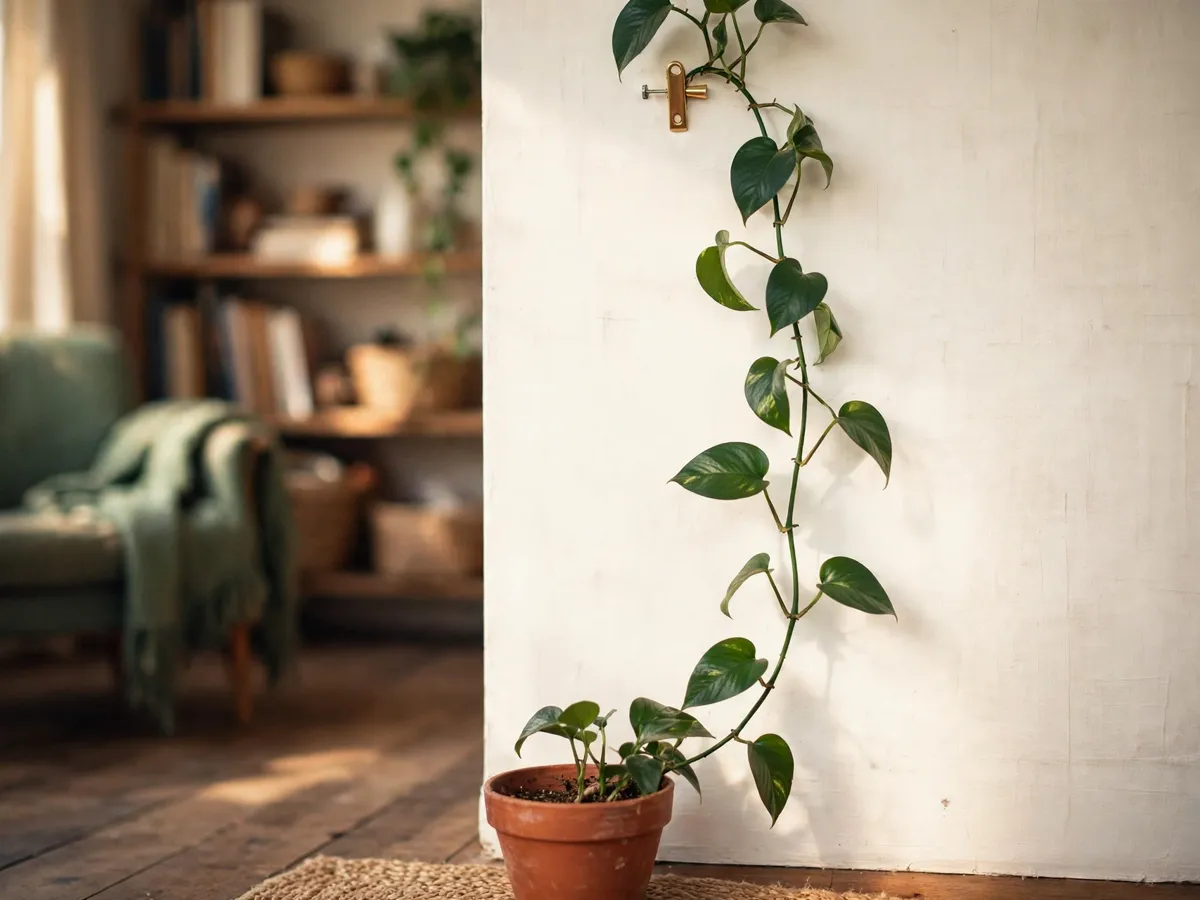
Wall clips are the cheapest support: $3–$10 for a pack of ten adhesive plant hooks, each carrying one stem. Space them four to six inches along the line you want the vine to follow and press a leaf node into contact with the wall. Clips are how a corridor, or the strip above a bookcase, becomes a green run with no pole at all.
Match the pot to the height. A three-foot pole carrying a mature vine is top-heavy, and a wet mix adds pounds above the rim. Use terracotta rather than plastic for anything over two feet, choose wide over tall, and keep it out of a walking path.
Training a vine onto its support
Training is attachment plus direction, done often enough that a stem never has to be forced. A tie pulled snug on a swelling stem bruises it; a vine bent around a corner it does not want snaps at the joint. Both are the usual reason a climber looks damaged after a month.
Use a soft tie or a clip and leave a loose loop, wide enough for two fingers to slide under. Where one clip is not enough, a figure-of-eight loop of twine between pole and stem holds without gripping. Check every tie twice a month and loosen any that has bitten in. A vine that has anchored itself no longer needs the clip, so take it off.
Point the newest node upward. A vine trained horizontally slows and sends side growth instead. Spiral the stems as they rise so each node presses against the surface; two nodes in contact per foot of pole is enough to hold the line.
Aerial roots need contact and humidity. Press a stem to the pole and leave it; within a week or two, small brown roots appear and grip. Pour a little water down the top of the pole, or mist it, and the roots find it sooner. Twining vines never anchor, so a hoya stem has to be wound through mesh by hand every few weeks.
Retrain early. While a tip is still soft it follows a clip anywhere; a hardened stem pulled around a corner cracks. If a long stem has wandered, cut below the point where you want new growth and root the top section in water — the houseplant propagation basics decide whether that cutting becomes a second vine or a lost one.
Pots, soil and drainage for climbers
A climber's root ball stays small relative to its height, which is why an oversized pot is the usual mistake. Choose a container with a drainage hole, one size wider than the root ball and no more. Extra mix holds water around a small root ball, and standing damp is the condition under which roots fail.
Weight is the pot's other job. For a pole over two feet, a terracotta container suits; a plastic one is fine for a clip run along a wall. The rule is an empty saucer: pour out the run-off twenty minutes after watering.
The mix should run through fast. Loosen a standard houseplant mix with bark and perlite until light shows through when you break a clump apart, and work a handful of sphagnum into the top inch to hold moisture near the aerial roots.
Repot in spring, one size up, trimming any root that has circled the base. A vine that has not been repotted in three years is usually the one that stopped producing bigger leaves. Keep the pole; replace the mix.
Cost: $8–$20 for a terracotta pot with a drainage hole, $12–$20 for a bag of bark-based mix that fills two six-inch pots.
Watering and feeding while it climbs
A climbing plant gives you two things to water: the pot and the pole. The pot follows the ordinary rule. The pole dries from the outside in, and it is the surface the aerial roots grip, so a bone-dry pole is the most common reason a vine refuses to attach.
For the pot, use the finger test. Push a finger two inches into the mix; cool and damp means wait, dry and light in the hand means water. Soak until it runs from the drainage holes and let it drain fully. In bright light in summer that is often every five to seven days for pothos and philodendron; in a cold, dim room in January, every two or three weeks.
For the pole, pour a little water down its top or mist it two or three times a week while the vine establishes. Coir holds moisture for days; a sphagnum pole holds more and dries slower. Once the roots have gripped, ease to a weekly misting so the surface stays damp rather than wet.
Feeding follows growth. While new leaves are opening, run a balanced liquid houseplant food at half strength through the pot once a month, and stop when the plant pauses. Surplus food only leaves salt behind; every few months, flush it by watering until it runs clear. The indoor plant food guide covers which numbers to read on a bottle.
Time: ten minutes a week. One misting pass on the pole, one finger test on the pot, one look at every tie.
Pet safety and what to avoid
Growing foliage upward keeps most of a vine above a cat, but the first two feet sit at paw height. Pothos, heartleaf philodendron, monstera and English ivy are all listed by the ASPCA as toxic to cats and dogs; ivy is listed for horses as well. Their calcium oxalate causes mouth irritation and vomiting if a pet chews, so treat the lower leaves as the risk rather than the top of the pole.
Train those four above three feet and clip the lowest stems short. Hoya and string of hearts are not on that list, which is not the same as edible: an animal that eats a quantity of any houseplant can end up with an upset stomach. Check a plant before you bring it home.
Two hazards have nothing to do with toxicity. A three-foot pole in a light plastic pot, standing in a walkway, will come down on a dog or a child, so weight the base. And ivy's holdfasts lift paint off a wall.
If your home chews everything, start from the pet-safe houseplants list and work backward, rather than buying first and rehoming the vine later.
Styling: where the vine goes
Decide the endpoint before you plant. A vine with nowhere to stop becomes a mess by month four, and the fix is a longer support rather than a trim. Three lines work in a small home: straight up a pole in a corner; along a run of clips at eye height above a bookcase or a bed head; or up one wall and back down over a ledge.
A pole beside a window is the easiest win, because a corner is dead space and the pole fills it without touching the path. Set the pot at the apex, train the vine up in a shallow spiral, and stop a hand's width below the top of the window.
A clip run turns a corridor, or the strip above a door frame, into a green line. Space the clips four to six inches, alternate which stem goes into which clip, and check the line from the doorway.
A trellis panel works as a screen: beside a wardrobe, in front of a cable rack, or leaning where a taller plant would not fit. For a whole wall, the vertical wall planting guide covers the frames and spacing.
Where the vine tops out, train it back down over the rim of the support and let two or three leaves hang. That turn is what separates a planted corner from a stem that simply stops.
Common failures and quick fixes
The vine will not grip the pole. Contact and humidity are both missing. Press a node against the surface, hold it with a loose tie, and mist the pole two or three times a week until roots appear. A dry coir pole repels them.
Leaves get smaller as they climb. Usually light, sometimes a dry pole, occasionally a pot that has run out of room. Move the container closer to the window and give it four weeks. If the newest leaf is still smaller, tip the plant out; if roots circle the pot, repot one size up in spring.
A stem snaps at the tie. It was forced. Loosen every tie on the plant, then retrain the stem in the direction it already points. Where a long run has cracked, cut below the break and root the top section in water.
Crispy brown edges on the lower leaves. Dry air or a heat vent, and damage already done. Trim the worst leaves off at the node; the next growth comes in clean.
Scale, mites or other pests under the clips. Check the undersides where a tie meets the stem. Wipe the stems with a damp cloth, keep the plant away from the others, and re-check weekly for a month.
The whole pole tips over. Under-weighted. Swap the plastic pot for terracotta, or set the pot inside a heavier one, and move it out of the walkway.
The pattern across all six: the fault sits in the light, the contact between stem and pole, or the water. Rarely in the food.
Your first climbing plant plan
A beginner's first corner, in the order to buy it.
- One bright spot, within two feet of an east or west window, checked by which way the newest leaf points
- One pothos or heartleaf philodendron in a four-inch pot, $5–$15
- One twelve-inch coir moss pole, $8–$22, or a mesh pole for $10
- One pack of adhesive clips or soft ties, $3–$10
- A terracotta pot with a drainage hole, one size wider than the nursery pot, $8–$20
- An airy mix loosened with bark
- Loose ties, one node pressed to the pole, newest growth pointed up
- Finger test before every drink; empty the saucer after twenty minutes
- Mist or top-pour the pole two or three times a week while it establishes
- Half-strength liquid food monthly, only while new leaves open
- Check every tie twice a month and loosen any that bites in
- Check pet safety first; keep the lower two feet clear in a home that chews
Total for one corner and one vine: $24–$77 depending on the pot and the pole. One afternoon to set up, ten minutes a week after that. Add a second support when the first is gripping on its own, not before.
Common questions
Which climbing plant is easiest for a beginner?
Pothos. It roots from every node, grips a coir pole in medium light, survives a missed watering, and costs less than the pole you put it in. Heartleaf philodendron is the close second and the finer-looking vine; both train the same way, so a beginner who learns on one can switch to the other without relearning anything.
Do I need a moss pole, or will a trellis do?
It depends on the vine. Grippers with aerial roots — pothos, philodendron, monstera — do best on a rough pole they can press into, and a trellis works if you keep the stems in contact with it. Twiners such as hoya and string of hearts need something thin enough to coil around, so mesh or a slim trellis beats a pole outright. Ivy wants a flat panel it can be lifted off later.
How do I keep a vine on a wall without ruining the paint?
Use clips, and do not let the plant grip the wall itself. Adhesive plant hooks rated for twice the stem weight come off clean on smooth paint; a picture rail or a leaning trellis panel avoids the surface altogether. English ivy is the exception worth refusing, because its holdfasts bite into paint and take the finish with them when you pull the stem away.
Why are my climbing plant's leaves staying small?
Work down three causes in order. Light first: move the pot within two feet of a window and give it four weeks. Pole second: a dry pole gives the aerial roots nothing to grip and nothing to drink from. Root room third: a vine that has not been repotted in three years stops sizing up its leaves. Feeding is rarely the first fix, and a slow plant fed hard only accumulates salt.
Are climbing plants safer around cats and dogs than low ones?
Only partly. Most of the foliage sits above reach, but the first two feet of any vine is at paw height, and pothos, philodendron, monstera and ivy are all listed as toxic to cats and dogs. Train those low stems short, or start with hoya and string of hearts, which are not on the list. Being absent from a toxic list is not a claim that a plant is food.
How long before a vine reaches the top of a pole?
In bright light, pothos and heartleaf philodendron cover a three-foot pole in one to two growing seasons. Adansonii runs a similar pace and shows the change best, because its leaves size up and open as it climbs. Hoya is slower, often two or three years to a modest panel.
Save these on Pinterest
Pin the six-vine list and the three-support comparison, because those are the two you will re-read before buying anything. The rest of the plans for small spaces and renters live in the Gardening & Planting Tips collection.