 Plant As Deco
Gardening & Planting Tips
African Violet Indoor Care: Bloom on the Windowsill
By Plant As Deco · Updated 23 November 2026
An African violet is a small windowsill bloomer with one strange rule: never wet the leaves. Everything else in its care follows from the fuzz on those leaves. Water goes in from below, in a tray, on a twenty-minute timer. The window is bright but sunless. The mix is light and fluffy, the pot is small, the feed is diluted. The rest of this page is diagnosis and rescue: the four reasons a violet stops flowering, the surgery that saves a plant rotting at the crown, and the single leaf that restarts a whole collection.
Weekend-ready: $6–$20 for a blooming plant, the pot and the mix, one afternoon. About five minutes of watering and turning after that, twice a month with feed.
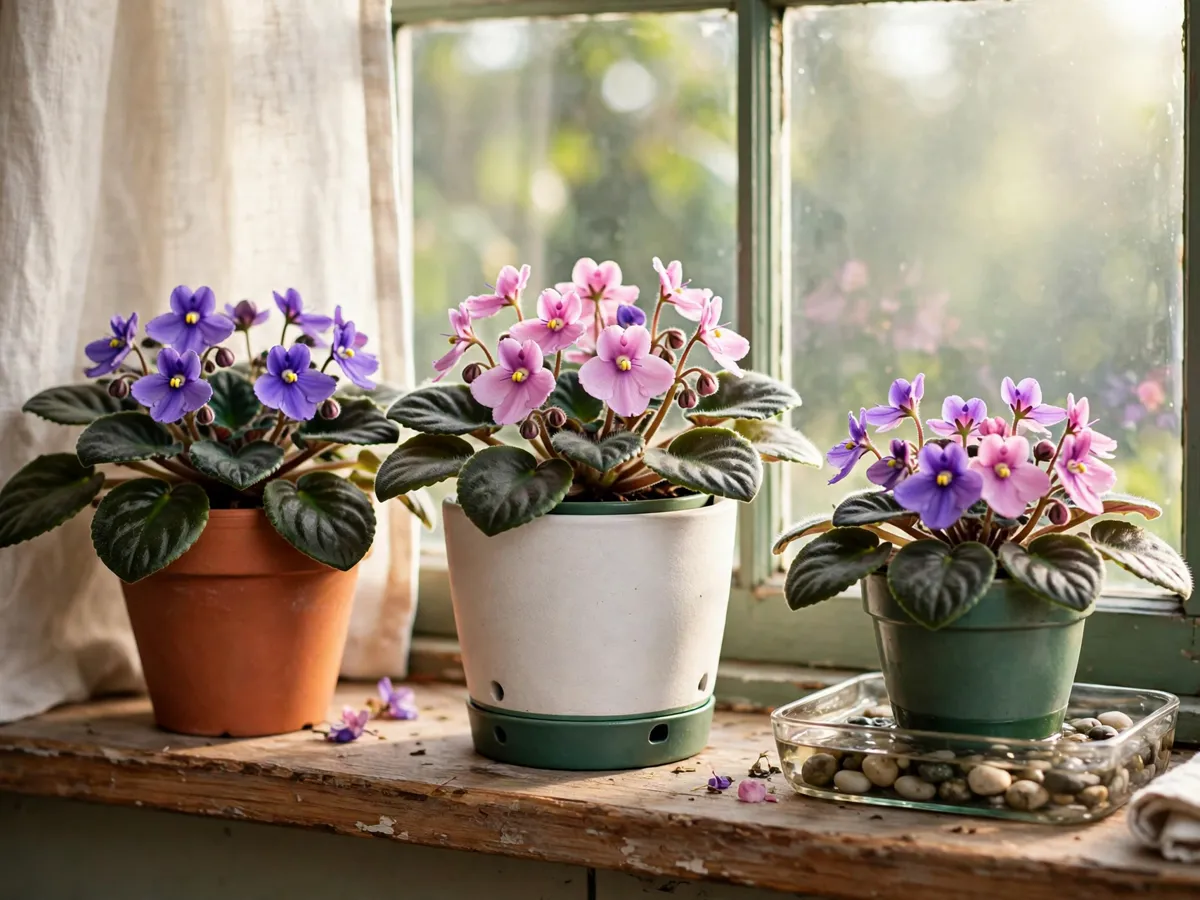
1. What an African violet actually is: the fuzzy windowsill Saintpaulia
Saintpaulia ionantha was collected in 1892 in the Usambara Mountains of northeastern Tanzania, growing on shaded rock ledges under a cloud forest canopy. It is not a violet at all; the flowers only resemble them, and the name stuck. Botanists have since folded the old genus into Streptocarpus, which makes the shelf name doubly wrong and doubly permanent.
The wild design explains every rule in this article. A flat rosette of fuzzy leaves with a single growing point at the center. Fine, shallow roots running through loose leaf litter. Light filtered through trees, so bright it grows flowers, but soft enough that full sun never lands on the leaves. In nature, rain drains off the fuzz in seconds. In a kitchen, a droplet sits on a leaf for an hour and scars it.
Among the low maintenance indoor plants, the violet is the blooming exception: modest effort that pays in flowers almost year round, each cluster holding two to three weeks. It stays under a foot across and it forgives a missed watering. The two things it never forgives are soggy mix and wet leaves.
Cost: $0. Time: 5 minutes to reset expectations. Caveat: a store violet raised in perfect greenhouse air sheds a few outer leaves while it settles into a dry apartment.
2. The one rule: never wet the leaves
Every leaf wears a coat of fine hairs, and a water droplet stands on those hairs like a bead on a brush. The bead does two kinds of damage before it dries. Cold water chills the tissue beneath it and leaves pale yellow-green rings and corky lines for the rest of the leaf life. In bright sun the droplet works as a small lens and burns a pinhole through the fuzz.
Standing water does a third, slower harm. In a dim, still room, wet fuzzy foliage is where gray mold gets its start, and once it runs through a flat rosette there is very little left to save. So the watering rule is absolute in practice: water goes into the mix, at the rim, from a narrow spout, at room temperature. If a splash lands on a leaf, blot it dry at once.
The rule reaches cleaning too. Violets cannot be wiped or showered the way glossy-leaf plants can; the fuzz holds water and rubbing bruises the leaf. Dust comes off dry, with a soft paintbrush swept outward from the center. The full routine, including the fuzzy-leaf exceptions, is in the how to clean indoor plant leaves guide.
Cost: $0, or $2–$4 for a soft brush. Time: 5 minutes a month per plant. Caveat: marks left by old water damage never fade on that leaf; only the new leaves come in clean.
3. Bottom watering: the tray method, the 20-minute limit
Bottom watering is the technique that makes the never-wet rule easy. Fill a tray or saucer with room-temperature water about an inch deep, set the pot in it, and let the mix drink through the drainage hole from below. Capillary pull wets the whole rootball from the bottom up, the leaves stay dry, and the crown never sees a drop.
The limit is twenty minutes. Lift the pot out, let it drain over the sink, and pour away the leftover tray water. A pot left standing past that point keeps drinking until the bottom of the mix is saturated, and saturated peat around the roots is where crown rot begins. If the surface is still dry after twenty, the mix was already moist enough, or it has dried out and shrunk away from the pot walls.
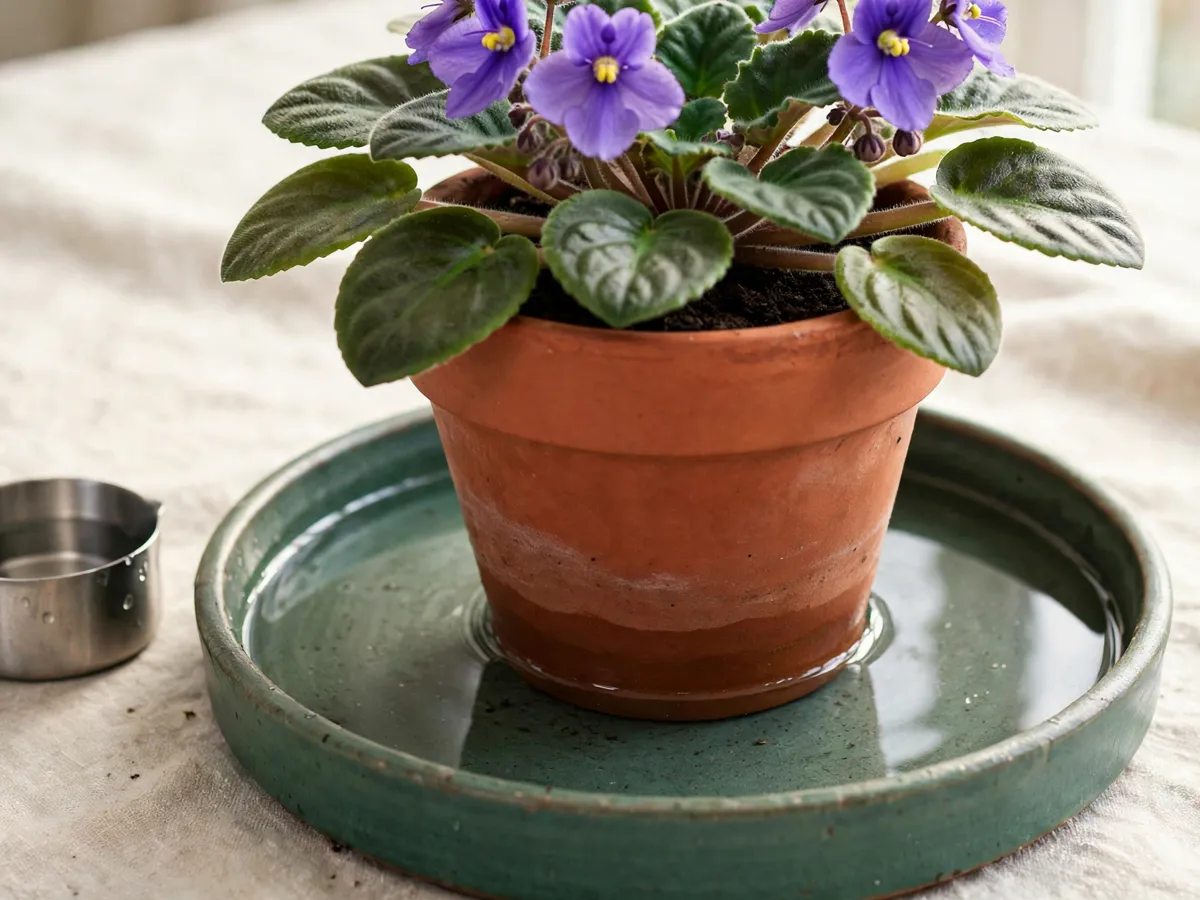
Temperature matters as much as direction. Cold water shocks the roots and spots the leaves, so fill the can after the last soak and let it sit until it matches the room.
Cost: $0, or $5–$10 for a deep tray. Time: 25 minutes, most of it waiting. Caveat: never let the pot sit in water overnight; that one habit is what turns a healthy violet into a crown-rot case.
4. Light: the bright indirect window, east or north logic
The light that blooms a violet is bright, generous and sunless. An east window is the classic: a couple of gentle morning hours on the leaves, then bright indirect light for the rest of the day. A north window, bright but sunless from morning to night, holds violets well too, which makes this one of the few houseplants that genuinely fits a north-facing apartment. A south or west window needs a sheer curtain in summer.
The plant reports its light level in the attitude of its leaves. A violet in the right light carries its leaves flat and horizontal, a tidy green plate. In weak light the leaves rise and reach on longer stalks and the crown turns funnel-shaped. In harsh sun the leaves flatten down against the pot, go hard and pale at the edges. Flat and horizontal is the goal.
Two habits finish the routine. Rotate the pot a quarter turn at every watering, because a rosette grows toward the glass. In winter, when window light halves, move the plant closer and wash the pane. The same sill in summer hosts the opposite plant: the jade plant indoor care guide covers the succulent that wants the full sun a violet refuses.
Cost: $0 to use the window you have, $10–$15 for a sheer curtain. Time: 10 minutes of observation a month. Caveat: a moved plant shows its opinion in the new leaves weeks later, so change one thing and wait.
5. Humidity: the pebble tray, not the misting bottle
A cloud forest plant measures its comfort in air moisture. The target indoors is roughly 50 to 60 percent, and a heated apartment in deep winter runs far below it. A dry room shows on the violet before anything else: buds dry and fail before they open, flowers drop early, and leaf edges turn crisp and brown while the faces stay green.
The pebble tray is the honest fix, because it raises moisture around one plant without ever touching the leaves. Take a shallow tray wider than the pot, fill it with a layer of pebbles, and set the pot on top. Keep water just below the base of the pot, never touching it, and top it up as it evaporates. The vapor drifts up around the leaves, which is exactly the form the plant wants. Grouping several plants on one large tray does the same job better, because a crowd of plants humidifies itself.
The misting bottle is the wrong tool. Misting wets the leaves, the one thing the fuzz forbids, and the droplets dry within minutes, so the gain is tiny while the spotting they can leave lasts the life of the leaf. If a room stays brutally dry all winter, a small humidifier near the shelf beats any tray.
Cost: $0 with a dish and stones, $8–$12 for a proper tray. Time: 5 minutes to set up, 1 minute to refill. Caveat: keep the pot above the water line; the pebbles are a stage, not a moat.
6. Soil and pot: the light fluffy mix, the self-watering ceramic
The mix should feel like a wrung-out sponge that falls apart in your fingers: light, fluffy, full of air. A bagged African violet mix is blended exactly that way, and the home version is equal parts potting soil, perlite and vermiculite. Dense all-purpose soil holds water for a week after one pour and slowly suffocates the fine roots.
Violets have shallow roots and shallow habits, and the pot is sized to match. The working rule: the pot diameter should be about one third of the leaf span, so a plant nine inches across belongs in a three inch pot. An oversized pot wraps the small rootball in mix that never dries, and wet mix is the road to both crown rot and the lazy, bloomless plant of section 8. Refresh the mix every six to twelve months, because peat breaks down, compacts and collects salts while it ages.
Older violets stretch upward on a bare stem, the neck, as the lowest leaves age off and the crown rises. The fix is a deep replant rather than a bigger pot: knock the plant out, trim a third of the rootball away, remove the tattered lower leaves, and sink the neck until the lowest ring of leaves sits just above fresh mix, back in the same pot. Done yearly, a violet stays a flat rosette for decades instead of a palm tree with a tuft.
The self-watering ceramic violet pot automates this article. It is an unglazed inner pot inside a glazed outer reservoir: water seeps through the porous wall at roughly the pace the plant drinks, the leaves never wet, and the reservoir needs a refill every week or two. A nylon wick cord from a jar of water into the mix does the same job for pennies. The one maintenance item is a white salt crust that builds on the ceramic over months; scrub it off and ease back on the feed.
Cost: $5–$10 for mix, $3–$6 for a plastic violet pot, $8–$25 for the ceramic self-watering set. Time: 20 minutes to repot. Caveat: in the two-piece ceramic set, the inner pot is the planter; the glazed outer is only a bottle.
7. Feeding: the diluted every-other-week bloom rhythm
A violet in bloom nearly year round is running a small factory on a small bench, and a steady weak feed beats rare heavy doses. The rhythm that works: a dedicated African violet food at a quarter of the label strength at every watering, or half strength every other week. Choose one rhythm and keep it boring, because salts build from surprises.
The honest version of bloom food is short. A formula with a modestly higher middle number supports bud set. A feed pushed hard on nitrogen grows lush, soft, dark leaves and no buds at all, while a violet fed nothing goes pale, small and slow. Whatever the bottle says, water the plant first: salts landing on dry roots burn the fine tips, so feed on damp mix only.
The feedback is visible. A white crust on the rim means too much; cut the dose or stretch the interval. Pale new leaves and slow growth mean too little. In winter, follow the plant rather than the calendar: if it still grows and holds buds under good window light, keep the dilute rhythm going; if it stalls in a cool room, stop until the first new leaves of spring.
Cost: $6–$10 for a bottle that lasts two seasons. Time: 5 minutes, every other week. Caveat: feed never buys blooms from a dim window; light sets the ceiling and the feed only fills it.
8. Blooms: why a violet stops flowering, 4 causes
A violet that grows leaves and refuses flowers is running one of four programs, and the decoder is short enough to memorize. Work down the list in order, because the first cause is the most common and each fix costs nothing to try.
Cause one: light. Weak light is the usual answer, and the plant confesses to it: dark leaves rising on long stalks, a funnel-shaped crown, soft growth. The fix is a brighter window or a closer seat at the glass, and the verdict arrives in new leaves first, then buds, over a month or two. Cause two: the pot is too big. A violet blooms once its roots fill the pot; in a roomy pot it grows roots and forgets flowers.
Cause three: feeding. A plant swimming in nitrogen makes leaves; a starved plant in exhausted mix makes neither. Dilute, regular feed plus a fresh bag of mix puts it back on schedule. Cause four: the room. Bud formation wants a steady 65 to 75 degrees; a plant living above 80 or below 60, or sitting over a heating vent, or catching a cold draft at the sash, holds its buds back. Very dry air finishes them off, which is the pebble tray section. Fix the shelf, not the fertilizer.
With all four aligned, the flushes cycle on their own. Snip spent flower stems off at the base with scissors, one minute a week, and the plant stops spending on seed and starts spending on the next round.
Cost: $0. Time: 10 minutes of diagnosis. Caveat: fix one cause at a time and give each a month, because changing four things at once hides which one actually worked.
9. Crown rot: the rescue surgery, and when it is too late
Crown rot is the violet disaster, and it almost always starts with water where water does not belong: a top watering poured into the center of the rosette, a pot left standing in its tray overnight, or a soggy, overpotted mix. The center of a violet is its single growing point, and when that point stays wet in a cool room it softens and collapses. The first sign is quiet: the young center leaves go limp while the outer ring still looks fine, and the crown tilts or pulls loose at a touch.
The surgery has a real success rate while firm tissue remains below the rot. Unpot the plant, rinse the rootball under running water, and with a clean blade cut away every brown, soft or translucent part of the stem and the base of the crown, slice by slice, until only firm pale tissue is left. Let the wound air-dry for an hour, then plant the cleaned neck in fresh, barely moist, fluffy mix, water lightly from the tray, and tent a clear bag over the pot while new roots run.
New center leaves within two to four weeks is the pass mark; nothing at all by six means the growing point was already gone. At that point the plant is finished, but the line is not: take one healthy leaf from the outer ring while any remain and restart it by the method in section 11. Growing replacements from leaves is exactly how violet collectors survive their own accidents.
Prevention is this whole article compressed into four habits: tray soaks capped at twenty minutes, no standing water, the one-third pot rule, and fresh mix every year.
Cost: $0, or $5–$10 for fresh mix. Time: 30 minutes of surgery plus weeks of watching. Caveat: the blade must reach firm pale tissue; soft brown all the way through means restarting from leaves instead.
10. Pests: cyclamen mites and mealybugs on violets
Two pests do nearly all the damage to indoor violets, and they sit at opposite ends of the difficulty scale. The mealybug is visible and beatable. The cyclamen mite is invisible to the eye and usually terminal for the plant that hosts it. Prevention is quarantine and attention: a new violet lives alone for a month before it joins the shelf, and the crown gets a ten-second look at every watering.
Cyclamen mites are near-microscopic and live deep in the folded young leaves of the crown, where sprays do not reach. The plant tells you before any tool can confirm it: the new center leaves come out deformed, curled inward, hard and grayish, and the flower buds fail or open twisted. Unlike a feeding problem it never grows out. On a suspected case, isolate the plant the same day. On a confirmed one the honest advice is hard: bag the plant and discard it with its pot and mix, wash the shelf, and wash your hands and tools before touching another violet, because the mites travel on contact. Do not take leaf cuttings from an infested plant; the cuttings carry the mites with them.
Mealybugs look like small clumps of white cotton tucked where a leaf meets the stem, and they are handled with patience rather than grief. Dip a cotton swab in rubbing alcohol and press it directly onto each insect, work over the sink, and repeat weekly for three rounds, because the first pass always misses the ones deep in the joints. A spill of gold pollen across the flowers and shriveled buds points to thrips instead; remove spent blooms and keep a sticky trap near the shelf. The identification pages and the wider set of options live in the indoor plant pests guide.
Prevention is quarantine and attention. A new violet lives alone for a month before it joins the shelf, and the crown gets a ten-second look at every watering, which is precisely when the deformed-center warning shows up. Dry leaves, bright light and a lightly fed plant keep every one of these problems small.
Cost: $3–$5 for alcohol and swabs. Time: 10 minutes per round, three rounds. Caveat: quarantine is the cheapest insurance in this article; skip it once and a whole shelf can pay for it.
11. Restarting from one leaf: the propagation cut
A violet is one of the few houseplants where the backup copy costs nothing beyond a clean blade and a cup. Any healthy leaf can sprout a cluster of tiny plantlets from the base of its stalk, which means a dying plant, a traded variety and a gift for a friend all begin the same way.
Choose the leaf like a juror. The best candidate sits in the middle ring of the rosette: fully grown, firm, deep green, free of marks, with a stalk about an inch and a half long. Avoid the tired outer ring and the soft baby leaves at the center, and never take a leaf from a plant you suspect of mites. Cut the stalk cleanly at an angle; a slanted cut exposes more rooting surface. Unlike succulent cuttings, a violet leaf wants no drying period: plant it within the hour.
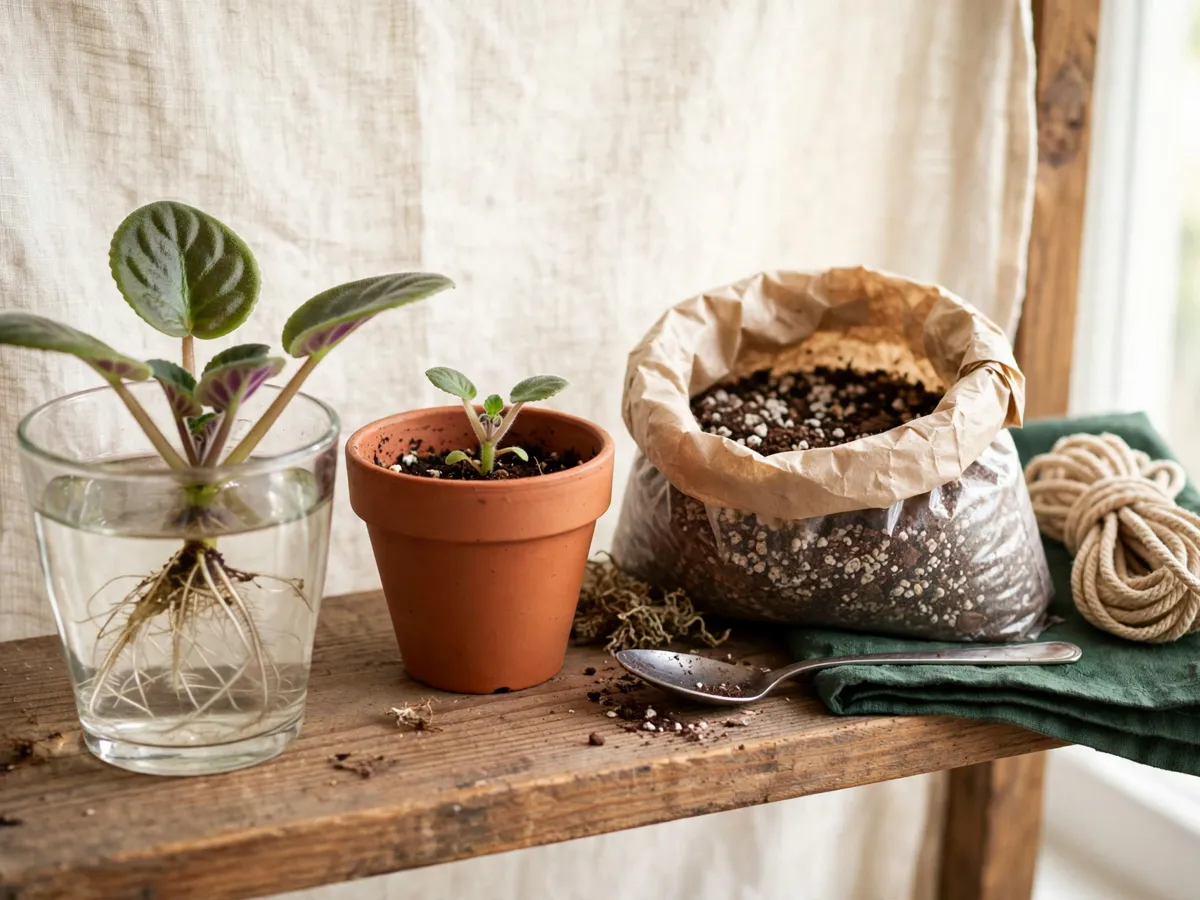
Rooting is quiet work. Insert the stalk about an inch into a small pot of moist, light mix, or half perlite and half vermiculite, at a slant so the leaf blade leans rather than lies. Keep the mix barely moist and the light bright and indirect, and tent a clear bag if the room is dry. Roots run in two to three weeks, then the payoff appears at the buried cut: tiny plantlets, usually six to ten weeks from the day of the cut. Let them reach the size of a nickel before easing them apart; each plantlet with its own tuft of roots goes into a two inch pot, and one leaf commonly yields several plants.
Expect the first flowers six to nine months from the cut. The leaf also roots in a shallow cup of water; transplant it to soil as soon as the first roots show, because roots raised in water are brittle. One honest limit: the pinwheel-variegated varieties sold as chimeras do not reproduce true from leaves, so the plantlets lose the pattern; divide the crown of those instead. The full set of methods, water and soil both, is in the houseplant propagation walkthrough.
Cost: $0 for the leaf, $5–$8 for mix and small pots. Time: 15 minutes of work plus two months of patience. Caveat: a leaf with a torn or stubby stalk base will not make plantlets; the growing tissue lives at the very end of the stalk.
12. Toxicity and placement: pets, kids, the shelf rule
The African violet sits on the safe list, and it deserves to be said plainly: the ASPCA records it as non-toxic to cats and dogs, which makes it one of the houseplants that can live in a home with animals without a backup plan. Stop there. Non-toxic is not a license to graze; any chewed plant material can upset a stomach, and a pet that eats plant material and then acts unwell is a question for a veterinarian, not a plant guide. A newly bought plant deserves a month of quarantine anyway, and fresh-from-shop foliage can carry spray residue.
Children get the same sentence with softer edges. What is not safe is the plant itself: a knocked violet breaks leaves at the base of the rosette, and a crown crushed once grows crooked for a year.
Placement is the whole management plan. The violet wants a window shelf at eye level: in the light, off the heating vent, out of the cold draft at the sash, with the pebble tray underneath. A windowsill that doubles as a pet runway is not that place, and a narrow plant stand one step into the room solves it while keeping the light. The shelf rule is short: if the plant can be knocked, chewed or climbed, it does not live there.
Cost: $0. Time: 10 minutes to choose the shelf. Caveat: this page is plant care, not veterinary advice; confirm any exposure with your vet.
13. Cost reality: $6–$20 for a blooming starter
This is the cheap end of houseplants, which is part of why the plant has been passed between friends for a century. A blooming starter in a four inch pot runs $6–$12 at a grocery store or garden center in almost any season, and the plain purple and pink varieties bloom hardest. A two and a half inch starter at $4–$6 is the patient choice. Named varieties, variegated leaves and chimeras ask $15–$40 and are a second-plant purchase, not a first one.
The setup is small: violet mix at $5–$10, a plastic violet pot and saucer at $3–$6 or the ceramic self-watering set at $8–$25, a soft brush at $2–$4, a dedicated feed at $6–$10 that lasts two seasons, and a pebble tray that costs nothing from a dish and a bag of stones.
The running cost is close to zero: five minutes twice a month, a bag of mix and a same-size pot once a year. Buy the eight dollar plant, learn the tray method on something cheap to lose, and take one leaf cutting the first month so the collection can never be fully lost again. At the store, two minutes of checking for a firm crown and unmarked leaves beats any discount.
Cost: $6–$20 to start well, plant, pot and mix included. Time: 45 minutes of shopping and one afternoon of potting. Caveat: a $6 violet in an east window outblooms a $40 specimen on a dark shelf; spend the difference on the pot.
Common questions
How often should I water an African violet?
Water when the top of the mix looks and feels dry, which in a bright warm room works out to roughly every three to five days in summer and every seven to ten in winter. Soak from the tray for up to twenty minutes, lift the pot out to drain, and use room-temperature water every time. The calendar is a hint; the surface of the mix is the rule.
Can an African violet bloom in a north window?
Yes, if the window is genuinely bright, and it is the safest room for the plant even if the flushes are slightly smaller, because a north window never delivers harsh sun. Read the leaf attitude: flat and horizontal means the light is enough, while a crown that rises and reaches on long stalks means move the pot closer to the glass.
Why does my African violet have spots on the leaves?
Almost always water damage. Pale yellow-green rings and lines are cold water that sat on the fuzz; hard brown patches are sun through a droplet; crisp brown edges mean dry air. None of them spread or threaten the plant, and all of them are permanent on that leaf. New leaves come in clean once the water goes in from below.
Is an African violet safe for cats and dogs?
Yes. The ASPCA lists the plant as non-toxic to both. It is still not food: chewing any houseplant can upset a stomach, and any pet that eats plant material and then acts unwell goes to the vet rather than to the internet. Keep newly bought plants away from chewers for the first few weeks while any spray residue from the shop fades.
How long does a leaf cutting take to become a blooming plant?
About two weeks to root, six to ten weeks to make plantlets, and six to nine months from the cut to the first flowers. The leaf is free and the mix is pennies, so the only real cost is patience. One healthy leaf commonly yields several plants, which is how one violet on a windowsill quietly becomes a row of them, and a friend gets one.
Save these on Pinterest
Pin the four-cause no-bloom decoder and the crown-rot rescue steps, the two sections that decide whether a violet lives and blooms on a rental windowsill. This guide and the rest of the gardening tips live together there.