 Plant As Deco
Gardening & Planting Tips
Anthurium Indoor Care: The Months-Long Wax Flower
By Plant As Deco · Updated 23 November 2026
An anthurium is the waxy red flower that holds the supermarket aisle for weeks on end. The red heart is a leaf. The flowers are dust-sized specks on the spike beside it. The plant is a rainforest tree-dweller that wants air around its roots more than rich soil. Care comes down to four sentences: bright indirect light, a chunky bark mix, water when the top of the pot has dried, and humid air that never lands on the blooms. The rest of this page is what goes wrong and how to read it.
Weekend-ready: $15–$35 for a blooming plant, a pot with a drainage hole and the chunky mix, one afternoon. Ten minutes of checking after that, roughly once a week.
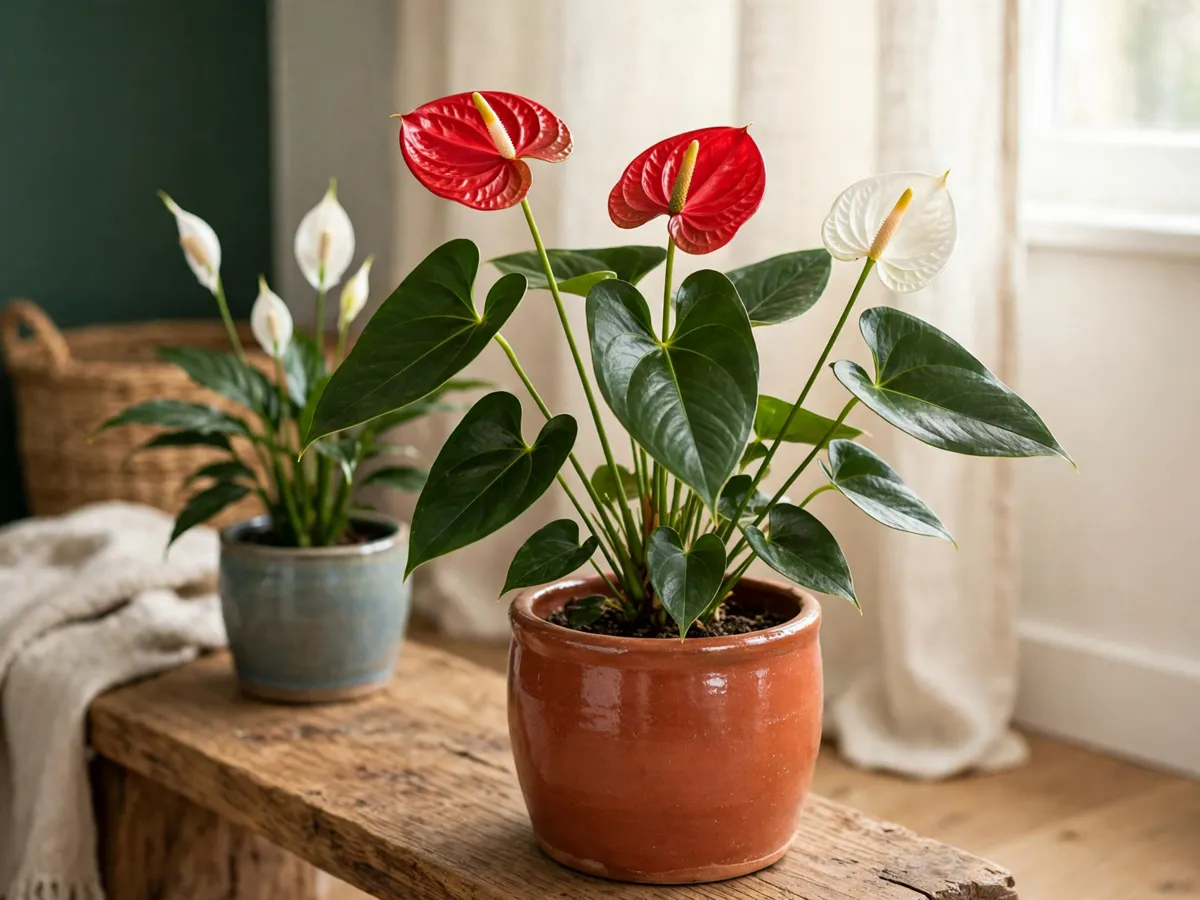
1. What an anthurium actually is: wax spathes, not petals
An anthurium is an aroid, kin to peace lilies and philodendrons, from wet tropical forest in Colombia and Ecuador, where many species perch on trees rather than in deep ground. That origin explains every rule here: roots built for air, leaves built for canopy shade, a bloom built to last.
The flower is a two-part structure. The red, pink, white or coral heart is a spathe, a modified leaf with a thick waxy surface that holds color for months; the true flowers are the tiny bumps climbing the spike beside it, the spadix. On this page, flower means the spathe, because the spathe is what the care protects.
You will meet anthurium on two lists elsewhere on this site, among the tropical houseplants for beginners and the colorful houseplants worth keeping. Those roundups pick one plant per idea; this page is the single-plant deep dive.
Cost: $0. Time: 5 minutes to learn what the flower is. Caveat: the first spathes on a newly bought plant often age faster than the ones that follow, while the plant adjusts to a home.
2. The chunky aroid mix: bark, perlite, air
The roots come first. A healthy anthurium root is thick, pale and firm, built to grip bark and drink from humid air. In dense bagged potting soil those same roots sit in a wet, airless sponge and rot from the tip inward, the most common way a store-bought plant dies at home.
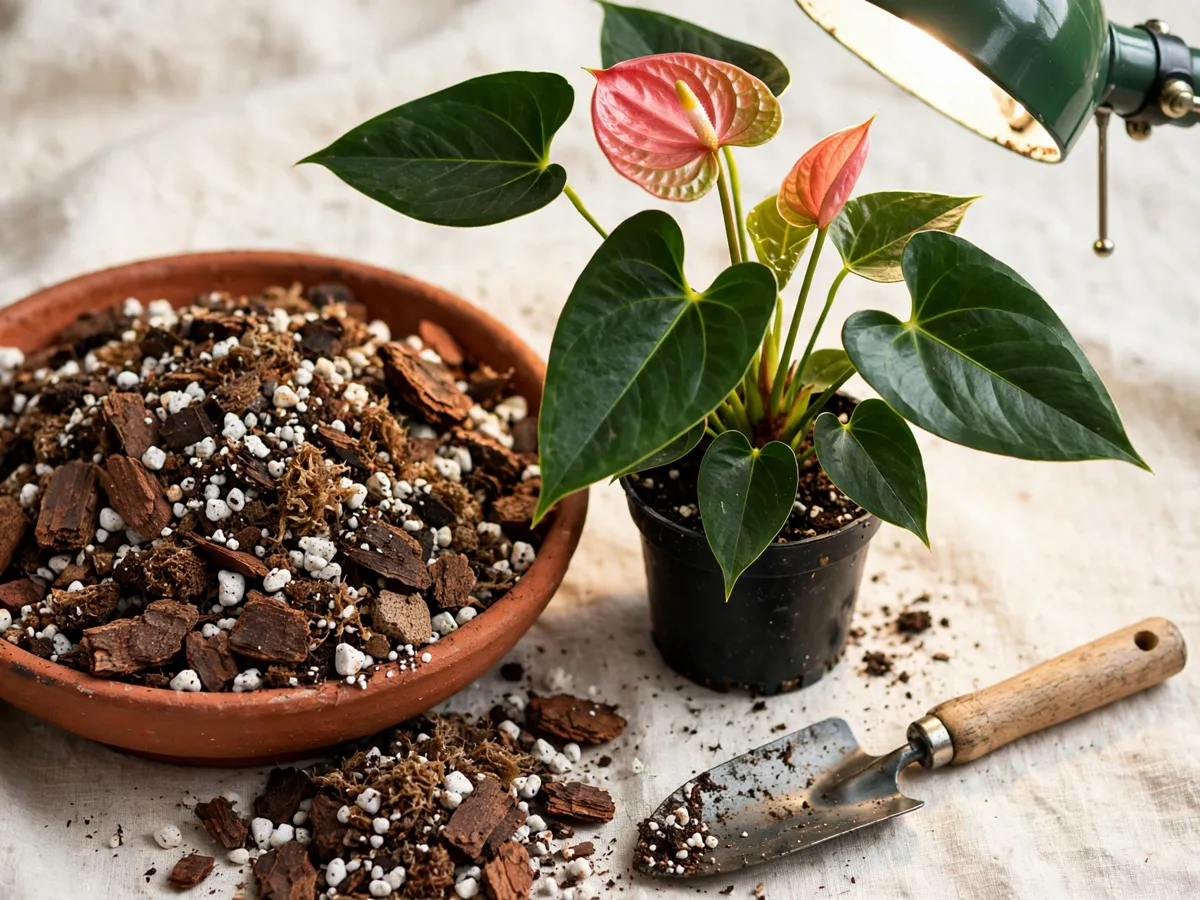
The mix that matches the roots is chunky: two parts peat or coco-coir based potting soil, one part orchid bark, one part coarse perlite, stirred until it holds shape when squeezed and crumbles when released. It should look like damp crumbs with visible bark and white grit, never smooth dark mud.
Drainage is the other half of the recipe. A hole in the pot is not optional, and a decorative cache pot works only if you lift the inner pot out and water at the sink.
Cost: $10–$16 for bark, perlite and soil that fill several pots. Time: 15 minutes to mix a batch. Caveat: a mix that looks chunky in the bag can pack dense in the pot, so confirm water runs freely from the hole after the first soak.
3. Light: bright and indirect, the northern-window logic
Anthurium wants bright indirect light: as much glow as the room can give, with little or no direct beam on the leaves. The northern-window logic is simple geography. In the northern hemisphere a north window takes no direct sun at any time of year, so its light is bright, even and never scorching, close to the shade of a forest gap.
An east window is the other easy answer, because gentle morning sun behaves like bright indirect light. South and west work at two or three feet of distance or behind a sheer curtain; a plant pressed against hot summer glass comes home with bleached patches that never recover.
Too little light is quieter: fewer and smaller new spathes, longer stems reaching, then a season of leaves and no color. Move the pot a foot closer to the glass before changing anything else, and give the change a month.
Cost: $0 to use the window you have, $10–$15 for a sheer curtain if the bright spot runs hot. Time: 10 minutes to place. Caveat: scorch marks on a spathe are permanent; only the next flower comes in clean.
4. Water: the almost-dry rule and the drought tolerance surprise
Water when the mix has dried almost through, not when the calendar says so. Dry top inch and a light pot mean water now, slowly over the whole surface, until it runs from the hole; damp means walk away. Ten minutes later, empty the saucer, because a pot standing in its own runoff pulls water back into the lowest roots and keeps them saturated for days.
In a bright warm room through the growing season that rhythm lands near once a week; in a short, dark winter week it stretches to two or three, because the plant is barely drinking. The mistake that kills this species is a fixed schedule: the same day every week, whatever the mix feels like.
The surprise is how much drought an anthurium absorbs: thick roots hold moisture, and a neglected fortnight costs brown leaf tips and a pause in flowering rather than collapse. Underwatering shows slowly, overwatering rots the rootball, and the fix for the first is one thorough soak.
Cost: $0. Time: 10 minutes per watering. Caveat: when in doubt, wait; a dry day costs a leaf tip and a wet week costs roots.
5. Humidity: the 60 percent target without misting the flowers
Rainforest air sits near saturation, and the anthurium does its best work around 60 percent relative humidity. Ordinary apartments run 30 to 50, and heated winter air falls below 30, dry enough to crisp leaf edges and stall buds. The dry-season playbook for the whole shelf sits in the winter houseplant care guide; the short version for this plant is a pebble tray beneath the pot and neighbors grouped close enough to humidify one another.
Misting is the popular advice that misses. A spray bottle wets the waxy spathe, and droplets standing on that surface leave mineral spots and invite the gray blotch that ruins a bloom. Humidify the air, not the plant: the tray, the grouping, a small humidifier nearby, or the brightest bathroom windowsill in the home, where shower steam does the work.
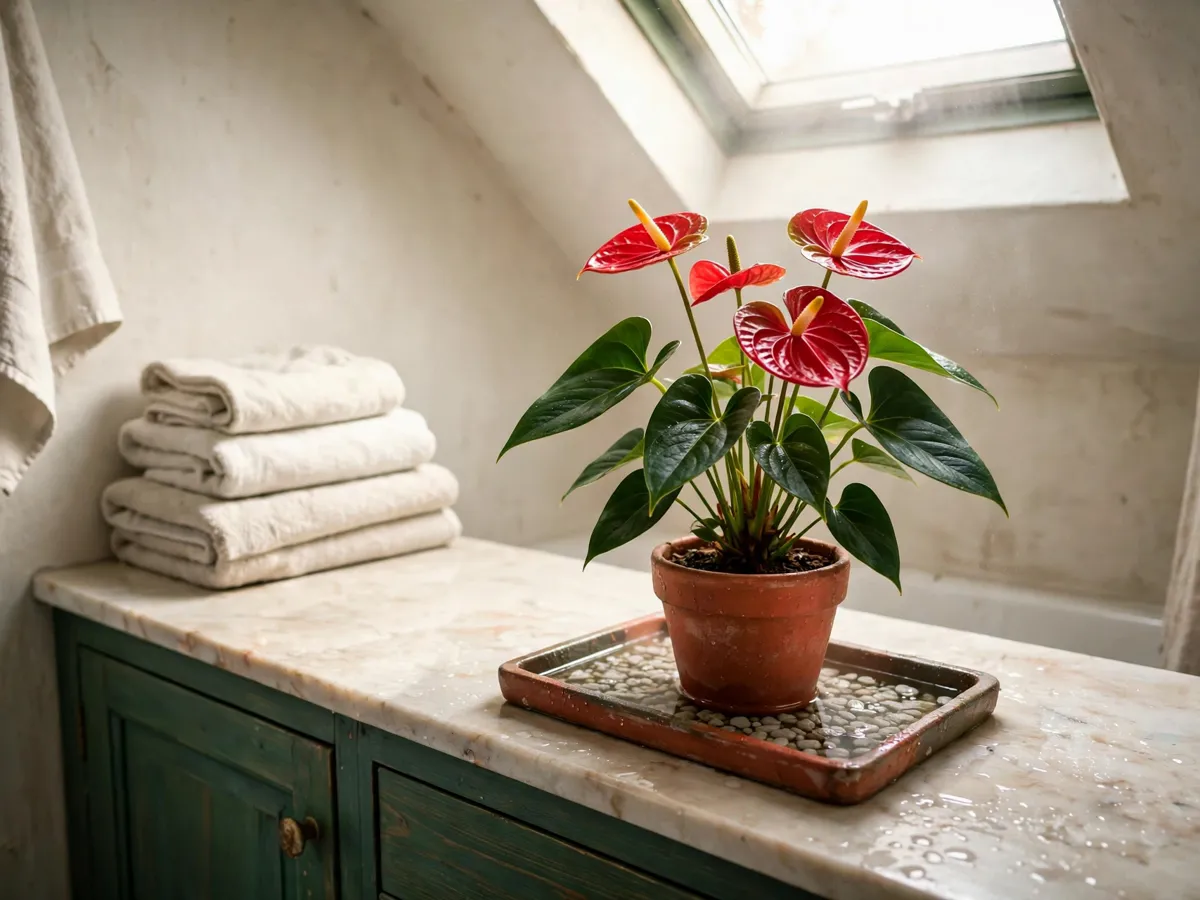
The test is a cheap hygrometer on the shelf beside the pot, not a guess. Weeks of readings below 50 are the signal to act.
Cost: $6–$12 for a pebble tray, or $10–$14 for a hygrometer. Time: 10 minutes to set up. Caveat: never trade air humidity for water on the flowers; the blooms pay for the shortcut.
6. Feeding: the dilute rhythm that keeps blooms cycling
Flowering for months is expensive, and the anthurium pays for it with dilute, steady feeding. In the growing season, a balanced liquid houseplant feed at quarter to half the strength on the label, in the watering can every third or fourth watering, keeps the cycle turning. Stronger does not mean more flowers; it means salt accumulating in the pot.
Salt damage announces itself as brown leaf tips and a white crust at the rim and the drainage hole. The cure is restraint and a flush: every couple of months, water with plain lukewarm water until it runs freely through, let it drain, and skip the feed that round. Never feed a dry pot, because salts against dry roots burn.
From late autumn through winter, cut the feed to a trace or stop it. A resting plant fed like a growing one holds unused nutrient in the mix, and spring spathes open from a pot already tired.
Cost: $6–$10 for a bottle that lasts more than a year at dilute strength. Time: 5 minutes, every third or fourth watering in season. Caveat: feed does not replace light; a dim plant fed harder grows leaves, not blooms.
7. The flower cycle: how one spathe lasts months, then rests
A single spathe, treated well, holds its color four to eight weeks and sometimes longer, the quiet miracle that sells the plant. The color fades at the base first, the heart turns green, then papery, then drops. A spathe that greens is not failing; it is finishing, and while green it still feeds the plant.
Cut a spent stem at its base with clean snips once the spathe is mostly brown, and wipe the blades with rubbing alcohol between plants. Cutting early throws away weeks of work; leaving a dead one hanging invites fungus.
Between waves the plant rests. A mature anthurium in strong light cycles new spathes much of the year, with a quiet month or two, usually in winter, where nothing opens. The rest is not decline: leaves stay glossy and the blooms return with rising light. A young plant may bloom once and then spend a year growing leaves before settling into the rhythm.
Cost: $6–$10 for snips, once. Time: 2 minutes per spent stem. Caveat: a green spathe is still working; wait for mostly brown before cutting.
8. Why flowers drop: 5 causes from cold drafts to overwater
Dropping flowers is the anthurium alarm, and the state of the fallen spathe names the cause. Read it before you change anything, because two causes have opposite fixes.
Cause one, cold: anthurium wants 65 to 80 degrees, and a draft from a winter door, a night window left open, or a leaf touching cold glass makes buds yellow and drop while the leaves stay firm. Move the pot out of the moving air. Cause two, overwater: spathes fade limply green, older leaves yellow from the bottom up, and the mix smells sour. That is the start of root trouble; let the pot dry and unpot it for a look before anything else.
Cause three, drought swings: a plant dried hard, then soaked hard, blasts its buds, which shrivel on the stem without opening. Even watering fixes it. Cause four, low light: flowers arrive smaller and fewer, then stop while the leaves reach; only more light answers. Cause five, dry air: buds brown at the edges and fail to open, and spider mites, which love the same air, often follow.
One more that is not a cause: shock. A plant moved, repotted, or brought home from the store pauses and drops the odd spathe while it re-orients. If the leaves are glossy and firm, hold the routine steady before diagnosing.
Cost: $0. Time: 10 minutes to read the fallen spathe and the mix. Caveat: limp spathes over sour, wet mix mean roots, and roots do not wait for the weekend.
9. Repotting: the root-crowd signal and the 2-year refresh
The honest repot signal is the root crowd: pale roots circling the surface, a rootball that lifts out in one piece, water running straight through channels instead of soaking in, or the plant pushing itself upward out of the pot. Aerial roots arching over the rim are normal anthurium behavior, not a signal; leave them in the air.
Even without crowding, the mix ages out. Bark breaks down over roughly two years into something closer to mud, and the airy root environment collapses while the pot still looks fine. Refresh on that clock: tip the plant out, crumble away what comes free, cut off any brown or soft roots, and settle it at the same depth in a pot one size up with fresh chunky mix.
Water lightly after the move, keep the plant out of direct sun for a few days, and expect a short pause in flowering while the roots re-colonize. Spring is the easy season.
Cost: $8–$18 for mix and a pot one size up. Time: 30 minutes. Caveat: potting up more than one size leaves a ring of permanently wet mix the roots never reach.
10. Pests: spider mites in dry air, the shower response
Spider mites are the anthurium pest of a heated apartment, because dry air is their weather. The first signs are easy to miss: fine stippling of pale dots on the leaf faces, a gray dullness where leaves used to shine, and webbing at the joints fine enough to pass for dust.
The response is a shower. Lukewarm water, the whole plant under the sink spray or an actual shower, both faces of every leaf rinsed, once a week for three weeks. Mites and their eggs do not survive the wash, and the water does a second favor by clearing the dust that dims leaves; the full routine lives in how to clean indoor plant leaves. Raise the humidity after, because a clean plant returned to the same dry shelf invites the next colony.
If webbing persists after three washes, move to insecticidal soap on the leaf faces and joints, and keep the plant isolated through the course. The wider identification pictures, for everything that is not a mite, sit in the indoor plant pests guide.
Cost: $0 for the shower method, $8–$12 for insecticidal soap if the third wash fails. Time: 15 minutes per wash, three washes. Caveat: skipping the third round lets the surviving eggs restart the colony.
11. Toxicity: calcium oxalate, pets and kids, the honest rule
This deserves plain words. Every part of an anthurium carries calcium oxalate, needle-shaped crystals packed into the leaves, stems and roots. The ASPCA lists anthurium as toxic to dogs and cats, and chewing it hurts: burning in the mouth, drooling, pawing at the face, vomiting and difficulty swallowing. A bite is rarely dangerous the way lilies are to cats, but that judgment belongs to a professional.
The rule: any suspected chew is a call to your veterinarian or a pet poison helpline, made the same hour, not a wait-and-see overnight. Rinse the mouth with water if the animal allows it, keep a piece of the leaf to show the vet, and let them decide the rest.
Placement is the prevention. Cats and toddlers both explore at leaf height, so the anthurium lives where neither reaches: a shelf that still catches bright light, a bathroom counter, a room the cat has not claimed. The waxy red spathe is exactly what a young cat takes for a toy.
Cost: $0. Time: 10 minutes to choose the spot. Caveat: this page is plant care guidance, not veterinary advice; confirm any suspected chew with your veterinarian.
12. The compact varieties for small spaces
The classic supermarket anthurium grows toward twenty inches and wants table or floor space, which is a lot for a studio. Breeders have answered with compact hybrids that top out between eight and twelve inches and bloom happily in a four or five inch pot: same waxy spathes, shorter stems, slower spread.
The tag tells you more than the color. Look for compact or dwarf printed beside the plant name and a mature height in single digits of inches; a plant without those words, however small in the shop, is a young full-size anthurium and will grow like one. Compact plants take the same mix, light and water, only drying faster in small pots.
The other small-space option is the foliage side of the family: velvet-leaf anthuriums grown for patterned leaves rather than spathes. They cost more, grow slower and fuss over humidity, and belong on a shaded shelf rather than a bright sill.
Cost: $15–$25 for a compact hybrid in bloom. Time: 10 minutes of tag reading at the shop. Caveat: a small pot dries faster; check the mix about twice as often.
13. Cost reality: $15–$35 for a blooming plant
The plant is fair-priced because it arrives in bloom. Grocery and big-box anthuriums run $15–$25 with one to three spathes open, and nursery plants with deeper color range and more buds run $25–$35. The honest buy is the one with two spathes fully open and a third bud still furled: you see the true color, and weeks of bloom are still to come.
The setup is a pot with a drainage hole at $6–$12, orchid bark and perlite at $10–$16 for a quantity that outlasts several repots, and a saucer or pebble tray at $3–$8. Nothing recurring: a dilute feed at $6–$10 lasts more than a year, and a hygrometer is a one-time $10–$14.
The long tail is repot mix and a pot one size up every two years, plus those ten weekly minutes. Buy the supermarket plant, learn the rhythm on it, then graduate to the nursery color range once the flowers stop being luck.
Cost: $15–$35 to start well, plant, pot and mix included. Time: 45 minutes of shopping and one afternoon of potting. Caveat: a $15 plant in bright indirect light outblooms a $35 plant on a dim shelf.
Common questions
How often should I water an anthurium indoors?
Water when the top inch of mix is dry and the pot feels light, then soak until water runs from the hole and empty the saucer ten minutes later. In a bright summer room that lands close to weekly; in winter, every two or three weeks. The finger test beats any schedule: pot size, mix and season move the drying time more than the calendar.
Why is my anthurium flower turning green?
Usually age, and it is normal. A spathe holds color four to eight weeks, then greens from the base before browning and dropping. While green it still feeds the plant, so leave it until mostly brown, then cut the stem at the base. A young spathe that greens early is more often low light or a cold night.
How long do anthurium flowers last?
One spathe, kept in bright indirect light and away from cold drafts, holds color four to eight weeks, sometimes longer. A mature plant cycles new spathes in waves much of the year with a rest pause, usually in winter, so the display lasts months while a single flower lasts weeks. More light and steady dilute feeding widen the waves.
Can I keep an anthurium in the bathroom?
If the bathroom has a window, it is one of the best rooms in the home for it: shower steam supplies the humidity the plant wants, and the flowers never need misting. Pick the brightest spot near the glass, keep the pot off cold tile in winter, and check the mix, because a small pot still dries fast. A windowless bathroom does not work.
Is anthurium safe for cats and dogs?
No. All parts contain calcium oxalate crystals, and the ASPCA lists the plant as toxic to both. Chewing causes mouth burning, drooling, vomiting and difficulty swallowing; a bite is rarely dangerous, but severity depends on the amount and the animal, and that call belongs to a veterinarian. Keep the plant on a shelf pets cannot reach, and phone the vet the same hour on any suspected chew.
Save these on Pinterest
Pin the five-cause flower drop decoder and the almost-dry water rule, the two sections that decide whether a supermarket anthurium blooms for months or quietly stops. This guide and the rest of the gardening tips live together there.