 Plant As Deco
Gardening & Planting Tips
Jade Plant Indoor Care: The 20-Year Windowsill Plant
By Plant As Deco · Updated 23 November 2026
A jade plant is a succulent shrub, not a cactus, and it wants the brightest window in the room, water only when the mix has dried nearly to the bottom, and gritty soil. Those three sentences are the care sheet. The rest of this page is diagnosis: what a shriveled leaf means against a translucent one, why a jade drops leaves after a move, and which cut turns a ragged stick into the woody little tree the plant is bought for.
Weekend-ready: $8–$30 for the plant, the pot and the gritty mix, one afternoon. Ten minutes of checking after that, about twice a month.
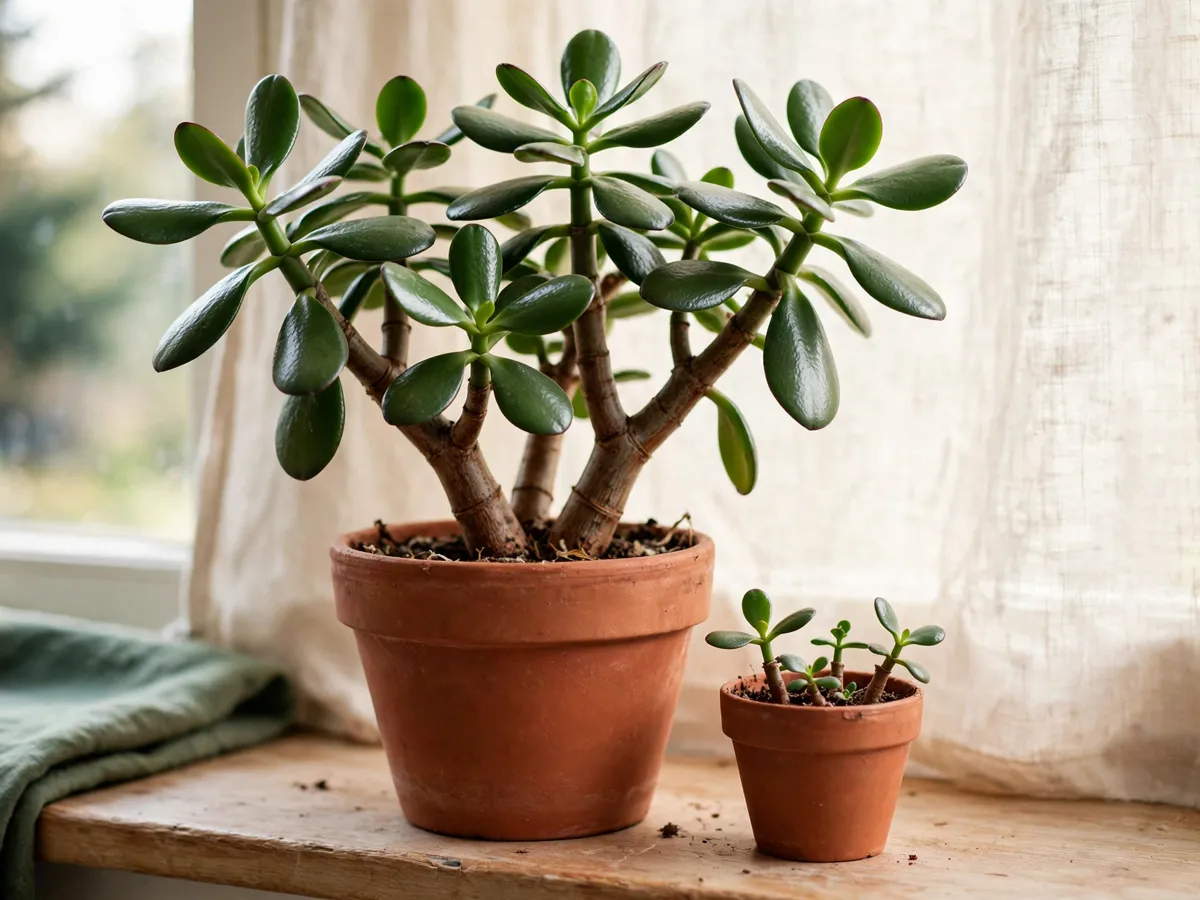
1. What a jade plant actually is: succulent shrub, not cactus
Crassula ovata is a succulent shrub from the dry slopes of eastern South Africa, closer to stonecrops than to any cactus. It stores water in thick, glossy leaves and builds a woody, branching trunk the way a garden shrub does. The storage trick is shared with cacti; almost nothing else about cactus advice applies.
Three facts explain most failures. It drinks fast and then needs air, which is why wet soil kills it and dry soil does not. It grows slowly, so impatience produces bad care: extra water, extra feed, a bigger pot early. And it lives decades, so the problems people blame on the plant are usually the problems of the first two years.
Cost: $0. Time: 5 minutes to reset expectations. Caveat: a jade raised in a warm greenhouse arrives soft-grown and sheds a few leaves while it settles into a drier room.
2. The light: the brightest window rule and the stretch warning
The rule is the brightest window in the home, with a few hours of direct sun on the leaves. An east window is the easy answer, south or west works with a curtain in high summer, and a north window is the wrong room for this plant. Keep the pot within a foot or two of the glass, not across the room where the light has spread thin.
Bright, but never sudden. Leaf tissue built for a shelf scorches when it lands in hot sun, so move the plant in over one to two weeks: a few hours in the new spot, back to indirect light, longer every second day. A sheer curtain is the cheap intermediate step while the leaves build their defenses.
Learn the stretch warning. In low light the gaps between leaves open, stems thin and lengthen, and the red leaf margins fade to flat green. Nothing else fixes that: more water, more feed and a bigger pot all fail on a light problem. Only light moves the plant back toward compact growth.
Cost: $0 to use the window you have, $10–$15 for a sheer curtain. Time: 10 minutes of moving across two weeks. Caveat: the stretch already in the plant never tightens again; only new growth comes in compact.
3. Water math: the soak-and-dry rhythm, pot size in the equation
The rhythm is soak, then dry nearly to the bottom. When the mix has dried out, pour slowly over the whole surface until water runs freely from the drainage hole, let the pot drain, and empty the saucer ten minutes later. That last step is a rule: a pot standing in a saucer of water draws it back through the hole, and the bottom of the rootball stays saturated for days. That is the condition rot grows out of.
The calendar is not the answer; the dryness is. Push a finger or a wooden skewer into the mix and water again when it comes out clean and dry almost to the bottom. In a bright warm room through the growing season that works out to roughly every ten to fourteen days. In winter, with short days and a cool room, three to six weeks between soaks is normal. A fixed weekly schedule is the most common way an indoor jade dies.
Pot size belongs in the equation because it sets the drying time. A snug pot with a full rootball dries in days; a cavernous pot wraps a small rootball in mix the plant never drinks from, and it stays wet for weeks. Two quick reads beat any schedule: lift the pot and feel its weight, and pinch a leaf. Plump and firm means leave it alone. Wrinkled and soft means thirsty. Mushy and translucent means rot, and water is the last thing that fixes.
Cost: $0. Time: 10 minutes per soak. Caveat: when in doubt, wait; a dry fortnight is nothing to a jade, and a wet one is where rot starts.
4. Soil and pot: gritty mix, drainage holes, the terracotta advantage
Jade roots are fine and shallow, built to drink fast and then breathe. A dense peat-heavy soil holds water for a week after one pour and suffocates them from the bottom up. The fix is grit: a bagged cactus and succulent mix works straight out of the bag, or cut regular potting soil with coarse perlite at two parts soil to one part perlite. The finished mix should run through your fingers like damp crumbs, not clump like wet clay.
A drainage hole is non-negotiable, because a sealed pot is a bathtub with a plant in it; if a decorative ceramic has no hole, use it as a cover pot and lift the inner pot out to water at the sink. Unglazed terracotta is the best default for jade: the porous clay pulls moisture out of the mix, and the weight keeps an old, top-heavy specimen from tipping onto the floor. Size the pot snug, not generous; six inches across is plenty for a plant that will fill it for three years. Among the low maintenance indoor plants, jade sits at the bright end of the effort scale: nearly unkillable by neglect, and only genuinely vulnerable to kindness.
Cost: $6–$14 for mix, $5–$12 for a terracotta pot with a hole. Time: 20 minutes to mix and pot. Caveat: a pot without a drainage hole is a decorative cover, not a planter, whatever the label says.
5. Feed and season: the growing-season schedule and the winter rest
Slow growth means low demand. In the growing season a balanced liquid houseplant feed at half the strength on the bottle, once a month, is more than enough. Half strength matters more than frequency: heavy nitrogen pushes soft, stretched growth that dilutes the compact, hard-leaved look the plant is kept for. Water before feeding, never into a dry mix, because salts against dry roots burn the fine tips. The label details live in the indoor plant food guide.
Winter is the opposite season and feeding stops with it. Short days slow the plant down, and a jade fed through a dark month holds nutrients its roots are not asking for, which is how salt crust accumulates and leaf tips discolor. Nothing at all from roughly November through February, water at half the summer frequency or less, and a cool bright room rather than a hot dry one. The full routine sits in the winter houseplant care guide.
Cost: $6–$10 for a bottle that lasts two seasons. Time: 5 minutes, once a month in the growing season. Caveat: feed never fixes a light problem, and a stretched jade fed harder only stretches faster.
6. Repotting: when the trunk outgrows the pot, the 3-step move
Every two or three years in spring is the working rhythm, timed to rising light so disturbed roots regrow fast. Act sooner on these signals: roots circling the surface or escaping the drainage hole, water running straight through because the mix has broken down, the pot tipping under an old top-heavy plant, or growth stalled despite good light. Snug roots alone are not a signal; a tight jade is a content jade, and an eager repot buys a leaf-drop and nothing else.
The move is three steps. First, water lightly the day before, then tip the pot sideways and ease the rootball out with a thumb along the rim, never by pulling the trunk. Second, crumble the old mix away and cut off any brown, papery roots; healthy jade roots are pale and fine. Third, set the rootball in a pot one size up at the same depth, backfill with gritty mix, firm it, and withhold water for about a week so the bruised tips seal before they drink. That last step is the one people skip, and it is the one that rots a freshly repotted jade. A heavy specimen that cannot come out gets a top dressing instead: replace the top two or three inches of mix, which buys a season and does not reach the old roots below.
Cost: $8–$18 for mix and a pot one size up. Time: 30 minutes plus a week of dry rest. Caveat: rough handling of the rootball costs leaves, and a top dressing buys a season, not a pass.
7. Pruning for shape: the branching cuts that build a tree form
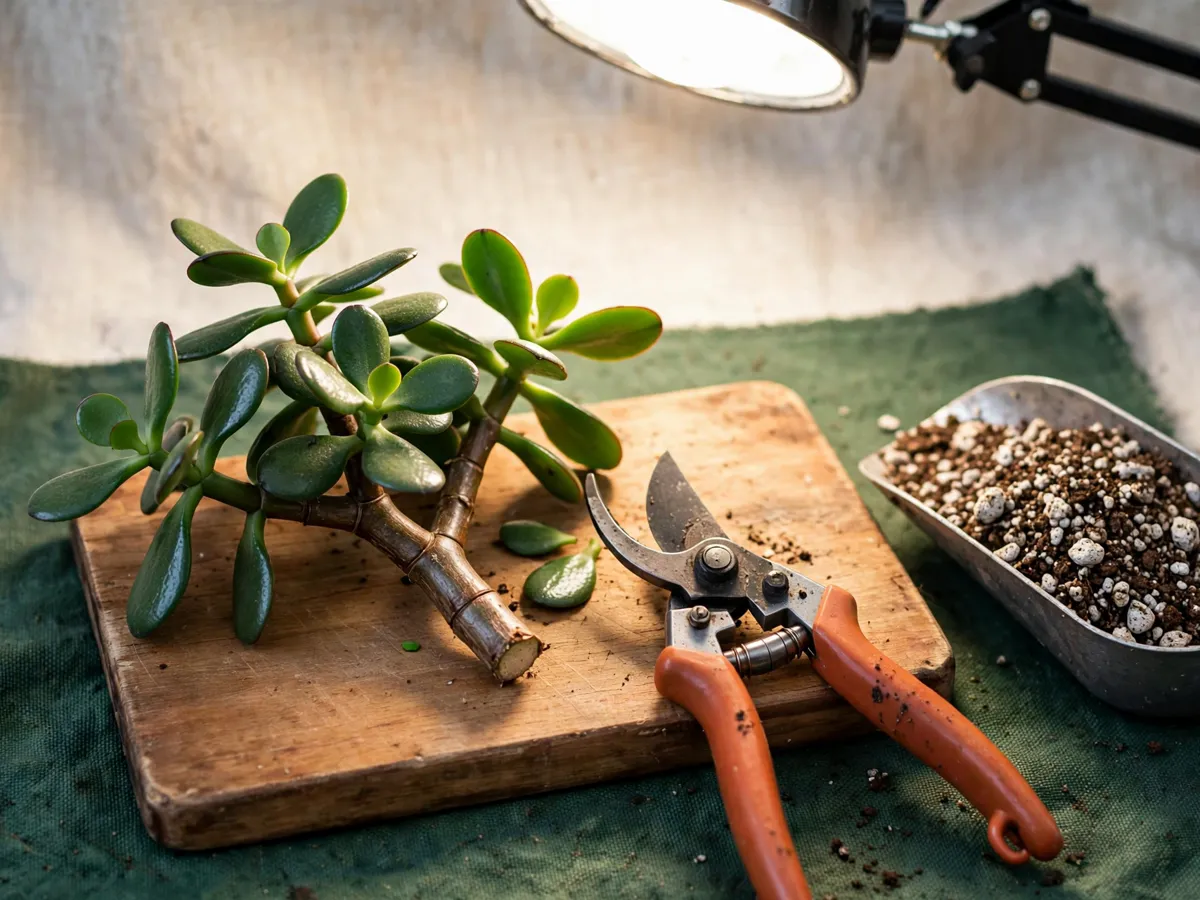
The shape is made by cuts, not by time. Left alone, a jade grows long bare legs with a sparse tuft at the end of each. Pruned, it branches into the short-trunked, dense canopy that reads as a small tree. The rule underneath every cut: trim just above a node, the point where a pair of leaves meets the stem. Jade breaks from dormant buds at those nodes, so a cut above one redirects the plant into two new shoots instead of one continuing leg.
Young plants get pinched: remove the soft growing tip of each new shoot in spring, twice a season for the first two years. Old plants get thinned and shortened: take out branches that cross or rub, cut the longest stems back to a node that has wood on it, and keep the canopy balanced over the pot so it does not tip. Wipe the snips with rubbing alcohol between plants so a wound on one does not travel to the next.
A badly stretched jade is not a lost jade: it pushes new growth from bare woody nodes, so a specimen ruined by years in a dim room can be cut back by half in one spring and it will branch from the old wood. Root the removed tops as cuttings and the renovation produces a second plant. Prune in dry morning air, and never prune a soggy jade: an open wound on rotting tissue is how a bad plant becomes a gone one.
Cost: $6–$10 for snips you can trust, or $0 for scissors you already own. Time: 20 minutes a season. Caveat: a hard cut on a plant still in the dark grows back stretched, so fix the light first.
8. Leaf drop diagnosis: 5 causes, 5 fixes (overwater first)
Leaf drop is the jade alarm system, and the shape of the fallen leaf tells you which alarm is ringing. Pick one up before you reach for the watering can, because two of the five causes have opposite fixes and the wrong one costs the plant.
Cause one is overwatering, the most common way a jade dies. Leaves go soft, translucent, sometimes pale yellow, and they slide loose at a touch rather than falling on their own; the trunk base feels dark or mushy where it meets the mix. The fix: stop watering, unpot, cut away every brown or soft root, dry the plant for a day, and replant in fresh gritty mix with water withheld for a week. Cause two is underwatering: leaves shrink, wrinkle, then drop dry and papery while the mix is bone dust deep down. The fix is one thorough soak and a shorter wait next time.
Cause three is shock: a move, a repot or a draft, and the leaves yellow and fall while stems stay firm. Hold the care steady and it settles in a fortnight. Cause four is cold: leaves pressed against freezing glass overnight go dark and waterlogged, then limp. Trim the blackened tissue and move the plant warmer. Cause five is slow light starvation: no dramatic drop, just the bottom of the plant thinning over months while branches lengthen. The fix is the brightest window rule, and it takes a season to show.
Cost: $0. Time: 10 minutes to read the fallen leaves and the mix. Caveat: soft translucent leaves with a dark base mean rot, and rot travels faster than diagnosis, so act the same day.
9. Pests: mealybugs on jade and the alcohol-swab treatment
Mealybugs are the pest to know on jade: small clumps of white cottony fluff tucked where a leaf meets the stem, in the joints of old wood, and in the crown of the mix. They suck sap, leave a sticky residue on the leaves below, and hide in exactly the crevices a glance at the leaf faces misses. Check the joints with a fingertip, not the surfaces with your eyes.
The treatment is rubbing alcohol on a cotton swab. Press the wet swab directly onto each insect; alcohol kills on contact without soaking the plant. Work over a sink so the dislodged fluff does not land on neighboring pots, and repeat weekly for three rounds, because the first pass misses the individuals deep in the crevices and eggs hatch between sweeps. Insecticidal soap and neem work on the foliage, and the indoor plant pests guide covers identification and the alternatives for everything that is not a mealybug.
Two additions matter on jade specifically. Check the roots: root mealybugs live in the mix, and a jade thinning with no fluff anywhere on its branches may be hosting them below, so a repot is the inspection. And isolate a treated plant, because mealybugs crawl: a new arrival standing next to the jade is how one plant becomes a whole shelf. The honest prevention is the care itself; a dry, bright, lightly fed jade almost never hosts a serious colony.
Cost: $3–$5 for rubbing alcohol and cotton swabs. Time: 10 minutes per round, three rounds over a month. Caveat: the third sweep is not optional; two sweeps and a pause is how a colony comes back.
10. Propagation: leaf and stem cuttings, the drying callus rule
Jade is the easiest houseplant to multiply, and almost every failure traces to one skipped step: the cut end is not allowed to dry before it touches soil. A fresh wound is an open door for the fungi in every potting mix, so lay the cutting in dry air, out of direct sun, for three to seven days until the end seals into a dry skin. That callus is the whole difference between a new jade and a rotted leaf on a stick.
Leaf propagation is slow and worth doing for abundance. Twist a healthy leaf off cleanly, base collar attached, because a leaf without that collar cannot start roots. Lay it on gritty mix in a shallow tray, mist the surface lightly every few days, and keep it in bright indirect light. A nub appears in a month or two, then a thumbnail plantlet, then a rosette with a taproot over the following months. The parent leaf feeds the baby for most of its first year.
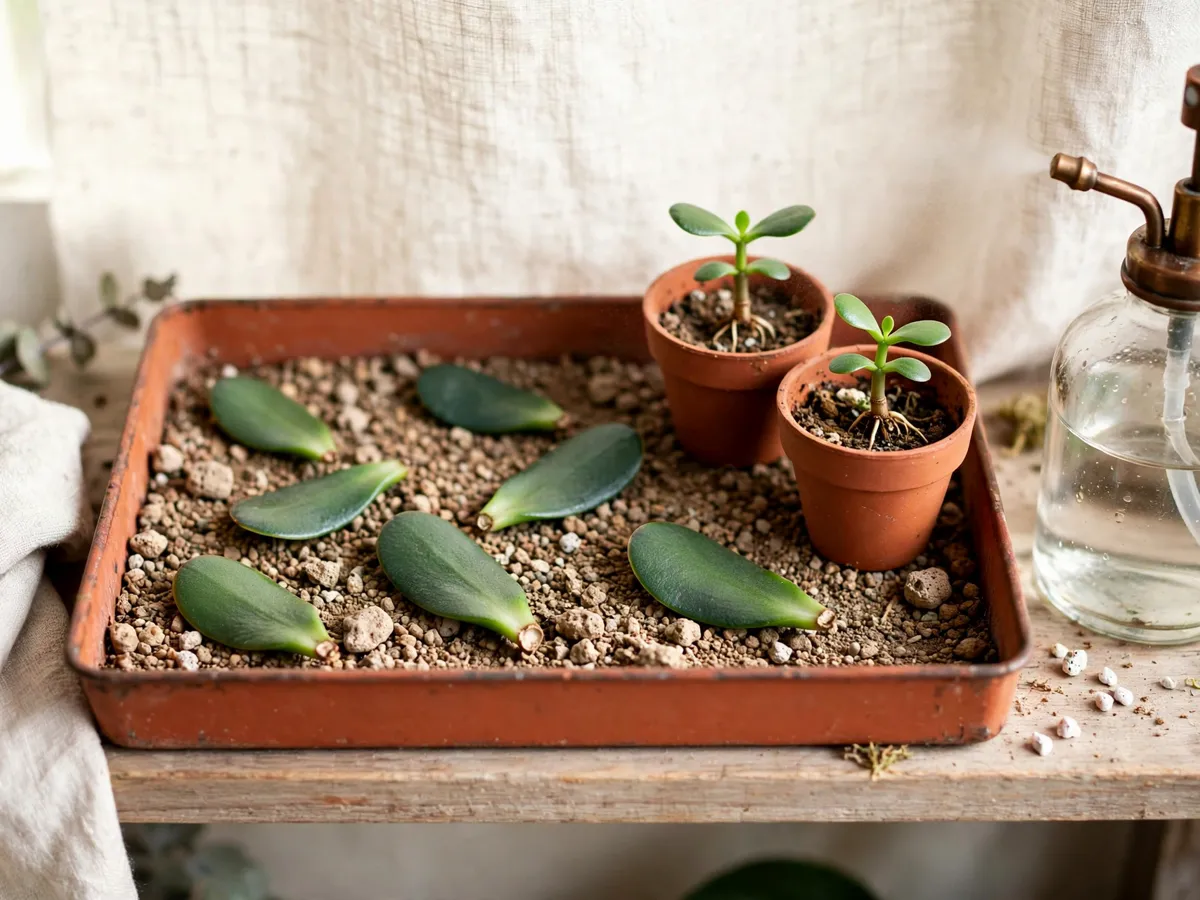
Stem propagation is the fast one. Snip a healthy branch four to six inches long just above a node, strip the lower leaves, callus it for a week, then stand it an inch deep in gritty mix and wait. In warm light, roots form in three to six weeks. Do not mist a stem cutting and do not root it in a cup of water: jade roots from soil, and water rots the stem faster than it roots it. Take cuttings in spring so they carry the warm months before their first winter. The general technique is in the houseplant propagation walkthrough.
Cost: $0 for the cuttings, $5–$10 for a tray and mix. Time: 15 minutes plus a week of drying. Caveat: a leaf without its base collar will not grow, and any cutting planted before it calluses will rot.
11. Toxicity and placement: pets, kids, the shelf rule
The ASPCA lists jade plant as toxic to dogs and cats, and that sentence deserves to be plain rather than hedged. The plant carries compounds that irritate the digestive tract, and a pet that chews it can vomit, have diarrhea, or seem dull and sleepy. Most reported cases are mild and pass without lasting harm, which is exactly why the plant has a reputation for being nearly harmless, and that reputation is what this section exists to correct. Nearly harmless is not harmless, and a suspected exposure is a call to your veterinarian or a pet poison helpline, not a wait-and-see: how severely an animal reacts depends on how much it chewed, its size, and the individual, and no plant guide gets to decide that for your vet.
Children are the other half of the placement problem, and the answer is the same: a toddler and a cat are both at leaf height, and neither should reach a plant you would not eat yourself. Jade sits at the mild end of the toxic list, not with lilies or azaleas. It is still not a reason to leave a chewable plant on the floor.
Placement is the entire management plan. The brightest window in a home with a curious cat is often the wrong window, and the honest compromises are a high shelf that still catches light, a bathroom or laundry window the pets do not use, or a desk in a closed room. The shelf rule: if the plant can be knocked, chewed, or climbed, it does not live there. For a home where plants and pets share every reachable surface, the pet safe low light houseplants guide lists the species that can live at nose height.
Cost: $0. Time: 10 minutes to choose the spot. Caveat: this article is care guidance, not veterinary advice; confirm any exposure with your vet.
12. The 20-year plant: what a mature jade becomes (and how to plan)
A two-decade jade is a different object from the one you bought, and the difference is the reason to buy the cheap one. Slow growth compounds: a four inch starter adds an inch or two of height a year, the lower stems thicken into wood, and the canopy densifies. Around year five it is a handsome tabletop plant. Around year ten it is a floor plant in a ten to twelve inch pot, heavy enough that the pot choice starts to matter. Around year twenty it is a specimen with a trunk you can hold, and cuttings from it carry that shape into another home.
Planning is honest about three things. Space: a plant that will eventually be two feet wide should not start life on a crowded shelf, and its eventual floor spot should not block a walkway. Stability: an old jade gets top-heavy, so a wide, heavy terracotta pot is the answer, and repotting a specimen is a two-person job. Money: a bag of mix and a pot one size up every few years, $10–$20 a time, which is less over a decade than one mid-range trained plant.
The renter angle is the good news, because a twenty-year plant does not require a twenty-year apartment. Jade travels well: compact, tough-rooted, content in a box near a window for a week. Take two stem cuttings before a move and you carry the same plant forward twice, one for the new window and one for a friend. The other windowsill succulent, the aloe vera care page, covers the same soak-and-dry logic on a different plant.
Cost: $10–$20 every few years, and $0 for the years between. Time: 30 minutes at each repot. Caveat: ten years in a dim corner produces a ragged shrub rather than a specimen, so the twenty-year result belongs to the twenty years of light.
13. Cost reality: $8–$30 for a starter plant
The plant is cheap and the upkeep is cheaper. A four inch starter at a garden center or a big-box store runs $5–$12, and the plain green form is the one to buy: variegated and dwarf forms ask $15–$40, grow slower and forgive less, the wrong trade for a first jade. A pre-trained specimen with two feet of woody trunk costs $40–$120 and is worth less than it sounds, because it arrives shaped by somebody else light and often sheds leaves adjusting to yours.
The setup is a six inch terracotta pot at $5–$12, a bag of cactus mix at $6–$14, small snips at $6–$10 if your scissors do not cut clean, and a saucer at $3–$6. The first year asks for nothing more: no feed beyond a $6–$10 bottle that lasts two seasons, and no grow light unless your only window faces north, in which case a modest bulb fixture at $20–$45 belongs in the same conversation as the curtain.
The long tail is where the value sits: mix and a pot one size up every two or three years, plus a fortnightly ten-minute check. Buy the eight dollar plant, learn the rhythm on something cheap to lose, and let the years do the expensive part. At the store, two minutes of checking for firm leaves and a clean base beats any price.
Cost: $8–$30 to start well, plant, pot and mix included. Time: 45 minutes of shopping and one afternoon of potting. Caveat: an $8 starter in a bright window outperforms a $100 specimen in a dark corner.
Common questions
How often should I water a jade plant indoors?
There is no fixed interval, because light, pot size, mix and season change the drying time more than the calendar does. Soak until water runs from the drainage hole, then wait until the mix is dry nearly to the bottom. In a bright warm room in the growing season that works out to roughly every ten to fourteen days, and in winter to every three to six weeks. A finger or skewer in the mix beats any schedule.
Should I move my jade outdoors for the summer?
If you have a spot with bright light and some morning sun, yes, and it usually grows harder and greener outside. Acclimate it over a week in dappled shade first, because outdoor light is far stronger than any window and a plant grown indoors will scorch. Bring it back inside before autumn nights fall toward 45 degrees, and inspect the joints and the top of the mix for hitchhiking bugs before it rejoins the shelf.
Does a jade plant flower indoors?
Sometimes, and it is a bonus rather than the point. Bud formation responds to short days, cool dry nights and a long stretch of barely moist mix, which is why an autumn on a cool bright windowsill occasionally earns small clusters of white or pale pink star-shaped flowers. A young jade rarely blooms; an older plant sometimes does; a heated, regularly watered living room usually does not.
Is a jade plant safe for cats and dogs?
No. It is listed as toxic to both, and chewing it can cause vomiting, diarrhea and lethargy. Most reported cases are mild and pass without lasting harm, but any suspected exposure is a veterinary question rather than a wait-and-see. Keep the plant on a high shelf that still gets light, or in a room the pets do not use, and choose genuinely pet safe species for anything at floor level.
Why are my jade leaves turning red or yellow?
Red or bronze margins are usually strong light, the same coloring a jade develops outdoors, and they are cosmetic rather than a problem. Yellow is the one to read carefully: a yellow leaf that falls onto dry mix is thirst or shock from a move, while a yellow leaf that feels soft and translucent and slides loose at a touch is water, and the base of the trunk needs checking the same day.
Save these on Pinterest
Pin the water math and the five-cause leaf drop decoder, the two sections that decide whether a jade lives for twenty years on a rental windowsill. This guide and the rest of the gardening tips live together there.