 Plant As Deco
Gardening & Planting Tips
Indoor Rose Plant Care: The Mini Rose Reality
By Plant As Deco · Updated 22 November 2026
You bought a mini rose in full bloom for a windowsill. It will flower, start to fail, usually inside three weeks, and the reason is the climate rather than your care. This guide covers the honest version: the one good week indoors, the seven day move outdoors where a rose actually lives, and the prune that brings a second flush.
Weekend-ready: $35–$90 to start, one afternoon of setup. That covers the plant, a pot with a drainage hole, a small bag of potting mix, and a bottle of rose feed. Three minutes a week after that, plus one five-minute prune every time a flower fades.
1. What the gift mini rose actually is
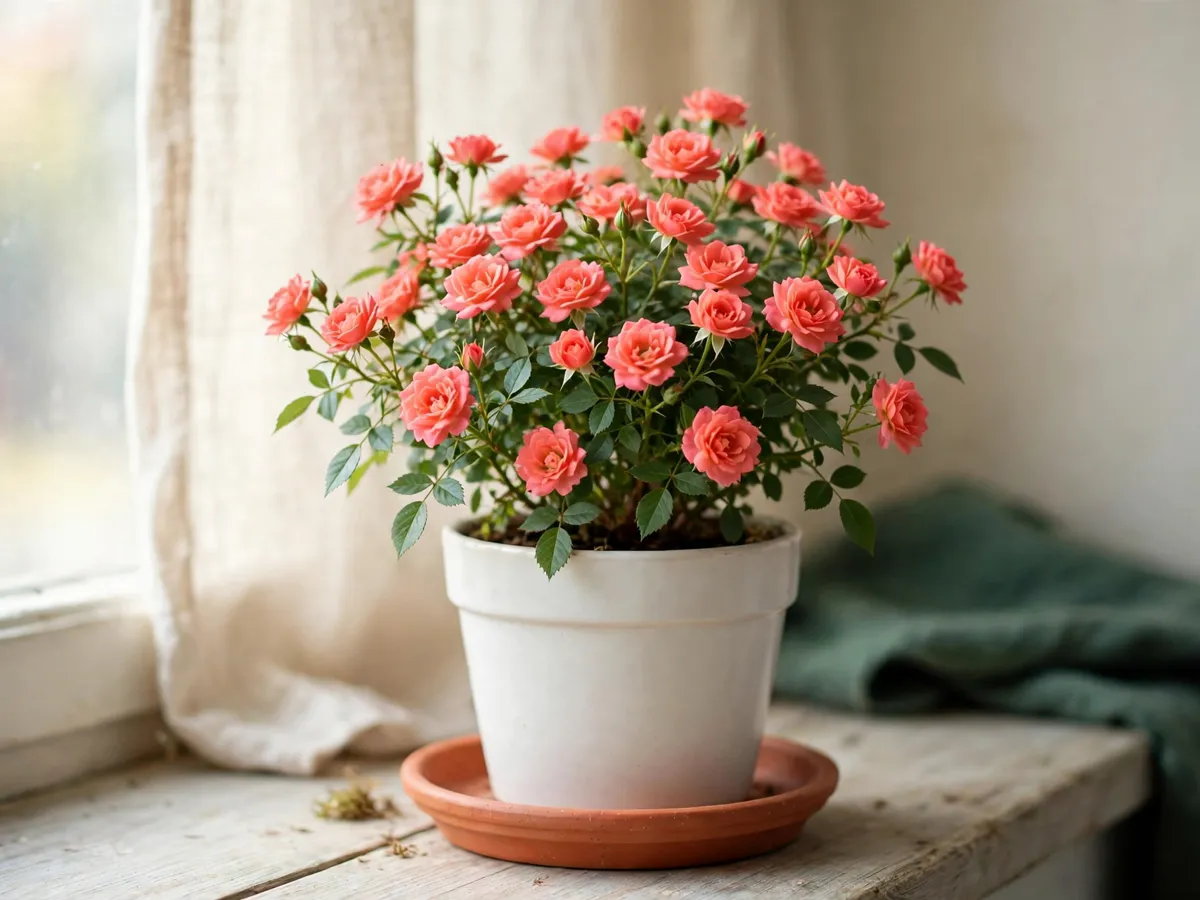
The little pot of roses at the grocery checkout or on the front bench of a garden center is a greenhouse crop. Growers raise it in cool, bright, moving air, then lift it into a container and bring it to full bud so every flower opens the day it reaches the shelf. You are seeing a plant at the single peak week of a months-long season.
Nothing in that history makes it a houseplant. Roses want hours of direct sun, cool air, wide day to night temperature swings, and air moving around the foliage. A heated US living room supplies the opposite of all four. Kept indoors year round, most of these plants decline within weeks: leaves yellow and drop, unopened buds brown on the stem, canes stretch thin, then the mites arrive. That is the plant, not your competence.
So this guide treats the indoor stint as a display with a known length, one to two weeks, then walks the plant outdoors where it can live for years in a pot or in the ground. If you have a porch, a balcony, or a patch of sun, everything below applies. If you have only a window, read section 10 and section 11 first, because they carry the verdict for that case.
Cost: $12–$30 for the plant. Time: ten minutes to inspect one before buying. Caveat: pass on any pot with browned bud casings, bare lower canes, or white speckling under the leaves, because that plant started its life already declining.
2. The one good week rule
Give it the best ten days a rose gets indoors. Set it on the brightest sill you have, south or east facing, with clean glass and nothing blocking the light. Keep it away from a radiator, a supply vent, and the draught line of a busy door. Cool air is the point: a rose in a warm room burns through its reserves faster than it can replace them.
Unpack it the same day. The cellophane sleeve and display collar hold moisture against the foliage and block the drainage holes, and both cause the first losses. Lift the plant out, confirm the bottom of the pot has a hole, and set it on a saucer you will empty.
Water lightly and often through this stretch. A blooming mini rose in a four or five inch pot in a warm room can dry out in a day, because a plant carrying thirty open flowers loses water through its petals constantly. Check the top inch every morning. Do not feed yet, the fresh mix has nutrients, and do not repot while it is in flower, because repotting costs roots and this one is spending everything on petals. Turn the pot a quarter turn each morning.
Cost: $0. Time: two minutes a day for ten days. Caveat: the flowers last longer in a cool room, so let the sill run cool on those evenings.
3. The transition, not the drop
Here is the mistake that ruins more gift roses than any disease. The plant comes off a dim shelf and goes straight onto a full sun porch, and three days later the leaves carry pale papery tan patches. That is sunscald, a sunburn on tissue, the same way your skin burns after a winter indoors. Leaves grown behind glass are thinner and carry less protection than leaves grown in the open.
Harden it off over seven to ten days instead. Days one and two, keep it indoors in bright indirect light. Days three and four, move it outdoors into full shade, a north side or a covered porch. Days five and six, give it an hour or two of morning sun and shade the rest. Days seven through ten, extend toward most of the day. If the leaves show a faint bronze flush, pull it back a step for two days and retry. Bring it inside if frost is forecast while it is still in a small pot, because a small container freezes through faster than ground does.
The porch or balcony is the real home, not a holding spot. The balcony garden for beginners guide covers laying out a small outdoor space so a flowering pot gets the sun and airflow it needs.
Cost: $0, or $8–$20 for a pot carrier. Time: ten minutes a day for a week. Caveat: scalded leaves will not heal, so count the loss in leaves, not the whole plant, and keep going.
4. Light: the number that decides everything else
A rose wants six or more hours of direct sun on its canes. Miniature roses in containers tolerate five and still flower, with smaller blooms and longer gaps between flushes. Below four hours, the plant survives and stops being interesting: it holds leaves and makes almost no flowers.
Indoors, the brightest south facing window is the minimum, and even that falls short. Glass filters part of the spectrum sun-loving plants are built around, and light drops steeply with distance from the pane. You are choosing between a plant that lives and a plant that blooms, and indoors you usually get only the first.
Read the plant for the answer. Long gaps between leaves, each new leaf smaller than the last, one thin bud where a cluster should be, canes that flop under their own weight: that is a stretched plant telling you the light is short. The fix is a better window, a move outdoors, or a lamp, in that order of value. A full spectrum LED run twelve hours a day keeps growth compact, but it does not substitute for open air, and it does not stop the mites a dry lamp-lit room invites. Outdoors, light afternoon shade protects petals from a hot west wall in July.
Cost: $0 for a windowsill audit, $25–$60 for a basic lamp. Time: five minutes to map which spots get direct sun and for how long. Caveat: count hours of direct sun on the leaves, not hours the room feels bright.
5. Watering: the pot with holes and the top inch
Start with the hardware, because it decides more than the schedule. The pot needs a drainage hole. The nursery pot it came in has one; a decorative ceramic or woven basket usually does not, and a rose sitting in a sealed container with water pooling at the bottom is a rose with drowning roots within a week. If you want the pretty vessel, use it as a cover: leave the plant in its own pot and lift that out to water and empty the catch.
Then water deeply when the top inch dries. Push a finger to the first knuckle, or push a wooden skewer to the bottom and pull it: damp soil clings to the wood, dry soil falls away. When it is dry, pour slowly around the whole surface until water runs from the drainage hole, then empty the saucer ten minutes later. A rose hates wet feet, and it also cannot carry a bloom on a mix that goes bone dry, so the cycle is evenly damp, never sodden, never dust. Frequency follows the plant: near daily for a blooming plant in a warm room, twice a day in August sun, every ten days in an unheated stairwell in January.
The wilt is a useful reading if you take it correctly. A mini rose that droops at the end of a hot afternoon and stands back up by morning is fine. One still limp in the cool of the morning was thirsty and perks within an hour of a deep drink. One that stays limp on soil wet to the touch has root damage, and more water will finish it. Unpot it, look for brown mushy roots instead of firm pale ones, and repot into fresh mix.
One more rule that matters more than it looks: water the soil, not the foliage, and water in the morning. Roses dislike wet leaves, and a leaf that stays wet into a cool night is how black spot starts.
Cost: $5–$15 for a pot with a real drainage hole. Time: three minutes per watering. Caveat: hard tap water leaves a white crust on the mix over a season; flush the pot with plain water every couple of months.
6. Feeding: a rose is a heavy feeder
Roses make wood and flowers at the same time, all season, from a root run limited to the pot. A container rose that never gets fed runs out of steam by midsummer. A general houseplant feed does something; a formula made for flowering shrubs does more, because it carries the balance a blooming plant needs.
Use it at half the label strength, applied with every third watering from spring through early fall. Dilute and frequent beats concentrated and occasional in a container: full strength salts build up in a small volume of mix and burn the root tips, and burnt roots show up as a plant that wilts in damp soil. Pour the feed onto soil that is already damp, never onto dry roots. Skip feeding on a plant that is stressed, freshly transitioned, or newly potted.
Stop feeding in early fall, about six weeks before your first expected frost, and this is not a preference. Late feed pushes soft new canes that have no chance to harden before cold; soft cane blackens in the first freeze and invites rot into the plant. Cutting the feed on time lets the wood ripen, which is what carries the plant through winter and sets next spring's flowers.
Read hunger in the leaves: uniformly pale new growth, smaller leaves than the season's first ones, thin canes, few buds. Yellowing that spares the veins and leaves a green net across the leaf is usually iron locked out by alkaline tap water, and yellowing on the oldest leaves first is usually water, not appetite. The plant food guide covers the difference, the dilution, and the seasonal pause.
Cost: $8–$18 for a bottle of rose feed, a full season for two or three plants. Time: one minute every third watering. Caveat: feed is for a plant in active growth; a dormant one gets water only.
7. The prune that brings the next bloom
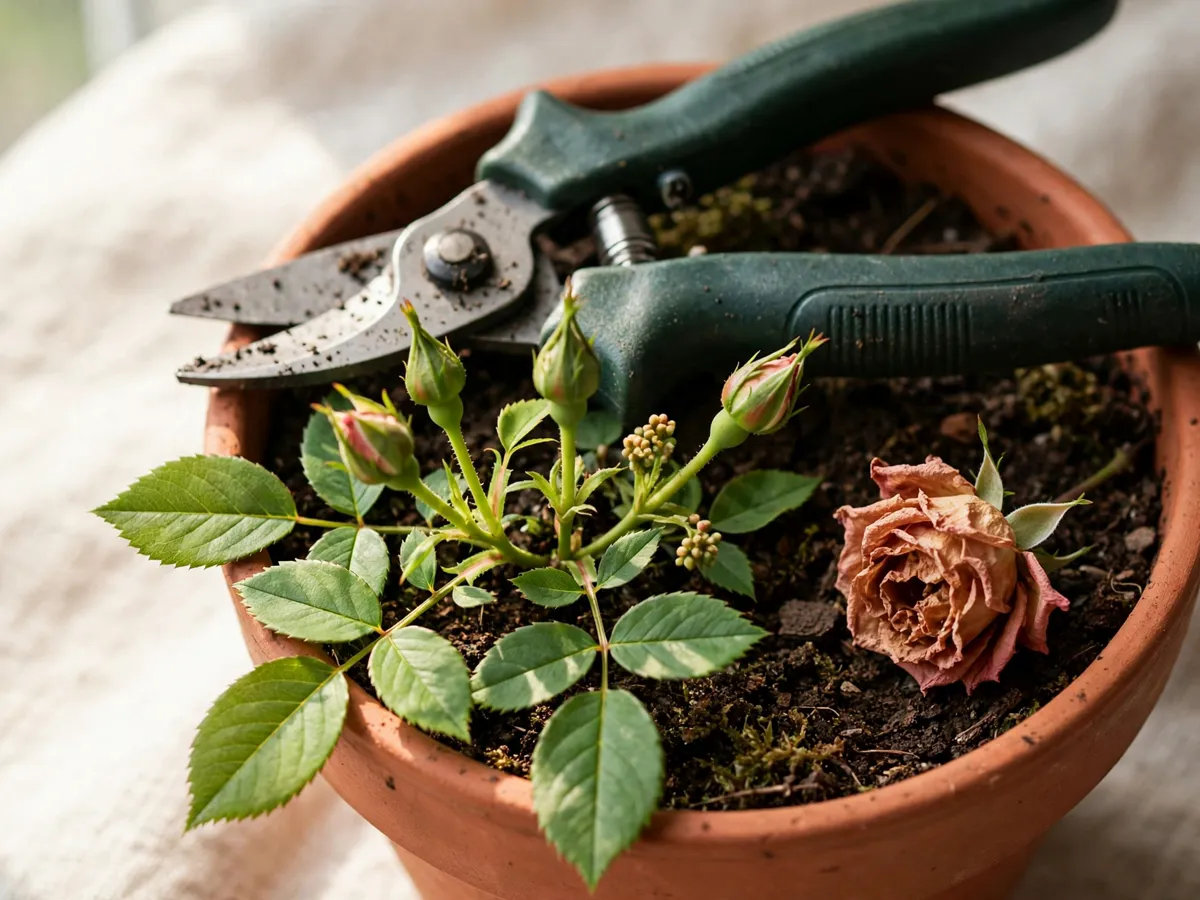
This is the highest value five minutes in the whole guide. When a head fades and the petals drop, cut the stem back to the first leaf below the flower that has five leaflets and faces outward, away from the center of the plant. Cut a quarter inch above that leaf, angled so water runs off rather than onto the bud.
The plant reflowers from that cut. A new cane pushes from the axil of that outward leaf and carries a bud at its tip: four to six weeks from cut to open flower, slower in cool weather or on an unfed plant. Done consistently, one gift pot gives flushes from late spring through fall.
The default behavior of most gift plants is the opposite. Owners watch the brown heads gather and put it off, and the plant does what roses are built to do: it turns the spent flower into a hip, a seed vessel, which signals the plant to stop pushing new buds. By the time anyone notices, the energy has gone into seed and the plant looks finished. It was reproducing, because nobody pruned it.
Two limits and one habit. Take no more than about a third of the plant in one pass, since every cut removes a leaf factory along with a bud site. While you are in there, remove spindly canes growing into the middle and any cane that crosses and rubs another, because that wood produces nothing and blocks the airflow that keeps disease out. And use clean, sharp bypass pruners, the scissor type, not the anvil type that crushes cane. Wipe the blades with rubbing alcohol before you start and between plants, and do not prune foliage that is still wet.
Cost: $12–$25 for bypass pruners. Time: five minutes every time a head fades. Caveat: a plant already losing leaves gets a light clean up only, not a hard cut, until it is growing again.
8. Spider mites, the indoor rose problem
If a rose fails indoors, this is usually what finished it. Spider mites are less an insect you bring home than a condition of the room. Outdoors, humidity, wind, rain and predatory mites hold them in check. A heated, dry, still room removes all four controls, and the population on a susceptible plant explodes within weeks. Roses, with thin leaves, are a favorite host.
The sign is stippling: hundreds of tiny pale pinprick dots on an upper leaf surface, each a cell the mite drained. The leaf then takes a dull bronzed cast, and the oldest leaves at the center drop first. In a heavy case you find fine webbing between canes and under leaves. Confirm with the paper test: set a white sheet under the plant, tap a stem firmly, and look at the paper. Specks that move are mites; stationary dust is not.
The first response is water, not chemicals. Carry the plant to a sink or shower and spray the undersides of every leaf with firm, lukewarm water for a full minute. That knocks down most of the living population. Repeat every three or four days for two weeks, because the spray does not kill eggs and the hatchlings need a second pass before they reproduce. Raise the humidity around the plant and move it away from other plants so it cannot pass the problem along.
If the shower passes do not clear it, follow with an insecticidal soap or neem spray labeled for ornamentals, applied to runoff on the leaf undersides in the evening, never in direct sun. The real cure is the one this whole guide points at: get the plant back into moving open air, where the mite problem largely solves itself. The full identification and treatment ladder is in the indoor plant pest guide.
Cost: $0 for the shower spray, $10–$18 for a soap or neem spray. Time: ten minutes per pass, two weeks of passes. Caveat: bronzed leaves will not green back, so judge recovery by new growth.
9. Disease in still air
Almost every rose disease this plant can catch has the same two ingredients: a leaf that stayed wet and air that did not move. That is why they show up together on a plant crowded onto an indoor sill or tucked into a sheltered balcony corner.
Black spot is the one to recognize early: circular dark lesions on the older, lower leaves, often ringed with yellow, spreading upward through warm days and damp nights until the plant is bare from the bottom up. The spores need several hours of leaf wetness to germinate, which is exactly what an evening overhead watering on a still indoor plant supplies. Powdery mildew is the second, a white talc-like coating on new leaves and buds in dry days paired with humid nights. Gray mold lands on the fading petals themselves in a closed room and can rot the cane below.
The fixes are cultural and they are the whole answer for a container gift rose. Water the soil in the morning so any splash dries before dark. Give the plant a foot or two of clearance from walls and neighbors so air moves through. Thin the spindly inner canes at the prune so the center opens. Pick up fallen leaves and petals rather than letting them sit on the mix. Remove infected leaves as soon as you see them and put them in the trash, because black spot leaf litter does not belong in a home compost pile that never gets hot enough to kill the spores.
Cost: $0 for the cultural fixes. Time: five minutes a week while checking the plant. Caveat: a plant stripped bare by mid summer on wet soil is usually root trouble as well as leaf disease, so check the pot before assuming a spray was the answer.
10. Winter, honestly
Miniature roses are not evergreen. In cold weather they drop their leaves, stop growing, and the canes go from green to woody brown. A first time owner looks at that bare stick in December and throws it out, because it reads as dead. It is dormant, a plant conserving itself, and that is the normal state for the season.
Test rather than guess. Scratch a small patch of bark near the base of a cane with a fingernail: green and moist underneath means the cane is alive. Brown and dry means that cane is gone, and if all the canes are brown to the soil line with mushy roots, the plant is finished.
Dormancy needs cold and just enough water. Cold bright storage does it: an unheated garage, an enclosed porch, a sheltered stairwell, anywhere above freezing and roughly under fifty degrees. Water every two or three weeks so the rootball does not dry completely, and skip the grow lamp, since a dormant plant is not photosynthesizing meaningfully. The second option is the ground: plant it out in fall before the soil freezes, or sink the whole pot into a sheltered bed, then after the first hard freeze mound six to ten inches of shredded leaves, straw or bark over the crown and pull it back in early spring. For a pot that must stay outside through a hard winter, wrap it in burlap, stuff the top with straw, and stand it against a south facing wall; the roots are what freeze, not the canes.
And the honest verdict for the renter with no outdoor space: a heated apartment is not a place a rose overwinters. You can hold it on the coolest bright sill for another few weeks, then the choice is compost or treat it as a seasonal display and buy a fresh one next spring, which is a reasonable way to own this plant. The cold season routine for the plants that do belong indoors is in the winter houseplant care guide.
Cost: $0 for a garage corner, $15–$30 for mulch or a roll of burlap. Time: twenty minutes to protect a pot or mound a crown. Caveat: a dormant plant in a warm room is the worst of both, so with no cold spot keep it on the coolest sill and expect a short life.
11. After the bloom: keep it, plant it out, or compost it
When the display fades you have one decision, and it depends on what is outside your door. Work down this list and stop at the first line that describes your situation.
- You have ground and six hours of sun. Plant it out, best in spring after the last frost. Dig a hole twice as wide as the pot and no deeper than the rootball, mix a shovelful of compost into the native soil, set the plant so the point where the leafy canes meet the root sits an inch above the surrounding soil, backfill, firm, and water it in. Mulch two to three inches, keeping it off the stem. Harden it off first, per section three.
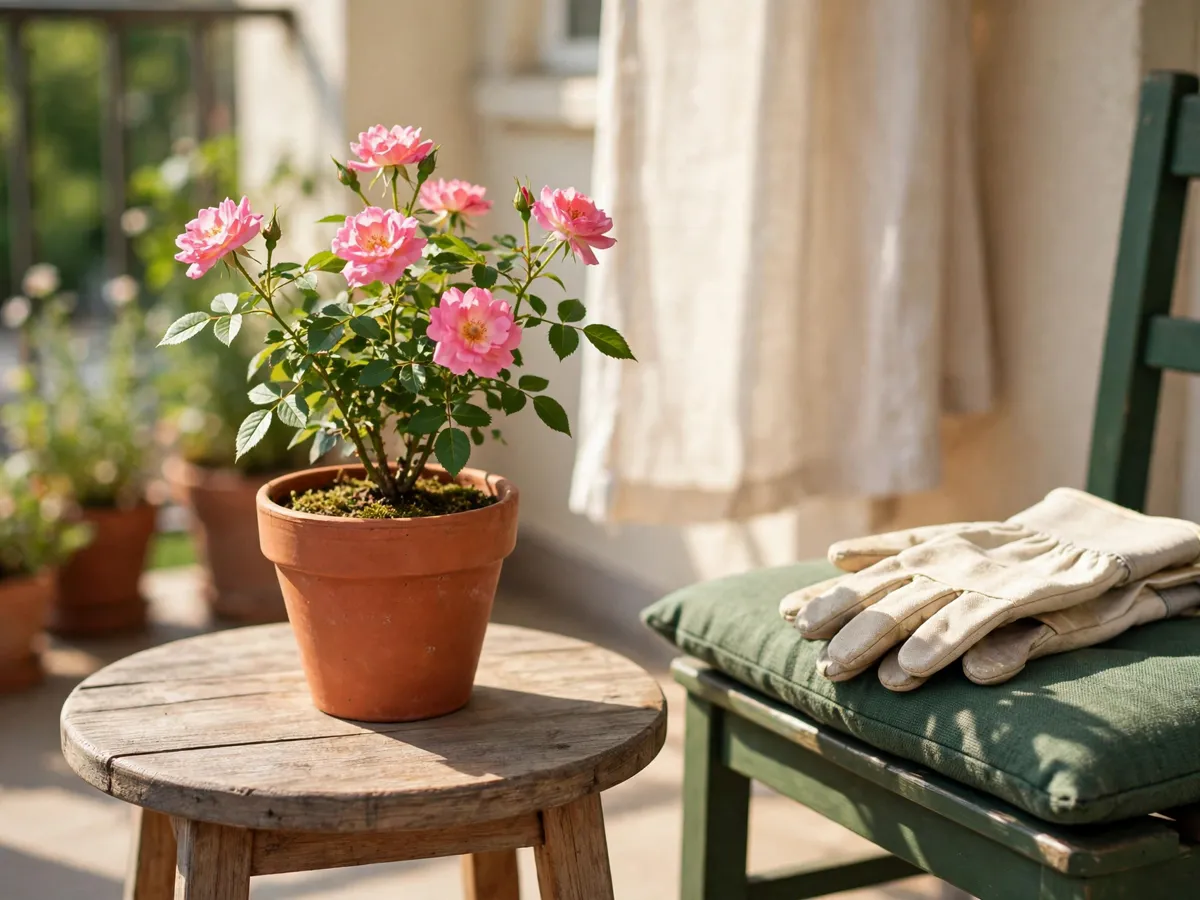
- You have a porch or balcony with sun. Keep it as a perennial container. Move it up one pot size at the next repot, into a ten to twelve inch container with a drainage hole, refresh the mix yearly, feed through the growing season, and deadhead every spent head. A mini rose kept this way flowers for years and improves each season.
- You have a window and nothing else. Hold it on the coolest bright sill through the last of the bloom, then compost it, or buy a fresh pot each season and enjoy the one good week each time. Neither is a failure. That is what this plant is in an apartment with no porch.
Two notes on planting out. The retail mini rose is usually grafted: the flowering variety sits on a hardier rootstock, and the join is the swollen bump near the soil line. Any shoot from below it is rootstock growth, vigorous and wrong flowered, so break it off at the base as soon as you see it, and keep the graft above the soil so the hardiness you bought survives. On composting: healthy trimmings and spent petals are fine in a pile, leaves carrying black spot are not, so those go in the trash.
Cost: $15–$35 to plant out or size up. Time: one hour for the move, ten minutes a season for rootstock shoots. Caveat: a plant that lost most of its leaves indoors still has a chance outdoors, but give it a full growing season before judging.
12. Is a rose pet safe?
The plant itself, yes. Roses are generally regarded as non toxic to cats and dogs: the leaves, petals and canes carry no dangerous compound, and a pet that eats a mouthful of foliage is looking at mild stomach upset at most. That is a genuinely good trait, and it puts a rose ahead of many popular houseplants on this one question.
The hazard is physical. Thorns catch in a tongue, a lip or a paw pad, and a cat that bats at a blooming pot can drive a spine in. A pot on the floor near a chewing puppy is a thorn accident waiting for a reason, so put it where the pet can look but not lick: a sill, a table, a high shelf beside the window.
The caveat that matters is chemistry. Many greenhouse roses are treated preventively with systemic pesticides and fungicides that stay in the tissue rather than sitting on the surface, and the pot label almost never discloses it. A pet that chews a treated leaf is ingesting something the plant does not advertise. Ask the grower whether the batch was treated, favor stock sold as pesticide free, and keep the plant out of reach of any animal that samples houseplants regardless.
This is care guidance, not veterinary advice. If a pet eats part of the plant and then vomits, drools or stops eating, call your vet and bring the label. For plants with no question marks at all, the pet safe low light houseplants list covers the ones that hold in dimmer corners than a rose ever would.
Cost: $0. Time: five minutes to move the pot out of reach. Caveat: thorn injuries to a paw pad or mouth are not always obvious for a day or two, so check a pet that was interested in the plant.
Common questions
Can I keep a mini rose alive indoors all year?
For a few weeks, comfortably. For a season, marginally, on the brightest coolest window you have, with a real risk of spider mites. Indefinitely, no, because a rose needs hours of direct sun, cool air and moving air that a heated room does not supply. The honest plan is to enjoy the bloom indoors and then move the plant outdoors.
Why is my indoor rose dropping leaves?
Check the soil first. Yellow leaves falling on a mix that stays wet points at drowned roots, usually a pot with no drainage hole or a saucer left full. Leaves dropping with pale stippling and fine webbing underneath points at mites, the dry room problem. Green leaves dropping right after you brought the plant home is the shed from a forced greenhouse bloom, and it settles once the plant is outdoors and growing again.
How often should I water a rose plant indoors?
When the top inch of mix feels dry, which for a blooming mini rose in a warm room is close to daily and in a cool dim room closer to weekly. Soak until water runs from the drainage hole and empty the saucer ten minutes later. A small pot in full bloom can dry in a single day, so check it rather than trusting a schedule.
Should I cut off the dead blooms?
Yes, and this is the prune that brings the next round. Cut each spent head back to the first five leaflet leaf below it that faces outward, a quarter inch above the leaf, angled away from the bud. The plant reflowers from that cut in four to six weeks. Left alone, it turns the flower into a seed vessel and stops producing buds.
My mini rose looks bare and brown in winter. Is it dead?
Not necessarily. Miniature roses lose their leaves and go woody in cold weather, and that is dormancy rather than death. Scratch a cane near the base: green underneath means it is alive and should push again in spring. Keep a dormant plant cold, bright enough to see by, and water it every two or three weeks so the rootball does not dry out completely.
Save these on Pinterest
Pin the one good week rule and the deadheading cut, the two things that turn a supermarket mini rose from a week-old gift into a season of flowers. This guide and the rest of the gardening tips live together there.