 Plant As Deco
Gardening & Planting Tips
Norfolk Island Pine Care: The Tree That Stays Alive
By Plant As Deco · Updated 23 November 2026
The little pine-shaped tree sold in December as a living Christmas tree is a tropical evergreen from the South Pacific, not a true pine, and that single fact drives every part of its care: it wants bright indirect light, steady warmth, and the humidity a heated winter room does not have. It also does not stop growing. This guide covers light, water, the winter-dry trap that browns its needle tips, and the size ceiling to know before you buy.
Weekend-ready: $10–$25 for the plant and a pebble tray, ten minutes of setup. A houseplant measured in years, not weeks.
1. What a Norfolk Island pine actually is
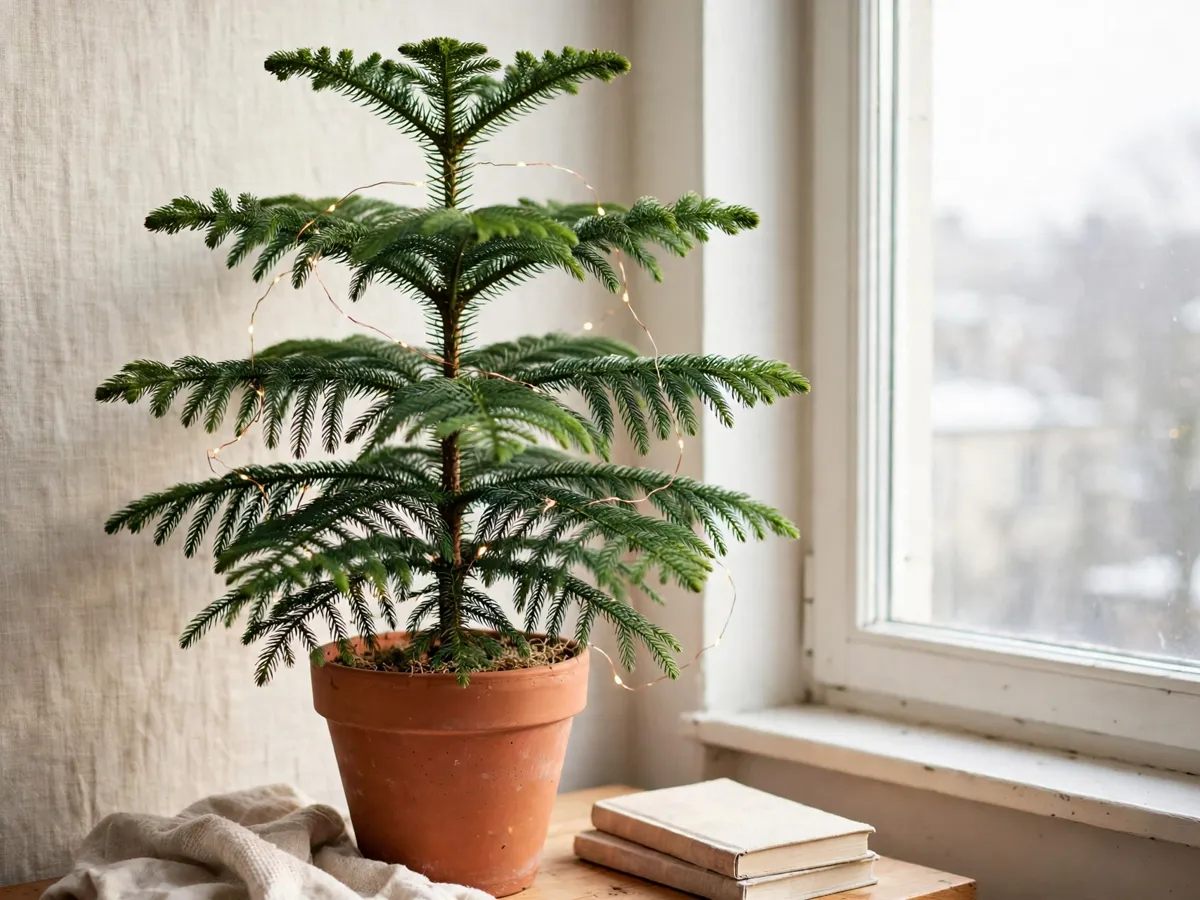
Look at one and the name makes sense: a neat pyramid of soft, needle-covered branches in evenly spaced tiers, the silhouette of a small Christmas tree. The name is where the honesty starts. Araucaria heterophylla grows wild on Norfolk Island in the South Pacific, a tropical evergreen, only distantly related to the cold-climate pines and firs of a Christmas tree farm. That origin matters more than the shape. A true pine expects freezing winters; this tree has never met one, and cold kills it fast.
Sellers offer it from table-top six inches to floor-sized four or five feet, and the tiered look is the plant's own doing: branches grow out in whorls, a full ring of them at each level, one new tier at a time. Indoors that pace is slow. In good conditions expect a few inches of height and one new whorl of branches per year, which is the honest pace of a deliberate, long-lived houseplant rather than a fast filler. Nothing needs pinching or training to keep the shape, and a healthy plant holds its symmetry with almost no help.
Cost: $0. Time: 5 minutes of reading. Knowing it is tropical is the whole care guide in one word.
2. Bright indirect light, the floor
An east or north-facing window, with the pot close to the glass, delivers bright indirect light all day. A south or west window is also fine at a few feet back, or screened by a sheer curtain. What it cannot hold up under is direct summer sun through glass: that light is strong enough to scorch, leaving brown, dried patches on the upper tiers while the lower branches stay green. If your only window is hot and south-facing, the sheer curtain is the difference between a healthy tree and a sunburned one.
December through February, move it to the brightest window you have. Winter sun is weak and short, and a tropical tree parked in a dim corner through the dark months comes out stretched and pale. The plant leans toward the light as it grows, so give the pot a quarter turn each week to keep the symmetry it was sold on. It is a ten-second habit that keeps the pyramid even.
Cost: $0. Time: 10 seconds a week to turn the pot. Direct summer sun through glass is the light that damages it.
3. Water: the inch rule and the two failure modes
Water when the top inch of soil is dry, and water fully: slowly, until it drains from the bottom, then empty the saucer ten minutes later. Nothing on a calendar. The top inch is a finger's depth, and the check takes seconds. A small pot in a warm room might need water weekly in summer; the same plant in winter might go two or three weeks. The pot tells you, not the schedule.
Overwatering shows as yellowing lower branches, a droopy overall look, and soil that stays wet long after watering. It is the more dangerous failure, because constantly soggy roots rot. Dry air shows differently: the needle tips brown while the rest of each branch stays green. That pattern, brown tips on otherwise healthy growth, is the number one complaint on this plant, and it is a humidity problem, not a watering problem. More water does not fix it; the next section does.
Cost: $0. Time: 10 seconds to check the soil. The saucer stays empty, or the roots sit in water.
4. The winter-dry trap and the humidity stack
Here is the trap in plain terms. The tree arrives in December, straight into heated air that holds far less moisture than a tropical evergreen wants. The needles lose water to the room faster than the roots can replace it, and the tips brown first, because they are the newest and softest growth. The room looks fine to you. To the plant, the living room has become a slow drought with the heating running.
The fix stack, from cheapest up: a pebble tray, a wide saucer filled with pebbles and water beneath the pot (the pot sits on the pebbles, above the waterline, never in it); grouping it with other plants so they share a more humid pocket; and a small humidifier nearby, the strongest option for a serious dry-air problem. The negative fix matters just as much: keep it away from heating vents and radiators. The Christmas-tree spot by the fireplace or over a floor vent is genuinely the worst place in the house for this plant, which is an awkward truth in December and a true one.
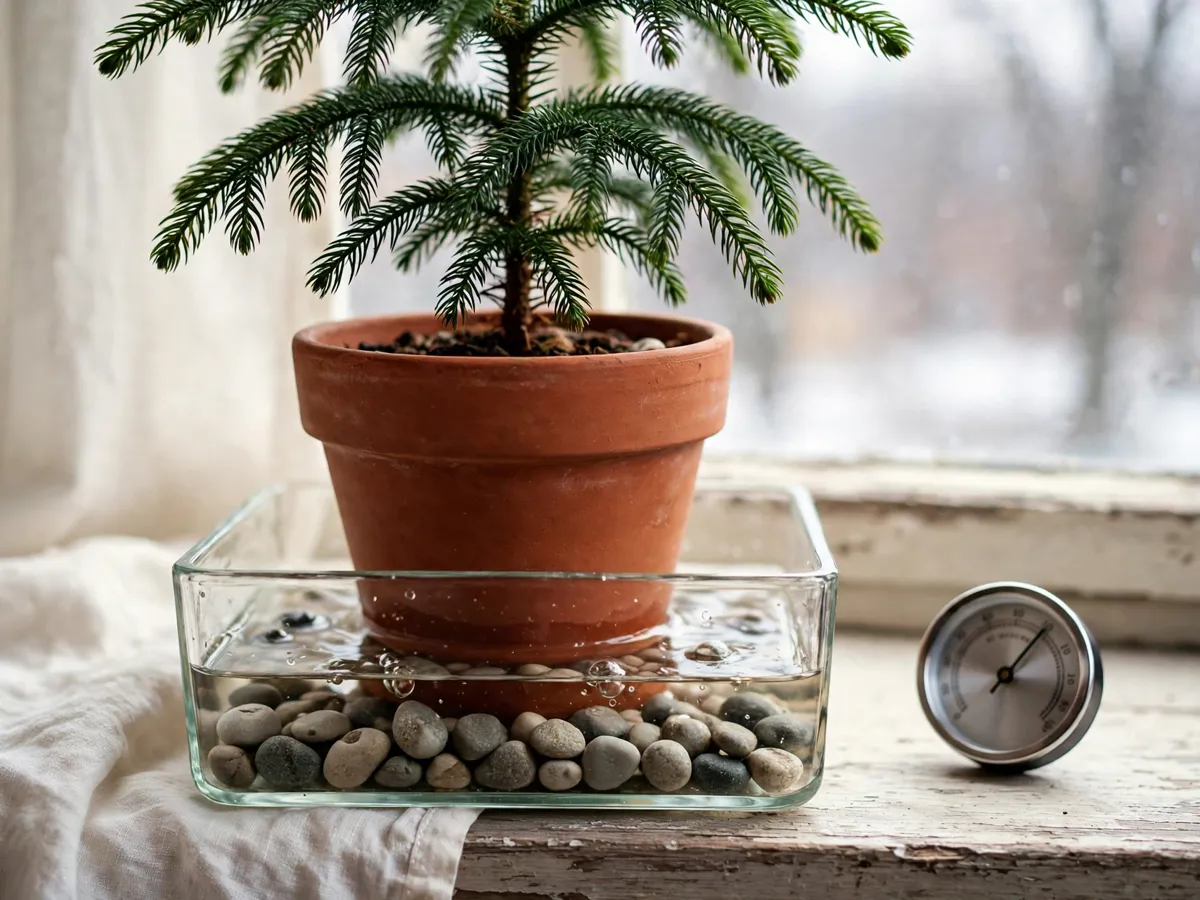
Cost: $3–$8 for a pebble tray, $30–$60 for a small humidifier. Time: 5 minutes to set up. Brown tips are the symptom; dry air is the cause.
5. The size ceiling, said before you buy
This is the honest part that belongs before the purchase. The cute six-inch table version becomes a five or six-foot floor plant over roughly five to eight years of steady care, and left alone long enough it heads for the ceiling, because in the wild it is a hundred-foot tree. Indoors the pace is the slow one from section 1, but it only goes one direction.
And there is no pruning it small. Cutting off the top kills the single leading stem that builds the shape, and the tidy pyramid is gone for the life of the plant. Pruning is not a size tool for this tree. So the decision is real: buy the size you have room for, or plan to enjoy it for years and then give it away tall. Repot every two years in spring, one pot size up, in a standard well-draining mix, the same routine the repotting one size up guide walks through step by step.
Cost: $10–$18 for a pot and mix every two years. Time: 20 minutes of repotting. Buy for the room it will become, not the table it is today.
6. Christmas dressing that does no harm
The seasonal promise of this plant is real, and worth saying plainly: a cut Christmas tree is spent by January, and this one is not. It keeps living as an ordinary houseplant all year, and every December it dresses up again, a little taller and one tier fuller than the year before. Dressing it is where a few lightweight rules keep the tradition alive.
- Lights. Battery LED fairy lights give off almost no heat, which incandescent strings do, and heat is what damages the needles. Wrap loosely.
- Ornaments. Small, lightweight ones on the inner branches only. The branch tips droop under real weight, and a heavy bauble on an outer tip can bend the branch out of shape permanently.
- No spray snow and no glitter. Both clog the needles and are nearly impossible to clean off a living plant.
One safety note, one sentence: this plant is mildly toxic to cats and dogs, so if pets share the house, skip the tinsel-and-tree corner entirely, because a tree dressed with dangling, chewable things is an invitation. When the season ends, the decorations come off and the pot goes back to the bright window.
Cost: $5–$15 for battery lights and light ornaments. Time: 15 minutes to dress, 10 to undress. Light and inner branches, every year after.
7. Temperature: the two draft traps
The comfortable range is steady 60 to 72 degrees Fahrenheit, which describes most homes year-round. What the tree dislikes is moving air at the wrong temperature: cold drafts from a doorway in winter, and hot dry drafts from vents and radiators. The classic December mistake is placing it in the front-door entryway where guests will see it, right in the path of every cold blast of outside air. A tropical evergreen reads that doorway as a series of small cold shocks, and the response is browned branches. Keep it in a room with steady temperature and moving air that is neither cold nor hot, and it settles in without complaint.
Cost: $0. Time: one placement decision. Steady beats perfect; the drafts are what hurt it.
8. Feeding lightly, or the tiers stretch
From spring through summer, give it a weak-strength balanced feed once a month. Weak means roughly half the strength the bottle suggests, the same restrained routine the indoor plant food guide explains for foliage houseplants. From autumn through winter, feed nothing at all, because the plant is resting and the roots sit in soil they cannot use.
The reason to stay light is visual rather than survival: too much feed pushes fast, loose growth, and the evenly spaced tiers stretch apart. The symmetry is the reason this plant gets bought, and heavy feeding quietly ruins it. A hungry Norfolk Island pine grows slowly and stays tidy. An overfed one grows fast and grows strange.
Cost: $8–$15 for a bottle of balanced feed, which lasts years at this strength. Time: 2 minutes a month, in season only.
9. Spider mites and the dry-air link
Two pests bother this plant, and both are caught by eye. Spider mites announce themselves as fine webbing in the branch joints and a pale, dusty look to the needles. They thrive in the same dry winter air that browns the tips, so the humidity stack from section 4 doubles as the prevention: a moist pocket around the plant is hostile ground for mites. A rinse in the shower or a steady spray of water knocks their numbers down, and the general signs-and-blasts approach in the indoor plant pests guide covers the routine without chemicals.
Mealybugs look like small cottony bits tucked into the branch joints. A cotton swab dipped in rubbing alcohol, touched to each one, removes them. Check the plant when you water, since both pests are easiest to stop in their first week, and a plant living in the right humidity is far less likely to host either.
Cost: $2 for alcohol and swabs. Time: 5 minutes of checking while you water. Dry air is the shared root cause worth fixing first.
10. The recovery honesty: whorls move up only
Here is the structural truth that sets expectations. A Norfolk Island pine grows its whorls of branches upward only, one new tier per year, and a tier that dries out and drops does not grow back. The plant replaces itself from the top, never from the bottom. So a stressed tree that loses its lowest ring of branches keeps a bare trunk section for life, with green tiers stacked above it.
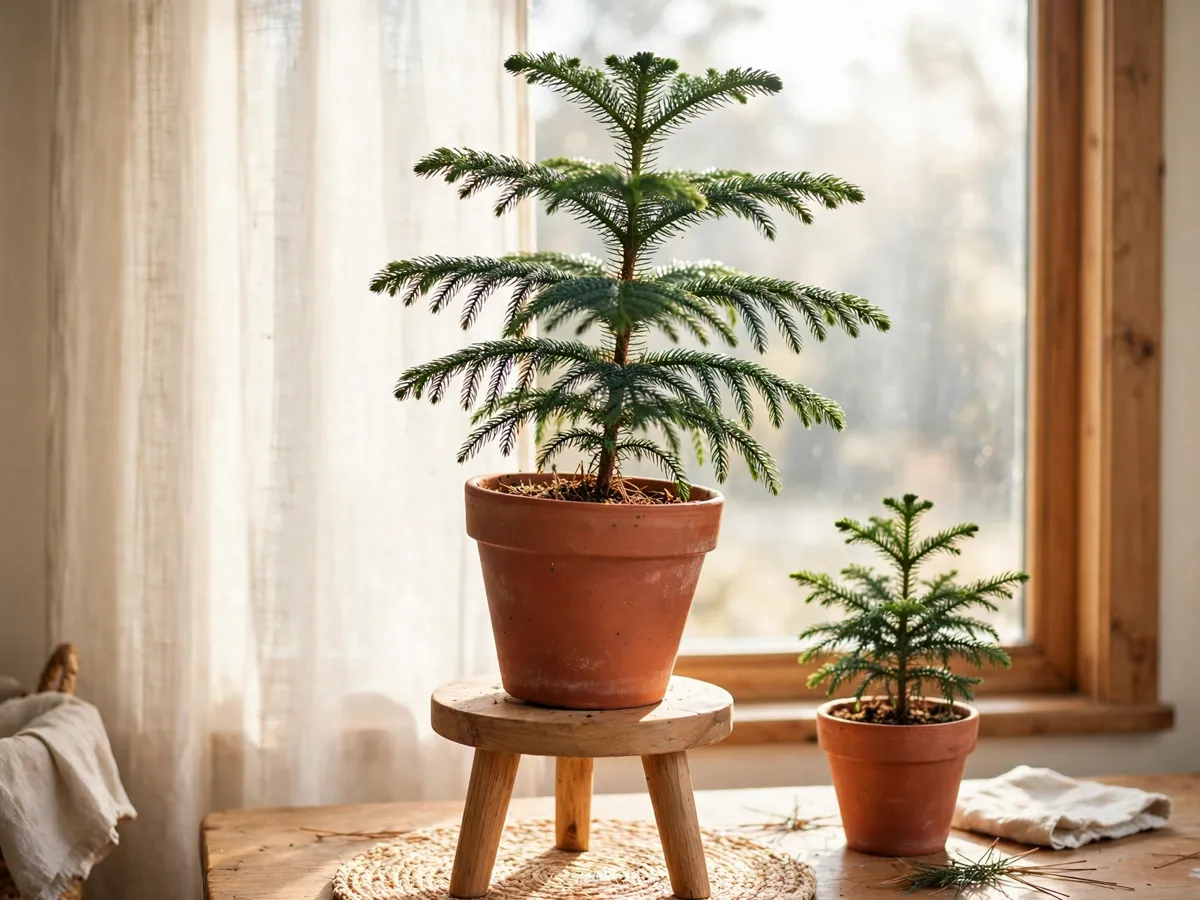
The practical consequence is that prevention beats repair on this plant. Steady watering, real humidity, and no drafts keep every tier alive, and that is the whole strategy, because there is no pruning trick or product that regrows a lost whorl. It pairs well with other slow-growing statement plants, and the styling habits in the large indoor plants guide apply to a floor-sized Norfolk Island pine the same way.
Cost: $0. Time: 10 seconds a week of prevention. A dropped tier is permanent, which is why the small habits matter.
11. Propagation: why cuttings fail, seeds work
The honest answer on making more of them: cuttings almost never root for home growers. This species wants professional conditions, the kind of mist bench and bottom heat a nursery has, and a cutting taken from a houseplant typically sits, stays green for a while, and then fails. Promising rooting success from a jar of water on a windowsill would be a lie, so it is not promised here. The workable routes are buying a second small plant (they are cheap) or growing one from seed, and the seeds sprout readily when they are fresh, the same starting patience the seed starting indoors guide builds on.
Cost: $0 for a packet of seed, or $10–$25 for a second plant. Time: weeks to germination, years to a tree. Cuttings are the route this plant reserves for nurseries.
12. The price of each size
Table-top plants, the six-to-ten-inch versions, run $10 to $25 in season. Floor plants at three to four feet run $50 to $150 depending on fullness and pot quality. Those are honest ranges, not markdowns or special finds, and they move with the calendar: December stock is cheapest after the holiday week, when stores clear living trees that no longer fit the season. That week is the discount window for a plant you intend to keep for years.
After the purchase, a year of care costs nearly nothing beyond the pebble tray: tap water, occasional weak feed, and the same pot for two years. Of everything in this guide, only the tray and the feed cost anything at all.
Cost: $10–$25 for small, $50–$150 for floor size, $3–$8 for the tray. Time: 5 minutes a week. The discount week is the one after the holiday.
Common questions
Is a Norfolk Island pine a real pine tree?
No. It is a tropical evergreen from Norfolk Island in the South Pacific, only distantly related to true pines. The pyramid shape is similar, but the care is tropical: steady warmth, bright indirect light, and no freezing temperatures, ever.
Why are the tips of my Norfolk Island pine turning brown?
Brown needle tips with the rest of each branch green is dry air, the number one complaint on this plant. It is a humidity problem, not a watering problem, so the fix is a pebble tray, grouped plants or a small humidifier, plus distance from heating vents. If whole lower branches are yellowing instead, that points to overwatering.
Can I keep a Norfolk Island pine small by pruning?
No. Cutting the top kills the single leading stem that builds the tidy pyramid, and the shape never recovers. Pruning is not a size tool for this plant. Buy the size you have room for, and expect a six-inch table plant to become a five or six-foot floor plant over roughly five to eight years.
Where should I put it at Christmas?
Near its brightest window, away from the fireplace, radiators and heating vents, and out of the front-door draft. Use battery LED lights and lightweight ornaments on the inner branches. After the season the decorations come off and the pot returns to the bright window.
Is a Norfolk Island pine safe for cats and dogs?
It is mildly toxic to both, so it belongs out of reach of pets that chew plants. If a pet chews any part of it, call a veterinarian promptly.
How often should I water it in winter?
On the inch rule, not a calendar: water when the top inch of soil is dry, fully, until it drains, then empty the saucer. In winter that often means every two to three weeks, because weak light and cool rooms slow the plant down.
Save these on Pinterest
Pin the humidity stack and the size ceiling, the two parts of this guide that decide whether the tree thrives past January. This guide and the rest of the gardening tips collection live together there.