 Plant As Deco
Gardening & Planting Tips
Olive Tree Indoors: Light Floor, Winter Chill and Pots
By Plant As Deco · Updated 22 November 2026
An indoor olive tree is the Mediterranean look in a pot, and a compromise from day one. Olives want blazing outdoor sun, a dry summer and a cold winter rest, and a living room offers none of the three. This guide covers the light floor, the winter chill, the watering rhythm and the heavy pot that keep a potted olive alive, written for renters and first homes.
Weekend-ready: $40–$120 for a young tree, a large terracotta pot and grit. One afternoon to pot it up, ten minutes a week to check.
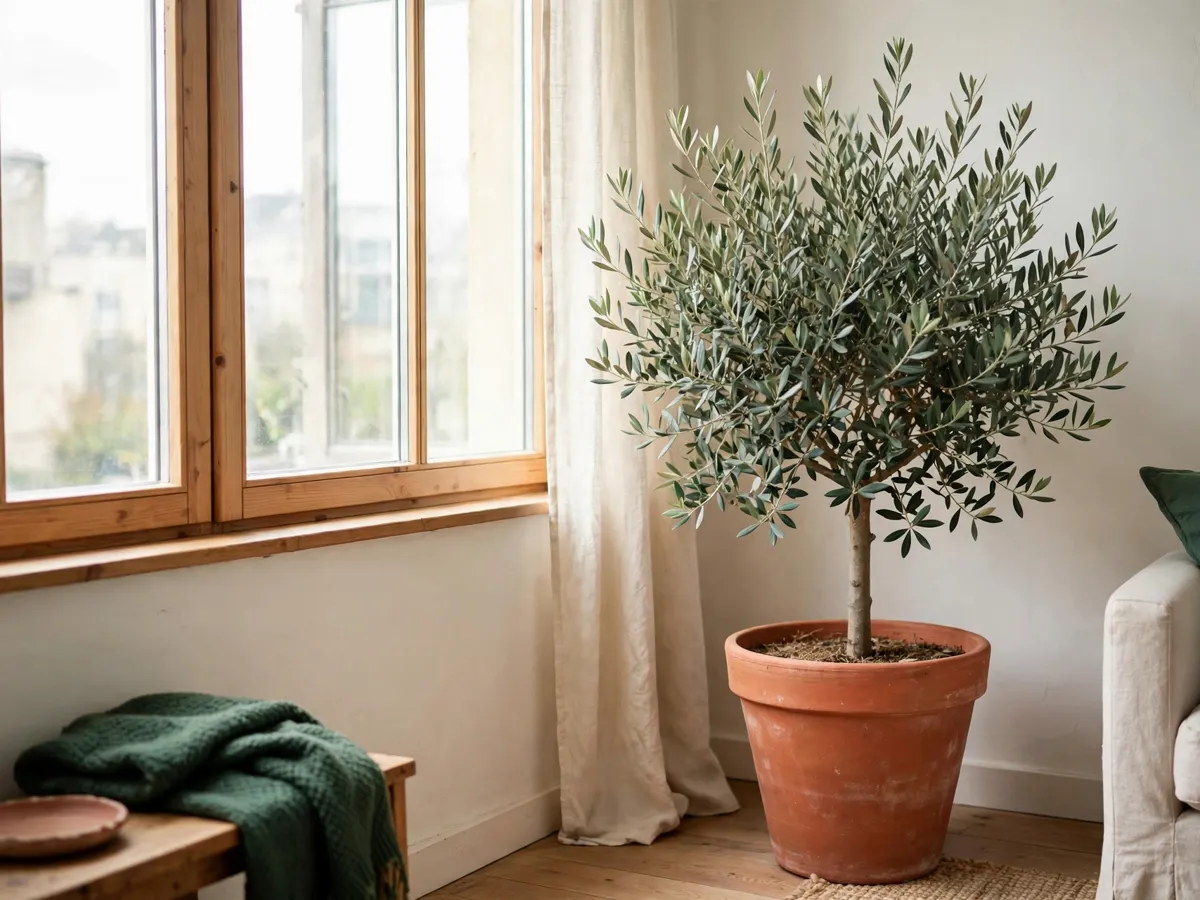
1. The compromise you are making
An olive is not a houseplant by nature. It is a sun-loving tree from the Mediterranean basin that happens to tolerate life in a container. Its instincts were shaped by three things a living room does not provide: full sun from morning to evening, a long dry summer, and a cool-to-cold winter rest.
Kept indoors year-round, an olive does not die dramatically. It survives politely, then declines. Growth goes sparse and pale, the canopy thins and sheds, and the tree essentially never fruits. That is not your failure as a grower.
The honest frame for success: an indoor olive is a beautiful silvery sculpture that needs a summer outdoors to stay healthy, and a winter spot that is cool and bright rather than warm and dim. If your home can supply a balcony, patio or stoop for the warm months and an unheated bright room for the cold ones, the tree can work. If it cannot, a true large indoor plant will give you the same corner-filling shape with far less sulking.
Cost: $0. Time: five minutes of honest planning. Both rooms have to exist before the tree does.
2. The cold snap it needs: winter chill
Olives are Mediterranean plants, and Mediterranean winters are cool and damp, not warm. The tree expects a dormant stretch every year, with temperatures somewhere between a cool spare room and a light frost, lasting weeks. That chill is how it rests and resets for spring.
A tree held at a constant seventy degrees never gets that rest. It stays half-awake all winter, and the stress shows up as shedding, weak pale growth and a rough handoff into spring. Warmth, the reflex most plant care reaches for, is the problem here, not the solution. Advice that treats an olive like a tropical wanting a toasty living room is quietly describing how to kill it slowly.
The indoor answer is a spot that is cool and bright at the same time: an unheated room with good windows, a cool stairwell landing, a garage window that stays above a hard freeze, an enclosed porch that never drops to solid freezing. Pick the room it will overwinter in before you buy the tree, not after. While it rests it drinks almost nothing. The winter houseplant care routine covers the rest of your plants for the same season.
Cost: $0. Time: ten minutes to pick the room. It must be bright as well as cool, or you trade one stress for another.
3. Hardiness zones, briefly and honestly
Plant zones are the public maps that split the country into bands by the average coldest night of winter; type a zip code into a free map tool and it names yours. The map answers one question: will this plant survive a normal winter in the ground where I live?
For olives the answer is clean. Outdoors and in the ground, they thrive in the warm-US zones, the warm-winter corners of the country. In the ground in the colder zones they die, usually within the first or second winter, and there is no indoor trick around that. A potted olive does not become hardy by living indoors half the year.
What the pot changes is mobility, and that is the whole northern play: summer out on the patio in full sun, a cool bright room to overwinter in, repeated every year. In the warm zones you can leave a potted olive outside year-round near a south wall and shelter it only through the sharpest cold snaps. If you need the exact band for your address, a map tool answers it in seconds; the pot, not the zone, makes the northern version work.
Cost: $0. Time: five minutes with a zone map. Zones describe survival in the ground, not what a pot in your window will do.
4. The indoor light floor
Give it the brightest window in the house. A south-facing window with nothing blocking it, no buildings, no deep eaves, no evergreen hedge, and in winter open the sheers fully, because December sun through a curtain is thin enough already. Even that window is the floor, not the target. It delivers a fraction of what the same tree drinks outdoors in June.
Below the floor, the tree tells you in two dialects. One is stretched, sparse growth: new leaves smaller and paler, spaced far apart along elongated stems, the canopy going see-through. The other is a slow steady drop, a few leaves every week, all over the tree, in any season. Both mean the light is not enough, and no watering change or feed will fix it.
Fix it by position first: the better window, the clean glass, the spot against the frame rather than three feet back. If the best window still is not enough through the dark months, a grow light over the tree tops it up, and the grow lights guide covers choosing and placing one.
Cost: $0–$45. Time: ten minutes. The window comes first and the lamp only tops it up.
5. The Mediterranean watering rhythm
Olives come from dry summers, and in a pot the rule simplifies: water deeply, then let the mix dry. The check is the top two inches of soil. Dry and dusty to the second knuckle, water; damp and cool, walk away. When you do water, pour slowly around the whole surface until it runs from the drainage holes, then empty the saucer so the bottom of the root ball never sits in a puddle.
The rhythm swings hard with the season. Outdoors in July heat, in a big terracotta pot in full sun and wind, the same tree can need water daily or close to it. In the cool winter room, a dormant tree may go weeks between waterings.
That swing is where the trap lives, because the number one killer of potted olives is a resting tree plus a kind waterer. Soil that stays cold and wet rots the roots and breeds fungus gnats, the small black flies that hover over damp soil. Drying the top layer between waterings starves their larvae, and the fungus gnats disappear with the habit.
Cost: $0. Time: two minutes per check. Water on the rhythm the soil sets, never on a calendar.
6. Pot and mix: heavy matters
The pot is structural. Olives get top-heavy fast, a dense silvery canopy on a thickening trunk, and a lightweight plastic pot tips the first time someone brushes past it. A large, sturdy terracotta pot with a wide base is the honest answer: it breathes through its walls so the mix dries evenly, and its own weight plus a root-balled tree keeps the whole thing standing.
Drainage holes are not optional, and in a large pot you want several. The mix matters just as much: use a gritty, free-draining blend, either a bagged cactus and palm style mix or a standard potting soil cut with coarse sand and fine grit, roughly a quarter to a third by volume. It should feel loose and gritty in the hand, not like a wet sponge.
Finish with a gravel top dressing, a shallow layer of pale pebbles over the soil surface. It matches the Mediterranean look the tree brings, and it keeps the crown, the base of the trunk where roots meet stem, dry and aired instead of pressed against damp soil.
Cost: $35–$70 for a large pot, gritty mix and gravel. Time: 45 minutes. Repot in spring as the tree wakes, not in the depth of winter.
7. The summer outdoors
One habit decides whether an indoor olive thrives or merely persists: outside for the summer. From late spring, once nights stay safely mild, through early fall, the tree lives in full sun on a patio, balcony or stoop. It gets many times the light of your best window plus real air movement, and the difference shows up as a thicker trunk, a denser canopy and leaves with real silver in them.
The care flips with it. Water deeply and often, sometimes daily in July heat. Feed with a dilute balanced liquid feed every few weeks through the outdoor months and stop entirely in winter. This is also the season for any repotting and pruning, while the tree is in active growth and recovers fast.
Mind the wind. A tall tree in a top-heavy pot can literally blow over in a summer storm. Tuck it against a wall, brace the container, or use a pot heavy and wide enough to shrug it off. For arranging a whole container setup around a statement plant like this, the balcony garden guide covers the layout side.
Cost: $0. Time: ten minutes to settle it outside. Full July sun dries a big terracotta pot fast, so check it daily.
8. Moving it in and out
The spring move out needs two weeks of patience. An olive that spent winter in a window has soft, indoor-adjusted leaves, and a sudden shift to all-day sun scorches them into pale patches that never recover. Start it in bright shade, give it morning sun only for a few days, then full sun. Two weeks of stepped exposure and the job is done.
The fall move in is about timing. Bring the tree inside before the first frost, a little earlier than feels necessary, because potted roots are exposed to cold in a way in-ground roots never are; a frost a garden shrub shrugs off can kill the fine roots in a pot. Expect the leaf drop covered in the next section, and do not feed again until spring.
Inspect the bark in both directions, every move. Scale insects and spider mites ride in on stems and leaf undersides, near-invisible at a glance. Before the tree comes in, hose the whole plant down outdoors, run a finger along every stem feeling for bumps, and check under the leaves. A pest caught on the patio is a five-minute problem. The same pest in your living room in January is a two-month campaign.
Cost: $0. Time: twenty minutes per move plus the acclimation fortnight in spring. Never skip the bark check.
9. Reading the leaf drop
Olives communicate by shedding, and indoor olives shed a lot. The pattern, not the pile, tells you which of four situations you are in.
- The fall drop. It comes inside in autumn and sheds for a few weeks. That is the light change, from all-day outdoor sun to one window, and it is normal enough. Let it finish, clean up the leaves, and fix nothing.
- The steady year-round drop. A few leaves every week, every month, no season to it. That is the light floor not being met. Move it brighter or add the lamp; watering changes will not touch it.
- The crispy edge. Leaves stay green but the margins and tips go dry and papery, worst on the radiator side of the pot. That is dry heated air, winter humidity at its lowest, and underwatering. Move it off the heat run, raise the local humidity if you can, and check the soil more often.
- The soft yellow wilt. Leaves yellow all over, go soft, and the soil stays soggy. That is roots drowning. Stop watering, lift the pot off its saucer, and if the mix stays wet for days, repot into fresh gritty mix with better drainage.
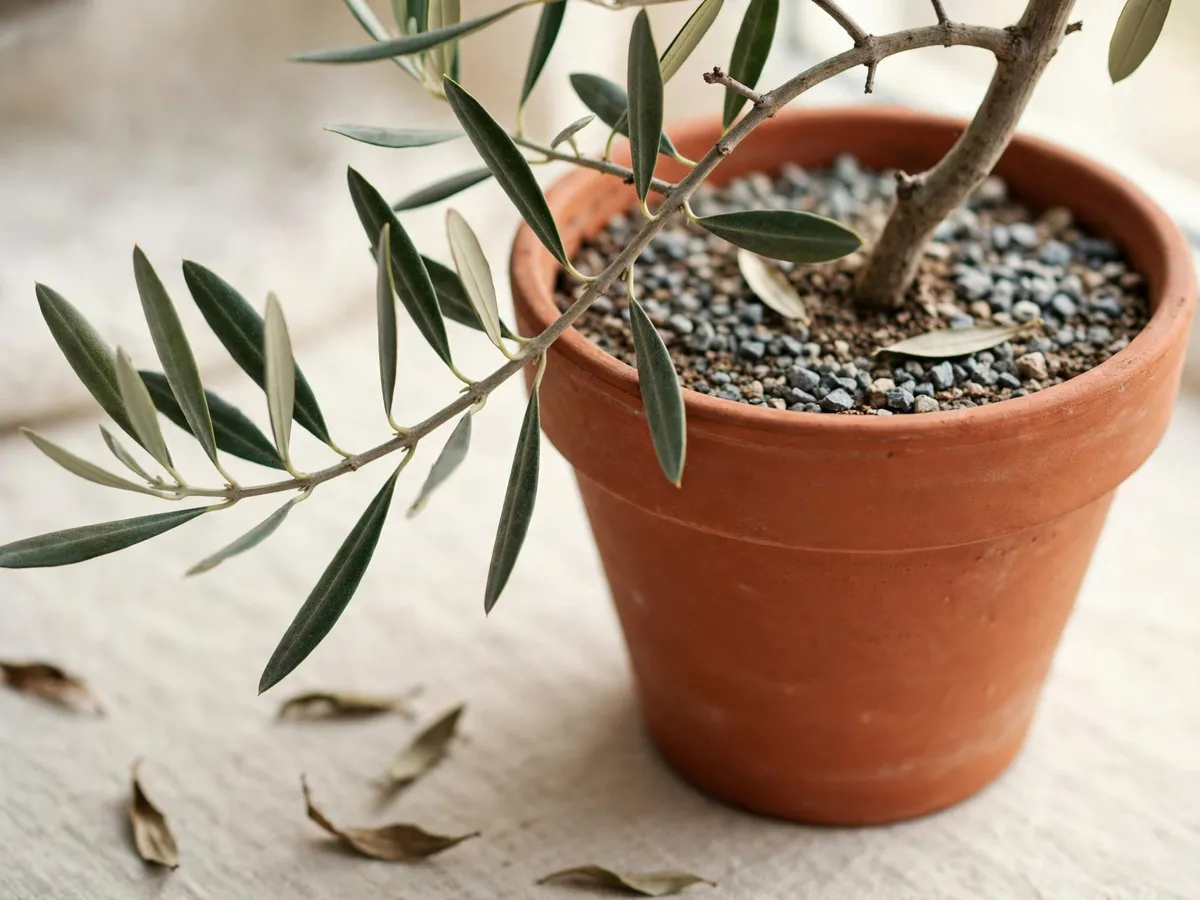
Cost: $0. Time: five minutes to diagnose. The drop has a direction; read the kind before reacting to the count.
10. Fruit, honestly never
Said once and plainly: an indoor olive essentially never fruits, and you should not buy one expecting olives. Fruit asks for a full outdoor season of sun, a tree old enough to be productive, and for many cultivated olives a pollination partner, a second compatible variety flowering nearby at the same time. A window in a living room supplies none of that.
Nurseries sell indoor-sized olives as foliage plants, and that is what they are: silvery, sculptural, slow-growing presence. The flowers, in the rare years they appear indoors at all, are tiny and easy to miss, and they set no fruit.
This is freeing rather than disappointing. You are not waiting on a harvest that never comes; you bought a shape, a color and a habit, and those it delivers. If you want actual olives, that is a warm-zone outdoor project with two trees, not a windowsill one.
Cost: $0. Time: none, once you stop waiting. Wanting fruit is the wrong reason to buy this plant.
11. Pests on bark and leaf
Two pests do nearly all the damage to indoor olives, and both prefer the indoor half of the year.
- Scale. Small brown bumps fixed to stems and leaf midribs, waxy and immobile once settled, easy to mistake for part of the bark. Run a fingernail along a stem; a bump that peels off is an insect. Scrape what you can, touch each spot with a cotton swab dipped in rubbing alcohol, and recheck weekly, because one pass rarely clears it. Dormant-season vigilance matters most: the bumps build quietly through winter while nobody is looking.
- Spider mites. They arrive with the dry heated air of winter: stippled, pale-flecked leaves, and eventually fine webbing where leaves join stems. The cheapest control is physical. Carry the tree to a shower or sink and spray the whole plant, tops and undersides, with room-temperature water, repeating weekly, and raise the humidity around it so the dry winter air stops favoring them.
The habit that prevents both is the bark inspection at every move, plus a monthly once-over of stems and leaf undersides while the tree is inside. Keep an infested olive away from other plants until it is clean; both pests travel pot-to-pot.
Cost: $5–$15 for rubbing alcohol and swabs. Time: fifteen minutes a month. Catch scale in winter, before the bumps become a colony.
12. Where it lives in a pet house
The foliage of an olive tree is generally listed as non-toxic to cats and dogs, which makes it one of the safer statement plants to keep around pets. A nibbled leaf is not the emergency some houseplants make it.
The honest pet risk is physics, not chemistry. This is a heavy, top-heavy plant, and a cat that launches off the container or a dog that shoulders past it can bring the whole thing down onto a paw or a floor. That is a vet visit and a broken pot, not a poisoning.
Place it like furniture with a fall radius: on the floor, out of the runway between sofa and window, on the widest, heaviest base you can give it. For more plants that are safe around pets, the pet safe houseplants guide lists the reliable ones for dimmer rooms.
Cost: $0. Time: five minutes of placement. The tree is the safe half of the equation; the pot is the dangerous half.
13. The buying read
Buy small and healthy, not tall and impressive. Look for a young compact tree in the $25–$40 range, the kind sold as a dwarf olive cultivar that stays container-sized: small silvery-green leaves, firm stems, bark free of bumps, soil that smells like soil rather than swamp. Run a finger down every stem before you pay.
The temptation is the six-foot tree at the garden center, the one that already looks like a courtyard in the south of France. It costs a fortune and it sulks hardest indoors. It was grown in full field sun, it has years of root and canopy to support, and your window is a fraction of the light that wood was built with.
The honest arithmetic: a $25–$40 young tree, one or two summers outdoors and a cool bright winter each year fills a corner beautifully, with visibly thicker growth every season you give it.
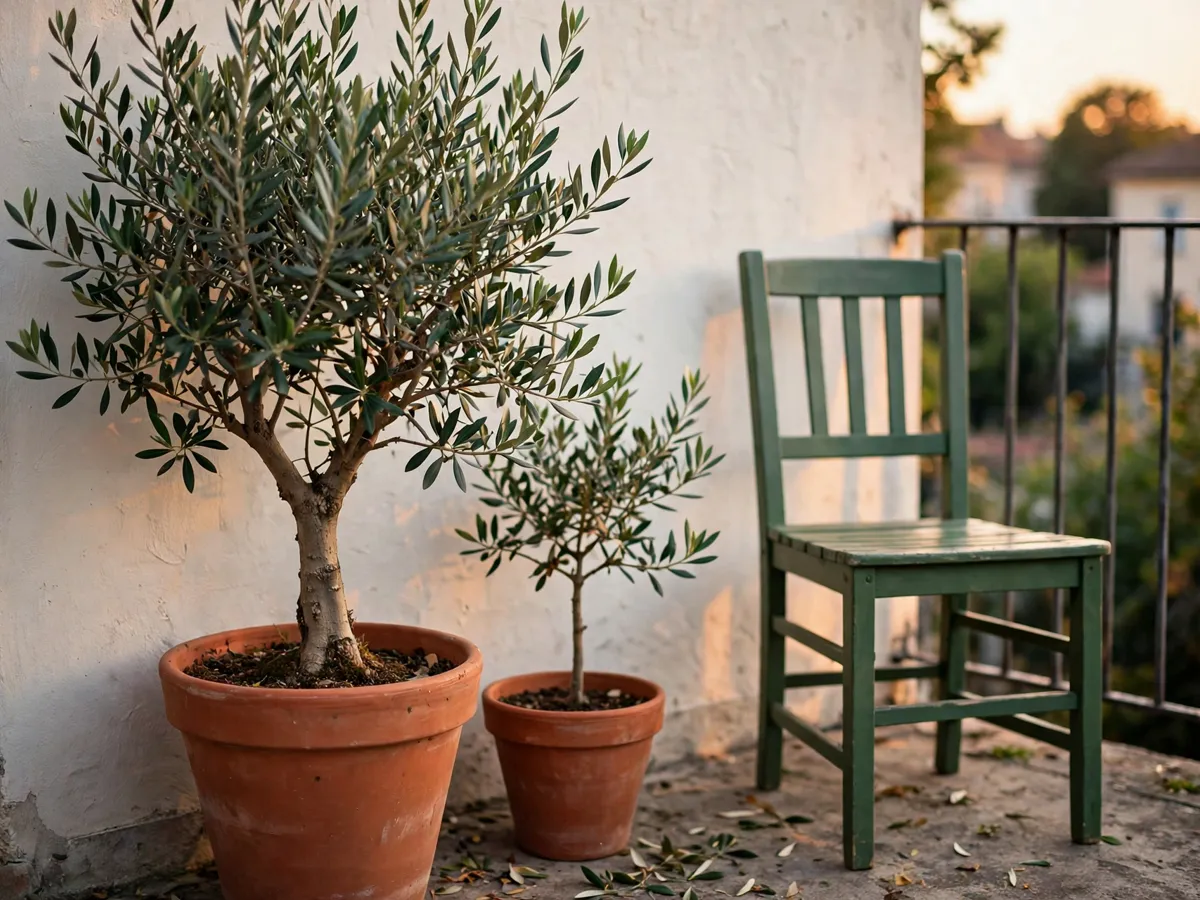
Cost: $25–$120 for tree, pot and mix. Time: thirty minutes in the shop. The humble tree with clean bark outgrows the expensive one indoors.
Common questions
Can an olive tree live indoors all year?
It can survive indoors all year, but it will not thrive. An olive needs a summer outdoors in real sun and a winter with a genuine chill in order to rest. Kept inside permanently at room temperature it sheds steadily, grows pale and sparse, and never fruits. A patio for summer and a cool bright room for winter keep the same tree going for years.
Will my indoor olive tree grow olives?
Almost certainly not. Fruiting needs a full season of outdoor sun, a mature tree, and for many varieties a second compatible olive nearby for pollination. A window supplies a fraction of that light, and the few flowers indoors set no fruit. Enjoy the silvery foliage; that is what the tree is sold as.
How often should I water a potted olive tree?
Water when the top two inches of soil are dry, not on a schedule. In a cool winter room that might mean every few weeks; outdoors in summer in a large terracotta pot it can mean daily. When you water, pour slowly until it runs from the drainage holes. The most common mistake is watering a resting winter tree on a summer rhythm.
Why is my indoor olive losing its leaves?
Match the pattern, not the count. A few weeks of shedding right after it comes inside in fall is the light change and is normal. A steady year-round drop means the light is too low, and a lamp may be needed. Crispy dry edges point to dry heated air and underwatering. Soft yellowing all over with wet soil points to overwatering and roots in trouble.
Does an indoor olive need a cool room in winter?
Yes. Olives expect a dormant winter rest somewhere between a cool room and a light frost. A tree kept warm all winter never rests. An unheated bright room, a cool stairwell window or a garage window that stays above a hard freeze all work. Cool and bright together, never cool and dark.
Are olive trees safe for cats and dogs?
The foliage is generally listed as non-toxic to both, so a nibbled leaf is not the emergency some houseplants make it. The real hazard is the pot: a large olive in heavy terracotta is a top-heavy object a playing pet can knock over onto a paw or a floor. Keep it on the floor, out of pet runways, on the widest base you can find.
Save these on Pinterest
Pin the winter-room decision and the leaf-drop decoder, the two parts of this guide you will want in November and again in May. This guide and the rest of the gardening tips live together there.