 Plant As Deco
Gardening & Planting Tips
Elephant Ear Plant Indoors: Care, Dormancy and Pets
By Plant As Deco · Updated 22 November 2026
An elephant ear plant indoors is one of the few houseplants that looks like furniture: three to five feet of broad tropical leaves that fill an empty corner in a single season. This guide covers what colocasia and alocasia actually need, how their care differs, why most of them decline by February, and what to do about it - from the honest dormancy choice to the pet-safety question most people ask too late.
Weekend-ready: $40–$80 to start, one afternoon of setup. That covers the plant, a pot with a drainage hole, one bag of mix and a humidity tray.
1. What an elephant ear looks like in a room
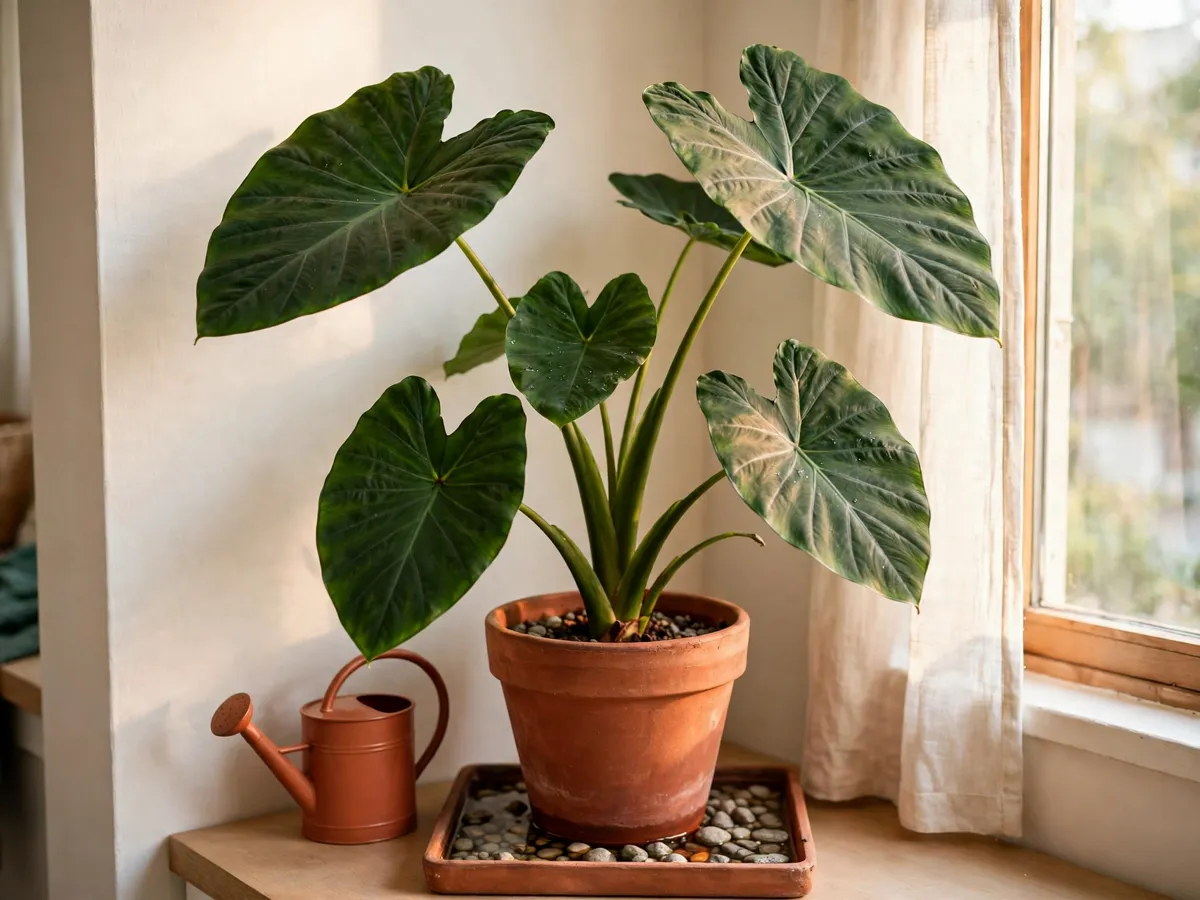
An elephant ear changes the scale of a room the way a floor lamp does. Indoors, a healthy plant stands three to five feet tall by the end of its first growing season, and each leaf runs one to two feet long. The leaves are the entire show: broad, arrow- to heart-shaped, held on thick stems that rise straight out of the soil. Between leaves the plant is mostly stems, so a mature specimen reads as a green fountain rather than a dense shrub.
The footprint matters more than the height. A single mature leaf spans wider than a dining chair, and the lowest leaves hang at knee height where elbows and vacuum cleaners go. Give the plant a corner nobody cuts through, with a few feet of clearance on the leaf side and enough floor space for a saucer under the pot. Leaves bruise easily; a plant in a walkway collects torn edges within a month.
Weight is the second reality check. Four feet of foliage plus damp soil in a twelve-inch pot is heavy enough that you will not be moving it for seasonal light changes. Pick the corner before you buy, not after. If you are planning a whole room of big leaves, the large indoor plants guide compares the footprint, weight and light demands of the common giants side by side.
Cost: $0. Time: 10 minutes to measure the corner. Check the ceiling clearance and the walkway before you buy the plant.
2. Colocasia vs alocasia: the one distinction that changes the care plan
Elephant ear is a nickname shared by two different plant groups, and the difference decides how you water.
Colocasia is the true elephant ear. Its large heart-shaped leaves point downward, drooping from thick stems, and the plant grows from a tuber (a fat underground storage organ, often sold as a spring bulb). Colocasia evolved at the edge of water. It tolerates consistently wet soil and genuinely enjoys a drink - in mild climates it grows in ponds. Green and deep-purple varieties are the ones most commonly sold as bulbs each spring.
Alocasia is the upright one. Its leaves are shield-shaped, held horizontal or angled up, with heavy pale veins that give varieties like the polka-dot and jewel types their graphic look. It grows from a rhizome, and it hates soggy soil. Keep an alocasia as wet as a colocasia and the roots rot within weeks.
Most care confusion comes from treating these as one plant. The watering section below gives each its own rule, and everything else in this guide notes where they differ. If a store label only says elephant ear, check the leaves: drooping hearts mean colocasia, upright shields mean alocasia. If you are building a shelf of humidity-loving foliage, the tropical houseplants for beginners guide places both in a wider starter set.
Cost: $0. Time: 5 minutes at the store to check the label and the leaf shape. Ask whether the plant is colocasia or alocasia before you take it home.
3. The light it actually needs
Both plants want bright indirect light, and indoors that means at least four hours of very bright light a day. The most reliable setup is a south-facing window with a sheer curtain, the plant a foot or two back from the glass. The curtain strips the harsh midday sun while leaving the intensity the leaves need to build size. An east window also works well, because gentle morning sun is welcome; it is direct midday and afternoon sun that scorches, showing up as dry brown patches on the widest leaves.
There is a simple feedback loop for judging your spot. In good light, each new leaf comes in as large as or larger than the last one. In marginal light, the leaves shrink with every cycle and the stems stretch tall and thin. That shrinking is the plant telling you the corner is too dim, months before it actually declines. Indoors, you can barely overdo bright indirect light, so err toward the brighter spot.
A dim corner is the one situation where this plant is the wrong purchase. Colocasia and alocasia cannot hold three feet of leaf area on the light a north window gives. If your brightest spot still reads as dim, choose from the low light indoor plants list instead, and save the elephant ear for a window that earns it.
Cost: $0–$12 for a sheer curtain if you need one. Time: 15 minutes to set the spot. Watch for brown patches the first week after any move.
4. Watering without guesswork
This is where colocasia and alocasia split, and where most elephant ears are lost. A colocasia likes consistently moist soil: in summer you water before the top inch fully dries, roughly every two to three days in a warm bright room. An alocasia wants the top one to two inches to dry first, which lands closer to once a week in the same room. Winter halves both intervals. Watering an alocasia on a colocasia schedule is the fastest route to root rot, and watering a colocasia on an alocasia schedule gives you drooping, stressed leaves all summer.
Two checks replace guessing. The finger test: push an index finger into the soil to the first knuckle, about an inch deep. Damp and cool means wait; dry and warm means water (for the alocasia, go two knuckles deep before deciding). The weight test: lift the pot right after a thorough watering once, and remember that heft. A dry pot weighs clearly less. After a few weeks you can walk past, tip the pot edge, and know the moisture level without touching the soil.
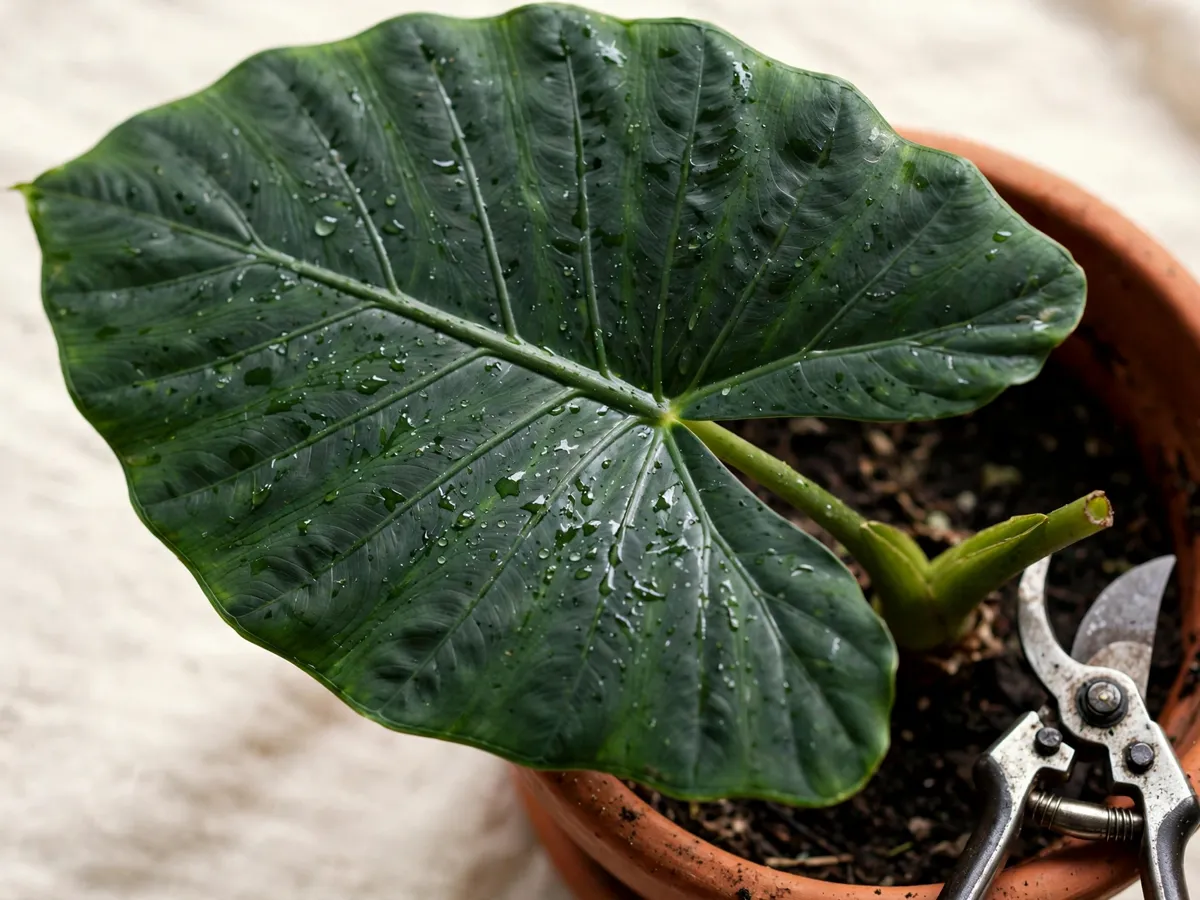
When you do water, do it fully: pour slowly around the surface until water runs from the drainage hole, then empty the saucer ten minutes later. A trickle that only wets the top inch salts the soil and leaves the lower roots dry, while a pot left standing in its own runoff suffocates them.
Cost: $0. Time: 2 minutes per plant. Calibrate the weight test on your own pot, since pot size and mix change the feel.
5. Soil and drainage
Both plants need a well-draining, airy potting mix. Bagged general houseplant mix works if you loosen a handful of perlite or orchid bark into it; the mix should feel springy when squeezed and crumble apart again, not clump like wet clay. Air pockets in the mix are what let roots breathe between waterings, and they are what allow the two different watering rhythms above to work.
Heavy garden soil is the silent killer here. It compacts in a pot, holds water long after the surface looks dry, and slowly shuts down the roots of both genera - the alocasia faster, because it expects a dry-down its mix never delivers. Dense old mix does the same thing on a delay: after a year or so the perlite settles and the pot suddenly stays wet twice as long as it used to. That is usually the real story behind a plant that rots in its second year despite unchanged care.
The pot rule is absolute: drainage holes, always. A decorative cachepot without a hole is a planter cover, not a pot; keep the plant in a holed nursery or terracotta pot and set that inside the pretty one. Terracotta breathes and pulls a little extra dry-down, which suits the alocasia especially well.
Cost: $10–$18 per bag of mix. Time: 20 minutes to pot up. Mix older than about two years compacts and holds water longer, so refresh it rather than topping it up.
6. Humidity and temperature
These are true tropicals, comfortable in the same range you are: roughly 60–80°F. Growth stalls below about 60°F, and leaves blacken at the edges when a cold draft hits them - an entry door opened all January, or a single-pane window in a cold snap. In winter, keep the pot pulled back from icy glass and away from doors, and away from heating vents, which blow desert-dry air straight onto foliage.
Humidity is where honesty helps. A pebble tray (a shallow tray of water and stones under the pot, water kept below the pot's base) raises the humidity in the inch of air right around the plant and genuinely helps a little. What it does not do is fix a dry apartment. A small humidifier running nearby does far more. Misting does almost nothing: the leaves are dry again within half an hour, and wet leaf surfaces overnight invite leaf spot. If your home sits at normal heated-winter dryness, expect slightly slower growth and the odd crisp edge; the plant will live with it, even if it will not love it.
Cost: $0–$15 for a tray and pebbles, more for a humidifier. Time: 10 minutes. A tray helps locally, a humidifier does more, misting does almost nothing.
7. Feeding through the growing months
Leaves this size are expensive to build, so feeding matters more for an elephant ear than for a pothos. Use a balanced liquid feed diluted to half the label strength, applied with a watering every two to four weeks from spring through late summer. Pour it onto already damp soil, never onto dry roots, and never exceed the half rate: full-strength salts burn the leaf tips and edges on fast-growing foliage.
Fresh mix carries the plant for its first two or three months, so a newly potted plant needs nothing. Stop feeding entirely by mid-fall, when light drops and growth slows. Feeding a plant that is slowing down only piles unused salts in the pot, and those salts are what show up as brown tips in November.
Cost: $8–$14 for a bottle of balanced liquid feed. Time: 5 minutes per month. Never feed a dormant plant; resume when spring growth reappears.
8. The February problem: dormancy, not death
Here is the part most guides leave out. In a typical US winter, indoor light drops to a fraction of its summer strength and the days shorten. A plant carrying four feet of giant leaves cannot support all of that foliage on winter light. Starting in late fall, the oldest leaves yellow, stems soften, and the plant visibly shrinks. By February many elephant ears look half dead. In the overwhelming majority of cases that is dormancy - the plant shedding leaf area it can no longer power and retreating to its tuber - and not a watering failure or a disease.
Once you accept the drop, there are two honest paths through winter, and either works.
Path one: let it rest. Stop feeding by mid-fall and cut watering back hard - a colocasia gets just enough to keep the tuber firm, an alocasia gets an occasional light drink only when the pot is fully dry. If a colocasia dies back completely, lift the tuber, brush off dry soil, and store it in a box of dry peat or shredded paper in a dark spot around 50–60°F. Replant in spring after the last frost, and it resprouts bigger than the year before. An alocasia usually keeps a few leaves: leave it in its pot in a cool room, water sparingly, and let it sit out the season. Dormancy trades a winter of leaves for a stronger summer plant.
Path two: keep it growing under lights. A full-spectrum grow light run 10–12 hours a day over the plant holds it in growth through the winter. Expect slower, smaller growth than summer, but the foliage stays and the plant keeps size. That costs a modest amount of electricity plus the fixture itself; the grow lights for indoor plants guide covers fixtures, distance and timers. The rest of the cold-season routine lives in the winter houseplant care guide.
Two checks keep a light-grown winter plant on track. Lift the pot edge weekly for the weight test: a light pot is asking for water even in December. And run one winter treatment as insurance against spider mites, which breed fastest on big leaves in dry heated air - a damp cloth wipe across leaf undersides each week is enough.
What kills elephant ears is indecision between the two: half-strength watering with no light plan, which leaves the plant too wet to rest and too dark to grow. Pick a path in November and follow it through to spring.
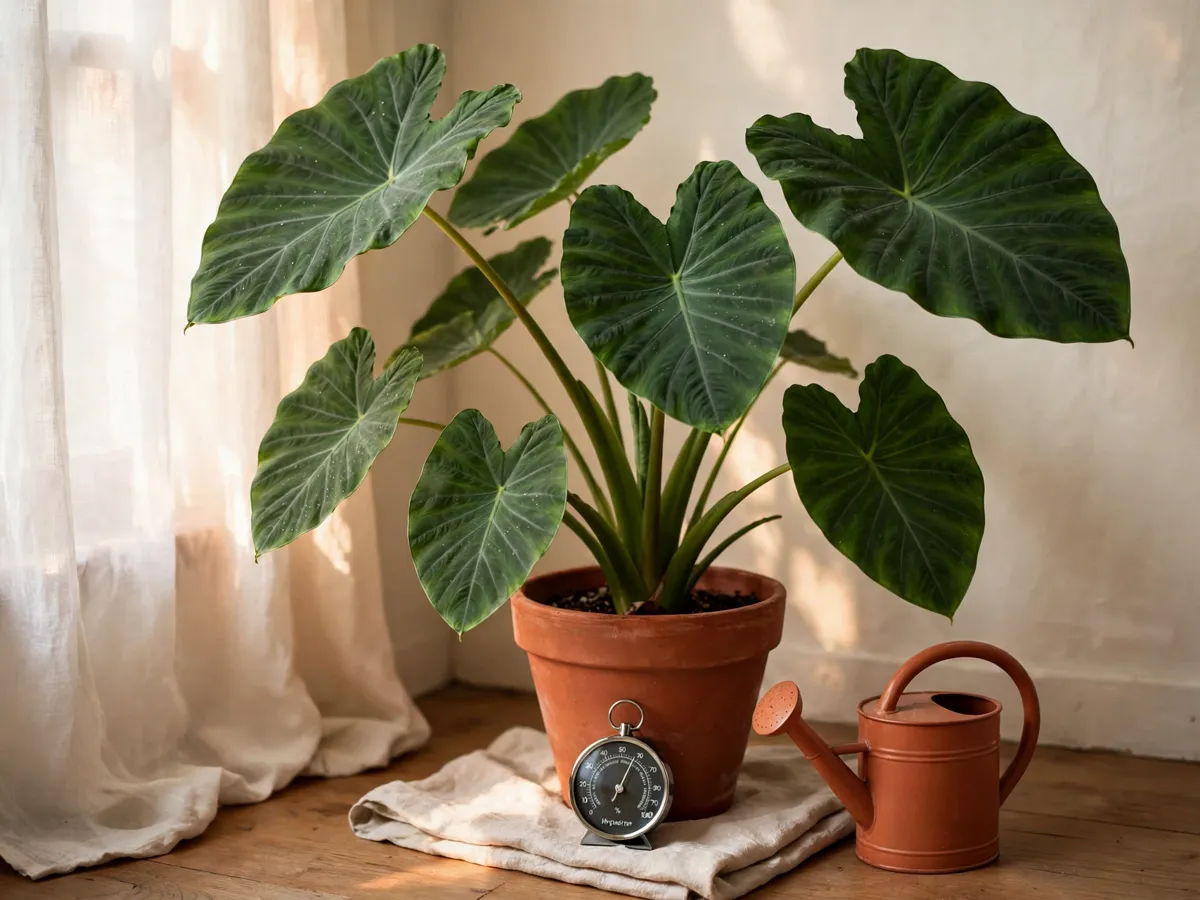
Cost: $0 to store a tuber, $15–$45 for a grow light. Time: 30 minutes to lift and pack. A stored tuber skips a season of leaves; a lit plant keeps its leaves but adds an electricity cost.
9. Yellow leaves and other alarms
Read the whole plant before reaching for a fix, because the same yellow leaf means different things in different seasons.
- Yellow lower leaves, soggy soil, musty smell. Overwatering. The soil is staying wet past the roots' comfort. Let the mix dry toward the plant's proper rhythm, confirm the drainage hole is clear, and remove leaves that have gone fully yellow.
- Crisp brown edges, curling, bone-dry soil. Underwatering or very dry air. Water thoroughly until it drains, then shorten the interval; if the soil is damp but the edges are still crisp, humidity is the missing input.
- Many leaves yellowing at once, starting mid-fall, growth stopped. Dormancy. This is the February pattern from the last section arriving on schedule. Follow the rest path or the light path; do not change the watering mid-decline.
- Pale stippled leaves with fine webbing underneath. Spider mites. They arrive in dry heated air. Wipe the leaf undersides with a damp cloth, raise the humidity, and repeat the wipe weekly until the stippling stops spreading. A reappearing spider mite pattern usually means the air is still too dry.
One yellow leaf now and then is normal aging - old leaves retire as new ones open. The signal is the pattern: several leaves in the same fortnight, or a change in the newest leaf's size. Pair the leaf with the soil moisture and the calendar, and the cause usually names itself.
Cost: $0. Time: 5 minutes to check leaf, soil and season together. Act on patterns, not on a single yellow leaf.
10. Repotting
Spring is the repotting window, when the plant is waking and recovers fastest. The signs it is time: roots circling the inside of the pot, roots pushing out of the drainage hole, or water running straight through because the pot is more root than mix. Colocasia in particular can fill a pot in a single season, since the tuber thickens as well as the roots.
Go up one size only - a twelve-inch pot moves to a fourteen-inch, roughly two inches wider. A jump to a much larger pot leaves a volume of wet soil around a small rootball, and that volume stays saturated for weeks. Use fresh airy mix, keep the plant at the same soil depth it grew at, water it in thoroughly, and hold off feeding for a couple of months while the fresh mix carries it. Never repot a dormant plant; wait for spring growth to start.
Cost: $15–$40 for a pot and fresh mix. Time: 30–45 minutes. Repot in spring, one pot size up, at the same soil depth.
11. Propagation basics
Elephant ears multiply by offsets, not by leaf cuttings. A happy tuber or rhizome produces small side plants and cormels (tiny storage nodules) around the base over a season or two. Harvest them at the spring repot: lift the plant, brush the soil back, and separate any offset that has its own roots and a growth point. Detached cormels pot up into small pots of the same airy mix at the surface, kept lightly moist, and sprout within a few weeks. For stubbornly attached pieces, a clean knife through the connection works, with each piece keeping roots and a growth point; let cut surfaces dry a day before potting.
Water rooting has honest limits here. Fast-rooting vines like pothos root in a jar in weeks; an alocasia corm started in water can take months and often sulks at the transfer to soil. Starting cormels directly in soil is slower to watch but far more reliable. And never divide a plant that is struggling or heading into dormancy - division spends the plant's reserves, and a declining tuber has none to spare.
Cost: $0–$12 for small pots and mix. Time: 30 minutes at spring repotting. A divided offset needs a full season to look like the parent.
12. Are elephant ears pet safe?
No. Colocasia and alocasia are both toxic to cats and dogs. All parts of the plant - leaves, stems, and the tuber itself - contain calcium oxalate crystals: microscopic needles that fire into the mouth, tongue and throat the moment the tissue is chewed. The result is intense mouth pain, drooling, pawing at the face, and swelling. A cat or dog that chews a leaf will be miserable fast, and a vet visit is the right response.
The details that catch people out: fallen and pruned leaves stay toxic on the floor, and the tuber is the most concentrated part - risky for a dog that digs houseplants, and for households storing spring bulbs at pet height. A high shelf is a delay, not a plan, for a cat that jumps; a plant that drops foot-wide leaves plus a chewing pet is an honest mismatch no placement fixes.
If that mismatch describes your home, skip the elephant ear and pick from the pet-safe low light houseplants guide instead - it lists pet-safe plants that still give you big tropical leaves.
Cost: $0. Time: 2 minutes to check your pet's habits honestly. Placement slows a determined chewer; a genuinely pet-safe plant is the actual fix.
Common questions
Why is my elephant ear dying in winter?
It is almost certainly going dormant, not dying. Indoor light drops sharply from November through February, and the plant sheds leaf area it cannot power, yellowing from the oldest leaves down. Check the season first: if it is late fall or winter, follow the dormancy paths in section 8 (rest the tuber, or add a grow light). If it is summer and the soil stays soggy, treat it as overwatering instead.
Can an elephant ear live indoors year-round?
Yes, either through a yearly rest cycle or under lights. The rest cycle lets the plant die back and stores the tuber until spring, which is how it lives in nature. A full-spectrum grow light run 10 to 12 hours a day holds the foliage through winter instead. What does not work is drifting between the two with half-adjusted watering.
Is an elephant ear plant toxic to cats and dogs?
Yes. Colocasia and alocasia both contain calcium oxalate crystals that cause mouth pain, drooling and swelling when chewed, and the whole plant - including fallen leaves and the tuber - carries them. Households with chewing pets should choose genuinely pet-safe plants instead; the pet-safe low light guide linked above is the shortlist.
Should I buy a colocasia or an alocasia?
Match it to your watering style and your spot. A colocasia suits a generous waterer with a very bright window: it drinks heavily, tolerates moist soil, and grows fastest into the biggest leaves. An alocasia suits a person who prefers letting pots dry: it wants a dry-down between waterings and rewards steady care with upright veined foliage. Both need the same bright indirect light and the same drainage rules.
How much light does an elephant ear need indoors?
At least four hours of very bright light a day, ideally a south window with a sheer curtain or an east window with morning sun. Direct midday sun scorches the leaves, so keep a barrier at harsh windows. Judge the spot by the newest leaf: as large as the last one means enough light; shrinking leaves mean move the plant closer or add a light.
Save these on Pinterest
Pin the colocasia-vs-alocasia watering rules and the dormancy decision - the two things that decide whether an elephant ear sees its second spring. This guide and the rest of the gardening tips collection live together there.